


While the positive law is primarily contained in the Convention and its Implementing Regulations, it is important not to overlook the clarifications provided by the Enlarged Board of Appeal regarding the various provisions.
Below is the list, by number, of the decisions of the Enlarged Board (updated as of 03/28/14).
G1/83 – Second therapeutic application
The decision G1/83 was issued on December 5, 1984.
The question before the Enlarged Board was whether a claim directed to « the use of a compound for a therapeutic use » could be allowed. This question was crucial for the pharmaceutical industry.
Initially (point 13 of the reasons), the Enlarged Board recalled that any wording such as « Use of a substance for the treatment of the human or animal body » would amount to claiming a therapeutic method, which is considered non-invention (A52(4) EPC 1973 and is now excluded from patentability under A53(c) EPC): such wording is therefore excluded.
However, the Enlarged Board of Appeal stated that the wording « Use of a compound X for the manufacture of a medicament for a therapeutic use Y » is acceptable since no exclusion applies to the manufacture of medicaments. Of course, it is necessary that the use Y be novel and inventive (point 23 of the reasons).
This latter wording is referred to as a « Swiss-type claim. »
It should be noted that this decision is no longer valid due to the amendment of A54(5) EPC, which explicitly allows a second therapeutic application.
The decision G2/08 confirmed the end of Swiss-type claims.
G5/83 – Second therapeutic application
The decision G5/83 (December 5, 1984) is in all respects identical to the decision G1/83 (except that it was drafted in English).
G6/83 – Second therapeutic application
The decision G6/83 (December 5, 1984) is in all respects identical to the decision G1/83 (except that it was drafted in French).
G1/84 – Opposition by the proprietor
The decision G1/84 was issued on July 24, 1985.
In this case, the proprietor of a patent had filed an opposition against their own patent, and this opposition had been declared inadmissible.
The Enlarged Board disagreed with this inadmissibility, stating that an opposition is not inadmissible merely because it was filed by the proprietor of said patent (point 8 of the reasons).
Indeed, it appears desirable to allow any person (A99(1) EPC 1973) to file an opposition in order to « ensure as far as possible that the EPO grants and maintains in force European patents only if they are considered valid, » even if this opposition is filed by the proprietor seeking to limit their patent (point 3 of the reasons).
It should be noted that this decision is no longer valid since the decision G9/93, which overturned this case law on the grounds that A99 EPC 1973 consistently provides that the opposition procedure is an inter partes procedure (notably A99(4) EPC 1973).
G1/86 – Reinstatement of an opponent in its rights
Decision G1/86 was issued on 24 June 1987.
As you know, when filing an appeal in opposition proceedings, an opponent or the proprietor may lodge an appeal by filing a notice of appeal (within a period of 2 months from the grounds, A108 EPC73 or A108 EPC) and subsequently by filing a statement of grounds (within a period of 4 months from the grounds).
While the wording of A122(1) EPC73 (i.e., « The applicant for or proprietor of a European patent ») allows the proprietor to benefit from restitutio in integrum, what about the opponent?
The Enlarged Board of Appeal states that a strict reading of A122(1) EPC73 should not be applied. Thus, an opponent may be reinstated in its rights under A122(1) EPC73 if it failed to file the statement of grounds of appeal in due time (point 15 of the reasons), as any other interpretation would be contrary to the principle of equal treatment (point 3 of the reasons).
However, the opponent does not benefit from the provisions of A122(1) EPC73 for the time limit for lodging the appeal (i.e., the initial 2-month period for filing the notice of appeal, see point 5 of the reasons). Although the proprietor may be reinstated in its rights for both aforementioned time limits, the Enlarged Board of Appeal explains this « favoritism » by the fact that:
- the proprietor cannot remain in uncertainty for an extended period regarding the scope of its rights;
- the opponent may always bring a revocation action.
Since A122 EPC remains substantially identical, this decision is a priori applicable under the EPC 2000.
G1/88 – Silence of the opponent
Decision G1/88 was issued on 27 January 1989.
Consider the following situation: an opponent has not, after receiving a communication pursuant to R58(4) EPC73 (now R82(1) EPC), submitted observations within a one-month period on the text in which the EPO intends to maintain the patent.
Does this mean that the opponent agrees with this text (« Qui tacet consentire videtur« ) and does it render any potential appeal by the opponent inadmissible?
The Enlarged Board of Appeal considers that it would be disproportionate to penalize the silent opponent by depriving it of its right of appeal (point 7 of the reasons). Indeed, among multiple arguments, the Enlarged Board of Appeal emphasizes that such a penalty would simply not be in the spirit of the EPC:
- when the omission of an act results in a loss of rights, the EPC explicitly provides for it (point 3.1 of the reasons);
- it would then be necessary to send a loss of rights communication (R69(1) EPC73 or now R112(1) EPC), which is not the case here (point 3.2 of the reasons).
G2/88
Decision G2/88 was issued on 11 December 1989.
As you can see, numerous questions were referred to the Enlarged Board of Appeal.
Change of claim categories
In this case, the proprietor had sought, during opposition, to change the category of a claim. Is this amendment acceptable and not contrary to A123(2) EPC73?
The Enlarged Board states that the change of category (e.g., “compound” or “use of the compound”), whether occurring during examination or opposition (without any need to consider national law, see point 3.3 of the Reasons), is a priori not prohibited, but it must be analyzed, in concreto, whether an extension of scope results from this change (point 4.1 of the Reasons).
For example, a transformation of a claim from “compound” to “use of that compound” for the purpose of achieving a given effect is not contrary to A123(2) EPC73 (point 5.1 of the Reasons). However, if the use claim is directed to the production of a product, it would be prohibited, as it would allow protection of that product under the provisions of A64 EPC73.
Second non-therapeutic application
In this case, a claim was directed to the use of a well-known additive to reduce friction in an engine. This effect was not known, as the additive was only known for limiting corrosion.
Should A54 EPC73 be interpreted as allowing a use claim where the only novel feature lies in the purpose assigned to that use?
The Enlarged Board of Appeal holds that the “new use of a known compound” actually refers to the achievement of a new technical effect underlying the new use (see point 9 of the Reasons). Consequently, a new implicit technical feature (i.e., the function consisting in achieving the desired purpose) is present in the claim (point 9.1 of the Reasons).
Ultimately, the “new use of a known compound” is therefore validated by the Enlarged Board (see point 10.3 of the Reasons).
G4/88 – Transfer of opposition
The decision G4/88 was issued on April 24, 1989.
The question put to the Enlarged Board was whether an opposition could be:
- transferred only to the heirs of the deceased opponent;
- freely assigned;
- assigned together with the business or a part of the business concerned by the field of the invention in question.
For the Enlarged Board (point 6 of the Reasons), it is clear that the transfer of the opposition occurs “naturally” upon assignment of a part of the business (understood in its broadest sense, in the economic meaning, point 5 of the Reasons), since the opposition constitutes an accessory to that part of the business if the opposition was initiated in the interest of that part (see operative part of the Reasons).
G5/88 – Power of the President of the EPO to conclude administrative agreements
The decision G5/88 was issued on November 16, 1990.
For the record, the German Patent and Trademark Office (Gitschiner Straße 97, 10969 Berlin) and the European Patent Office (Gitschiner Strasse 103, 10969 Berlin) have neighboring premises in Berlin.
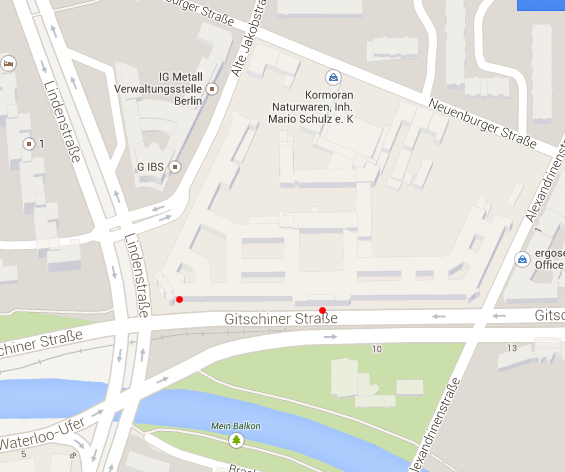 German and European Office in Berlin
As a result, it was very common for absent-minded individuals to file European patent applications (or any other document, such as opposition documents) with the German Office and vice versa.
The President of the EPO had sought to address this issue by concluding an administrative agreement with the German Office on June 29, 1981. This agreement notably provided that documents submitted to the German Office would be deemed to have been received by the EPO on the date of receipt by the German Office.
In this case, an opposition had been filed with the German Office but received by the EPO after the 9-month deadline. It is understandable that the proprietor wished to have this opposition declared inadmissible.
The question put to the Enlarged Board of Appeal was therefore whether the President of the EPO had the power to conclude such an agreement affecting the rights conferred by the EPC. It should be noted that this agreement was not approved by the Administrative Council.
According to the Enlarged Board, neither the President’s power of representation defined by A5(3) EPC73 (point 2.2 of the reasons), nor his obligation to take « all appropriate steps… to ensure the functioning of the European Patent Office » under A10(2) EPC73 (points 2.6 and 2.7 of the reasons) justify such an agreement.
Nevertheless, based on the principle of « protection of good faith and legitimate expectations« , the Enlarged Board decided that the ineffectiveness of the agreement would not be retroactive.
G6/88 – Second non-therapeutic use
The decision G6/88 was issued on December 11, 1989.
This decision follows the same reasoning as decision G2/88 issued on the same day.
G7/88 – Power of the President of the EPO to conclude administrative agreements
The decision G7/88 was issued on November 16, 1990.
This decision follows the same reasoning as decision G5/88 issued on the same day.
G8/88 – Power of the President of the EPO to conclude administrative agreements
The decision G8/88 was issued on November 16, 1990.
This decision follows the same reasoning as decision G5/88 issued on the same day.
G1/89 – A posteriori lack of unity and PCT application
The decision G1/89 was issued on May 2, 1990.
In this decision, the Enlarged Board recalls (see point 3 of the reasons) that, even at the PCT search stage, the search division acting as ISA must properly assess the novelty and inventive step of the claims in order to evaluate unity of invention in accordance with A17.3.a PCT (even though this assessment does not constitute a true « examination » within the meaning of the EPC or the PCT).
Consequently, it is entirely possible for the ISA to raise a posteriori lack of unity objections (point 5 of the reasons), and in doing so, the EPO may require the applicant to pay an additional search official fee (point 7 of the reasons).
G2/89 – A posteriori lack of unity and PCT application
The decision G2/89 was issued on May 2, 1990.
This decision follows the same reasoning as decision G1/89 issued on the same day.
G3/89 – Correction of obvious errors
The decision G3/89 was issued on November 19, 1992.
R88 EPC73 (now R139 EPC) provides that errors in claims, the description, or drawings may be corrected if the rectification is obvious.
In the view of the Enlarged Board of Appeal, A123(2) EPC73 is fully applicable to the correction: it is therefore necessary to consider, as of the filing date, what the person skilled in the art could objectively derive from the description (point 2 of the reasons).
The person skilled in the art must therefore be able, as of the filing date (i.e., without reference to any subsequent publication) and based on the common general knowledge in the relevant field:
- to objectively and unambiguously identify the error, and
- to simply deduce the correction to be made.
Consequently, this correction has no retroactive effect: it is merely a statement of fact (point 4 of the reasons).
Any means of evidence is admissible (point 8 of the reasons), provided that such means (written, testimony, etc.) demonstrates the common general knowledge of the person skilled in the art as of the filing date and not thereafter (point 7 of the reasons).
G1/90 – Revocation of patent for non-payment of printing fee
The decision G1/90 was issued on March 5, 1991.
In the case at hand, the proprietor of a patent that had just been maintained in amended form (i.e., after opposition) had failed to pay the printing fee prescribed by A102(3)(b) EPC73 within the three-month period provided for under R58(5) EPC73.
The question then arose as to whether the revocation of the patent provided for under A102(4) EPC73 or A102(5) EPC73 should be the subject of a decision (appealable under A106 EPC73) or a mere finding under R69 EPC73 (not directly appealable).
The Enlarged Board of Appeal initially observed that if the Convention had intended the sanction for non-payment of the printing fee to be the automatic loss of rights, the wording of the article would likely have been « shall be deemed revoked » (point 4 of the reasons) or « shall be deemed withdrawn » (point 6 of the reasons), as is the case elsewhere in the Convention.
According to the Enlarged Board of Appeal, the revocation of a patent for failure to pay the printing fee (A102(4) EPC73) or for failure to file translations of the claims (A102(5) EPC73) must take the form of a decision. Indeed:
- A revocation decision would not be « meaningless » (point 13 of the reasons), contrary to the assertions of the Board of Appeal, even if the loss of rights does not concern the substantive patent law (i.e., novelty, inventive step, etc.). The appeal may be particularly useful to challenge matters of fact (e.g., the effective date of payment).
- The filing of a request for restitutio in integrum does not genuinely give rise to any legal uncertainty (point 14 of the reasons), even if the decision has not yet been issued. The decision rendered in a subsequent appeal (which would be filed against the decision) will be merged with the decision on the restitutio in integrum.
- There is no compelling need to bring about the loss of rights as soon as possible, even for the protection of third parties (point 15 of the reasons).
- The revocation decision is legally simpler (a single step, as opposed to notification + decision on request, point 17 of the reasons).
The provisions of R82 EPC are substantially identical to those of A102(4) EPC73 and A102(5) EPC73. Thus, this decision remains applicable under the EPC 2000.
G2/90 – Jurisdiction of the Legal Board of Appeal for decisions issued by an opposition division
The decision G2/90 was issued on August 4, 1991.
In this case, a patent proprietor had forgotten to pay the publication official fees for their patent after publication. The formalities officer granted them an additional two months and subsequently revoked the patent. For the proprietor who filed an appeal, the formalities officer had no legal basis to do so.
This assertion was clearly purely legal in nature.
The legal question at issue was whether the Legal Board of Appeal had jurisdiction over appeals against decisions entrusted to formalities officers.
The jurisdiction of the Boards of Appeal is defined in A21 EPC73. While the Legal Board of Appeal may intervene against decisions issued by an examining division (A21(3) c) EPC73, point 3.2 of the reasons), there is no provision for it to intervene in decisions of an opposition division (A21(4) EPC73, point 3.3 of the reasons).
In the Enlarged Board’s view, the text is clear and should not be interpreted as an oversight (points 3.3 and 3.4 of the reasons): only the Technical Board of Appeal has jurisdiction over decisions issued by an opposition division.
The A21 EPC being identical, this decision still appears to apply under the EPC 2000.
G1/91 – Unity of invention and maintenance in amended form after opposition
The decision G1/91 was issued on December 9, 1991.
If, after opposition, the patent is amended such that the claims no longer share a common inventive concept (A82 EPC73), is it possible to maintain it in amended form? Indeed, A102(3) EPC73 provides that « the patent and the invention to which it relates shall satisfy the requirements of this Convention. » Do these requirements include unity of invention (point 2.1 of the reasons)?
In the Enlarged Board’s view, the rationale behind the requirement of « unity of invention » is of an administrative nature (point 4.1 of the reasons): its purpose is for the classification of patents under the International Patent Classification, as well as to prevent applicants from abusively including multiple inventions in a single application and thereby avoiding significant search and filing official fees.
Moreover, the Enlarged Board notes that the requirement, although initially envisaged in the preparatory work of the Convention to apply until the end of the opposition proceedings, was limited to patent applications (point 6.2 of the reasons), as it was deemed « unnecessary » due to the absence of any possibility to oppose on grounds of lack of unity of invention.
Consequently, lack of unity should not be taken into account for the maintenance of patents in amended form after opposition.
This decision remains valid under the EPC 2000.
G2/91
The decision G2/91 was issued on November 29, 1991.
Refund of appeal fees in cases involving multiple appellants
In this case, certain Boards of Appeal retained the first appeal fee paid and refunded subsequent appeal fees, as « the other parties to such proceedings shall be parties to the appeal proceedings as of right, » as specified in A107 EPC73.
Other Boards retained all fees paid by each of the appellants.
Which was correct?
According to the Enlarged Board, each appellant must pay… and this is justified by the following paragraph.
Independent right to pursue an appeal upon withdrawal by one appellant
Indeed, the Enlarged Board emphasizes that an appellant who has not paid has no right to pursue the appeal alone if the only appellant who has paid withdraws.
Only the latter may decide to maintain their appeal (point 6.1 of the reasons).
Thus, any refund of an appeal fee would deprive appellants of their rights.
This decision remains valid under the EPC 2000, as A107 EPC has not changed.
G3/91 – Restitutio in integrum
Decision G3/91 was issued on September 7, 1992.
As you are no doubt well aware, the EPC provides:
- that, for European applications:
- the search official fee (A78(2) EPC73) must be paid within one month of the filing of the application, and
- the designation official fees (A79(2) EPC73) must be paid within six months from the date of publication of the European search report; and
- a request for examination (A94(2) EPC73) must be filed within six months from the date of publication of the European search report;
- that, for Euro-PCT applications:
- the search official fee (A157(2) b) EPC73) must be paid within 31 months from the earliest priority date (R107(1) e) EPC73);
- the national official fee (covering the designation official fees, A158(2) EPC73) must be paid within 31 months from the earliest priority date (R107(1) d) EPC73); and
- a request for examination (A150(2) EPC73) must be filed within 31 months from the earliest priority date (A39.1.b PCT).
As you can see, there are certain similarities…
However, the first three time limits are explicitly excluded by A122(5) EPC73, whereas the last three time limits are not mentioned… Is this an oversight? Should it be considered that these are also excluded from restitutio in integrum?
In the Enlarged Board’s view, all these time limits should be treated in the same way: thus, the time limits for payment of the search official fee, the national official fee, and the time limit for filing the request for examination do not benefit from restitutio in integrum (for European applications as well as for Euro-PCT applications).
This decision is no longer applicable under the EPC 2000, since the various time limits mentioned above now benefit from restitutio in integrum.
G4/91 – Intervention
Decision G4/91 was issued on November 3, 1992.
In the case at hand, a third party (against whom an infringement action had been brought) filed a notice of intervention pursuant to A105(1) EPC73, while the opposition division had decided to maintain the patent in amended form a few weeks earlier…
Is the intervention valid given that the time limit for appeal was still running (i.e., given that the decision had not yet become final)?
According to the Enlarged Board, intervention is not possible in this scenario, unless one of the parties to the opposition proceedings files an appeal: indeed, without such an appeal, the opposition proceedings are not pending.
This decision remains applicable under the EPC 2000, since R89 EPC retains the same provisions.
G5/91 – Appealable Decisions
Decision G5/91 was issued on May 5, 1992.
In the case at hand, the proprietor of an application alleged that one of the members of the opposition division was not impartial, but the director refused to reconstitute the division.
Independence of EPO First Instance Body Members
The Enlarged Board notes (point 2 of the reasons) that A24(1) EPC73 provides for impartiality for members of the boards of appeal and the Enlarged Board, but not explicitly for members of first instance bodies such as:
- the examining division,
- the opposition division,
- etc.
Nevertheless (point 3 of the reasons), this obligation is, in fact, a general principle and must apply to all.
Decisions subject to appeal
Can the proprietor file an appeal against the refusal of the chairman to reconstitute the opposition division?
The Enlarged Board of Appeal states (point 5 of the Reasons) that there is no legal basis for such an appeal.
As specified in A106(3) EPC73, it is not possible to file an appeal against a decision that does not terminate proceedings (such as the present decision) unless said decision provides for an independent right of appeal.
Of course, this issue may be the subject of an appeal together with the final decision (point 6 of the Reasons).
This decision remains valid under the EPC 2000, as A106 EPC has remained unchanged on this point.
G6/91 – Reduction of official fees
The decision G6/91 was issued on 6 March 1992.
A14(4) EPC73 and A14(4) EPC73 provides that persons having their residence or principal place of business in a Contracting State may file documents in an official language of that State (other than English, French or German) and thereby benefit from a reduction of official fees (R6(3) EPC73).
Simultaneous submission of the translation
In the case at hand, a person had filed an appeal against a decision by simultaneously submitting a document drafted in their language along with a translation.
As a preliminary point, the Enlarged Board of Appeal considers that there is no objection to filing a translation of the documents at the same time as those documents (point 9 of the Reasons). However, care must be taken, as these translations must not be mistaken for the originals, for example: by way of illustration, translations cannot be transmitted BEFORE the originals without risk of being considered as the latter (point 12 of the Reasons).
Multiple documents and translation limited to only certain documents
What happens if the proprietor files several documents to perform a procedural act, only some of which are in their language?
In principle, there is no reason to consider that all documents must be filed in the language of the applicant in order to benefit from the reduction (point 15 of the Reasons). Indeed, when certain documents may be submitted after payment of the official fee, how is it possible to determine the amount of the official fee to be paid (we are not talking about reimbursement of the official fee, but rather a reduction, point 16 of the Reasons)?
For the Enlarged Board of Appeal, it is sufficient to file in one’s language the essential document of the first procedural act to benefit from the official fee reduction (point 21):
- the request for examination for the examination fee (point 19 of the Reasons),
- the notice of appeal for the appeal fee (and not the grounds, point 24 of the Reasons),
- etc.
This decision remains, in principle, valid under the EPC 2000, as A14 EPC and R6 EPC have changed little on this point.
G7/91 – Withdrawal of the appeal
The decision G7/91 was issued on 5 November 1992.
It refers explicitly to the following decision, decision G8/91.
G8/91 – Withdrawal of the appeal
The decision G8/91 was issued on November 5, 1992.
In this case, an opponent had filed an appeal without the proprietor doing so, then withdrew it… can the appeal procedure continue ex officio (somewhat like for the opposition R60(2) EPC73, point 6 of the reasons)?
Even if the lack of ex officio continuation may allow first-instance decisions containing errors to « survive, » the Enlarged Board of Appeal does not consider it useful to permit the boards of appeal to continue an appeal ex officio.
Indeed:
- There is an opposition procedure open to all if a third party believes there is an error in a decision (point 10.1 of the reasons);
- A priori, there are not that many errors in first-instance decisions (point 10.2 of the reasons);
- Although the Office strives to grant valid patents free from defects, it is necessary to close the procedure at some point for the proper management of the Office’s resources (point 10.3 of the reasons);
- National procedures for revoking a patent remain available (point 11.1 of the reasons);
This decision remains valid under the EPC 2000, as the principles of appeal remain the same.
G9/91 – Competence to assess the validity of claims
The decision G9/91 was issued on March 31, 1993.
Extent of the challenge
Can opposition divisions or boards of appeal assess the validity of claims not challenged by an opponent or appellant? Are they bound by the opponent’s statement under R55 c) EPC73 (now R76(2) c) EPC)?
For the Enlarged Board, the requirement for the appellant to state the extent to which the patent is challenged (R55 c) EPC73) would be meaningless if this extent could subsequently be broadened (point 10 of the reasons).
Consequently, the opposition division or the board of appeal has no right to assess unchallenged claims (point 11 of the reasons).
However, it is entirely possible to assess unchallenged dependent claims (point 11 of the reasons):
- if the independent « parent » claim has been challenged;
- if their validity is prima facie doubtful.
Grounds of the challenge
Does the same reasoning apply to the grounds of the challenge? Are opposition divisions or boards of appeal bound by the opponent’s statement?
For the Enlarged Board, A114 EPC73 allows the opposition division to examine certain grounds ex officio, but this must remain exceptional, particularly if prima facie these grounds are prejudicial, in whole or in part, to the maintenance of the patent (point 16 of the reasons).
For proceedings before the boards of appeal, the principle of A114 EPC73 should be applied much more restrictively, as it is a non-inquisitorial judicial procedure (point 18 of the reasons).
Thus, an argument not presented at the opposition stage by the opponent cannot be presented at the appeal stage (unless, of course, it is accepted by the proprietor, point 18 of the reasons).
G10/91 – Competence to assess the validity of claims
The decision G10/91 was issued on March 31, 1993.
This decision reiterates the reasoning of G9/91.
G11/91 – Correction of obvious errors
The decision G11/91 was issued on November 19, 1992.
This decision adopted the substance of the reasoning in G3/89 issued on the same day.
G12/91 – Final Decision
Decision G12/92 was issued on December 17, 1993.
The facts of the case were as follows:
- an opposition had been filed against a patent;
- the opposition division decided to reject the opposition and the three members of the division signed the prescribed form;
- the proprietor proposed to combine claims 1 and 2;
- the form was handed over by the opposition division to the internal mail service without taking this last proposal into account;
- the form was dispatched by the internal mail service.
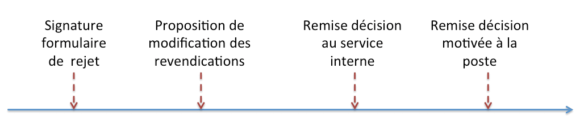

The question then arises as to when the internal decision-making process is completed.
The Enlarged Board recalls that, for oral proceedings (point 2 of the Reasons), the internal decision-making process occurs upon its pronouncement, i.e., at the end of the oral proceedings. Indeed, the body that issued it can no longer revisit it (except in the case of a referral for a preliminary ruling).
According to the Enlarged Board and for a written procedure, the end of the internal process cannot be:
- the date of dispatch of the reasons by the internal mail service (point 6.2 of the Reasons), as it does not reflect the date of the decision-making;
- the date of signature by the three members (point 7.1 of the Reasons), as they may still reconsider their decision if an important element is brought to their attention;
- the date of submission of the fair copy by the division to the formalities section for notification (point 8 of the Reasons), as it cannot be determined from the file.
Thus, the only remaining possibility is « the date of handing over to the EPO’s internal mail service by the formalities section of the division » (point 9 of the Reasons). This date, in the view of the Enlarged Board, can be very easily determined from the file since, according to the President of the EPO, it is always three days prior to the stamped date.
G1/92 – Public Availability of the Composition or Structure of a Disclosed Product
Decision G1/92 was issued on December 18, 1992.
The question in this case was whether the composition of a product was made available to the public merely by the fact that the product itself was made available to the public (where analyses were necessary to determine the composition)?
According to the Enlarged Board, if the person skilled in the art is able to discover the composition or the internal structure of the product and to reproduce it without undue burden, then the product and its composition or internal structure are part of the prior art (see point 1.4 of the Reasons).
The EPC does not require that the person skilled in the art be prompted to analyze the composition or internal structure of a product, and it is therefore not possible to add this condition (point 2 of the Reasons), especially since this condition would be subjective (point 2.1 of the Reasons).
Thus, any disclosure of a product also discloses its composition or structure (provided that its discovery by the person skilled in the art does not involve undue burden).
This decision has no reason to have been called into question by the EPC 2000.
G2/92 – Non-Payment of Additional Search Fees and Unsearched Claims
Decision G2/92 was issued on July 6, 1993.
Consider the following situation:
- a filing contains two inventions in the claims;
- a lack-of-unity objection is raised at the search stage (A82 EPC73) and the search division requests payment of an additional search fee (R46(1) EPC73);
- the applicant does not pay this search fee;
In this case, can the applicant request examination of the second invention (which was not searched)?
The Enlarged Board holds that (point 2 of the Reasons), if despite the invitation from the search division, the applicant decides not to pay an additional search fee, it will not be possible subsequently to make this invention the subject of the claims of the filing.
Only a divisional application will be possible.
G3/92 – Unauthorized Applicant
The decision G3/92 was issued on June 13, 1994.
A61(1)(b) EPC73 provides, in particular, that in the case of an invention « stolen » by an unauthorized applicant (e.g., filing by an employee when the invention belonged to the employer), the person from whom the invention was stolen may file a new application.
The question raised was whether A61(1)(b) EPC73 applied even if the application by the unauthorized applicant was no longer pending (e.g., failure to submit the request for examination, omission of an official fee, etc.). Indeed, the legal certainty of third parties would not be respected in this scenario, as they would legitimately believe that the invention covered by the patents is free.
For the Enlarged Board of Appeal, if the procedure under A61 EPC73 were no longer applicable when the first application was no longer pending, this would amount to accepting that a court could recognize the right to a patent for a person, while the EPO would refuse such a right for internal procedural reasons (point 5 of the reasons).
Therefore, there is no reason to refuse a person who has been recognized as having a right to an invention by a national authority the filing of an application under A61(1)(b) EPC73 (point 5.2 of the reasons).
G4/92 – Basis of Decisions and New Arguments During Oral Proceedings
The decision G4/92 was issued on October 29, 1993.
In an inter partes procedure, if a party does not attend the oral proceedings, does it waive its right to be heard? Can new documents or new arguments then be cited against its application or patent?
In reality, this question is much broader, as (point 3 of the reasons) it concerns the principle of the right to be heard when rendering decisions. Indeed, A113(1) EPC73 states that « decisions […] may only be based on grounds or evidence on which the parties concerned have had an opportunity to present their comments. »
Thus, to respect the right to be heard, a decision cannot be based on:
- facts raised for the first time during those oral proceedings;
- new evidence (which has not even been announced, point 9 of the reasons).
However, a decision may be based on:
- evidence announced prior to the oral proceedings (and which confirms a party’s allegations) but produced only during those oral proceedings;
- new arguments (point 10 of the reasons) insofar as they do not alter the grounds on which the decision is based (since they merely constitute a new line of reasoning in support of the legal and factual submissions already presented).
There is no reason why the EPC 2000 would have changed this decision.
G5/92 – Restitutio in Integrum
The decision G5/92 was issued on September 27, 1993.
The questions raised in this decision are substantially the same as those in G3/91, so the reasons for the decision will not be detailed (they are therefore identical:)).
G6/92 – Restitutio in Integrum
The decision G6/92 was issued on September 27, 1993.
The questions raised in this decision are substantially the same as those in G3/91, so the reasons for the decision will not be detailed (they are therefore identical:)).
G9/92 – Non-appealing party and reformatio in pejus
Decision G9/92 was issued on July 14, 1994.
Where a person files an appeal, can another party to the proceedings (a non-appealing opponent, the non-appealing proprietor, the board of appeal, etc.) request to amend the contested decision to the detriment of the appellant?
According to the Enlarged Board of Appeal, the board of appeal must base its decision ultra petita (i.e., without going beyond what is requested in the appeal).
Thus, if the proprietor is the sole appellant, the opponent or the board of appeal may not request the rejection of a set of claims granted by the opposition division (point 14 of the reasons).
If the opponent is the sole appellant, the patent proprietor may not incidentally extend the scope of its claims (point 16 of the reasons).
G10/92 – Divisional application and parent application about to be granted
Decision G10/92 was issued on April 28, 1994.
This decision addressed the question of the deadline for filing a divisional application. In other words, until when is a parent application pending when the latter is about to be granted?
It should be noted that R25(1) EPC73 underwent numerous amendments during the lifetime of the EPC73. In this case, R25(1) read as follows at the time of this decision:
(1) The applicant may file a divisional application relating to any pending earlier European patent application until the time when the applicant gives, in accordance with Rule 51, paragraph 4, his approval of the text in which it is intended to grant the European patent.
For the Enlarged Board of Appeal, there is therefore no difficulty of interpretation, and if the applicant has given his approval of the text of the parent application, it is no longer possible to divide.
This decision is no longer applicable since the wording of R25(1) EPC73 (and later R36(1)(a) EPC, now deleted) was completely changed.
G1/93 – Restrictive feature, the « 123(2)-123(3) » pincer
Decision G1/93 was issued on February 2, 1994.
Let us assume that during examination, the proprietor adds a limiting feature to a claim. This feature is not, in fact, supported by the description.
Can the proprietor simply remove this feature during opposition?
The Enlarged Board of Appeal emphasizes that A123(2) EPC73 and A123(3) EPC73 are not interdependent provisions (point 13 of the reasons), a principle that would then mean that one or the other provision should apply depending on the circumstances of the case. These provisions are indeed independent, and both must apply in the event of amendment(s) to a patent.
Thus, if, due to the presence in the claims of a feature violating the provisions of A123(2) EPC73, an amendment is envisaged, this amendment must comply with A123(3) EPC73:
- the amendment is refused if it extends the scope of the claims;
- the amendment may be accepted if it consists of replacing the feature with a « more restrictive » and supported feature.
This decision remains applicable under the EPC2000, as A123(2) EPC and A123(3) EPC are identical.
G2/93 – Filing of biological material and deposit number
The decision G2/93 was issued on 21 December 1994.
In certain applications, reference may be made to certain biological material not publicly accessible (R28(1) EPC73 or R31(1) EPC) provided that an indication of the depositary authority and the accession number of the deposited biological material is communicated within a 16-month period from the earliest priority.
The question at issue was whether the provisions of A91 EPC73 (i.e., additional period to remedy an irregularity, in particular for the submission of priority documents under R38(3) EPC73) could apply even though this article did not explicitly mention this case.
For the Enlarged Board of Appeal, there is a fundamental difference between the requirement to provide the « accession number » (a substantive condition for sufficiency of disclosure) and the requirement to provide priority documents (a formal condition). Thus, no analogy is possible.
In conclusion, the time limit set in R28(2)(a) EPC73 is not extendable.
G3/93 – Opposability and validity of priority
The decision G3/93 was issued on 16 August 1994.
The question at issue was whether a document published during the priority period constitutes prior art opposable, under A54(2) EPC73, to a European patent application where the priority claim (the application includes elements not disclosed in the priority document) is invalid.
We recall that A87(1) EPC73 defines the right of priority. This right is granted, in accordance with the Paris Convention, for the same invention as that disclosed in the priority document.
A89 EPC73 provides that, where an application validly claims priority, the priority date is considered to be the filing date of the European patent application for the purposes of A54(2) EPC73, A54(3) EPC73 (opposable state of the art), and A60(2) EPC73 (the right to the patent belongs to the first applicant).
Thus, if a priority is invalid, any intervening disclosure therefore becomes opposable (point 9 of the reasons).
G4/93 – Non-appealing party and reformatio in pejus
The decision G4/93 (available in English only) was issued on 14 July 1994.
This decision is the English « version » of the reasons in G9/92.
G5/93 – Restitutio in integrum
Decision G5/93 was issued on January 18, 1994.
As you know, decision G3/91 emphasized that the following time limits do not benefit from restitutio in integrum (Euro-PCT application):
- payment of the search
(A157(2) b) EPC73) within 31 months from the earliest priority filing (R107(1) e) EPC73); - payment of the national
(covering designation , A158(2) EPC73) within 31 months from the earliest priority filing (R107(1) d) EPC73); - filing of the request for examination (A150(2) EPC73) within 31 months from the earliest priority filing (A39.1.b PCT).
The Enlarged Board confirms its analysis but notes that the EPO itself had published contradictory information in the « Notice to PCT Applicants » (OJ EPO 1991, 333). In this notice, it stated that « in the event of a loss of rights [due to non-payment of the basic national fee, designation fees, the search fee, and claim fees], the applicant may, pursuant to Article 122 EPC, be restored in those rights » (point 2.1 of the reasons).
Thus, it would be inequitable if A122 could not be applied in such cases at least until the date on which decision G3/91 was made available to the public (point 2.3 of the reasons).
Consequently, the Enlarged Board states that restitutio in integrum is indeed not available for the aforementioned time limits unless the request for restitutio was filed before decision G3/91 was made available to the public.
G7/93 – Late amendments after approval of the text intended for grant
Decision G7/93 was issued on May 13, 1994.
If an applicant gives approval under R51(4) EPC73 (now R71(3) EPC), may they, before the final grant decision, request an amendment to the claims and withdraw their approval of the previously validated text?
For the Enlarged Board, A113(1) EPC73 does not grant any particular right to the applicant regarding their approval (including no right to amend), but rather prohibits the EPO from taking a decision on an application text other than « the text submitted to or agreed by the applicant or the proprietor of the patent » (point 2.1 of the reasons).
In this case, the Enlarged Board emphasizes that R86(3) EPC73 (now R137(3) EPC) grants the EPO discretionary power to accept amendments proposed by the proprietor during examination (point 2.3 of the reasons). However, this discretion must be exercised constructively. Thus, both of the following must be considered (point 2.5 of the reasons):
- the applicant’s interest in obtaining a legally valid patent in all designated states, and
- the EPO’s interest in concluding the examination procedure by deciding on the grant of the patent.
Thus, the EPO may override the applicant’s « withdrawal » of approval if the EPO has invited the applicant to pay the grant and printing
This decision may have been challenged by the new wording of R71(3) EPC: indeed, the terms of the applicant’s approval of the text have significantly changed. Nevertheless, the withdrawal of this approval appears to remain the same: the EPO would retain full discretion in considering new claims once this approval has been given.
G8/93 – Withdrawal of the appeal by the appellant and closure of the appeal proceedings
Decision G8/93 was issued on June 13, 1994.
What happens if an opponent, as the sole appellant, withdraws its appeal? Is the opposition procedure automatically closed, or may the opposition division continue the opposition under A114(1) EPC73, particularly if it considers that there are serious grounds for revoking or limiting the patent?
The Enlarged Board first emphasizes that it is not possible to « withdraw the opposition » at the appeal stage: only the withdrawal of the appeal is possible (the question posed by the board of appeal had conflated these concepts, point 2 of the reasons).
Finally, the Enlarged Board confirms its decision G8/91 and states that it is not permitted for the boards of appeal to continue an appeal ex officio if the appeal is withdrawn by the sole appellant, regardless of the proprietor’s opinion.
G9/93 – Opposition by the proprietor
Decision G9/93 was issued on July 6, 1994.
As in decision G1/84, the question arose as to the legality of a proprietor opposing its own patent. This question was relevant because the Enlarged Board had considered in decision G9/91 that its analysis of the basis of the opposition procedure was incorrect in decision G1/84 (see point 2 of the reasons):
one may question the accuracy of the statement, at least as a generalization, made by the Enlarged Board of Appeal in case G1/84 (OJ EPO 1985, 299, point 4 of the reasons: « … it would be wrong to regard (the opposition procedures under the EPC) as essentially contentious proceedings between parties in dispute […]. » […].
In any event, the Enlarged Board of Appeal, in its current composition, considers that the post-grant opposition procedure under the EPC must in principle be regarded as a contentious procedure between parties normally defending opposing interests, to whom fair treatment must be accorded.
Thus, did the reasoning in G1/84, which allowed self-opposition, remain applicable?
The answer is no! (point 5 of the reasons)
For the Enlarged Board, the term « any person » in A99(1) EPC73 must be interpreted in light of the purpose of the procedure (point 3 of the reasons). In particular, the argument that the EPO must make an effort « to grant and maintain only valid patents » does not appear sufficient (point 4.2 of the reasons).
If the lack of limitation (at the time) is a problem, it should be addressed by the legislator rather than through legal interpretative artifices (point 4.1 of the reasons).
G10/93 – Scope of examination and ex-parte appeal proceedings against a decision rejecting an application
Decision G10/93 was issued on November 30, 1994.
In an appeal against a decision to reject an application during examination, does the board of appeal conduct a full assessment of patentability or is it limited to the grounds for rejection of the first-instance body (i.e., without re-examining the validity conditions that the examining division considered fulfilled)?
The Enlarged Board first notes that, for inter partes proceedings, the limited consideration of new grounds was justified by the contentious nature of the procedure (point 2 of the reasons) and by the judicial character of such an appeal.
In contrast, ex-parte proceedings are administrative and thus more inquisitorial in nature (point 3 of the reasons). Therefore, the boards of appeal may take into account new grounds, new evidence, or new facts.
However, it is not necessary to conduct a full examination (point 4 of the reasons), as this falls within the competence of the examining divisions. If the board of appeal considers that a patentability condition is not met, it may:
- introduce it into the appeal proceedings; or
- request the examining division to examine the issue.
This principle does not violate the non reformatio in pejus (point 6 of the reasons), since no decision can be worse than the rejection of the application.
G1/94 – Intervention in appeal proceedings
Decision G1/94 was issued on May 11, 1994.
A105 EPC73 provides that an alleged infringer may intervene in an opposition. But can they do so in appeal proceedings against an opposition decision (which have a different legal nature from opposition proceedings: judicial rather than administrative, as per G8/91)? Can the intervener raise any grounds for opposition, or are they bound by those already presented?
In a previous decision (G4/91), the Enlarged Board of Appeal had merely stated that if none of the parties to the opposition proceedings filed an appeal, any intervention would remain ineffective (point 1 of the reasons).
Referring to the preparatory work of the EPC (point 8 of the reasons), the Enlarged Board emphasizes that the discussions among the contracting states intended to include appeal proceedings within the scope of A105 EPC73 and had even adopted R57(4) to mitigate some negative effects through R57(4) EPC73.
The Enlarged Board thus confirms that the term « opposition proceedings » in A105(1) EPC73 should be understood as also covering appeal proceedings against an opposition decision (point 10 of the reasons).
Furthermore, the Enlarged Board notes that an intervener in such appeal proceedings may present any grounds, arguments, or evidence they wish, even if these were not previously raised (point 13 of the reasons). In such cases, a remittal to the first instance may be possible. Indeed, prohibiting the intervener from using these means of defense (given that they are accused of infringement) would contravene the purpose of the intervention.
G2/94 – Right to be heard before the board of appeal and ex parte proceedings
Decision G2/94 was issued on February 19, 1996.
In this case, an authorized representative requested that a board of appeal permit a former member of the board (in this instance, a former president who had left office two years prior) to address the board.
What are the rules governing the right to be heard by a non-representative? In particular, if that person is a former president?
First, the Enlarged Board refers to decision G4/95 (issued earlier) regarding the right to be heard by an assistant (point 1 of the reasons). Although decision G4/95 applies to opposition proceedings, the principles remain the same for ex parte proceedings: the board has full discretion to allow it if it so wishes.
However, to permit an intervention by a third party, the board must be notified sufficiently in advance, indicating the name, status, and subject matter to be addressed by the intervener (point 2 of the reasons).
If the intervention is permitted, the assistant then presents their oral submissions under the continuous responsibility and supervision of the authorized representative (point 3 of the reasons).
Regarding the right to be heard by a former member of the board, there are no rules formally prohibiting it. Care must therefore be taken to avoid, at the very least, any « appearance of favoritism » (point 4 of the reasons) in simple oral submissions. Thus, in the absence of other rules, boards of appeal have discretion to determine when a former member may address the board (point 7). A period of 3 years should, in principle, be a reasonable compromise (point 8).
G1/95 – Number of grounds for opposition under A100 a) EPC73
The decision G1/95 was issued on July 19, 1996.
In this case, the board of appeal rejected an application on the grounds that the claimed subject-matter lacked industrial application and was not an invention (A52(1) EPC73 and A52(2) EPC73). However, the opposition filed only cited lack of novelty (A54 EPC73) and inventive step (A56 EPC73).
In fact, all the aforementioned articles are listed under a single item of A100 EPC73 (listing the possible grounds for opposition):
a) the subject-matter of the European patent is not patentable under Articles 52 to 57;
The question therefore arises: is A100 a) EPC73 a single ground or multiple grounds (point 2 of the reasons)?
For the Enlarged Board of Appeal, item a) of A100 EPC73 can only constitute a single ground, since the « legal bases » for novelty, inventive step, etc. are different (point 4 of the reasons).
Consequently, the board of appeal cannot introduce a new ground (as stated in decision G9/91) not raised by the opponent, even if that ground is industrial application and the opponent had cited lack of novelty or inventive step.
G2/95 – Replacement of the entire application due to an error
The decision G2/95 was issued on May 14, 1996.
Imagine that an applicant files a first application in France, then files a second EP application claiming priority from the French application. The filing of this second application is completely botched, and the description filed does not correspond at all to the invention of the first application (don’t laugh… it happens).
Is it possible, within the framework of an error correction under R88 EPC73, to replace the entire set of documents of an application with other documents (i.e., those that the applicant actually intended to file)?
The Enlarged Board of Appeal recalls that the provisions of A123(2) EPC73 take precedence over the provisions of R88 EPC73 (point 2 of the reasons). Thus, due to the prohibition of extending the subject-matter of an application, it is only possible to use documents other than the description, claims, and drawings or documents that confirm the common general knowledge of the person skilled in the art as of the filing date, which is determined by A80 EPC73 (G3/89): it is therefore not permitted for a correction to rely on other documents, even if they were submitted during the filing of the European patent application, particularly priority documents, the abstract, etc. (G3/89).
So no! it is not possible…
G3/95 – Inadmissible referral
The decision G3/95 was issued on November 27, 1995.
It is not very interesting, as the question raised by the President was deemed inadmissible, the cited decisions not being contradictory.
G4/95 – Oral proceedings: speaking by a person other than the representative
The decision G4/95 was issued on 19 February 1996.
The question at issue was whether a third party (other than the representative) could speak during oral opposition proceedings.
The Enlarged Board sees no objection to this but regulates this practice, regardless of the person speaking: the relevant instance must give its consent, such consent being granted at its discretion.
The main conditions for this consent are:
- authorization must be requested and must include the name and qualifications of the person wishing to speak and specify the subject of the oral presentation;
- this authorization must be received by the EPO sufficiently in advance of the oral proceedings: the opposing parties must be able to prepare their response to this presentation. Otherwise, the authorization must be refused (unless the opposing parties agree) (point 10 of the Reasons);
- the speaking is done under the continuous responsibility and control of the professional representative (point 8 of the Reasons).
While this decision primarily applies in opposition or appeal against opposition (inter partes proceedings), there is no reason why it should not apply in ex parte proceedings, as highlighted in decision G2/94 (issued subsequently).
G6/95 – Application of R. 71a to the boards of appeal
The decision G6/95 was issued on 24 July 1996.
In this case, the Administrative Council of the EPO had added a rule R. 71a EPC 1973 pursuant to the powers conferred by Art. 33(1)(b) EPC 1973. R. 71a(1) EPC 1973 provides, inter alia, for a communication, sent together with the summons to oral proceedings, detailing the points to be discussed.
However, a board of appeal questioned this new provision (not so much on substance but rather on form): the Administrative Council does amend the Implementing Regulations based on Art. 33(1)(b) EPC 1973 (general power), but appears to conflict with the Rules of Procedure of the Boards of Appeal (RPBA), which it itself adopted pursuant to Art. 23(4) EPC 1973 (special power), since R. 11(2) RPBA does not provide for such a communication as a mandatory requirement (only as a possibility).
In short, the board of appeal was somewhat at a loss… Which provision should apply?
The board of appeal noted that the RPBA does not have to « always conform to the version in force of the Implementing Regulations » (point 2 of the Reasons). Indeed, the Administrative Council cannot amend the Implementing Regulations (i.e., the introduction of R. 71a(1) EPC 1973) in such a way that the effect of an amended rule would contradict the EPC itself (i.e., the validation of the RPBA, the Articles being superior to the Rules, Art. 164(2) EPC 1973, point 4 of the Reasons).
Thus, R. 71a(1) EPC 1973 cannot apply to the boards of appeal, otherwise we would be in the very contradiction mentioned above (point 5 of the Reasons).
G7/95 – Attacking novelty in opposition where the ground raised is inventive step
The decision G7/95 was issued on 19 July 1996.
In fact, this decision was issued on the same day as decision G1/95 (on the number of grounds under Art. 100(a) EPC 1973) and shares substantially the same reasoning.
Here, the Enlarged Board states that, although inventive step and novelty are two distinct grounds, it is possible to attack the novelty of the invention without having explicitly raised it (having only raised inventive step) provided that this novelty is assessed in relation to the closest prior art document.
G8/95 – Correction of a grant decision and jurisdiction of the legal/technical Boards of Appeal
The decision G8/95 was issued on April 16, 1996.
If a « request for amendment of the reasons for grant » (R89 EPC73) is filed by the proprietor and the Examining Division refused to allow it.
The question raised was which Board of Appeal had jurisdiction (technical or legal). Does this depend on the subject of the appeal?
The Enlarged Board recalls that the jurisdiction of the Boards of Appeal against decisions of the Examining Division is defined by A21(3) EPC73 (point 2 of the Reasons). Letter a) states that the technical board is competent where the decision under appeal is « concerning […] the grant of a European patent. »
The question is therefore whether the decision issued on a request for correction of the reasons for grant « concerns » the grant decision.
The Enlarged Board notes (point 3 of the Reasons) that appeals against grant decisions aim to obtain what was refused (A113(2) EPC73), and thus seek to correct a substantive error: this is indeed why an appeal may be filed (A107 EPC73). The « request for amendment of the reasons for grant » (R89 EPC73) also seeks to amend a decision, but this concerns a formal error (point 3.2 of the Reasons).
Even if it addresses only form, it is clear that a request for correction of the reasons for grant does indeed concern the grant of the patent (point 3.3 of the Reasons): consequently, the technical Board of Appeal is competent (point 6 of the Reasons)!
G1/97
The decision G1/97 was issued on December 10, 1999.
Appeal against an appeal / request for review
Following a decision of rejection by a Board of Appeal, an appellant had filed an appeal against that decision, arguing that the revocation decision had been taken by a board exercising the functions of the Opposition Division in accordance with A111(1) EPC73 and that, therefore, its decision was subject to appeal.
However, the Enlarged Board disagrees: decisions of the Boards of Appeal acquire res judicata effect as soon as they are issued, an appeal under A106 EPC73 against such decisions is therefore excluded (point 2.a of the Reasons). A111(1) EPC73 does not in any way require the Boards of Appeal to remit cases to the first instance so that parties retain a right of appeal: the Boards of Appeal retain discretionary power to decide on the merits.
Such an appeal must be declared inadmissible by the Board of Appeal that issued the decision for which review is sought: the decision of inadmissibility may be issued immediately without procedural formalities.
A122 and A121 allowing correction of a violation of a fundamental procedural principle
Furthermore, the appellant had filed requests for restitutio in integrum (A122 EPC73) and for further processing (A121 EPC73). Indeed, it argued that it had not had the opportunity to file additional sets of claims despite all the attention it had paid to the case, because the Board of Appeal had never indicated its intention to reject.
This reasoning is not accepted by the Enlarged Board, as these two articles require the failure to meet a time limit, which is not the case in the present situation (point 2.b of the Reasons).
R89 allowing correction of a violation of a fundamental procedural principle
The appellant had also argued that a review of the reasons was possible based on R89 EPC73 (same arguments as above).
The Enlarged Board states that R89 EPC73 allows for formal errors in decisions, but not substantive errors (point 2.c of the Reasons).
Court of cassation
CJEU
The appellant also argued that the preparatory work of the convention showed that the CJEU was to be seized in cases of fundamental procedural violation.
The Enlarged Board of Appeal does not share this view. On the contrary, referral to the CJEU was abandoned by the legislator in favor of the Enlarged Board of Appeal, which was to suffice as a regulatory instance (point 2.e of the reasons).
Creation of a Specific Remedy
Furthermore, as the vast majority of the contracting states provide for the possibility of cassation in cases of fundamental procedural violation, the appellant argued that A125 EPC73 provides the legal basis for such cassation within the EPC system:
In the absence of a procedural provision in this Convention, the European Patent Office shall take into consideration the principles of procedural law generally recognized in the Contracting States.
The Enlarged Board does not consider this article sufficient: it refers to « principles » and would not allow for the complete creation of a specific cassation remedy (points 3.a to 3.d of the reasons).
Conflict with TRIPS
The appellant argued that if no cassation remedy were available, A32 TRIPS (which takes precedence over the convention) would be violated:
With respect to any decision concerning the revocation or forfeiture of a patent, an opportunity for judicial review shall be available.
The Enlarged Board of Appeal does not agree, as A62(5) TRIPS (a rule specific to administrative decisions, unlike A32 TRIPS, which applies to all decisions, see point 5.d of the reasons) is in fact the applicable article in this case:
Final administrative decisions in any of the procedures referred to in paragraph 4 may be subject to review by a judicial or quasi-judicial authority. However, there shall be no obligation to provide an opportunity for such review of decisions in cases of unsuccessful opposition or administrative revocation, provided that the grounds for such procedures may be the subject of invalidation proceedings.
Indeed, an administrative decision (here, the decision of the opposition division) maintaining a patent may be subject to review (here, an appeal) by a judicial or quasi-judicial authority (here, a board of appeal). There is no indication that A32 TRIPS must apply to the review decision (otherwise, appeals would be endless…).
G2/97 – Principle of Good Faith and Failure to Pay the Appeal Fee
The decision G2/97 was issued on November 12, 1998.
If the appellant fails to pay the appeal fee, does the principle of good faith require the EPO to notify the « potential appellant » of the omission?
According to the Enlarged Board (point 4.1 of the reasons), the « protection of the legitimate expectations of users of the European patent system » requires the EPO to notify the applicant of any (potentially) impending loss of rights if the applicant may expect to receive such a notice.
For example, if the EPO receives correspondence stating « please find enclosed a check » and no check is present, the EPO must notify the applicant of this potential irregularity. Similarly, if the applicant’s request is unclear, the EPO must ask the applicant to clarify the request.
However, this principle does not extend further: the EPO has no obligation to warn the applicant if there is no reason to doubt.
G3/97 – Opposition and « Straw Man »
The decision G3/97 was issued on January 21, 1999.
The question raised was whether the use of a « nominee » (commonly referred to as a « straw man ») was an acceptable practice in opposition proceedings to conceal the true opponent?
The Enlarged Board of Appeal emphasizes that the concept of a « true opponent » is legally absurd, as any third party may file an opposition and the notion of an opponent is a procedural one (point 2.1 of the reasons). Thus, the Enlarged Board of Appeal decided that an opposition is not inadmissible merely because the opponent is a straw man.
However, this does not mean that such a practice constitutes a circumvention of the law:
- the opponent acts on behalf of the patent proprietor (circumvention of the principle set out in G9/93, point 4.1 of the reasons);
- the opponent acts on behalf of a client in the context of activities that, overall, are characteristic of those of an authorized representative, without possessing the qualifications required by A134 EPC73 (point 4.2.1 of the reasons).
This does not preclude the following situations:
- an authorized representative acts in their own name on behalf of a client (point 4.2.2 of the reasons);
- an opponent having their domicile or seat in a Contracting State to the EPC acts on behalf of a third party who does not meet this condition (point 4.2.3 of the reasons).
When determining whether there is an abusive circumvention of the law, the principle of free evaluation of evidence should be applied: such evidence must be provided by the party alleging inadmissibility and must be clear and unambiguous.
G4/97 – Opposition and « Straw Man »
The decision G4/97 was issued on January 21, 1999.
It reiterates the same reasons and decisions as decision G3/97.
G1/98
The decision G1/98 was issued on December 20, 1999.
Claims Encompassing a Plant Variety
In this case, the Board of Appeal was uncertain whether it should reject a claim to a « transgenic plant » given that:
- this claim in fact encompassed certain specific plant varieties (without individually claiming them);
- A53(b) EPC73 prohibits claims to « plant varieties ».
We recall that a plant variety is (point 3.1 of the reasons) a plant grouping within a single botanical taxon of the lowest known rank, which can be:
- defined by the expression of the characteristics resulting from a given genotype or combination of genotypes,
- distinguished from any other plant grouping by the expression of at least one of the said characteristics, and
- considered as a unit with regard to its suitability for being propagated unchanged.
For the Enlarged Board of Appeal (point 3.1 of the reasons), the Board of Appeal confuses the scope and the subject-matter (i.e., the underlying invention) of the claim. Only claims whose subject-matter is a plant variety are prohibited: the prohibition under A53(b) EPC73 is a prohibition on the subject-matter of the claims, not their scope.
Indeed, the prohibition concerning the scope appears excessive, as applying a similar reasoning to the provisions of A53(a) EPC73 could exclude a photocopier from patentability (e.g., photocopying banknotes, etc.).
Furthermore (point 3.4 of the reasons), the Enlarged Board of Appeal recalls that this prohibition was created to avoid double protection (by patent and by plant variety rights under the UPOV Convention). If this prohibition is rather administrative, the 1991 UPOV Convention no longer prohibits double protection. In any event, this history advocates for a strict interpretation of A53(b) EPC73 to avoid unduly restricting the field of patentability (point 3.10 of the reasons).
Product obtained by a plant variety production process
The question also arose as to whether a plant variety production claim should be excluded due to A64(2) EPC73. This article provides that products obtained by a process are also protected by such a claim, which would indirectly protect plant varieties, even though they are excluded by A53(b) EPC73.
For the Enlarged Board of Appeal (point 4 of the reasons), there is no issue, since the protection thus granted to products is not as broad as that granted by a product claim as such. Indeed, the protected product is in fact a « product-by-process » characterized by its method of manufacture.
Thus, A64(2) EPC73 is inoperative for analyzing the patentability of a claim.
G2/98 – Priority and conditions for the « same invention »
The decision G2/98 was issued on May 31, 2001.
The President requested some clarification on the concept of the « same invention. »
First, the Enlarged Board of Appeal notes that the EPC (A87 EPC73 and A88 EPC73, in particular) constitutes a « special agreement » within the meaning of the Paris Convention (provided for by A19 Paris Convention) and must therefore comply with this convention (point 3 of the reasons).
In particular, A88(2) EPC73, first sentence, and A88(3) EPC73 correspond to A4F Paris Convention, and A88(4) EPC73 corresponds almost word for word to A4H Paris Convention (point 6.1 of the reasons).
In reality, for the interpretation of « same invention, » several interpretations are possible (let E be the European application claiming priority from application P):
- A strict interpretation: if subject-matter A is claimed in application E, then priority is valid if A is disclosed alone in P. If subject-matter A+B is claimed in application E, then priority is invalid if A+B is not disclosed as such in P.
- A broad interpretation: If subject-matter A+B is claimed in application E, then priority may be valid if A is disclosed alone in P, but B is unrelated to the function and effect of A, and consequently to the character and nature of A.
Under the strict interpretation, the « same invention » of A87(1) EPC73 corresponds to the concept of « same subject-matter » in A87(4) EPC73. This strict interpretation is fully consistent with A87(4) EPC73 or A88(2) EPC73 to A88(4) EPC73 (point 6.8).
Under the strict interpretation, there are more difficulties. Indeed:
- A54(3) would be rendered meaningless… (point 8.1 of the reasons)
- The concept of the first application (A87(4) EPC73) would become more complex to assess (point 8.2 of the reasons): if an applicant files A+B and then A+B+C, it would be necessary to determine whether C is a non-essential feature before deciding if A+B+C is a first application (and thus the priorities claiming it could be invalid).
- The concept of the first application (A87(4) EPC73) would become subjective (point 8.3 of the reasons): depending on the documents cited, certain features may become non-essential or address different technical problems.
Consequently, a strict interpretation must be adopted: « same invention » means that a claim in a European patent application shall only be entitled to priority if the person skilled in the art can derive the subject-matter of that claim directly and unambiguously, using common general knowledge, from the previous application as a whole.
G3/98 – Six-month period and non-prejudicial disclosures in case of abuse vis-à-vis the applicant
The decision G3/98 was issued on 12 July 2000.
A55(1) EPC73 provides for a kind of « grace period » for the filing of an application in cases of disclosures resulting from an abuse against the applicant (e.g., theft, breach of an NDA, etc.).
The question raised was whether this period should be calculated:
- from the priority date (i.e., taking into account A89 EPC73);
- or from the date on which the European patent application was effectively filed.
First, no reference to A55 EPC73 can be found in A89 EPC73, whereas the latter mentions several other articles (point 2.1 of the reasons).
Furthermore, A55(1) EPC73 does not refer to the « filing date » but to the « filing » (which is more the act than a date that may differ from the date of the act) (point 2.2 of the reasons). The importance of the term « filing » is reinforced by its use in A55(2) EPC73, which leaves no doubt as to the difference from the expression « filing date » (point 2.3).
In addition, the preparatory work shows (point 2.4 of the reasons) that the expression initially used was indeed « filing date, » but this was amended at the request of the Dutch delegation to clearly indicate that the date to be considered was the date on which the patent application was effectively filed.
In conclusion, the decisive date for calculating the six-month period is therefore the date on which the European patent application was effectively filed (without taking into account any priorities).
G4/98 – Retroactivity of designation and non-payment of designation fees
The decision G4/98 was issued on 27 November 2000.
In this referral by the President, the question arose as to the effect of the non-payment of designation fees. Indeed, both the filing date and the list of designated countries could be affected, and it is important to understand this point.
In fact, A91(4) EPC73 provides that the designation of a country is « deemed withdrawn » if the corresponding designation fee is not paid (point 3.1 of the reasons). The preparatory work clearly shows that the non-payment of designation fees has no effect on the filing date (A90 EPC73).
When the EPC intends to indicate retroactivity, it uses, in the view of the Enlarged Board (point 3.2 of the reasons), the terminology « not filed » or « not submitted » (cf. A94(2) EPC73 for examination, A99(1) EPC73 for opposition, A108 EPC73 for appeal, and A136(1) EPC73 for conversion) rather than « deemed withdrawn. »
Moreover, decision G1/90 (point 6) had already indicated that « deemed withdrawn » meant that the loss of rights occurred at the end of the relevant period (point 3.3 of the reasons). A different interpretation of the same expression in the EPC would be dangerous.
Retroactivity could have the following effects (point 5 of the reasons):
- loss of the filing date (which would be contrary to A4A(3) PC, as this condition is not a requirement for a regular national filing);
- retroactive destruction of divisional applications stemming from this application, since this application did not exist on the day the divisional application was filed (which would be contrary to the principle of independence of applications);
- retroactive destruction of conversions.
Thus, in the view of the Enlarged Board, the non-payment of designation fees cannot have a retroactive effect on the list of designated countries (point 6 of the reasons).
The Enlarged Board notes that there are mechanisms for extending time limits (R85 EPC73). However, the non-designation does not take effect at the end of the extended period, but at the end of the « normal » period (point 7.2 of the reasons)!
G1/99 – Exceptions to the principle of non reformatio in pejus
The decision G1/99 was issued on April 2, 2001.
In the present case, an opponent was the sole appellant and challenged the decision to maintain the patent in an amended form. The patent had been amended during opposition by adding a feature.
Is it possible for the proprietor to remove this feature during the appeal (in violation of the principle of non reformatio in pejus, since the scope is broadened) if this feature poses a problem for the patentability of the patent?
It is recalled that decision G9/92 (or G4/93, which is its English version) specifically addresses the reformatio in pejus, an unwritten jurisprudential principle (point 6 of the reasons) derived from the principle of judgment ultra petita.
An exception to this principle may be made in order to address a newly raised objection during the appeal proceedings, if the patent as maintained in amended form would otherwise have to be revoked, such revocation being the direct consequence of an inadmissible amendment (A123(2) EPC73) that the opposition division had allowed.
Under such circumstances, the patent proprietor may be permitted, in order to remedy the situation, to present the following requests, in this order:
- amendments aimed at limiting the scope of the patent as maintained (and which are not contrary to A123(2) EPC73);
- amendments aimed at extending the scope of the patent as maintained (but within the limits of A123(3) EPC73);
- deletion of the inadmissible amendment (but within the limits of A123(3) EPC73).
G2/99 – Six-month time limit and non-opposable disclosures in cases of abuse vis-à-vis the applicant
The decision G2/99 was issued on July 12, 2000.
This is the same decision as decision G3/98 (German version).
G3/99 – Admissibility of joint opposition
The decision G3/99 was issued on February 18, 2002.
In this case, several parties had filed a joint opposition and paid only a single opposition official fee. Is this practice acceptable?
For the Enlarged Board of Appeal, there is no reason to reject this practice as long as the formal requirements are met (i.e., the requirements of A99 EPC73 and R55 EPC73) (points 9 and 10 of the reasons).
In the case of a joint opposition, it is the common representative appointed in accordance with R100 EPC73 who must file the appeal (otherwise, the board must consider that the appeal is not duly signed and must invite the common representative to sign it within a given period). The unauthorized person who initially filed the appeal must be informed. If the former common representative no longer participates in the proceedings, a new common representative must be appointed in accordance with R100 EPC73 (points 14 and 20 of the reasons).
If one of the co-opponents withdraws from the proceedings, the EPO must be informed by the common representative for the withdrawal to take effect (point 19 of the reasons).
G1/02 – Authority of formalities officers
The decision G1/02 was issued on January 22, 2003.
In the case at hand, an opposition fee had been paid outside the time limit set by A99 EPC73, and the formalities officer had issued a decision declaring the opposition not filed (following a notification of loss of rights and a request for a decision under R69(2) EPC73).
This decision was issued by the formalities officer in accordance with the communiqué of the Vice-President in charge of Directorate-General 2 dated April 28, 1999 (p507, point 4 and point 6) and « aimed at delegating certain tasks normally incumbent on the EPO opposition divisions to formalities officers. »
For the Enlarged Board of Appeal, R9(3) EPC73 does indeed allow the President of the Office to delegate certain tasks to EPO staff who are not qualified as lawyers or engineers (point 3 of the reasons). Furthermore, A10(2)(i) EPC73 allows the President to delegate his powers, in particular to his Vice-Presidents, if he so wishes (point 3.2 of the reasons).
For the Enlarged Board of Appeal, there is no « particular technical or legal difficulty » that would prevent such delegation to formalities officers (point 6 of the reasons).
Consequently, the authorized delegations are not contrary to the provisions of the EPC.
G2/02 – Priority of an application from a country not party to the Paris Convention but to the TRIPS Agreement
The decision G2/02 was issued on April 26, 2004.
In the case at hand, an applicant sought to claim a priority from India, knowing that at the filing date of the Indian application, India was not a party to the Paris Convention but was a party to the TRIPS Agreement (note, the EPO is not a party to the TRIPS Agreement but only to the Paris Convention).
Although the content of the Paris Convention and the TRIPS Agreement is substantially identical regarding priorities, A87(1) EPC73 is clear (point 2 of the reasons): priority is only possible for parties to the Paris Convention. To seek to amend or broadly interpret this point would in fact be to substitute oneself for the legislator, who alone has the power to correct this error (points 8.3 and 8.6 of the reasons).
Although the provisions of A87(5) EPC73 allow for an « ad hoc » and reciprocal priority, no communication from the Administrative Council has ever validated such priority with India (point 3.2 of the reasons).
This decision is no longer applicable, as A87(1) EPC has changed and now refers to « members of the World Trade Organization » (all of which have ratified the TRIPS Agreement).
G3/02 – Priority of an application from a country not party to the Paris Convention but to the TRIPS Agreement
The decision G3/02 was issued on April 26, 2004.
This decision is identical to decision G2/02.
G1/03 – Disclaimers
The decision G1/03 was issued on April 8, 2004.
The question at issue was whether a disclaimer could be allowed, even if it was not supported by the description (A123(2) EPC73).
A « disclaimer » is understood as an amendment to a claim that introduces a « negative » technical feature, which typically excludes particular embodiments or specific fields from a general feature (point 2 of the reasons).
A disclaimer may be allowed if it aims to:
- Restore novelty over prior art under A54(3) EPC73 and A54(4) EPC73 (thus now only A54(3) EPC);
- Restore novelty over an accidental disclosure under A54(2) EPC73 (i.e., if unrelated to the claimed invention and so remote that the person skilled in the art would never have taken it into consideration) (point 2.3.4 of the reasons); and
- Exclude subject-matter falling under an exception to patentability under A52 EPC73 to A57 EPC73 for non-technical reasons (point 2.4.3 of the reasons, and notably for the PCT, knowledge of all exclusions may be complex for the applicant).
A disclaimer must not remove more than is necessary.
If a disclaimer is relevant to the assessment of inventive step or sufficiency of disclosure, then it is contrary to A123(2) EPC73 (point 2.6.1 of the reasons).
G2/03 – Disclaimers
The decision G2/03 was issued on April 8, 2004.
This decision is identical to decision G1/03.
G3/03 – Reimbursement of the appeal fee and interlocutory revision
The decision G3/03 was issued on January 28, 2005.
R67 EPC73 provides that in the case of interlocutory revision, the appeal fee may be reimbursed by the department whose decision was appealed. But may it refuse such reimbursement?
First, the Enlarged Board notes (point 2 of the reasons) that interlocutory revision allows the appeal to be allowed (if « reimbursement is equitable by reason of a substantial procedural violation« ), but the department whose decision was appealed may neither reject the appeal nor declare it inadmissible or unfounded (A109(1) EPC73 and A109(2) EPC73).
Of course, it is necessary for the appellant to request such reimbursement for it to be granted (point 3 of the reasons).
From the perspective of procedural efficiency (point 3.4.3 of the reasons), the Enlarged Board considers it preferable to let the board of appeal decide whether to reject the request for reimbursement, even if the department whose decision was appealed has allowed the appeal by way of interlocutory revision.
Thus, the first-instance department whose decision was appealed has no competence to reject the request for reimbursement of the appeal fee. The board of appeal is competent (in the composition defined by A21 EPC73, as if the appeal had not been allowed by way of interlocutory revision).
G1/04 – Diagnostic method
Decision G1/04 was issued on December 16, 2005.
The reason for this referral was « simply » the lack of clarity regarding the prohibition under A52(4) EPC73 (now A53 c) EPC): but what exactly is « a diagnostic method« ?
After extensive reasoning, the Enlarged Board of Appeal stated that a claim is excluded if it comprises ALL of the following features:
- the deductive decision phase in medicine, as a purely intellectual activity (point 5.2 of the reasons),
- the preceding steps that are constitutive of making that diagnosis (point 5.3 of the reasons), and
- the specific interactions « applied to the human or animal body » (without any condition as to type or intensity, i.e., merely requiring the presence of the body) that occur when those preceding steps that are of a technical nature are carried out.
If any step is missing, it is, at most, merely data processing (point 6.2.2 of the reasons) or data acquisition.
It is irrelevant, for determining whether a method should be excluded as a « diagnostic method, » whether a practitioner participates or must participate in the operations (presence or responsibility, point 6.1 of the reasons).
G2/04
Decision G2/04 was issued on May 25, 2005.
Transfer/assignment of an opposition
As in decision G4/88, a board of appeal considered whether an opposition could be freely assigned. For the referring board of appeal, decision G4/88 did not apply to the case of an assignment of a 100% owned subsidiary where the opposition had been initiated by the parent company.
For the Enlarged Board of Appeal (point 2.1.1 of the reasons), decision G4/88 did not address whether an opposition could be assigned. However, decision G3/97 (point 2.2 of that decision) clearly stated that an assignment of an opposition was not unrestricted.
It is clear that (point 2.1.2 of the reasons) the status of a proprietor is accessory to a patent. Nevertheless, the proprietor and the opponent cannot be treated identically, as their legal situations differ: an opposition is an action without a title and is therefore not accessory to any entity.
In decision G4/88, the Enlarged Board of Appeal upheld the transfer of the status of opponent upon the transfer of part of a company’s business activities. However, for the Enlarged Board of Appeal, the concept of « part of a company’s business activities » cannot be equated with the sale of a subsidiary that itself has its own activities (point 2.2 of the reasons).
Indeed, the subsidiary could very well have filed an opposition (possibly a joint opposition), which was not possible in the situation underlying G4/88 (since « the business activity of a company » has no legal personality, point 2.2.1 of the reasons).
Consequently, the status of opponent cannot be freely transferred, even if the opposition is in the interest of one of its assigned subsidiaries.
Identity of the appellant in an appeal concerning the proprietorship of an action
As you have understood, it was unclear here whether the opposition could be assigned and, therefore, who had the right to file the action.
The Enlarged Board of Appeal proposes a pragmatic approach: even though procedural acts should normally not contain conditions (point 3.2.1 of the reasons), it is possible, to avoid any legal uncertainty, to file the appeal in the name of the most likely person (subjective interpretation) and, subsidiarily, in the name of another person, according to another possible interpretation.
G3/04 – Intervention during appeal proceedings followed by withdrawal of the appeal
Decision G3/04 was issued on 22 August 2005.
The question at issue was whether an appeal could continue with an intervener when the sole appellant had withdrawn its appeal.
According to the Enlarged Board (point 5 of the reasons), the intervener must necessarily pay the opposition official fee (A105(2) EPC73) in order to intervene, even if this is only at the appeal stage.
However, A107 EPC73 does not provide that the intervener may acquire the status of appellant if it intervenes at this stage of the proceedings (point 6 of the reasons). Indeed, only parties to the opposition (and the intervener was not one) may file an appeal.
The fact of being a party to the proceedings by right does not mean that the intervener is an appellant.
Thus, if the sole appeal has been withdrawn, the proceedings cannot continue with a party that intervened during the appeal proceedings.
G1/05 (1) – Exclusion and objection
If a member of a board of appeal states, in their declaration of withdrawal, a reason that could in itself constitute a potential ground for objection on the basis of partiality, the decision regarding the replacement of the member concerned of the board must normally take this duly into account (point 7 of the reasons).
In proceedings before the Enlarged Board of Appeal, unless there are special circumstances casting doubt on the ability of a member of the Board to subsequently assess a party’s arguments impartially, a member of the Enlarged Board of Appeal cannot give rise to suspicion of partiality on the ground that a board of appeal of which the member was part has taken a position on the question in a previous decision (point 27 of the reasons).
G1/05 (2) – Correction of a divisional application when the parent application is no longer pending
Decision G1/05 was issued on 28 June 2007.
For reference, A76(1) EPC73 provides:
A divisional application […] may be filed only in respect of subject-matter which does not extend beyond the content of the earlier application as filed
The question at issue was whether a divisional application that extends, at its effective filing date, beyond the content of the earlier application (i.e., non-compliance with A76(1) EPC73) may be corrected a posteriori, even when the parent application is no longer pending.
The Enlarged Board notes (point 2.6 of the reasons) that, initially, the EPC contained two provisions aimed respectively at addressing conflicts with national defense requirements (since divisional applications are filed directly with the EPO) and at preventing the pending application from containing added subject-matter. The current provision of A76(1) EPC73 results from the merger of these provisions, and there is no particular reason to interpret this provision differently. The purpose of this provision is therefore (point 2.7 of the reasons):
- to set a formal requirement to prevent applicants from adding new subject-matter to a divisional application that could give rise to objections under national security, and
- to define the substantive patentability requirement for divisional applications, namely that they may not contain any subject-matter added with respect to the application from which they derive.
Thus, for the Enlarged Board, the fact that a divisional application does not meet the requirements of A76(1) EPC73 at the time of its filing is not a ground for invalidity of that application (point 2.9 of the reasons).
In principle, A96(2) EPC73 applies (point 3.4 of the reasons), and it is possible to amend the divisional application to comply with A76(1) EPC73 (points 3.6 and 7 of the reasons). The preparatory work supports this view (point 4.2 of the reasons).
The fact that the parent application is pending or not has no effect (point 8.1 of the reasons), since the divisional application is a new independent application.
G1/06 – Cascade of divisional applications
The decision G1/06 was issued on June 28, 2007.
It addresses the same facts and grounds as decision G1/05 but is a distinct decision.
The question raised was how to treat cascades of divisional applications under A76(1) EPC73: should only the immediately preceding application be considered, or the entire cascade of divisional applications, to determine the « elements of the initial application« ?
First, the Enlarged Board notes that, although not explicitly mentioned in A76(1) EPC73, divisional applications of divisional applications (i.e., cascades of divisionals) appear permissible since a divisional application is an application like any other (point 10.2 of the reasons).
According to the Enlarged Board, the filing date of the initial application can only be attributed if the divisional application effectively contains elements of that initial application and all intermediate divisional applications also contain those elements.
An element omitted during the filing of a preceding application in the series cannot be reintroduced into that application or any subsequent divisional application in the series (point 11.2 of the reasons).
G2/06 – Use of embryos
The decision G2/06 was issued on November 25, 2008.
Following Directive 98/44/EC of the European Parliament, Rules R23ter EPC73 to R23sexies EPC73 were added to the Implementing Regulations (decision of the Administrative Council dated June 16, 1999, entering into force on September 1, 1999). In particular, R23quinquies c) EPC73 provides that European patents shall not be granted for « uses of human embryos for industrial or commercial purposes » as being contrary to ordre public (A53(a) EPC73).
The question was whether R23quinquies c) EPC73 applied retroactively to applications filed before the entry into force of this rule.
On this question, the Enlarged Board was requested to make a referral to the CJEU. The Enlarged Board considers that it is neither obliged nor authorized to do so (points 3 to 11 of the reasons): while this may be the case for national judicial authorities (Article 234 of the EC Treaty), the Enlarged Board is rather an international organization whose contracting states are not all members of the EU (point 4 of the reasons).
For the Enlarged Board (point 13 of the reasons), the fact that the Implementing Regulations do not provide for transitional provisions is a clear indication that these rules must be applied immediately to all pending applications. This is reinforced by the reference to A53(a) EPC73: this list merely clarifies an article already in place, and nothing suggests that the commercial exploitation of human embryos was ever considered patentable.
R23quinquies c) EPC73 explicitly excludes « uses of human embryos »: should it be understood that products which can only be obtained through the use of human embryos (at least as of the filing date) are permitted?
For the Enlarged Board, the wording of the claim (i.e., product vs. process) should not matter (point 22 of the reasons). Otherwise, it would suffice to draft the claim skillfully and judiciously to avoid the exclusion… which would be contrary to the pursued objective: respect for human dignity.
Thus, products obtained through the use of human embryos must also be prohibited (even if, after the filing date, a method not using human embryos is found, points 33 to 35).
G1/07 – Surgical method
The decision G1/07 was issued on February 15, 2010 (the French text is not available in HTML, so here is decision G1/07 in PDF format, published in the OJ 2011, 134).
The question raised here was whether, in a predominantly non-surgical method, a « minor interaction » with the human body (such as the injection of a contrast agent into a vein) should be excluded under the exclusion of « surgical methods » (A52(4) EPC73 or A53 c) EPC) even if its purpose was not to treat or sustain the life of the person.
For the Enlarged Board of Appeal, it is clear that the claim including a single « surgical » step falls under the prohibition of A53 c) EPC (point 3.2.5 of the reasons).
The purpose of this « surgical » step is irrelevant: whether it is performed for treatment, diagnosis, or aesthetic purposes, the answer remains the same (points 3.3.2.5 to 3.3.10 of the reasons). Indeed, if « surgical method » were to be understood as « surgical method for a therapeutic purpose, » this exclusion would already be covered by the prohibition of « therapeutic methods » and would therefore serve no purpose.
The fact that decision G1/04 (point 6.2.1 of that decision) stated that « Surgical methods within the meaning of Article 52(4) EPC include any physical intervention on the human or animal body in which the maintenance of the life and health of the subject is of paramount importance » actually means (point 3.3.5 of the reasons) that surgical methods are methods requiring special attention due to the danger they pose to the person undergoing the intervention.
In short (point 3.4.2.7 of the reasons), the Enlarged Board of Appeal considers that a surgical step is:
- an invasive step,
- involving a substantial physical intervention on the body,
- requiring professional medical expertise,
- and presenting a risk to health, even when performed with the necessary professional care and expertise.
Note that the risk to health must be linked to the mode of administration and not to another element (e.g., the contrast agent itself, which may be allergenic) (point 3.4.2.3 of the reasons).
It is, of course, possible to include a « disclaimer » to exclude a surgical application on the human or animal body.
It is also possible to omit a step if the claim remains clear (point 4.3.1 of the reasons). In particular, formulations such as « pre-injected, » etc., may be used.
G2/07 – Essentially biological process
The decision G2/07 was issued on December 9, 2010 (the French text is not available in HTML, so here is decision G2/07 in PDF format, published in the OJ 2012, 130).
This is known as the « Broccoli » decision :).
As you know, A53 b) EPC states that « essentially biological processes for the production of plants or animals » are excluded from patentability, even though « microbiological processes » are allowed.
According to R26(5) EPC, a process for the production of plants or animals is essentially biological if it consists entirely of natural phenomena such as crossing or selection.
In this case, a non-microbiological process for the production of plants was claimed, comprising a crossing step and a selection step. Is this process patentable if it includes a « technical » step (in addition to or within a crossing/selection step)?
For the Enlarged Board of Appeal (point 6.4.2.3 of the reasons):
- must be excluded a process comprising a crossing step and a selection step where human intervention is aimed at enabling the execution of these steps.
- must not be excluded a process comprising a crossing step, a selection step, and an additional technical step:
- that independently introduces a trait into the genome or modifies a trait in the genome (the introduction or modification of this trait does not result from the mixing of genes of the plants selected for sexual crossing);
- that is performed within the framework of the crossing and selection steps (any additional technical step performed either before or after the crossing and selection process should therefore be disregarded).
G1/08 – Essentially biological process
Decision G1/08 was issued on December 9, 2010 (the French text is not available in HTML, so here is decision G1/08 in PDF format, published in the OJ 2012, 206).
It reiterates the same facts and reasons as decision G2/07.
G2/08
Decision G2/08 was issued on February 19, 2010 (the French text is not available in HTML, so here is decision G2/08 in PDF format, published in the OJ 2010, 456).
Dosage/Regimen of a medicament
In this case, the Board of Appeal considered whether « use of product X for producing a medicament for the treatment of disease Y by oral administration once a day » could be patentable if such use was known except for the dosage regimen.
As you know, EPC Article 54(5) (formerly EPC 1973 Article 54(5)) provides that a known substance may be patentable if it can be used as a medicament (referred to as the « first therapeutic use« ).
Furthermore, EPC Article 54(5) (which had no equivalent in the EPC 1973) provides that a known substance may be patentable « for any specific use » previously unknown (referred to as the « second therapeutic use« ). Thus, the legal gap that previously existed (and was filled by decision G6/83 of the Enlarged Board of Appeal) no longer exists (point 5.9 of the reasons).
For the Enlarged Board, there is no reason to interpret « for any specific use » restrictively (i.e., « to treat a new disease« , point 5.9.1.1 of the reasons, point 5.10 of the reasons), as this would be contrary to the common interpretation of this expression.
Thus, it is appropriate to accept the patentability of a « different therapeutic treatment » if, of course, the requirements of novelty and inventive step are met (point 5.10.9 of the reasons).
This different therapeutic treatment may well be a « dosage regimen » (point 6.1 of the reasons). Thus, a new dosage regimen may render a claim patentable (point 6.2 of the reasons).
End of Swiss-type claims
Since EPC Article 54(5) did not exist under the EPC 1973 regime, the Enlarged Board had allowed Swiss-type claims in decision G6/83 (point 7.1.1 of the reasons):
- instead of claiming « Medicament containing compound X for therapeutic use Y« ,
- one claimed « Use of compound X for the manufacture of a medicament for therapeutic use Y« .
Indeed, the first formulation did not overcome novelty issues. Since the EPC 2000, this issue has disappeared, and there is no longer any need to apply the previous case law (point 7.1.2 of the reasons).
Swiss-type claims indeed posed the problem (point 7.1.3 of the reasons) of the absence of any functional relationship between:
- the therapeutic features (potentially conferring novelty and inventive step) and
- the manufacturing process claimed.
Thus, it is appropriate to no longer use the formalism of Swiss-type claims (applicable three months after the date of the Enlarged Board’s reasons).
G3/08 – Computer program
The decision G3/08 was issued on May 12, 2010 (the French text is not available in HTML, so here is decision G3/08 in PDF format, published in the OJ 2011, 10).
In this case, the President had referred the matter to the Enlarged Board of Appeal (under A112(1)(b) EPC), as it appeared that certain decisions were « divergent » regarding the patentability of software:
- T 1173/97: this decision emphasizes the function of the computer program (does the claimed program have a technical character?) and completely disregards the wording of the claim (in this case, the Board accepted the wording « computer program« , as it inherently has the potential to produce an « additional » technical effect);
- T 424/03: this decision emphasizes the wording of the claim (in this case, the Board refused the wording « computer program » but accepted « computer program product » or « computer-implemented method« ).
For the Enlarged Board, « divergent decisions » and « evolution of the law » must not be confused: the evolution of the law does not allow for a valid referral to the Enlarged Board under A112(1)(b) EPC (point 7.3.1 of the reasons).
Indeed, it may happen that Boards of Appeal change their approach (possibly radically) by declaring that the previous practice is no longer relevant (point 7.3.5): in this case, there is no divergence, as it is clear that the old practice should no longer be followed.
According to the Enlarged Board (points 10.9 to 10.12 of the reasons), there is no divergence between these two decisions, but rather a natural evolution of case law (since only the legal basis for refusal or grant changes, not the decision itself, point 10.13 of the reasons).
Consequently, the President’s referral is not valid.
G4/08 – Language of proceedings upon entry into the PCT national phase
The decision G4/08 was issued on February 16, 2010 (although the decision is in French, here is decision G4/08 in PDF format, published in the OJ 2010, 572).
In this case, the question was whether it was possible to freely choose the language of proceedings (possibly by filing a translation) if the PCT application had already been published in one of the Office’s languages.
A14(3) EPC provides that « the official language of the European Patent Office in which the European patent application was filed or translated shall be used as the language of proceedings » (point 3.2 of the reasons).
For the Enlarged Board (point 3.4 of the reasons), the fact that A153 EPC clearly distinguishes between the Office’s languages and other languages indicates that the term « another language » in A153(4) EPC refers to « another language than the Office’s languages » and not « another language than the one the applicant wishes to use as the language of proceedings« . Moreover, the reference to provisional protection reinforces this point: how else could it be understood that provisional protection is denied on the grounds that the application was published in French while the desired language of proceedings is English?
No provision of the PCT (particularly R49.2 PCT) allows for the choice of an official language if the application is already in one of the authorized languages (points 2.8 and 3.6 of the reasons).
Thus, it is not possible to freely choose the language of proceedings (by possibly translating the application) if the PCT publication language is already one of the official languages (point 3.10 of the reasons).
Similarly, the EPO cannot allow, during proceedings, the substitution of the language of proceedings with one of its other official languages as the new language of proceedings. Indeed, this possibility was removed from R3(1) EPC 1973 in 1991 and cannot be reintroduced through case law (point 4.5 of the reasons).
G1/09 – Pending application and divisional application
The decision G1/09 was issued on 27 September 2010 (the French text is not available in HTML, so here is decision G1/09 in PDF format published in the OJ 2011, 336).
As you know, EPC Rule 36(1) provides that it is possible to « file a divisional application in respect of any earlier European patent application still pending. »
The question raised was whether an application that has been refused remains pending until the expiry of the period for filing an appeal, when no appeal has been filed. Or before?
Indeed, there is no definition in the EPC of « pending application » (point 3.1 of the Reasons).
First, it should be noted that « pending proceedings » and « pending application » must not be confused (point 3.2.2 of the Reasons), as proceedings may be stayed while the application is still pending.
The meaning of « pending application » in EPC Rule 36(1) relates to the applicant’s procedural right to take action: division (point 3.2.3 of the Reasons). Thus, the substantive rights conferred by the EPC on the application still exist when the application may be divided (point 3.2.4 of the Reasons).
However, EPC Article 67(4) clearly shows that the substantive rights conferred by the patent application cease after it « has been refused by a decision which has become final. » Thus, it is necessary for the refusal decision to be final for the substantive rights to cease (point 4.2.1 of the Reasons).
Consequently, an application may be divided even if it has been refused, but only until the expiry of the period for filing an appeal (point 4.2.4 of the Reasons), even if no appeal is filed.
G1/10 – Correction of a patent by way of correcting a decision
The decision G1/10 was issued on 23 July 2012 (the French text is not available in HTML, so here is decision G1/10 in PDF format published in the OJ 2013, 194).
EPC Rule 140 provides:
In decisions of the European Patent Office, only linguistic errors, errors of transcription and obvious mistakes may be corrected.
In the case at hand, an applicant could invoke EPC Rule 140 to correct the granted text of a patent (for example, in opposition proceedings). The interplay with pending proceedings (ex parte vs. inter partes) was, in particular, a question for the Board of Appeal.
For the Enlarged Board (point 5 of the Reasons), it is not possible to correct a patent using EPC Rule 140 (and this had already been stated for EPC 1973 Rule 89 in decision G1/97). Indeed, the preparatory work shows that the legislator intended to prevent third parties from being prejudiced.
In any event, from the date of its grant, a European patent is no longer within the competence of the EPO (point 6 of the Reasons).
It should be noted that the applicant may well correct an obvious error before grant by means of EPC Rule 139 (point 9 of the Reasons). Furthermore, the applicant has a period of 4 months to give his approval of the text intended for grant (point 10 of the Reasons). If the EPO issues a decision that is not in conformity with the applicant’s approval, the applicant may then file an appeal, as he has been adversely affected by the violation of EPC Article 113(2) (point 12 of the Reasons).
In conclusion, EPC Rule 140 allows for the correction of errors contained in decisions of the EPO (other than grant decisions), and not errors appearing in documents filed by a patent applicant or proprietor (point 11 of the Reasons).
G2/10 – Disclaimer and A123(2)
The decision G2/10 was issued on August 30, 2011 (the French text is not available in HTML, so here is the G2/10 PDF decision published in the OJ 2012, 376).
The question at issue was whether a disclaimer could contravene A123(2) EPC if the excluded embodiment was explicitly described in the application.
In the opinion of the Enlarged Board of Appeal, although the subject of disclaimers was extensively discussed in decision G1/03 (point 3.9 of the reasons), that decision does not address the issue raised in the present case: that of a disclaimer that nevertheless targets an embodiment (or, more generally, an object) described in the application.
In any event, decision G1/03 never stated that the introduction of a disclaimer never changes the technical content of the application (point 4.4.2 of the reasons).
Thus, in accordance with the application of A123(2) EPC, it must be verified that the introduction of the disclaimer does not add new technical information for the person skilled in the art (point 4.5.1 of the reasons, direct and unambiguous derivation from the application as filed based on common general knowledge).
For example, if the introduction of a disclaimer effectively results in the selection of a sub-range from a range that was not disclosed, it is likely that such a disclaimer should not be allowed (point 4.5.4 of the reasons).
To determine whether this is the case, it is necessary to conduct a case-by-case assessment covering all technical aspects, taking into account:
- the nature and scope of the disclosure in the application as filed,
- the nature and scope of the excluded subject-matter,
- and its relationship with the remaining subject-matter in the amended claim.
In principle, the fact that the excluded embodiment is disclosed in the description is irrelevant (point 4.5.5 of the reasons): indeed, the applicant may choose the embodiment they wish and is not obliged to include all of them.
G1/11 – Jurisdiction of the Legal Board of Appeal
The decision G1/11 was issued on March 19, 2014.
In this case, a Legal Board of Appeal had been seized to hear an appeal against a decision in which an examining division had refused the reimbursement of search official fees (issue of lack of unity of invention).
The Legal Board was troubled because, although A21(3) c) EPC formally designates it as competent (since A21(3) a) EPC and A21(3) b) EPC do not apply), the lack of unity of invention is a matter of technical assessment.
The Enlarged Board shares the view of this Legal Board of Appeal: it emphasizes that the spirit of A21(3) c) EPC was to entrust purely legal questions to the Legal Board.
Therefore, in light of this legal gap, the Enlarged Board states that a Technical Board of Appeal should be competent for issues concerning the reimbursement of the search official fee referred to in R64(2) EPC.
G1/12 – Correction of the Appellant’s Name
The decision G1/12 was issued on April 30, 2014.
In this case, a Board of Appeal questioned whether it was possible to correct the name of the appellant (under R101(2) EPC or under R139 EPC) if the true intention was to file the appeal in the name of the person who should have filed it.
According to the Enlarged Board, it is entirely possible to correct the name of the appellant:
- by means of R101(2) EPC, if, within the time limit for filing the appeal, the appellant is identifiable:
- the true intention of the appellant must be assessed, which is evaluated based on the principle of free evaluation of evidence;
- by means of R139 EPC, under the conditions provided by the case law even outside the appeal period:
- the appellant bears the burden of proof, which must be of a high standard.
G2/12 – Product obtained by an essentially biological process
The decision G1/12 was issued on March 23, 2015.
It is known as the « Tomatoes II » decision.
In this case, the members of a board of appeal questioned whether the exclusion from patentability of essentially biological processes for the production of plants (A53 b) EPC) also excluded the products obtained by such processes.
The Enlarged Board sees no reason for such an exclusion: products obtained by excluded processes may well be patented (even if claimed in the form of a product-by-process).
G1/13 – Status of a party / Application of national law
The decision G1/13 was issued on November 25, 2014.
In this case, the Enlarged Board reaffirms the supremacy of the national law of the States concerning the qualification of legal entities.
If a company is dissolved but its legal personality is retroactively restored, the boards of appeal have no reason not to take this retroactive restoration into account.
G2/13 – Product obtained by an essentially biological process
The decision G2/13 was issued on March 23, 2015.
It is known as the « Broccoli II » decision.
This decision is identical to decision G2/12.
G1/14 – Service by means other than registered letter with advice of delivery
The decision G1/14 was issued on November 19, 2015.
In fact, in this case, the Enlarged Board found the question inadmissible and therefore did not answer the question posed.
Nevertheless, the Enlarged Board specified that if a decision is not served by registered letter with advice of delivery, as required by R126(1) EPC (but, for example, by means of UPS), there is a defect in service.
Indeed, the first sentence of R126(2) EPC cannot be satisfied: therefore, no time limit can begin to run, even if it is proven that the addressee received the document.
G3/14 – Clarity in opposition
The decision G3/14 was issued on March 24, 2015.
In this case, a legal board of appeal was seized to address questions relating to the examination of clarity in opposition proceedings. The question was to what extent the clarity of an amended claim could be examined.
We know that amendments made during opposition proceedings must be clear (A101(3) EPC in conjunction with A84 EPC), even though this is not a ground for opposition (T301/87).
However, can the opposition division examine the clarity of a mere combination of two existing claims, or can it only examine the clarity related to the amendment made (e.g., change of a term)?
The Enlarged Board considers that A101(3) EPC cannot be interpreted extensively: clarity objections must originate from the amendments made.
Bonjour,
Merci bcp pour votre blog. C’est un trés bon résumé !
Petite remarque concernant G2/98:
Dans l’hypothèse d’une interprétation large (et non stricte), il existe plus de difficulté…
Bien à vous,
C’est juste ! rien à redire
Bonjour,
Bravo pour votre blog qui est une référence dans le domaine.
Concernant la G1/99, les deux dernière modifications possible pour le titulaire ne se font pas dans le respect de 123(2) mais de 123(3) il me semble.