


Effects of Division
Applicable EPC
The applicable EPC must be identified as of the division date (and not the filing date of the parent application, « Notice from the European Patent Office, dated 20 September 2007, concerning the transitional provisions applicable to the EPC 2000 during the transitional period between the EPC 1973 and the EPC 2000« , OJ 2007, 504).
Benefit of the Earlier Filing Date
The division of a European patent application allows for the filing of a patent application while benefiting from the filing date of another European application, i.e., the « parent » application (the very first application, A76(1) EPC, last sentence).
File Publication
Upon division, the file of the earlier application becomes accessible to the public before the publication of that application and without the applicant’s consent (A128(3) EPC).
Purpose of Divisional Applications
A divisional application is primarily useful where one of your applications contains several inventions and the Examiner has raised a « lack of unity of invention » (A82 EPC).
In such a case, some inventions may have to be abandoned for the examination to proceed.
Filing a divisional application is the appropriate solution in this situation.
Conditions for Dividing an Application
Substantive Conditions
Content of the Application
Extension of Content
When dividing an application, it is crucial not to extend the content of the application beyond the disclosure of the parent application.
Indeed, A76(1) EPC states that a divisional application:
[The divisional application] may be filed only in respect of subject-matter which does not extend beyond the content of the earlier application as filed.
In practice, the examination of A76(1) EPC is the same as that of A123(2) EPC (T514/88).
This is why, in practice, the description of divisional applications is rarely modified (or almost never, even to delete a sentence) compared to the parent application.
Competence to Verify This Condition
The Examining Division is competent to verify this condition (and not the Receiving Section, J13/85).
Correction of a Potential Extension
The Enlarged Board of Appeal (G1/05, but especially G1/06) allows deficiencies in this requirement to be corrected after division, even when the conditions for division are no longer met (Guidelines C-IX 1.4).
If no correction is made, the application is refused (Guidelines C-IX 1.4).
It is then not possible to convert this divisional application into a normal application (T555/00).
Content of the application
The content of the application consists (G11/91):
- of the description,
- of the drawings and
- of the claims (only if they were filed on the filing date, i.e., excluding the option under R58 EPC).
The disclosure does not include the abstract (A85 EPC).
However, the disclosure includes missing parts added in accordance with R56 EPC.
Second-generation (and subsequent) divisional application
If it is possible to divide a divisional application, the content of this new application may only benefit from the filing date of the earlier application if it is present throughout the entire chain of division, without ever having been abandoned at the dates of the divisions (G1/05).
The claims
Claims of the parent application
If, during the examination of the parent application, the applicant deletes certain claims without indicating that they reserve the right to reintroduce them in a subsequent divisional application (J15/85), the examining division is required to refuse such a claim in a divisional application.
Thus, it is advisable to avoid any statement implying any abandonment of the claim (Guidelines C-IX 1.3).
It is possible to subsequently prove that the true intention was to file a divisional application (T910/92).
Claims of the divisional application and double patenting
The claims of the divisional application may be completely different from those of the parent application (this is normal, as it is precisely the purpose).
To avoid any « double patenting, » the EPO may refuse to grant a patent if the claims of the divisional application are identical to those of the parent application (Guidelines C-IX 1.6, Guidelines G-IV 5.4 or T1391/07).
However, they must be identical:
The legal basis for the refusal of « double patenting » will be A97(2) EPC and A125 EPC (« principles generally acknowledged in the contracting states« , G4/19).
It should be noted, however, that it is entirely possible to file a divisional application with the same set of claims, provided that this set is temporary and intended to be amended subsequently (G1/05 and G1/06).
On the other hand, if the claims of the divisional application only partially overlap with the claims of the parent application, no objection should be raised (T877/06).
Finally, as recalled in A84 EPC, the new claims must be supported by the description.
Formal requirements
Types of parent application
It is possible to divide any European application.
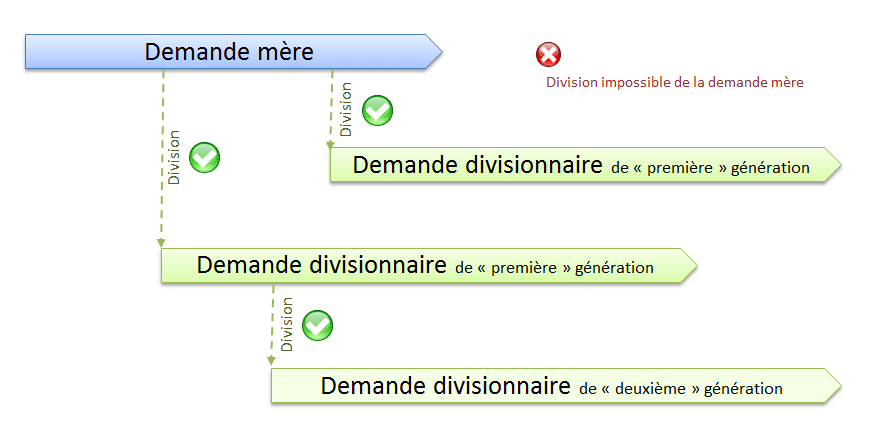
As shown in the diagram above, it is entirely possible (Guidelines A-IV 1.1.1 or Guidelines C-IX 1.1, T1158/01, G1/05):
- to divide the same application multiple times;
- or to carry out chain divisions.
It is also possible to divide a Euro-PCT application once it has entered the European phase (since the PCT contains no provisions regarding divisional applications, Guidelines A-IV 1.1, Guidelines E-IX 2.4.1, J18/09)
Pending parent application
To divide an application, it is necessary that the application to be divided is still pending: this is mandated by the wording of R36(1) EPC.
However, behind this simple expression « pending application » lie real difficulties.
Here are some specific cases:
- if an application is deemed withdrawn, it is considered pending until the expiry of the unobserved time limit in question, i.e., the first time limit (J4/86):
- it is therefore necessary to divide at the latest the day before (i.e., the last day of the time limit), but not on the day of expiry itself.
- the date of notification of the loss of rights is irrelevant.
- filing a request for a decision under R112(2) EPC does not maintain the application pending (J1/05).
- filing restitutio in integrum does not maintain the application pending if this request is subsequently refused (J4/11).
- if an application is refused, it is considered pending:
- until the expiry of the appeal period if no appeal is filed (G1/09); after the appeal period, it is no longer considered pending (J22/13), or
- until the end of the appeal if an appeal is validly filed (Guidelines A-IV 1.1.1) due to its suspensive effect
- The end of the appeal may be the occurrence of a ground for inadmissibility of said appeal – and not the decision establishing it (e.g., failure to file the statement of grounds of appeal will give rise to the ground for inadmissibility at the end of the time limit for filing it: it will therefore be possible to divide before the expiry of said time limit, J23/13, but no division will be possible after the expiry of this time limit, J22/13).
- if a renewal official fee for an application is not paid, the application is still pending until the end of the 6-month period for payment with an additional official fee (time limit provided by R51(2) EPC).
- if a PCT application has not yet entered the European phase, it is not considered pending (J18/09).
- if the proceedings relating to an application are stayed under A61 EPC, the application is no longer considered pending for the purposes of the division (J20/05), as any other interpretation would be contrary to the purpose of the stay of proceedings: the protection of the proprietor.
- if the application is withdrawn, the effect of such withdrawal takes effect on the day the EPO receives the declaration of withdrawal (« Notice dated 9 January 2002 concerning the amendment of Rules 25(1), 29(2) and 51 EPC« , OJ 2002, 112).
- the division must therefore be filed at the latest on the day before, but not on the same day.
- if the Examining Division decides to grant a patent, the patent application is considered pending until the day before the publication of the mention of grant (J7/04, J8/19):
- The decision to grant does not take effect on the day the decision-making process ends (« Notice dated 9 January 2002 concerning the amendment of Rules 25(1), 29(2) and 51 EPC« , OJ 2002, 112).
- An appeal against the decision to grant allows the application to remain pending (J1/24 contra J28/03).
If the divisional application is filed without a claim, it is still possible to file claims even if the parent application is no longer pending.
Parent application not « pending »
If the above conditions are not met, the Receiving Section notifies the applicant (R112(1) EPC) that no filing date can be accorded to the divisional application.
Place of filing
Unlike « standard » applications, divisional applications may only be filed with the EPO (A76(1) EPC):
- The Hague;
- Munich;
- Berlin.
No filing with a national office is possible (A75(1) b) EPC together with A76(1) EPC together with R36(2) EPC). If, as a courtesy, a national office were to receive a divisional application and forward it to the EPO, the filing date would be the date of receipt by the EPO (T196/10, Guidelines A-II 1.1 and Guidelines A-IV 1.3.1).
Languages
The language of filing of a divisional application must be that of the filing of the parent application or, at the applicant’s choice, the language into which the application has been translated (R36(2) EPC).
Thus, if a European patent application was filed in Italian and subsequently translated into English in accordance with the provisions of A14(2) EPC, it is possible to file a divisional application in Italian or in English.
In case of error, an irregularity exists (J13/14):
- The irregularity is not an irregularity under R57 EPC, which could be corrected after invitation pursuant to R58 EPC.
- Neither R139 EPC nor A123(1) EPC is applicable.
Applicants
The applicants of the divisional application must be exactly the same as those of the parent application, unless an assignment has been validly recorded in the European Patent Register pursuant to R143(1)(f) EPC (J2/01) (in case of universal succession, this is not necessary T15/01).
Thus, if the parent application has multiple applicants, a single one of these applicants cannot file a divisional application.
The assignment is validly recorded in the European Patent Register when the following steps have been completed:
- Submit a request for registration of the transfer:
- this request must be signed by the party submitting the request (R50(3) EPC);
- this request must be submitted in an official language of the EPO (R3(1) EPC). A14(4) EPC is not applicable, as this is not a document to be submitted within a set time limit.
- Pay an administrative fee (R22(2) EPC):
- it is set by the President of the EPO (A3 RFEE) and published in the OJ.
- It currently amounts to [montant_epo default= »95 € » name= »Schedule of fees and official fees – Registration of transfers »] (« Schedule of fees and official fees« , OJ 3/2012, supplement, 2.1 point 1, p19).
- Submit evidence of the assignment:
- it is not necessary to provide the assignment document, but a document proving the consent of the parties (the signature of both parties is mandatory, A72 EPC, Guidelines E-XIV 3);
- this evidence may be submitted in any language, as it constitutes evidence (R3(3) EPC), but a translation may be required by the Office.
- A document mentioning the obligation to assign an invention (e.g., employee) does not constitute evidence of assignment (J12/00), as the assignment may never have taken place even if the obligation exists.
Designated states
States not designated in the earlier application (or whose designation has been withdrawn, even after the filing) cannot be (re)introduced (A76(2) EPC, G4/98, J12/18 and Guidelines A-IV 1.3.4).
For extension states, a request for extension of the effects of a divisional application is only deemed filed if the corresponding request is still valid in the parent application at the date of filing of the divisional application (Guidelines A-III 12.1), i.e., if the extension official fee can or has been paid (Guidelines A-III 12.2):
- within the 6-month period after publication of the search report,
- or, where applicable, within the period prescribed for performing the acts required for entry of an international application into the European phase.
Representative
The representative of the parent application is not automatically authorized to file divisional applications for that application.
Indeed, this must be explicitly stated in the parent power of attorney (in this case, form 1003 has a pre-checked box providing for this possibility) or a new power of attorney must be filed (Guidelines A-IV 1.6).
Official fees to be paid
Which schedule of official fees should be applied?
Before determining which official fees must be paid, we may consider which schedule of official fees should be applied:
- should the one applicable at the date of filing of the documents of the parent application be used?
- should the one applicable at the date of filing of the documents of the divisional application be used?
Even though, by virtue of the legal fiction, the divisional application is accorded the filing date of the parent application, the « filing date » should not be confused with the « date on which the documents of the application were filed, » as emphasized by the Enlarged Board of Appeal (G3/98).
Thus, the amount of an official fee is determined, as usual, with reference to the time at which it becomes due and is paid (J7/13 and Guidelines A-X 5.1.2).
Filing and search official fees
Time limit
The filing and search official fees must be paid within a 1-month period from the division (R36(3) EPC).
Otherwise, the application is deemed withdrawn (R36(3) EPC).
A121 EPC is applicable.
Filing official fee
Normally, the filing official fee is [montant_epo default= »115 € » name= »A2(1).1 RRT – dépôt en ligne »] for online filing, [montant_epo default= »200 € » name= »A2(1).1 RRT – dépôt non en ligne »] otherwise (A2(1).1 RRT).
Since April 1, 2014, the filing official fee is calculated based on the generation of the divisional application (« Decision of the Administrative Council of 13 December 2013 amending Rule 6 of the Implementing Regulations to the European Patent Convention and Article 14(1) of the Rules relating to Fees« , JO 2014, A4, A2(1).1ter RRT). Thus, an additional official fee is provided:
- for a second-generation divisional application: [montant_epo default= »210 € » name= »A2(1).1ter RRT – divisionnaire de 2ème génération »];
- for a third-generation divisional application: [montant_epo default= »420 € » name= »A2(1).1ter RRT – divisionnaire de 3ème génération »];
- for a fourth-generation divisional application: [montant_epo default= »630 € » name= »A2(1).1ter RRT – divisionnaire de 4ème génération »];
- for a fifth-generation or higher divisional application: [montant_epo default= »840 € » name= »A2(1).1ter RRT – divisionnaire de 5ème génération et supérieure »].
Additional official fee for more than 35 pages
The additional official fee for more than 35 pages applies to all divisional applications filed as of April 1, 2009 (« Notice from the European Patent Office dated 26 January 2009 concerning the fee structure for 2009« , JO 2009, 118).
The additional official fee if the application exceeds 35 pages is set out in A2(1).1bis RRT ([montant_epo default= »14 € » name= »A2(1).1bis RRT »] per page strictly above 35).
Search official fee
In case of lack of unity of invention in the parent application and payment of a new search official fee to cover the second invention (subject of the division) under R64(1) EPC, a search official fee must be paid (Guidelines A-IV 1.4.1).
The search official fee is set out in A2(1).2 RRT ([montant_epo default= »1165 € » name= »A2(1).2 RRT – recherche demande déposée après 1er juillet 2005″] for an application filed after July 1, 2005, [montant_epo default= »840 € » name= »A2(1).2 RRT – recherche demande déposée avant 1er juillet 2005″] for an application filed before July 1, 2005).
However, a refund is possible (A9(2) RRT).
Designation official fees
The designation official fee must be paid within a period of 6 months from the date of publication of the search report for this divisional application (R36(4) EPC).
Otherwise, the application is deemed withdrawn (R39(2) EPC).
A121 EPC is applicable.
Claim official fees
Principle
If the number of claims provided exceeds 15, a claim official fee is due for each claim from the 16th onward (R45(1) EPC).
This official fee is [montant_epo default= »225 € » name= »A2(1).15 RRT – revendication de la 16 à la 50″] from the 16th to the 50th claim (A2(1).15 RRT) and [montant_epo default= »555 € » name= »A2(1).15 RRT – revendication au delà de la 50″] beyond.
Time limits
This official fee must be paid within a period of 1 month from the first filing of claims (R45(2) EPC).
If no official fee is paid, a notice of deficiency is sent by the filing section to the applicant, and a further period of 1 month is granted (R45(2) EPC; no additional official fee is due).
A121 EPC applies to both these time limits.
Sanction
If, at the end of this last period, the official fees are still not paid, the corresponding claims are deemed withdrawn (R45(3) EPC).
Features contained in a claim deemed withdrawn, and which are also present in the description, may be reintroduced into the application (J15/88). If they do not appear in the description, the claims will be considered as truly withdrawn and cannot be reintroduced (a priori, an amendment to the description at the time of non-payment of the official fee to provide support for the claims in the description should be acceptable).
Insufficient payment
If there is an insufficient payment of the official fee to cover all claims and no indication is given at the time of payment as to which claims the official fees have been paid for, a notification is sent to the applicant to clarify this (RFA6(2)).
If the applicant does not respond, the payment is not deemed void (contrary to what is stated in the second sentence of RFA6(2), as this sentence no longer applies): the payment is deemed to have been made for the first claims from the 16th onward (J9/84).
Case of reference to claims
The notice of deficiency under R45(2) EPC will not be sent (Guidelines A-III 9):
- as long as the applicant has not provided the copy of the earlier application:
- the applicant has a period of 2 months from the filing date to provide this copy (R40(3) EPC);
- before the EPO does not know the number of claims;
- and as long as the period of 1 month from the filing date (R45(2) EPC) has not expired (since a reference to claims of another application is considered as a filing of claims within the meaning of this rule).
Withdrawal of claims after filing
Once the application has been filed and before payment of the claim official fees, it is not possible to withdraw certain claims exempt from official fees in order to benefit other claims (e.g., withdrawal of all claims except 1-2 and 30-25): only the first claims 1-15 will be exempt from official fees (J9/84).
If a claim is withdrawn at a later stage of the procedure, the claim official fees that would have been paid are not refunded.
It is entirely possible to reintroduce a claim deemed withdrawn during examination (subject to R137(5) EPC) if and only if the subject-matter of the claim is found in the description (J15/88, T490/90 and Guidelines A-III 9).
Annual official fees
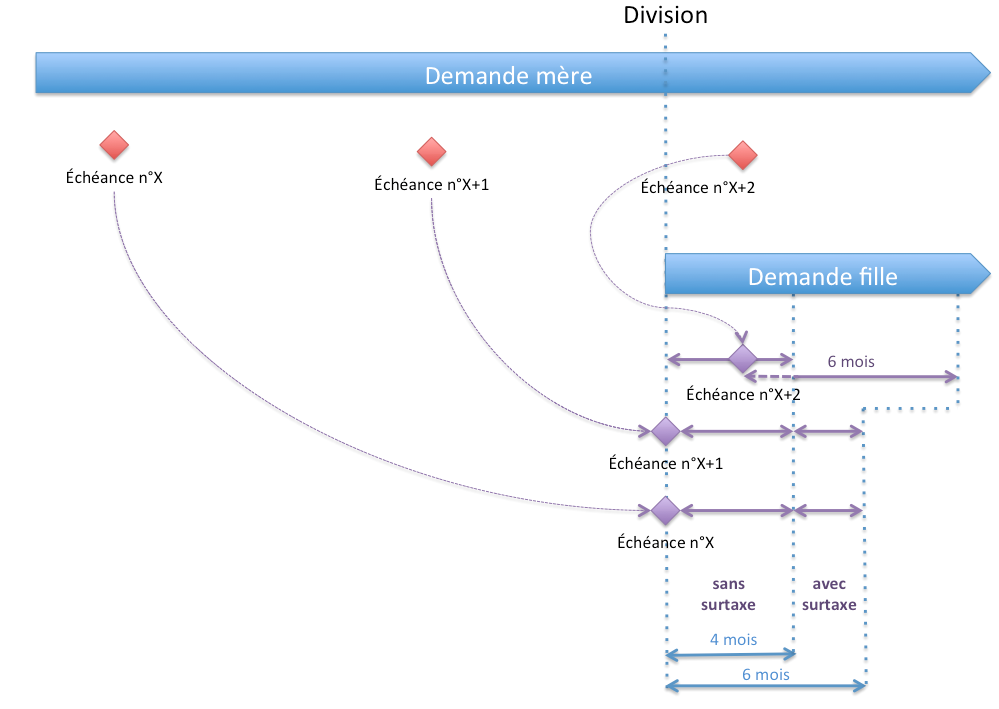
When filing a divisional application, it is necessary to pay an official fee corresponding (R51(3) EPC):
- to all the annual official fees due at the filing date of the divisional application for the parent application;
- optionally, to the annual official fee that would become due within 4 months from the division.
These official fees are due upon filing but may be paid without surcharge within a period of 4 months from the division (R51(3) EPC).
Furthermore, this payment may be made within a period of 6 months with a surcharge (R51(2) EPC) from the due date, i.e.:
- the filing date of the divisional application for the annual official fees due at the filing date of the divisional application, or
- the actual due date for the annual official fee that would become due within 4 months from the division.
Procedural aspects
Priority
It is possible to claim a priority if it was claimed in the parent application (Guidelines A-IV 1.2.2):
- if the parent application still claims this priority, this priority claim is automatic;
- otherwise, an explicit step to claim priority must be taken.
If the certified copy has already been submitted, it is not necessary to resubmit it (Guidelines A-IV 1.2.2 and « Decision of the President of the European Patent Office, dated 12 July 2007, on the filing of priority documents in the case of European divisional applications« , OJ 2007, Special Edition No. 3, B.2, Art. 1(1)).
Otherwise, it must still be submitted within the 16-month period from the earliest priority (R53(1) EPC), unless in the meantime the priority documents have been provided for the parent application: in this case, the EPO must be informed (Guidelines A-IV 1.2.2).
Submission of a previous search
It is not necessary to provide a new copy of a previous search under A124(1) EPC together with R141(1) EPC (« Notice from the European Patent Office, dated 28 July 2010, concerning amended Rule 141 EPC and new Rule 70ter EPC – system for the use of priority documents » OJ 2010, 410, point 2.1 and Guidelines A-III 6.12).
However, if no previous search was available at the time of the division, it will be necessary to respond to the notification under R70ter(1) EPC.
Reference to an earlier application
It is possible to make a reference to the parent application (R40(1)(c) EPC and Guidelines A-IV 1.3.1).
Nevertheless, the copy of the earlier application and its translation need not be submitted, as the EPO has access to them (Guidelines A-IV 1.3.1).
Request for grant
The request for grant must explicitly state that the application constitutes a divisional application and indicate the number of the earlier application (R41(2) e) EPC).
If the EPO realizes that it is a divisional application while this is not indicated in the request, the EPO notifies the applicant of this irregularity (Guidelines A-IV 1.3.2).
The applicant then has a period of 2 months to correct (A90(3) EPC together with A90(3) EPC together with R57 b) EPC together with R58 EPC).
This period does not benefit from A121 EPC.
If nothing is done within this period, the application is refused (A90(5) EPC).
Conversion of a divisional application into a normal application?
When filing a divisional application, it is not possible, after the filing, to « convert » the divisional application into a normal application (particularly if the divisional application violates the provisions of A76 EPC) (Guidelines C-IX 1.4).
Special situations
« Poisonous divisional applications »
Example of factual situation
For illustration purposes, consider the following situation:
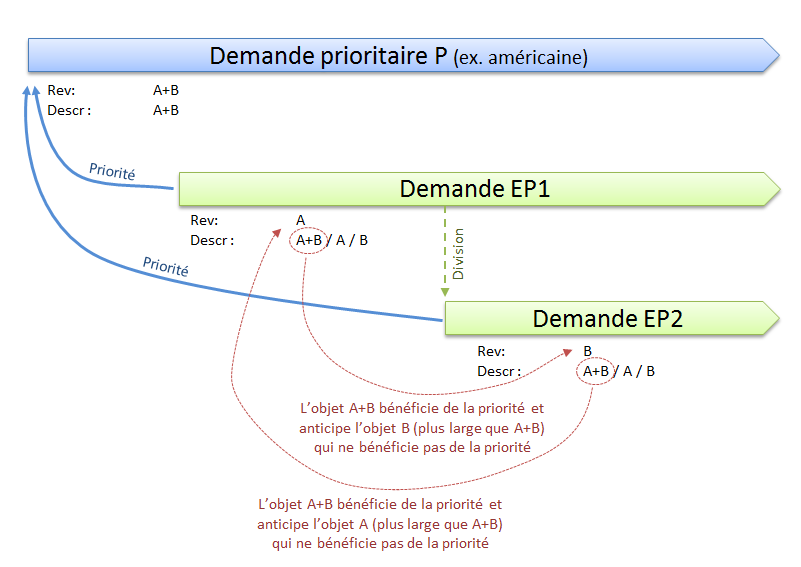
- An application P was filed in the USA, which describes an embodiment implementing, together, two objects A and B, i.e., A+B. The embodiment A+B is claimed.
- An application EP1 is filed in Europe and claims priority from application P. However, the applicant envisions certain improvements and considers that objects A and B can be implemented separately (i.e., broadening of the invention). These objects A and B are therefore claimed. The European examiner, being meticulous, raises a lack of unity of invention and invites the applicant to choose the invention they wish to protect. The examiner also informs the applicant of the possibility to divide their application.
- Wishing to also protect object B, and on the examiner’s advice, the applicant divides their application EP1 by filing a divisional application EP2 and claims object B.
Up to this point, you might think everything is fine… and yet, as you will see, the applicant has just lost both applications EP1 and EP2!
Let us analyze the claim to object A in EP1:
- The claim to A is not supported by the priority P.
- Thus, the priority of application P is not valid for this claim;
- The effective date for the claim to A is therefore the filing date of EP1.
- Regarding object A+B, it is disclosed by the European application EP2.
- This object is also disclosed by the priority document;
- The effective date for object A+B is the filing date of application P.
- Since EP2 is a European application, it can be used as a prior art document for novelty purposes (document A54(3) EPC).
- Since object A+B is more specific than object A, the disclosure of A+B in EP2 anticipates the claim to A in EP1.
A similar reasoning can be applied to the claim to object B in EP2.
Thus, as a consequence, EP1 is not novel in view of EP2 and EP2 is not novel with respect to EP1, all because of this cursed division…
This reasoning was upheld by decision T1496/11.
The Enlarged Board of Appeal comes to the rescue
In decision G1/15, the Enlarged Board of Appeal states:
The right to partial priority may not be refused for a claim encompassing alternative subject-matter by virtue of one or more generic expressions or otherwise (generic “OR”-type claim) provided that said alternative subject-matter has been disclosed for the first time, directly, or at least implicitly, unambiguously and in an enabling manner in the priority document. No other substantive conditions or limitations apply in this respect.
Thus, the following reasoning must be followed (point 6.3 of the decision):
- determine the subject-matter disclosed in the priority application that is relevant with respect to the prior art disclosed during the priority period,
- examine whether this subject-matter is encompassed by the claim of the application claiming priority
If this is the case, the claim is conceptually divided into two parts:
- the first corresponding to the invention disclosed directly and unambiguously in the priority document,
- the second being the remaining part of the “OR”-type claim, which does not benefit from the priority but in itself gives rise to a right of priority under Article 88(3) EPC.
So, phew…
Bonjour, merci pour cette fiche complète!
J’ai une petite question sur le cas de demande en instance, dans le cas de demande réputée retirée, ci-dessus il est mentionné qu’ il faut « diviser au plus tard la veille (i.e. le dernier jour du délai), mais pas le jour même de l’expiration. »
Je ne comprends pas pourquoi le dernier jour du délai n’est pas inclus dans le délai.
Dans le cas d’une priorité, le délai de priorité peut être revendiqué le dernier jour du délai?
Y a t-il une décision particulière qui l’explique?