
Historical overview of the employee inventions regime
With the law of January 2, 1968 (Law No. 68-1 aimed at promoting inventive activity and amending the patent regime), there were no specific provisions regarding employee inventions (even though provisions existed in the preparatory works, they were removed during the vote).
For a long time, the courts therefore « created » the law to address this complex issue.
A case law-based regime distinguished, at the time, between « service inventions » (which belonged jointly to the employer AND the employee) and other inventions (which belonged exclusively to the employee).
In 1978, the law enshrined this case law-based regime (roughly), which is now codified in Article L611-7 of the Intellectual Property Code.
Finally, additional remuneration was made mandatory (by the law of November 26, 1990) for « mission inventions » (a concept we will define shortly… stay tuned!).
Ownership of inventions
The principle of invention ownership
Article L611-6 CPI states that the right to the patent belongs to the inventor or to their successor in title: we might think that an employee’s invention belongs to them.
However, under certain conditions, the employer may become the successor in title of the employee.
The special regime for employees
According to Article L611-7 CPI, a distinction must be made between three categories of inventions for employees.
Mission inventions
Inventions are classified as mission inventions when they are made (Article L611-7 CPI, point 1):
- in the performance of an employment contract involving an inventive mission (i.e., a general and early instruction from the employer) that corresponds to the employee’s actual duties (e.g., with regard to their job description, Paris High Court, Chamber 03, Section 03, October 16, 2001), and/or
- within the framework of studies or research explicitly (but not necessarily in writing) assigned to them (Paris High Court, Chamber 03, Section 03, March 16, 2005).
The latter case is often more difficult to prove, as the instruction to invent given to the employee is late (for example, during a mission) and evidence is harder to gather.
Here, we are squarely within the core of the employment contract: the instruction to invent is given directly by the employer to one of their employees.
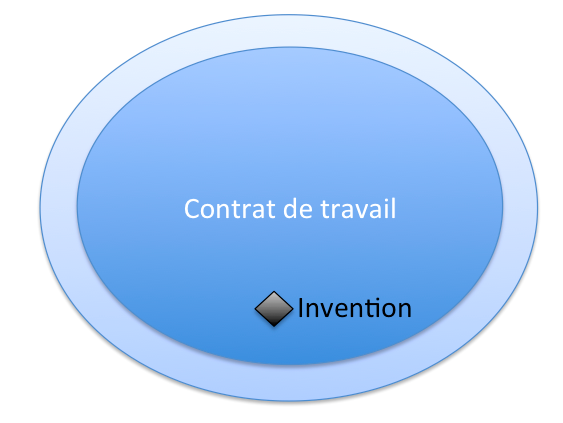
In this situation, the right to the patent belongs to the employer (Article L611-7 CPI, point 1).
This right is automatically assigned to the employer by law, without any action on their part.
Attributable inventions outside the scope of employment
In this case, the inventions must not fall under the first category and must be made (L611-7 CPI, point 2):
- either in the course of the employee’s duties,
- or in the field of activity of the company, or through the knowledge or use of the company’s specific means (the term « specific » in Article L611-7 CPI, point 2 appears to exclude an employer’s ability to claim an invention if the employee merely used a company pen to write…).
Here, we are at the periphery of the employment contract: indeed, there is no instruction from the employer to invent, but it turns out that their employee invents something.
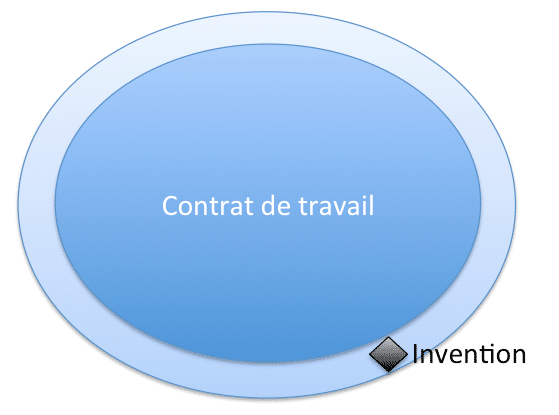
In this situation, the employer may claim the right of attribution of the invention, but this attribution is not automatic: the employer must explicitly request it (L611-7 CPI, point 2 together with R611-7 CPI) within a period of 4 months from receipt of the employee’s invention disclosure (see the formalities below).
Non-attributable inventions outside the scope of employment
The inventions covered by this category are all other inventions not falling under the above categories (L611-7 CPI, point 2, first sentence).

In this situation, the right to the patent simply belongs to the inventor.
Relevant inventors
Condition No. 1: Inventors
An inventor is someone who conceives, devises, and realizes the invention.
Therefore, a person who merely sets the technical problem to be solved (i.e., defines the objective to be achieved) is not an inventor. The same applies to someone who merely carries out experiments.
In practice, this can be challenging, but factual elements may help (keeping laboratory notebooks, interacting with the IP firm for drafting the patent, imprecise instructions given by their hierarchy, C. Cass. com., 12 February 2013, No. 12-12898).
Condition No. 2: Employees
The relevant inventors are employee inventors, i.e., those who have an employment contract under French law (possibly unwritten) at the date of the invention (C. Cass. soc., 2 June 2010, No. 08-70138) and who are subject to hierarchical instructions in return for a salary.
The following are thus excluded:
- corporate officers or company managers (non-employees);
- interns (C. Cass. com., 25 April 2006, No. 04-19482), even if they have signed internal regulations providing for an automatic assignment of inventions (Conseil d’État, 4th and 5th sub-sections combined, 22 February 2010, No. 320319).
Formalities to be observed by the employee when disclosing an invention
Employee’s duty
As mentioned above, the employer has certain rights and must be allowed to exercise them properly.
The employee must immediately inform (R611-1 CPI) the employer by registered letter with acknowledgment of receipt (or any other means allowing proof of sending R611-9 CPI) and provide sufficient information to enable the employer to assess the classification of the invention (R611-2 CPI) into one of the three categories of inventions we have just presented.
Employer’s Decision
The employer must decide on the classification of the invention within 2 months from the date of receipt of the invention disclosure by the employer (R611-6 CPI). Failing this, the classification is deemed accepted.
If the employer classifies the invention as an « attributable non-service invention, » they have an additional 2 months (i.e., 4 months from the date of receipt of the disclosure) to claim assignment (R611-7 CPI).
Disagreement
Naturally, in practice, it is quite likely that the employee and the employer may disagree on the classification of the invention into one of the categories. In the event of such a disagreement, it is possible to refer the matter to the CNIS (conciliation commission known as the « National Commission for Employee Inventions, » established under Article L615-21 CPI), and in this case, the time limits mentioned above are suspended (R611-8 CPI).
Consequences of Non-Compliance with Formalities
For the Employee
If the employee fails to comply with these formalities, no sanction is provided for in the statute.
However, damages may be sought by the employer in the event of a patent filing by the employee to the employer’s detriment.
In any case, this does not constitute gross misconduct (C. Cass. soc., January 15, 2015, No. 13-14811) that could justify dismissal.
Some have sought to characterize the employee’s « non-disclosure » as misconduct that would effectively deprive the employee of any additional remuneration. However, this misconduct is not considered sufficiently serious to deprive the inventor of their right to remuneration (Paris Court of First Instance, 3rd Chamber, 4th Section, January 30, 2014, Vincent G. v. ADER Languedoc-Roussillon et al).
For the Invention
The Cour de cassation further states (C. Cass. com., December 18, 2007, No. 05-15768):
[…] the formalities prescribed by Articles L. 611-7, R. 611-1 et seq. of the Intellectual Property Code are not provided for under penalty of nullity [of the patent].
Presumption of Inventorship
The inventors named in the patent are presumed to be the true inventors.
However, this is a rebuttable presumption that may be overturned by evidence to the contrary (Paris Court of First Instance, 3rd Chamber, 3rd Section, May 16, 2014; Jacques V. v. Kadant-Lamort). Thus, if an employer has designated an employee as an inventor, they must produce convincing evidence to demonstrate to the court that the employee was, in fact, not a true inventor.
Employee-Employer Relations
Employee Notification
Since the Macron Law of August 6, 2015, the employee must be informed (L611-7 CPI, 1°):
- of any filing of an intellectual property title application;
- of any grant of an intellectual property title.
Tensions as Grounds for Dismissal?
While employee-employer conflicts often arise upon the employee’s resignation, dismissal, or retirement, they may also occur during the performance of the employment contract.
In such cases, it is important to distinguish between the circumstances: a legal action brought by the employee (even if it aims to halt a production line and thus indirectly harm the employer) cannot constitute a legitimate ground for dismissal (C. Cass. soc., September 17, 2014, No. 13-15930), unless the employee’s claims are abusive.
Additional Remuneration / Payment of Fair Compensation
The applicable law
One of the issues that arises here is the application of the law over time.
For example, imagine that an invention is made before the 1990 law, but the filing of the patent is done after that same law. Which law should apply?
According to the Cour de cassation, the applicable regime must be assessed as of the date of the creation of the invention and not the date of grant of the patent (C. Cass. civ., 20 September 2011, n°10-20997).
This solution, satisfactory from an intellectual standpoint, may nevertheless pose evidentiary challenges. How can the exact date of creation of the invention be determined? It will then be necessary to look through email exchanges, work meetings, etc.
Triggering event
It is therefore important to determine from which point the additional remuneration provided by law is due:
- At the time of the invention?
- At the time of the patent filing?
- At the time of exploitation of the invention/patent?
- At the time of grant of the patent?
The courts consider that the inventions referred to in Article L611-7 of the IPC are patentable inventions, whether or not a patent is filed, and whether or not exploitation takes place (C. Cass. com., 18 December 1984, n°83-11677, or C. Cass. civ. ch. com., 20 September 2011, n°10-20997).
The different remuneration regimes
Service inventions
The law provides for an « additional remuneration » in the context of service inventions (L611-7 IPC, 1°).
There is no definition of this term in the statutes, and it is necessary to look to case law to form an opinion.
Inventions before 1990
Before 1990, there was no law requiring additional remuneration.
It is therefore necessary to look at collective bargaining agreements:
- if a collective bargaining agreement stated that the amount of this remuneration should be set « as a lump sum, taking into account the general research framework in which the invention was made, the difficulties of practical development, the employee’s original personal contribution to the individualization of the invention itself, and the commercial interest thereof« , it must be understood that the amount should be based on the profits and turnover achieved by the employer and not on the employee’s salary (C. Cass. com., 21 November 2000, n°98-11900);
- if a collective bargaining agreement stated that the employee should be given « a bonus commensurate with the value of the invention » (Art 17 of the Supplementary Agreement for Engineers and Managers of the Chemical Industries Collective Agreement), the remuneration should not be based on the employee’s salary (Paris Court of Appeal, 4th ch., sect. B, 13 May 2005).
Inventions after 1990
Since 1990, the additional bonus is not optional. It is mandatory and must be provided for (L611-7 IPC):
- by collective bargaining agreements,
- company agreements, and/or
- individual employment contracts.
However, it must be noted that many collective bargaining agreements still do not systematically provide for this remuneration, and employment contracts are often silent on this point.
If the collective bargaining agreement sets certain conditions for this remuneration, the relevant article of the collective bargaining agreement must be considered null and void (C. Cass. com., 22 February 2005 n°03-11027, or C. Cass. com., 12 February 2013, n°12-12898), regardless of whether a patent has been filed or granted.
The court will then be free to determine the additional remuneration as it sees fit (often in a manner favorable to the employee, see the section « Method of calculating the additional remuneration« ).
Case of attributable non-service inventions
For attributable non-service inventions (L611-7 CPI, 2°), a « fair price » must be paid to the employee.
This fair price must be determined based on the initial contribution of the parties involved and the industrial and commercial utility of the invention (Court of Appeal of Colmar, 2nd Civil Chamber, Section A, January 9, 2013, Case SNCF and L611-7 CPI, 2°).
Case of non-attributable non-service inventions
In this latter case, as the invention remains the property of the inventor, no remuneration is due to the employee in this regard.
Statute of limitations
Duration of the statute of limitations
Most courts consider the additional remuneration to be a wage claim (Cass. com., June 12, 2012, No. 11-21990 or Cass. com., January 26, 2012, No. 10-13825).
The statute of limitations for this type of claim is:
- 5 years for inventions made before June 18, 2008 (former Article 2277 of the Civil Code);
- 5 years for inventions made between June 19, 2008, and June 16, 2013 (Article 2224 of the Civil Code);
- 3 years for inventions made since June 17, 2013 (Article L3245-1 of the Labor Code).
Commencement of the statute of limitations
Does the statute of limitations begin:
- From the creation of the claim (i.e., the invention)?
- From the employee’s knowledge of the exploitation of the invention and from the moment the claim would be determinable?
In light of the extensive case law on the subject (and the new wording of Article L3245-1 of the Labor Code), it appears that proponents of the commencement of the statute of limitations on the day the claim would be determinable prevail (Cass. soc., May 5, 2004, No. 02-13318, Cass. com., February 22, 2005, No. 03-11027, Cass. soc., January 26, 2012, No. 10-13825, Cass. com., June 12, 2012, No. 11-21990).
Methods for calculating additional remuneration
Common remuneration systems
Today, many companies provide for additional remuneration.
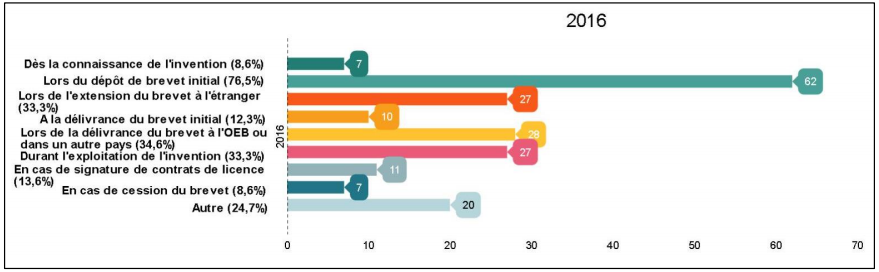
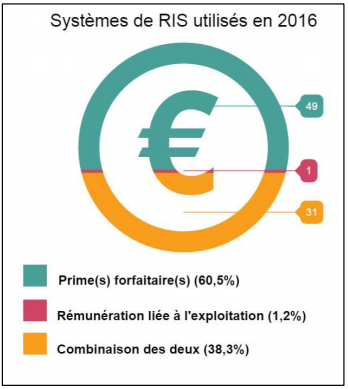
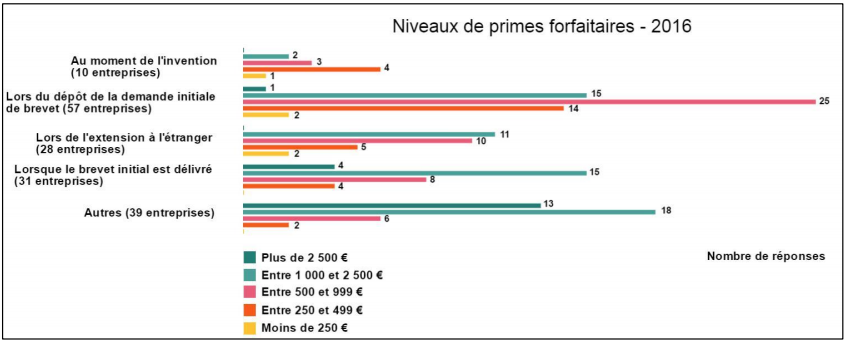
A 2016 INPI study provides interesting indicators for understanding the methods of calculating this remuneration (Employee Inventions Remuneration – Practices in France – Analyses by the Intellectual Property Observatory – October 2016).
Here are three self-explanatory graphs:
Optional preliminary procedure: the CNIS
If the employee feels aggrieved (i.e., they have received nothing or not enough in their view), they may freely choose (Cour d’appel de Lyon, 1re ch. civ., sect. A, 27 September 2012) to refer the matter to the CNIS or the Paris District Court (TGI).
If the CNIS is seized, the employee will have a one-month period from the date of the CNIS’s proposal to refer the matter to the Paris District Court (L615-21 CPI). Otherwise, the CNIS’s proposal will constitute a final agreement between the parties.
Calculation method used by the judicial courts
In the absence of a synthesis of CNIS proposals (which are confidential), we will summarize the decisions of judicial courts regarding the calculation methods for this additional remuneration.
Patent bonus / exploitation bonus
The methods used may vary significantly and can be applied cumulatively or alternatively depending on the circumstances:
- determination of a « lump sum » for the invention (i.e., often referred to as a « patent bonus« ) ;
- determination of a bonus based on the commercial success of the invention and its exploitation (i.e., often referred to as an « exploitation bonus« ).
Average amounts
By way of illustration, courts may award a « patent bonus » (i.e., applicable even if the invention is not exploited):
- 150 € (Cour d’appel de Paris, Pôle 5, 2e ch., 11 March 2011) ;
- the expert estimates that the usual practice is 150 € for filing, 150 € for grant, and 150 € for an extension (Cour d’appel de Paris, Pôle 5, 2e ch., 16 December 2011) ;
- 150 € (Tribunal de grande instance de Paris, 3e ch., 3e sect., 11 January 2013) ;
- 1 500 US$ (Cour d’appel de Paris, Pôle 5, 1re ch., 30 January 2013) ;
- 150 € (Cour d’appel de Paris, Pôle 5, 2e ch., 25 October 2013) ;
- according to a 2008 INPI survey, the average amount of this lump-sum bonus is 150 € for the filing of an application (Cour d’appel de Paris, Pôle 5, 1re ch., 11 September 2013) ;
- etc.
Similarly, courts may award an « exploitation bonus » as follows:
- 150 € for a FR, EP, and PCT patent (Cour d’appel de Paris, Pôle 5, 1re ch., 14 April 2010) ;
- from 150 € to 150 € per patent (Cour d’appel de Toulouse, 2e ch., 2e sect., 16 March 2010) ;
- from 150 € to 150 € per patent (Cour d’appel de Paris, Pôle 5, 2e ch., 11 March 2011)
- from 150 € to 150 € per patent (Cour d’appel de Paris, Pôle 5, 1re ch., 26 June 2013) ;
- from 150 € to 150 € per patent (Cour d’appel de Paris, Pôle 5, 2e ch., 25 October 2013) ;
- according to an expert: 150 € multiplied by a multiplier coefficient if the invention is a commercial success, 150 € in other cases (in the field of electronics, Cour d’appel de Paris, Pôle 5, 2e ch., 16 December 2011) ;
- etc.
It should be noted that the differences between these amounts are partly explained by the economic interest and commercial success of the invention (thus, the situation must be analyzed on a case-by-case basis).
This « exploitation bonus » is not systematically provided for in collective agreements, but even in the absence of a collective agreement, some decisions still award it.
Method: Alignment with the civil service regime?
It should also be noted that some judges have sought to align the additional remuneration with the regime applicable to state employees under Article R611-14-1 CPI (Regional Court of Paris, 3rd Chamber, 1st Section, 10 November 2008).
This method was explicitly rejected, in another case, by the Court of Appeal of Paris, Division 5, 2nd Chamber, 16 December 2011.
Request for additional documents
In any event, the pre-trial judge may request the employer to produce a significant number of documents (Regional Court of Paris, 3rd Chamber, 4th Section, order of the pre-trial judge, 15 May 2014), potentially under penalty:
- content of each patent family for each invention;
- lists of third parties directly or indirectly holding a right in an invention or a patent derived from the invention (assignment, license, contribution, pledge, bank guarantee, etc.);
- copy of each contract (e.g., sale, license, supply, and contribution agreements), relating to any product directly or indirectly covered (e.g., by supply of means) by any of the claims of a patent;
- details of all payments received in connection with a patent;
- documents relating to the valuation of each invention, in particular all documents quantifying its economic value, including:
- sales volume,
- gross margin,
- net margin,
- production savings,
- and their commercial interest.
Brief focus on the applicable law
From the outset, we have been discussing the articles of the Intellectual Property Code governing the right to the title (L611-7 CPI).
But are they actually applicable?
This is a complex issue governed by private international law.
In Europe, Regulation (EC) No 559/2008 or Rome I (which is based on the Rome Convention) provides, in Article 8, that the employment contract shall be governed:
- by the law chosen by the parties (subject to more favorable provisions of the other options);
- by the law of the country with which the employment contract is most closely connected;
- by the law of the country in which the work is habitually carried out;
- failing that, by the law of the country where the establishment that hired the employee is situated.
It is up to you to determine the applicable law…
Effectivement, ce blog n’est pas nominatif.
Néanmoins, il n’existe aucune obligation de le faire:)
D’autant que je cite mes sources systématiquement donc cela est compliqué de faire plus factuel. (PS : je suis de plus certain que certaines personnes chez Nuss connaissent en réalité mon identité)
Concernant les mentions légales obligatoires, elles existent bien dans https://www.sedlex.fr/contact/
la présentation du sujet est synthétique et selon moi objective et impartiale. A chacun ensuite d’approfondir et de se faire conseiller. Le poste d’Andrew montre d’ailleusr qu’un salarié y a trouvé des informations utiles… Et au passage, les « officines de propriété industrielle » conseillent les salariés comme les employeurs. Seul hic, on ne sait pas qui « se cache » derrière ce site. Aucune info dans les contacts, pas de mention légale. Enfin, je n’ai rien trouvé !
@LALOUBERE Jean-Claude
Votre spam semble être rédigé en toute partialité donc je ne vais pas faire long.
Je ne pense pas trop m’avancer en disant que l’auteur de ce site est simplement du côté de la loi et que votre spam, faute d’arguments, ne reflète que la lourdeur propre à son genre.
…Et je passe outre l’absurdité de l’insulte à notre métier qui n’existerait pas sans les inventeurs.
Sedlex, comme toutes les officines de propriété industrielles, ne sont pas du coté des inventeurs. Elle est présente sur les sites Internet (Internet n’est pas public) et sur les réseaux publics pour donner une mauvaise information et tromper les inventeurs.
Sedlex, comme toutes les officines de propriété industrielles, ne sont pas du coté des inventeurs. Elle est présente sur les sites Internet (Internet n’est pas public) et sur les réseaux publics pour donner une mauvaise information et tromper les inventeurs.
@ Andrew : la prescription de 5 ans prévue par l’article 2224 du Code Civil trouvera à s’appliquer. Les questions seront :
Y a-t-il prescription de l’action en paiement de la rémunération supplémentaire ? Depuis l’origine ? Depuis le moment où l’inventeur dispose de tous les éléments ?
A quels actes la prescription s’applique par ailleurs ? A chaque vente d’un produit couvert par le brevet ? Aux bénéfices, à un pro-rata du CA ?
Autres questions : ces brevets sont-ils toujours en vigueur ? L’employeur exploite-t-il l’objet de chacun de ces brevets ? Si certains sont déchus/abandonnés, le droit à rémunération sera sans doute éteint.
Une créance (droit personnel) est peut-être ouverte pour la période de validité jusqu’à extinction de chaque brevet respectif.
Sur la question de la prescription ou non : voir le lien joint relatif à une décision récente
Bonjour,
Cet article fut pour moi une révélation.
J’ai déposé depuis 1997 plus de 12 brevets pour mon employeur.
J’ai dans mon contrat de travail une clause « mission inventive » et je considérais jusqu’à aujourd’hui que j’étais « payé » pour cela.
J’ignorais donc qu’il puisse y avoir rémunération supplémentaire.
Si je saisis demain la CNIS, que puis je faire valoir concernant les brevets déposés de 1997 à 2007 ?
Cordialement
Andrew