Time Limit for Entering the National Phase
Before a Designated Office
Principle
In general, no designated office may process or examine the international application before the expiration of a 30-month time limit from the priority date (A23.1 PCT together with A22.1 PCT).
Thus, no translation or official fee is due before the expiration of this time limit (A23.1 PCT together with A22.1 PCT).
Designated States with a Reservation
For certain States, the applicable time limit is the former 20-month time limit, as they have made a reservation to A22.1 PCT:
- Luxembourg,
- United Republic of Tanzania.
These two States are, however, each part of a regional patent system accessible via the PCT, for which the applicable time limit is the new 30-month time limit (EPC for Luxembourg, ARIPO for Tanzania).
For information, Uganda withdrew its reservation as of April 1, 2015.
Longer Time Limit
A longer time limit may be provided for by national legislation (A22.3 PCT).
Reminder / No Reminder
Most designated offices do not send a reminder regarding entry into the national phase.
Consequently, it is the applicant’s responsibility to monitor the applicable time limits (applicant’s guide, national chapter §3.003).
Before an Elected Office
Principle
If the applicant files a demand for international preliminary examination before the expiration of the 19-month time limit from the priority date, the time limit for entering the national phase is 30 months (even for States that have made a reservation, see above) (A39.1.a PCT).
The national examination may not begin before the expiration of this time limit (A40.1 PCT).
Longer Time Limit
Of course, a longer time limit may be provided for by national legislation (A39.1.b PCT and R77 PCT).
Early Entry into the National Phase
The national procedure may be initiated early if the applicant expressly requests it from the office concerned (A23.2 PCT and R47.4 PCT for designated offices and A40.2 PCT and R61.2.d PCT for elected offices).
If the express request for early entry into the national phase is filed before the publication of the international application, the applicant or the designated office must additionally request the IB to communicate the documents of the application under A20 PCT (A23.2 PCT or A40.2 PCT together with R47.4 PCT).
Nevertheless, it remains necessary for the applicant to perform the prescribed acts indicated below (applicant’s guide, national chapter §3.004).
Acts to Be Performed for Entry into the National Phase
Requirements
National official fees
Payment of national official fees is prescribed by A22.1 PCT and A39.1.a PCT: this official fee is indicated (along with cases of reduction, exemptions, etc., applicant’s guide, national chapter §4.007) in the applicant’s guide, as the designated or elected Offices must notify the amount of the official fee to the IB (R49.1.a.ii PCT and R76.5 PCT together with R49.1.a.ii PCT).
National official fees must be paid in the currency and within the time limits prescribed by the national Offices (applicant’s guide, national chapter §4.005).
Annual fees and renewal fees that became due upon entry into the national phase must be paid before the expiration of the national phase entry deadline (applicant’s guide, national chapter §4.005).
Translation of the application
Requirement
A translation of the international patent application must be furnished if the language of filing or publication is not accepted by the designated Office (A22.1 PCT together with R49.2 PCT) or by the elected Office (A39.1.a PCT together with R76.5 PCT together with R49.2 PCT).
Language
The prescribed language(s) are indicated in the applicant’s guide, as the Office in question must notify the IB of the language(s) (A22.1 PCT together with R49.1.a.i PCT for the designated Office or A39.1.a PCT together with R76.5 PCT together with R49.1.a.i PCT for the elected Office).
If several languages are indicated, the applicant may choose (R49.2 PCT for the designated Office and R76.5 PCT together with R49.2 PCT for the elected Office).
The language of the translation may be that of the proceedings (applicant’s guide, national chapter §4.009).
Content of the translation (for all Offices)
Filing
The required translation pertains to (R49.5.a PCT for the designated office R76.5 PCT together with R49.5.a PCT for the elected office):
- the description (including the title) as filed or amended, where applicable;
- the claims as filed or amended (under A19 PCT or A34 PCT), where applicable (for amendments during examination A36.2.b PCT, A39.1 PCT together with R74.1 PCT and R76.5 PCT); the text of the drawings as filed or amended, where applicable; the translation of the drawings may consist of (R49.5.d PCT for the designated office R76.5 PCT together with R49.5.d PCT for the elected office): the submission of new redrawn sheets; the submission of copies of the drawings with the translation affixed. The term « Fig. » need not be translated (R49.5.f PCT for the designated office R76.5 PCT together with R49.5.f PCT for the elected office).
If the translation is not submitted within the time limit for entering the national phase, the international application may lose the effect of a regular national filing (A24.1.iii PCT together with A22.1 PCT together with R49.5.d PCT for designated offices and A39.2 PCT together with A39.1.a PCT together with R76.5 PCT together with R49.5.d PCT for elected offices).
Reference to Biological Material
If a reference to biological material is not included in the description, a translation must be submitted:
- at the same time as the translation of the application (R49.3 PCT for the designated office R76.5 PCT together with R49.3 PCT for the elected office), or
- if omitted, upon invitation from the office that deems it necessary (R49.5.h PCT for the designated office R76.5 PCT together with R49.5.h PCT for the elected office).
Content of the Translation (Depends on the Offices)
Abstract
The abstract must also be translated (R49.5.a PCT for the designated office R76.5 PCT together with R49.5.a PCT for the elected office), but some offices do not require this translation (applicant’s guide, national chapter §4.011).
Request
A translation of the request may be required, but most offices do not require it (R49.5.a.i PCT for the designated office R76.5 PCT together with R49.5.a.i PCT for the elected office): if a translation is required, the office provides a blank request form in the required language free of charge (R49.5.b PCT for the designated office R76.5 PCT together with R49.5.b PCT for the elected office).
Filed claims
Normally, only the amended claims need to be translated.
Nevertheless, an office may require both (R49.5.a.ii PCT for the designated office R76.5 PCT together with R49.5.a.ii PCT for the elected office):
- the translation of the set of claims as filed and
- the translation of the set of claims amended under A19 PCT.
Otherwise, the office will either disregard the claims for which the translation has not been submitted or invite the applicant to submit the missing translation within a reasonable time, and if the applicant fails to respond to this invitation, the office will either disregard the claims for which the translation has not been submitted or consider the application withdrawn (R49.5.c-bis PCT for the designated office R76.5 PCT together with R49.5.c-bis PCT for the elected office).
Statement justifying A19 PCT amendments
An office may require the submission of a translation of the statement justifying the amendments made under A19 PCT (R49.3 PCT for the designated office R76.5 PCT together with R49.3 PCT for the elected office).
The only consequence of failing to submit this translation is that the office will not take this statement into account (R49.5.c PCT for the designated office R76.5 PCT together with R49.5.c PCT for the elected office).
Copy of the original drawings
An office may require the submission of a copy of the original drawings (but not the originals) together with the translation of the application (R49.5.a.iii PCT for the designated office R76.5 PCT together with R49.5.a.iii PCT for the elected office).
In practice, very few offices actually require this.
In case of omission, the applicant will be invited to provide this copy within a reasonable time (R49.5.e PCT for the designated office R76.5 PCT together with R49.5.e PCT for the elected office).
Formal requirements for the translation / copy of the drawings
The formal requirements for translations and copies of the drawings are set by the designated office (applicant’s guide, national chapter §4.023), but these must be compatible with those of the PCT and therefore cannot be more restrictive (R49.5.j PCT for the designated office R76.5 PCT together with R49.5.j PCT for the elected office).
Number of copies of the translations
A single copy of the translations is required in most cases, but some offices require more (A27.1 PCT together with R51bis.1.c PCT for designated offices and A27.1 PCT together with R76.5 PCT together with R51bis.1.c PCT for elected offices).
If copies are missing, offices give the applicant the opportunity to correct this irregularity after the national phase has been entered (applicant’s guide, national chapter §4.024).
Certification of the Translation
As a rule, it is not necessary to provide a certification (by a public authority or a sworn translator) of the translation (applicant’s guide, national chapter §4.025).
However, if the office subsequently doubts the accuracy of the translation, the office may request certification (A27.2.ii PCT together with R51bis.1.d.ii PCT for designated offices and A27.2.ii PCT together with R76.5 PCT together with R51bis.1.d.ii PCT for elected offices).
Verification of the Translation
Some (few) offices may require that the translation be verified (i.e., a signed declaration stating that, to the best of that person’s knowledge, the translation is accurate and complete (A27.2.ii PCT together with R51bis.1.d.i PCT for designated offices and A27.2.ii PCT together with R76.5 PCT together with R51bis.1.d.i PCT for elected offices).
Submission of a Copy of the International Application
If required by an office, a copy of the international application may be requested (A22.1 PCT for designated offices, or A39.1.a PCT for elected offices) if the IB has not transmitted this copy pursuant to A20 PCT.
However, this requirement is not mandatory for national offices (R49.1.a-bis PCT for designated offices and R76.5 PCT together with R49.1.a-bis PCT for elected offices).
If the applicant requests early entry into the national phase and early processing of the application (pursuant to A23.2 PCT or A40.2 PCT), and if the IB has not yet communicated the copy, the applicant must (applicant’s guide, national chapter §4.028):
- submit this copy themselves along with any amendments filed under A19 PCT at the same time as the request for early processing;
- request the IB to transmit the copy pursuant to A13.2.b PCT.
Designation of the Inventor
An office may require that the name or address of the inventors be provided at the time of entry into the national phase (if missing during the international phase A22.1 PCT).
Some states also provide for a notification in case of omission, but this is not mandatory, and such omission may result in the application being considered withdrawn (A24.1.iii PCT).
Indication of the protection sought
Upon entry into the national phase, the applicant must indicate the type(s) of protection sought if they wish their application to be processed:
- as an application other than for a patent;
- (R49bis.1.a PCT together with A43 PCT for designated Offices and R76.5 PCT together with R49bis.1.a PCT together with A43 PCT for elected Offices);
- as an application seeking the grant of multiple forms of protection;
- (R49bis.1.b PCT together with A43 PCT together with A44 PCT for designated Offices and R76.5 PCT together with R49bis.1.b PCT together with A43 PCT together with A44 PCT for elected Offices);
- as an application seeking the grant of additional protection;
- (R49bis.1.c PCT together with A43 PCT for designated Offices and R76.5 PCT together with R49bis.1.c PCT together with A43 PCT for elected Offices);
- as an application seeking the grant of a continuation or a continuation-in-part of an earlier application;
- (R49bis.1.d PCT for designated Offices and R76.5 PCT together with R49bis.1.d PCT for elected Offices).
If no indication is given upon entry into the national phase, the application is processed as an application seeking the grant of a patent (R49bis.1.e PCT for designated Offices and R76.5 PCT together with R49bis.1.e PCT for elected Offices) unless the official fee paid corresponds to another form of protection, in which case the application is considered as seeking that form of protection.
Specific national requirements
Principle
Additional national requirements may be necessary, but these may be fulfilled outside the national phase entry deadline (R51bis.3.b PCT for designated Offices and R76.5 PCT together with R51bis.3.b PCT for elected Offices).
The Office may (R51bis.3.a PCT for designated Offices and R76.5 PCT together with R51bis.3.a PCT for elected Offices) issue an invitation to the applicant to comply with the specific national phase requirements within a minimum period of 2 months.
Statement concerning the inventor, assignments and the right to file
Certain offices may require the applicant to provide
- any document relating to the identity of the inventor;
- (A27.2.ii PCT together with R51bis.1.a.i PCT for designated offices and A27.2.ii PCT together with R76.5 PCT together with R51bis.1.a.i PCT for elected offices);
- any document relating to the applicant’s right to file a patent;
- (A27.2.ii PCT together with R51bis.1.a.ii PCT for designated offices and A27.2.ii PCT together with R76.5 PCT together with R51bis.1.a.ii PCT for elected offices);
- any document proving the right of priority (if the applicant or their name is different);
- (A27.2.ii PCT together with R51bis.1.a.iii PCT for designated offices and A27.2.ii PCT together with R76.5 PCT together with R51bis.1.a.iii PCT for elected offices);
- any sworn statement or declaration concerning the inventorship;
- (A27.2.ii PCT together with R51bis.1.a.iv PCT for designated offices and A27.2.ii PCT together with R76.5 PCT together with R51bis.1.a.iv PCT for elected offices);
- any evidence concerning non-prejudicial disclosures (abuse, trade fairs, etc.);
- (A27.2.ii PCT together with R51bis.1.a.v PCT for designated offices and A27.2.ii PCT together with R76.5 PCT together with R51bis.1.a.v PCT for elected offices).
Receiving Offices
This statement must be sent to the national office having such specific requirements: the IB does not forward these documents to the offices concerned if it receives them (applicant’s guide, national chapter §5.003).
Anticipation in the international phase
A statement under R4.17 PCT may be made in the request for filing in order to anticipate national requirements.
In such case (unless reservations apply), the office may no longer require them unless it can reasonably doubt the veracity of the statement (R51bis.2 PCT for designated offices and R76.5 PCT together with R51bis.2 PCT for elected offices).
However, in the case of evidence concerning non-prejudicial disclosures, offices may require any additional proof, as R51bis.1.a.v PCT does not appear in the exclusions under R51bis.2 PCT.
Missing indications concerning certain applicants
In a filing with multiple applicants, the PCT does not require complete indications to be provided for all.
A national office may require upon entry into the national phase that the signature of all applicants be provided (A27.2.ii PCT together with R51bis.1.a.vi PCT for designated offices and A27.2.ii PCT together with R76.5 PCT together with R51bis.1.a.vi PCT for elected offices).
Additionally, such office may require that the missing information concerning the applicants be provided (A27.2.ii PCT together with R51bis.1.a.vii PCT for designated offices and A27.2.ii PCT together with R76.5 PCT together with R51bis.1.a.vii PCT for elected offices).
Representation
Most designated offices require that applicants domiciled abroad be represented by a local representative (A27.7 PCT together with R51bis.1.b.i PCT for designated offices and A27.7 PCT together with R76.5 PCT together with R51bis.1.b.i PCT for elected offices).
Others require that applicants domiciled abroad have a service address in the State concerned (A27.7 PCT together with R51bis.1.b.i PCT for designated offices and A27.7 PCT together with R76.5 PCT together with R51bis.1.b.i PCT for elected offices).
For entry into the national phase as such, it is not necessary to have a representative (R51bis.3.b PCT for designated offices and R76.5 PCT together with R51bis.3.b PCT for elected offices), and the designation may be made after the national phase entry deadline.
After entry into the national phase, the representative may need to be designated in a power of attorney signed by the applicant(s) (A27.7 PCT together with R51bis.1.b.ii PCT for designated offices and A27.7 PCT together with R76.5 PCT together with R51bis.1.b.ii PCT for elected offices).
Submission of the priority document
Normally, the priority document must be submitted during the international phase to the RO or the IB. In this case:
- the IB is responsible for transmitting it to the designated Offices that request it;
- no Office may require the submission of a certified copy by the applicant upon entry into the national phase (R17.2.a PCT). However, a simple photocopy may be required (applicant’s guide, national chapter §5.009) along with a translation.
A translation of the priority document may be required if:
- the validity of the priority claim is relevant to patentability (A27.2.ii PCT together with R51bis.1.e.i PCT for designated Offices and A27.2.ii PCT together with R76.5 PCT together with R51bis.1.e.i PCT for elected Offices);
- the filing date was assigned by the RO following an incorporation of an element or part by reference (A27.2.ii PCT together with R51bis.1.e.ii PCT for designated Offices and A27.2.ii PCT together with R76.5 PCT together with R51bis.1.e.ii PCT for elected Offices).
Some States may have had reservations (A27.2.ii PCT together with R51bis.1.f PCT for designated Offices and A27.2.ii PCT together with R76.5 PCT together with R51bis.1.f PCT for elected Offices), but today, none exist.
Exclusions
Use of national form
No applicant is required to use a national form to complete the acts for entry into the national phase (R49.4 PCT for designated Offices and R76.5 PCT together with R49.4 PCT for elected Offices).
Failure to complete certain acts
Sanction
If certain acts are not completed within the time limit for opening the national phase, the application may cease to have the effects of a national filing for the Office concerned (A24.1.iii PCT and A24.2 PCT for designated Offices and A39.2 PCT and A39.3 PCT for elected Offices).
Possible corrections
Every Office must first give the applicant the opportunity to correct the application if the national law provides for such situations in analogous or comparable cases for national applications (A26 PCT).
Restoration of rights upon entry into the national phase
See « Provisions applicable after entry into the national phase > Excuses for delays > Special case of acts to be completed for entry into the national phase ».
Provisions applicable after entry into the national phase
Substantive patentability requirements
The PCT allows Contracting States to choose any substantive patentability requirement they wish (A27.5 PCT), for example, for prior art.
It should simply be noted that unity of invention is not a substantive patentability requirement, and Contracting States must follow the rules set out in the PCT under R13.2 PCT rather than their own rules.
Correction of the Provided Translation
When the translation of the application contains an error, this error must be correctable (applicant’s guide, national chapter §6.002) during the national phase.
The scope of the translation must, of course, not exceed that of the original text (A46 PCT).
Amendments to the Application During the National Phase
Principle
It is possible to amend, at least once, the claims, the description, and the drawings during the national phase (A28.1 PCT together with R52.1 PCT for designated Offices or A41.1 PCT together with R78.1 PCT):
- within a minimum period of 1 month from entry into the national phase;
- for at least 4 months, if the IB has not communicated the application and other documents to the Office (pursuant to R47.1 PCT and, where applicable, A36.1 PCT).
Amendments must normally not go beyond the content of the application as filed (unless otherwise provided by national law, A28.2 PCT for designated Offices or A41.2 PCT).
Correction of Obvious Error
The correction of obvious error depends on national legislation (applicant’s guide, national chapter §6.017).
When authorization for rectification has been refused in the international phase, and this refusal has been published at the applicant’s request pursuant to R91.3.d PCT, a request for rectification must still be filed (applicant’s guide, national chapter §6.016).
Review of Decisions
Decisions Subject to Review
Normally, in the international phase, there is no means of challenging the decisions of Authorities (except with regard to unity of invention).
However, it is possible to request each designated Office to review (A25 PCT) a decision of an International Authority among (A25.1.a PCT):
- refusal to accord a filing date by the RO or withdrawal of the filing date initially accorded;
- finding that the application is deemed withdrawn by the RO for failure to pay an official fee or to correct an irregularity;
- finding that the application is deemed withdrawn by the IB for failure to transmit the original copy of the application within the prescribed time limit.
Procedure
In order to have a decision reviewed, the following is required:
- to request the IB (invoking A25 PCT) to send each designated Office (as indicated by the applicant) a copy of any relevant document contained in the file (A25.1.a PCT, if the Office is designated for the IB or A25.1.b PCT, if the designation of the Office is considered withdrawn by the IB)
- furthermore, if the review concerns the refusal to accord a filing date, the applicant must provide a copy of the refusal notification (R51.2 PCT and R20.4.i PCT);
- to request each of the designated Offices to review the decision (A25.2.a PCT) (applicant’s guide, national chapter §6.019):
- by providing any element that may support the request (evidence, etc.);
- by paying the national official fee required for entry into the national phase;
- by providing the translation of the international application.
Time limit
The request must be addressed to the IB or to any office within 2 months following the date of the notification informing the applicant of an unfavorable decision (A25.1.c PCT together with R51.3 PCT together with R51.1 PCT).
It is therefore, in most cases, necessary to request early processing of the application.
Outcome
If the review is positive, the designated office processes the application as if the error had never occurred (A25.2.a PCT).
If the review is negative, the office may nevertheless process the international application as having the effect of a regular national filing (A24.2 PCT), particularly if a delay may be excused.
Excuses for delays
Principle
A delay in complying with a time limit after which the application is deemed withdrawn may be excused in certain cases (A24.2 PCT together with A48.2 PCT).
It appears that, in order to obtain an excuse for the delay, a review of the decision must be requested at the same time (applicant’s guide, national chapter §6.021).
No provision of the PCT allows for an excuse of the time limit during the international phase (except in cases of force majeure R82 quater PCT).
Grounds for excuse
Each office may freely choose the grounds allowing for the excuse of a delay (A48.2.b PCT), but it must at least excuse delays for the grounds provided by the national legislation for national applications (A48.2.a PCT).
For example, the grounds provided by the national legislation may include (R82bis.2 PCT):
- reinstatement of rights,
- restoration,
- restitutio in integrum,
- further processing,
- etc.
Excusable time limits
Any time limit is excusable:
- if it is set in the PCT (R82bis.1.i PCT);
- if it is set by an international authority (RO, ISA, IPEA, IB, R82bis.1.ii PCT) (except the SISA?);
- if it is set by the designated or elected office (or set in the national legislation for that office) for any act to be performed by the applicant before that office (R82bis.1.iii PCT).
Special case of acts to be performed for entry into the national phase
Principle
For acts to be performed upon entry into the national phase, offices must allow the applicant to reinstate their rights if the time limits are not met (R49.6 PCT for designated offices and R76.5 PCT together with R49.6 PCT for elected offices), except for reservations provided under R49.6.f PCT for designated offices and R76.5 PCT together with R49.6.f PCT for elected offices.
States having made a reservation
The following states have made a reservation provided for under R49.6.f PCT:
- CA Canadian Intellectual Property Office (but if the omission is remedied by paying a reinstatement official fee, this may be acceptable)
- CN Intellectual Property Office of the People’s Republic of China
- DE German Patent and Trademark Office
- IN Patent Office (India)
- KR Korean Intellectual Property Office
- LV Latvian Patent Office
- MX Mexican Institute of Industrial Property
- NZ Intellectual Property Office of New Zealand
- PH Intellectual Property Office (Philippines)
- PL Patent Office of the Republic of Poland
Grounds for excuse
To be excused, the delay must (at the discretion of the designated office, R49.6.a PCT for designated offices and R76.5 PCT together with R49.6.a PCT for elected offices):
- not be intentional;
- have occurred despite due care having been exercised under the circumstances.
The request for reinstatement of rights must include a statement (R49.6.c PCT for designated offices and R76.5 PCT together with R49.6.c PCT for elected offices) or, where applicable, evidence (R49.6.d.ii PCT for designated offices and R76.5 PCT together with R49.6.d.ii PCT for elected offices, if required).
Official fee
A possible reinstatement official fee may be required (R49.6.d.i PCT for designated offices and R76.5 PCT together with R49.6.d.i PCT for elected offices).
Time limit
The time limit for filing a request for reinstatement of rights is (the earlier of the two time limits, R49.6.b PCT for designated offices and R76.5 PCT together with R49.6.b PCT for elected offices):
- 2 months from the removal of the impediment;
- 12 months from the expiration of the time limit for entering the national phase.
Of course, national legislation may provide for a longer time limit or no time limit at all (R49.6.b PCT for designated offices and R76.5 PCT together with R49.6.b PCT for elected offices).
Graphical summary regarding review of decisions and excuse of delays
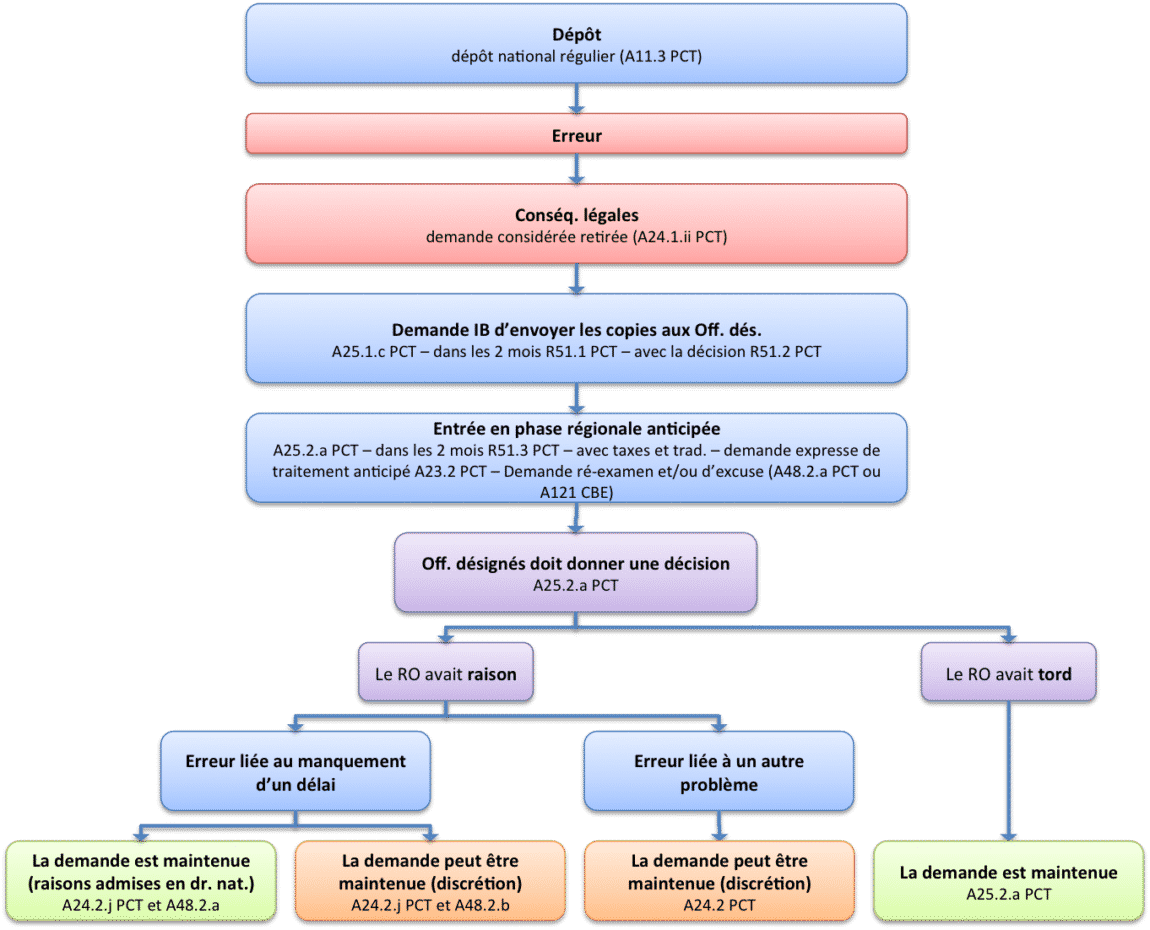 Organigramme de révision des décisions et de l’excuse des retards en phase nationale
Correction of errors by the RO or IB
Principle
If the RO or IB has made an error, the office must correct that error (if it would have corrected it under its national legislation, and assuming it had made the error itself R82ter.1.a PCT).
Correctable Errors
Correctable errors are those concerning (R82ter.1.a PCT):
- the fixing of the filing date;
- the priority if it was erroneously disregarded by the RO or the IB.
Rectification Procedure
The applicant must request correction of the error from the designated office. This request must be submitted upon entry into the national phase (applicant’s guide, national chapter §6.029).
Special Case of Incorporation by Reference
Where the filing date has been accorded by the RO following incorporation by reference of an element (under R20.3.b.ii PCT) or a part (under R20.5.d PCT), an office may process the application as if the filing date had been accorded without taking into account the incorporation by reference if it does not agree with the RO (i.e., shifting the filing date to the date of submission of the reference documents R82ter.1.b PCT).
For example, this may be related to:
- the non-submission of the priority document to the RO or the IB (R82ter.1.b.i PCT);
- a formal requirement concerning the incorporation not having been complied with (R82ter.1.b.ii PCT);
- the missing part or element not being fully contained in the priority document (R82ter.1.b.iii PCT).
In any event, the office must allow the applicant time to submit, within a reasonable period:
- observations (R82ter.1.c PCT) or
- a request not to take into account the incorporated parts in the national procedure (R82ter.1.c PCT together with R82ter.1.d PCT).
Laisser un commentaire