
Competencies
The Enlarged Board of Appeal is competent on (A22 EPC):
- legal questions referred by the Boards of Appeal (A112 EPC).
- these questions may be asked at the discretion of the Board of Appeal: the parties cannot compel the Board of Appeal to ask a question;
- these questions must be asked if the Board of Appeal deems it necessary to deviate from an interpretation or explanation given in an opinion or decision of the Enlarged Board of Appeal (A21 RPBA);
- if a question is asked, the parties are those of the appeal;
- legal questions referred by the President of the EPO if there are divergent decisions issued by Boards of Appeal (A112 EPC);
- if the decisions are not truly divergent, the question is inadmissible (G3/95).
- petitions for review (A112bis EPC).
Opinions and Decisions
Composition
Principle
The Enlarged Board of Appeal is composed of (A22 EPC) 5 lawyers and 2 technicians.
Recusal of a Member of the Enlarged Board of Appeal
If a member of the Enlarged Board of Appeal is suspected of bias, a party may request the recusal of that member (A24(3) EPC).
As a general rule, the fact that a member of the Opposition Division is a former employee of the applicant is not a sufficient reason to declare that member biased (T143/91). This applies a priori to members of the Enlarged Board of Appeal.
If a member of a board has a close family relationship with a party, it is appropriate for that member to recuse themselves (G1/05). This applies a priori to members of the Enlarged Board of Appeal.
As a general rule, the presidents or vice-presidents of the EPO in charge of a Directorate-General (and therefore subordinate to the President of the EPO) cannot be members of the Enlarged Board of Appeal because a conflict of interest could arise from this function (R19/12).
Decision
If a question is referred by a board of appeal (A112(1) a) EPC), the Enlarged Board of Appeal issues a decision and thus binds the board of appeal (A112(3) EPC).
The referral to the Enlarged Board of Appeal (which is a decision of the board of appeal) contains (A23(2) RPBA) :
- the indication that it was made by the board of appeal;
- the date on which it was made;
- the names of the chairman and the other members of the board of appeal who participated;
- the designation of the parties and their representatives;
- a summary of the facts;
- the question referred by the board to the Enlarged Board of Appeal;
- the question must not be asked in relation to points already settled (T79/89);
- an alleged contradiction with the guidelines or a previous decision of a board of appeal does not allow referral to the Enlarged Board (T603/89);
- the question must be referred if the board intends to deviate from an opinion or interpretation of the Enlarged Board (A21 RPBA)
- the context in which the question arose.
Of course, for a question to be referred to the Enlarged Board, it is necessary that the appeal be admissible (unless the question relates precisely to this admissibility, G3/99).
The appeal procedure is then suspended and resumed after the decision of the Enlarged Board of Appeal.
Opinion
If a question is referred by the President of the EPO, the Enlarged Board issues an opinion.
The President can only refer to the Enlarged Board if two decisions from two different boards of appeal are divergent on a question (A112(1) b) EPC). Regarding the Legal Board of Appeal, it is sufficient that its composition is different (G4/98, as there is only one Legal Board of Appeal).
If one of the members of the Enlarged Board has an opinion divergent from the main opinion.
Observations from third parties are also possible.
The Enlarged Board of Appeal is not bound by its previous decisions or opinions.
Suspension of first instance proceedings
First instance proceedings may be suspended during the referral to the Enlarged Board if (« Communication from the European Patent Office, dated September 1, 2006, concerning the suspension of proceedings« , OJ 2006, 538 and EPO Guidelines E-VI 3) :
- a party explicitly requests it;
- the first instance is of the opinion that the outcome of this instance entirely depends on the decision or opinion of the Enlarged Board.
The petition for review
Appealable decisions
Appealable decisions are those of the Boards of Appeal, if (A112bis(2) EPC) :
- a member of the Board of Appeal participated in the decision in violation of A24(1) EPC (i.e. condition for challenge):
- has a personal interest,
- has acted as a representative for one of the parties
- has taken part in the decision that is the subject of the appeal.
- a member of the Board of Appeal participated in the decision despite being challenged (in accordance with A24(4) EPC);
- a person not qualified as a member of the Boards of Appeal participated in the decision;
- the appeal procedure was tainted by a fundamental violation of A113 EPC;
- right to be heard not respected (A113(1) EPC).
- The Enlarged Board specified in decision R6/22 that for a petition for review to be admissible, an objection under Rule 106 EPC must be explicitly formulated and recognized as such by the Board. A mere reference to the right to be heard (A113(1) EPC) is not sufficient. The party must insist on obtaining a clear response from the Board, otherwise the petition for review will be inadmissible (points 2.3 and 2.4 of the reasons);
- decision not based on a text accepted by the applicant/proprietor (A113(1) EPC);
- right to be heard not respected (A113(1) EPC).
- the appeal procedure was tainted by another fundamental procedural defect as defined in the Implementing Regulations (R104 EPC):
- the Board of Appeal did not grant an oral procedure when it was requested by the appellant (R116(1) EPC),
- the Board of Appeal rendered its decision but without ruling on a request relevant to that decision.
- a criminal offense established under the conditions provided for in the Implementing Regulations (established and not condemned in a decision that has become final, R105 EPC) may have had an impact on the decision (e.g. corruption).
These grounds must have been raised at the appeal stage by the appellant (R106 EPC) in an unambiguous manner and indicating which defect is targeted (R4/08) and have been rejected by the Board of Appeal.
This principle has two exceptions:
- if the ground concerns a criminal offense,
- if the objection could not be raised during the appeal procedure.
If this was not the case, the petition is inadmissible (A112bis(5) EPC together with R108(1) EPC).
They must have been rendered after December 13, 2007.
Petitioner
The petitioner must be a person to whom the appeal decision did not grant relief (A112bis(1) EPC).
Otherwise, the Enlarged Board rejects the petition for review as inadmissible (A112bis(5) EPC together with R108(1) EPC).
Petition
Content
The request must include:
- the name of the applicant and their address (according to the provisions of R41(2) c) EPC) (R107(1) a) EPC);
- the number of the decision to be reviewed (R107(1) b) EPC);
- the grounds for review (see above) (R107(2) EPC);
- the facts and evidence (R107(2) EPC).
Issues with the identification of the opponent
A major error in the identification of the applicant (e.g., it is impossible to identify the applicant at all), there is an irregularity (under R108(1) EPC) and the request for review must be rejected as inadmissible (unless the applicant has remedied it within the review period, analogy of Guidelines D-IV 1.2.2.1 vi): a correction of the error can nevertheless be requested beyond the review period under R139 EPC (analogy of T219/86).
A minor error in the identification of the applicant (e.g., formal conditions not met), there is an irregularity (under R108(2) EPC) and it can be corrected after an invitation from the registry of the Enlarged Board of Appeal (« Decision of the Enlarged Board of Appeal of 12 November 2007 concerning the tasks entrusted to the Registry of the Enlarged Board of Appeal« , OJ 1/2009, supplement, III.2, A2(2)), even after the review period, analogy of the Guidelines D-IV 1.2.2.2 i)).
A121 EPC applies to this time limit when it concerns a review relating to a granting procedure.
A122 EPC applies to this time limit only for the proprietor.
Issues with the decision to be reviewed
If no decision is indicated, the request for review must be rejected as inadmissible (R108(1) EPC and R107(1) b) EPC).
Issues with the grounds, facts, and evidence
If the grounds, facts, and evidence are not presented, the request for review must be rejected as inadmissible (R108(1) EPC and R107(1) b) EPC).
Place of filing
The request for review must be filed directly with the EPO (R109(1) EPC together with A108 EPC): Berlin, The Hague, or Munich (Guidelines D-III 1).
If the opposition is filed elsewhere (e.g., national office, Vienna agency, etc.), transmission is possible (but there is no obligation Guidelines D-IV 1.2.2.1 i), but the important date remains the final receipt date by the EPO (analogy of T522/94).
Signature
The request for review must be signed by the applicant or the representative (R107(3) EPC and R50(3) EPC).
Initials or a paraphe are not sufficient (analogy of Guidelines D-III 3.4).
If the request is not signed, the formalities officer will invite the applicant to remedy this irregularity within a specified period (R50(3) EPC).
If the irregularity is not corrected within the specified period, the request is deemed not to have been filed (analogy of Guidelines D-IV 1.2.1 ii)).
A121 EPC applies when it comes to a review relating to a grant procedure.
A122 EPC applies only to the proprietor.
Obligation
In principle, this request must be typed or printed (R107(3) EPC and R50(2) EPC).
The request may be filed electronically (« Decision of the President of the European Patent Office dated 9 May 2018 concerning the electronic filing of documents« , OJ 2018, A45) or by fax, but confirmation may be requested upon invitation by the EPO (« Decision of the President of the European Patent Office dated 20 February 2019 concerning the filing of patent applications and other documents by fax« , OJ 2019, A18).
If this confirmation is not received within the time limits, the request is deemed not to have been filed.
A margin of 2.5 cm must be reserved on the left side of the sheet (R107(3) EPC and R50(2) EPC).
Otherwise, the application is rejected as inadmissible (R108(1) EPC).
Preference
Preferably, the request for review must comply with the conditions of R49(3) EPC (R107(3) EPC) :
- the sheets should preferably be in A4 format and used in portrait format (except possibly for drawings, tables or mathematical formulas);
- the sheets should preferably be numbered with an Arabic numeral centered at the top of the sheet (but not in the margin);
- for typed texts, the line spacing should preferably be 1.5;
- all texts should preferably be in a font where the capital letters are at least 2.1 mm high (the size depends on the chosen font, so be careful) and in black;
- the margins should preferably not be less than the following scheme:

Language
Petition
The petition for review must be filed in an official language of the EPO (i.e. German, French, English, R3(1) EPC).
However, it is possible to file the opposition petition in the official language of a Member State if the petitioner has his domicile (or registered office) in that State, or if he is a national of that State with his domicile abroad, and that State has an official language other than German, English or French (A14(4) EPC).
A translation must be submitted (A14(4) EPC) at the earliest simultaneously with the untranslated document (G6/91) in one of the official languages of the Office, regardless of the language of the proceedings (Guidelines A-VII 2) and within the latest expiring deadline among:
- a period of 1 month from the date of submission of the document (R6(2) EPC, and not from the end of the deadline).
- the deadline for the review petition (R6(2) EPC).
A121 EPC applies when it concerns a review relating to a grant procedure.
A122 EPC applies only to the proprietor.
If the required translation is not produced within the deadlines, the review petition is deemed not to have been filed (A14(4) EPC, last sentence).
Evidence, prior art, etc.
Other documents serving as evidence may be produced in any language (even if a translation may also be requested within a period that cannot be less than 1 month, R3(3) EPC).
Deadline
This petition must be filed within 2 months from the written notification of the decision (A112bis(4) EPC, except in the case of a criminal offense where the deadline is then 2 months from the establishment of this offense, but not exceeding 5 years).
A priori (by analogy with T389/86), the petition should be validly filed if it is filed before the notification of the decision.
If the petition is filed out of time, it should be deemed not to have been filed.
A121 EPC is not applicable.
A122 EPC applies to the applicant or the proprietor (but probably not for the 5-year deadline), but not to the opponent, the inventor, etc.
This restitutio in integrum must be filed within a period of 2 months from the expiration of this deadline (R136(1) EPC).
Review fee
Principle
The petition for review is deemed to have been filed only after payment of the review fee (A112bis(4) EPC, i.e. to be paid within the prescribed time limit).
This fee is 2760 € (A2(1).11bis RFR).
It may be paid after the petition (R108 EPC, last sentence).
In general, the party filing the petition for review will not be notified of a failure to pay the fee, unless the omission is obvious from the circumstances (G2/97).
If this fee is not paid within the time limit, the petition for review is deemed not to have been filed (A112bis(4) EPC).
Reduction
Reduction before April 1, 2014
If the petition for review was filed in the official language of a member state and if the opponent has his domicile (or head office) in that state, or if he is a national of that state residing abroad, and if that state has an official language other than German, English or French, the fee may be reduced by 20% (A14 RFR).
The reduction will only be granted if the translation is provided at the earliest at the same time as the petition for review (G6/91).
Reduction from April 1, 2014
For applications filed (entering the national phase) from April 1, 2014, no reduction is possible (« Decision of the Administrative Council of 13 December 2013 amending Rule 6 of the Implementing Regulations to the European Patent Convention and Article 14(1) of the Rules relating to Fees« , OJ 2014, A4).
Examination of the petition
Effect of the petition
The petition for review has no suspensive effect (A112bis(3) EPC).
Competences and compositions
The Enlarged Board of Appeal rules on petitions for review (A22(1) c) EPC):
- 2 legally qualified members and 1 technically qualified member (R109(2) a) EPC),
- when examining the petitions for review (admissibility) and when rejecting those that are clearly inadmissible or unfounded;
- 4 legally qualified members and 1 technically qualified member (R109(2) b) EPC),
- when analyzing the substance of the petition.
- this formation is actually the same as for admissibility, but supplemented by 2 legally qualified members (A2(3) RPBA).
The presidency is held by a legally qualified member.
Examination of the admissibility of the petition
Principle
The Enlarged Board examines whether the petition contains any irregularities (see below).
If irregularities exist and can no longer be corrected, the petition for review is rejected as being inadmissible (R108(1) EPC and R108(2) EPC).
This rejection must be decided unanimously by the 3 members (R109(2) a) EPC).
If such a rejection is not voted unanimously, the petition is referred to the Enlarged Board without an opinion on the merits in the formation of 5 members (A17 RPBA).
Irregularities to be corrected within the time limit for filing the petition
Initially, the EPO verifies (R108(1) EPC) the compliance of the petition with the provisions relating to:
- the status of the petitioner (A112bis(1) EPC),
- the validity of the grounds invoked (A112bis(2) EPC),
- the sufficient presentation of the grounds, facts and evidence in the petition (R107(2) EPC),
- the date of filing of the petition (A112bis(4) EPC),
- the presentation of the objection relating to the substantial defect at the appeal stage (R106 EPC), or if the criminal offense is established (R105 EPC)
- the designation of the contested decision (R107(1) b) EPC).
These irregularities may/must be corrected within the time limit for filing the petition for review (i.e., 2 months from the notification of the decision, R108(1) EPC).
At this stage of the procedure, any other parties do not participate (R109(3) EPC).
If at the end of the time limit for filing the petition for review, there are still irregularities, the petition for review is rejected as being inadmissible (R108(1) EPC).
Irregularity to be corrected within a specified time limit
If the provisions relating to the name and address of the petitioner (R107(1) a) EPC) are not complied with, the EPO sets a new time limit for the petitioner to correct this irregularity and if it is not corrected within the time limit, the petition for review is rejected as being inadmissible (R108(2) EPC).
Admissible petition
If the petition does not contain any of the irregularities mentioned above, the petition is then examined as to its substance.
Examination of the substance of the petition
Procedure
The procedure is the same as for the boards of appeal (R109(1) EPC).
However, the procedure before the enlarged board is a simplified procedure and some time limits may be shortened (R109(1) EPC together with R132(2) EPC).
The petitioner may be summoned to an oral procedure if requested or ex officio. The summons period may be shorter than the 2 months minimum (R109(1) EPC together with R115(1) EPC).
Decision
If the petition is well-founded, the Enlarged Board of Appeal (A112bis(5) EPC and R108(3) EPC) :
- shall set aside the decision of the Board of Appeal;
- shall order that the proceedings before the Board of Appeal be reopened;
- shall order the reimbursement of the petition fee (R110 EPC) if the proceedings are reopened before the Boards of Appeal.
A replacement of the members of the Board of Appeal who participated in the decision set aside may be ordered. It may also request, exceptionally, that the case be dealt with by another Board of Appeal.
The rejection of the petition is not subject to appeal (A106 EPC).
Annuity
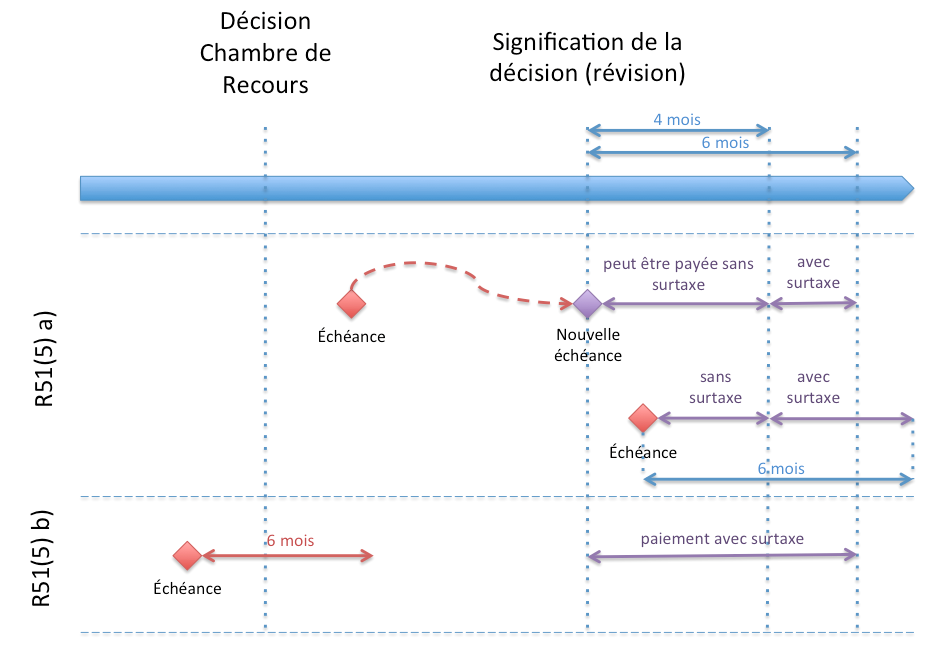
It may happen that a deadline has not been paid between the decision of the Board of Appeal and the corresponding review decision.
In this case, it is necessary to pay these annuities according to the principle detailed (R51(5) a) EPC and R51(5) b) EPC) in the following figure:
Protection of third parties
If, between the appeal decision and the review decision, a third party has in good faith commenced serious preparations for the purpose of exploiting the subject matter of the patent (A112bis(6) EPC), they shall be granted a free license:
- for their business;
- or for the needs of the latter.
Laisser un commentaire