


Opposition is an extremely useful procedure for third parties.
Indeed, after the grant of a patent, a third party may file an opposition against this grant and request the EPO to revoke the patent.
In practice, following an opposition:
- 1/3 of patents are maintained;
- 1/3 of patents are maintained in an amended (i.e., limited) form;
- 1/3 of patents are revoked.
The Opposition Division
Principle
The Opposition Division consists of three technically qualified examiners (A19(2) EPC), two of whom were not part of the Examining Division.
If the Opposition Division includes two members of the Examining Division, its decision may be annulled for a procedural violation (T285/11).
They may be assisted by a legally qualified member who did not participate in the grant (A19(2) EPC). If the Opposition Division is expanded to four members, it may exercise its discretion to reduce the division to three members (if the circumstances justifying the expansion have ceased, T1254/11).
The examiner who conducted the examination of the application during the examination procedure cannot be the chair (A19(2) EPC).
The chair has a casting vote in the event of a tie (A19(2) EPC).
Challenge of a member of the Opposition Division
Although the provisions of A24(3) EPC concerning the challenge of members should apply only to members of the Boards of Appeal and the Enlarged Board of Appeal, decision G5/91 stated that the obligation of impartiality also applies to staff of the first-instance departments of the EPO.
However, the fact that a member of the Opposition Division is a former employee of the applicant is not sufficient grounds to declare that member partial (T143/91).
If a member of a board has a close family relationship with a party, that member should withdraw (G1/05).
Territorial scope and effects
Opposition is the last opportunity for a third party to obtain the revocation (or limitation) of the patent:
- in a centralized manner, for all countries (A99(2) EPC), and
- with retroactive effect (A68 EPC).
Territorial Scope
The opposition applies to all designated states (A99(2) EPC, including extension states).
It is not possible to file an opposition for only certain countries: in such a case, the opposition will be deemed to apply to all designated states (Guidelines D-I 3).
However, this does not mean that the opposition must treat all designated states in the same way. Indeed, there may be several sets of granted claims due to:
- a partial assignment (R18(2) EPC);
- earlier national rights (R138 EPC);
- prior art relevant only to certain states due to their designations (A54(4) EPC73).
Thus, amendments made to the claims may differ depending on the set considered: the patent may even be revoked for some states while being maintained for others (Guidelines D-I 3).
Nevertheless, it is not possible to rely on an earlier national right during an opposition.
Lapse or Surrender of the Patent in All Designated States
An opposition is possible even if the patent has been surrendered in all designated states or if the patent has lapsed in all those states (R75 EPC, Guidelines D-I 2).
Indeed, the opponent may wish to benefit from the retroactive effect of revocation for protection.
Retroactivity
Certain rights may have arisen from the mere patent application (provisional protection) and its grant: it may therefore be useful to seek their retroactive annulment (A68 EPC, the effects of the patent are deemed never to have existed).
Standing of the Parties and Time Limit
Proprietor
Naturally, the proprietor is a party to the opposition proceedings as of right (A99(3) EPC).
If there are several different proprietors depending on the designated states, they are considered co-proprietors in the opposition proceedings (A118 EPC).
Opponent
Any Third Party
The opponent may be any third party (A99(1) EPC), without requiring a legitimate interest (G3/97 and Guidelines D-I 4).
It is even possible for several persons to file a joint opposition (R151(1) EPC) provided they are properly identified before the end of the opposition period (T25/85 and G3/99). In such a case, a common representative must be appointed. If not appointed, the EPO will appoint one (R151(1) EPC):
- the representative of the first-mentioned opponent in the request;
- failing that, the representative of another opponent who must appoint one for the further proceedings;
- failing that, the first-mentioned opponent in the request.
Even if another company’s logo is used in the notice of opposition, this does not necessarily create a contradiction that would give rise to uncertainty as to the true opponent (T1121/21).
Limitation of the term « any person »
The only limitation to this principle is that the proprietor themselves cannot file an opposition against their own patent (G9/93) even though this was permitted for a time (G1/84).
No limitation of the term « any person »
It is entirely possible to file an opposition against a patent for practice purposes (T798/93).
A no-challenge clause in a license agreement does not, as a general rule, render an opposition inadmissible (G3/97).
An inventor or a shareholder of the proprietor company may well file a valid opposition (T864/04).
Straw man
Finally, it should be noted that the use of a straw man is possible in order to conceal the true identity of the person wishing to file an opposition. However, this use is limited (G3/97 and G4/97):
- an opponent must not conceal the proprietor of the patent;
- an opponent, who is not a representative, and who carries out actions that, overall, are characteristic of those of an authorized representative (as this would be an abusive circumvention of the obligation to be represented by a representative).
There is no issue:
- if a representative acts in their own name but on behalf of their client;
- if the opponent has their domicile or registered office in a contracting state and acts on behalf of a third party who does not meet this condition;
- if the « straw man » opponent clearly confirms that they are acting on behalf of a third party (identified or not) (T2365/11).
Proof of circumvention of the procedure must be provided by the party invoking it: this proof must be clear and unambiguous (G3/97).
Identification
The opponent must be clearly identified before the end of the opposition period.
However, an error in identification may be corrected under EPC Rule 139 (T579/16). To do so, three conditions must be met (analogy with G1/12):
- The correction must reflect the true intention.
- The burden of proof lies with the opponent,
- The standard of proof is high (e.g., instruction emails);
- The error may be an incorrect indication: this is the case with an error in the identification of the opponent;
- The request for correction must be filed without delay.
Representation
If an opponent has neither a residence nor a principal place of business in the territory of a contracting state, they must be represented (A133(2) EPC).
If the conditions requiring a representative are met but no representative has been appointed, there is an irregularity (R77(2) EPC). The EPO notifies the opponent and invites them to remedy the situation within a specified period.
Note that if an opposition is filed by a representative or an employee of the opponent, it may be necessary for them to file a signed power of attorney (R152(1) EPC and « Decision of the President of the European Patent Office, dated 12 July 2007, concerning the filing of powers« , OJ 2007, Special Edition No. 3, L.1):
- for an authorized representative:
- in case of replacement of a former representative whose termination of mandate has not been notified to the EPO, unless:
- reference is made to a general power of attorney already recorded with the EPO;
- the EPO is notified of the termination of the former representative’s mandate before the end of the specified period.
- if circumstances so require (e.g., in case of doubt by the EPO).
- in case of replacement of a former representative whose termination of mandate has not been notified to the EPO, unless:
- for a professional representative (attorney):
- in all cases unless reference is made to a general power of attorney already recorded with the EPO;
- for an employee of the opponent:
- in all cases unless reference is made to a general power of attorney already recorded with the EPO.
If the power of attorney is not filed, the representative or employee is requested to remedy this irregularity within a specified period.
If the power of attorney is still not filed within this period, the opposition is deemed not to have been filed (Guidelines D-IV 1.2.1 iv).
If, during the opposition proceedings, the opponent « loses » their representative (e.g., disbarment, death, etc.), they are invited to appoint a new one. If they do not comply with this invitation, they will still receive the date of the oral proceedings, but their attention will be drawn to the fact that, if they appear alone, they will not be allowed to intervene (Guidelines A-VIII 1.1).
Transfer of the status of opponent
The transfer is possible only in the following cases (Guidelines D-I 4):
- hereditary succession (R84(2) EPC);
- universal succession (e.g. merger of a legal entity);
- even if the merger is not recorded in the Register of European Patents pursuant to R22(3) EPC, the universal successor nevertheless immediately becomes the opponent (T15/01).
- partial succession (i.e. assignment of a business division)
- if the opposition was filed in the interest of the assigned asset (G4/88).
- this is not possible if the asset is a subsidiary (G2/04), as it has its own legal personality.
- it is necessary to provide evidence that the status of opponent has been transferred with the assigned asset (T298/97): the mere interest in seeing the patent revoked is not sufficient.
The subrogation of the parent company to affiliated companies is also possible (Guidelines D-I 4).
These provisions also apply at the stage:
- of the appeal (G4/88);
- of the period for filing an appeal (T563/89 together with G4/88). It is entirely possible to file an appeal in the name of one person (the person presumed correct according to the appellant’s interpretation) and, in the alternative, another person (i.e. another possible interpretation, G2/04).
The relevant date for assessing the transfer of the status of opponent is the date on which the documents proving the succession/assignment are submitted to the EPO (T1563/13): thus, if an opponent assigns its business, then files an appeal, and finally submits the documents proving the assignment, the opposition appeal is valid and the transfer may take effect.
Verification of the status of opponent
The EPO must, at every stage of the proceedings, verify the status of the opponent: it may well happen that the opponent who has filed an appeal finds its status as opponent challenged by the board of appeal (T1178/04).
Parties to the proceedings and termination
The opponent is a party to the opposition proceedings (A99(3) EPC), but only until its possible withdrawal or the rejection (having become final) of its opposition (Guidelines D-I 6).
Intervener
Intervention conditions
Principle
A third party may « intervene » in an ongoing opposition where (A105(1) EPC):
- such third party has been sued for infringement (A105(1) a) EPC); or
- such third party has been requested to cease infringing acts and has filed an action for a declaration of non-infringement (A105(1) b) EPC).
- However, the cease-and-desist request must not merely be a letter warning of possible infringement and reserving the right to take legal action in the future (T392/97).
It should be noted that an infringement seizure (T305/08) or a Beweissicherungsverfahren (German equivalent of an infringement seizure, T1746/15) does not provide a basis for intervention.
Based on this patent / Extension states
The infringement action or cease-and-desist request must be based on « this patent » (A105(1) a) EPC and A105(1) b) EPC).
Thus, an infringement action in an extension state based on a patent obtained through extension will not allow valid intervention (T1196/08).
Intervention must be based on judicial action initiated in a designated state and not in an extension state (T7/07 and T1196/08).
Third party to the proceedings
Principle
The intervener must be a third party to the proceedings: thus, an opponent who has not filed an appeal but wishes to intervene (since there is greater freedom regarding arguments and requests that may be presented) cannot intervene as they are already a party to the proceedings pursuant to A107 EPC (T1038/00).
Case of corporate groups
If the parent company is an opponent, this does not prevent a subsidiary from intervening, provided the conditions of A105(1) EPC are met (T305/08 or T435/17).
Case of straw men
Similarly, if a person has a straw man act on their behalf to file an opposition and then files an opposition themselves, it may be questioned whether this person is truly a third party to the proceedings: in this case, there are indeed distinct legal entities, and thus the intervener is indeed a third party (T384/15).
The question of abuse of proceedings may arise, but each case must be examined individually.
Conditions relating to the ongoing opposition
Intervention may be filed as long as an opposition procedure is pending (A105(1) EPC) i.e.:
- there is a valid and pending opposition procedure (G4/91 and Guidelines D-VII 6);
- the final decision has not yet been issued (G4/91 i.e. handed over to the internal mail service of the decision, i.e. 3 days before the date indicated on the decision G12/91, unless a date of handing over to the internal mail service is clearly indicated on the decision, T2573/11).
- if no appeal is filed, it is not possible to file an intervention during the period between the final decision and the end of the appeal period (G4/91).
- if an appeal is filed, the intervener will be considered as « intervener at the appeal stage » (see below, Guidelines D-VII 6), since the appeal has suspensive effect.
If filed before the end of the opposition period, the intervention statement will be interpreted as an opposition (A105(1) EPC).
In the event of withdrawal of the opposition by the last opponent and intervention on the same day by a third party, it appears that the intervention is admissible since the withdrawal of an opposition does not automatically mean the end of the opposition procedure (R84(2) EPC).
Time limit
The intervener must file a notice of intervention within 3 months from the first (T296/93) legal action mentioned above (i.e. initiating action, R89(1) EPC).
In case T452/05, this first action was considered to be the service of the action (« injunctive order was served« ), but this may depend on the national law in question.
Neither A121 EPC nor A122 EPC applies to this time limit, since the third party is neither the applicant nor the proprietor.
Procedure
In practice, the intervener must file, within the time limit indicated above, a written and reasoned statement in the form of a notice of opposition (R89(2) EPC together with R76 EPC).
Evidence of the legal action must be provided (A105(1) EPC).
The opposition official fee must be paid within the same time limits for the intervention to be duly filed (R89(2) EPC and A2(1).10 RFees: [montant_epo default= »745 € » name= »A2(1).10 RFees »]).
The opposition division may decide not to communicate this notice of intervention to the proprietor/other opponents and/or not to invite the proprietor to present observations and amend the application (R79(4) EPC).
The formalities officer informs the intervener of the status of the procedure and requests them to indicate within 1 month whether any documents submitted by the other parties are required (and, if so, transmits them) (Guidelines D-IV 5.6).
Effects
Principle
The intervener is a party to the opposition proceedings (A105(1) EPC) until its possible withdrawal or the rejection (having become final) of its intervention (Guidelines D-I 6).
If the intervention is admissible, the intervener is treated as an opponent (A105(2) EPC) and will have the same rights (such as the right to file an appeal): therefore, if all other opponents withdraw their opposition, the intervener may continue the proceedings (G3/04).
No new measure
However, it appears impossible for the intervener to challenge new claims that had previously been spared by the « actual » opponents (G9/91, point 10).
New grounds / arguments / evidence
An intervener may introduce any new ground for opposition, argument, or evidence in its intervention even if the period for filing an opposition has already expired (otherwise, this would render the very principle of intervention and R89(2) EPC together with R76 EPC meaningless) (T2951/18).
Points already decided
Nevertheless, if certain aspects of the opposition have already been decided, the intervener may no longer revisit what has already been decided (T694/01). Thus, if the opposition division has decided to maintain the patent in amended form, the intervener may only discuss issues of bringing the description and drawings into conformity with the claims.
Withdrawal of an intervention
The intervener becomes an opponent as a result of its intervention (see above). Therefore, the effect of withdrawing an intervention is the same as that of withdrawing an opposition (T1665/16).
Thus, the documents cited by an intervener form part of the proceedings without the need to discuss their admissibility, whether at first instance or on appeal (T1665/16).
Intervention at the appeal stage
Principle
If the intervention occurs at the appeal stage, the intervener is treated as an appellant who has not filed an appeal (G3/04). Thus, if all those who have filed an appeal withdraw, the proceedings are terminated.
The intervener must pay the opposition official fee (A105(1) EPC and R89(2) EPC and A2(1).10 RFees: [montant_epo default= »745 € » name= »A2(1).10 RFees »]).
Withdrawal of the opposition on the same day
If the last appellant withdraws its appeal on the same day that the intervener files its declaration, the exact chronological order of these events must be examined to determine whether the intervention is admissible (T517/97):
- if the intervention is declared admissible, the appeal proceedings are terminated (G3/04) and the opposition official fee is not refunded;
- otherwise, the opposition official fee is refunded, as the intervention is not admissible.
No new measure
It does not appear possible to challenge new claims, i.e., claims that, until then, had not been subject to attack (G9/91).
New grounds / arguments / evidence
The intervener may present new arguments and new grounds under A100 EPC not previously submitted (G1/94). If new grounds are raised, the case is generally remitted to the opposition division (except in special cases, G1/94).
Points already decided
If certain aspects of the opposition have already been decided, the intervener may no longer challenge what has already been decided (T694/01). Thus, if the board of appeal has decided to maintain the patent in amended form, the intervener may only discuss issues relating to the adaptation of the description and drawings to the claims (even if the case is remitted to the opposition division, A111 EPC, res judicata).
Parties and suspension of proceedings
Suspension
The opponent or the intervener may not request a suspension of proceedings: it must be a third party to the proceedings (R78(1) EPC).
Furthermore, such suspension may only be ordered if the opposition division considers the opposition admissible (R78(1) EPC and Guidelines D-VII 4.1).
Partial substitution
In the event of resumption of proceedings and if the third party is substituted for the proprietor (A99(4) EPC) for only some of the designated states (the recognition protocol not applying, a substitution by a French court will have no effect in the other countries), the maintained European patent may contain several sets of description-drawings for different designated states (R78(2) EPC).
The unity of the patent is therefore affected.
The former proprietor and the new « partial » proprietor of the patent will not be considered co-proprietors (A99(4) EPC) unless they so request.
The two opposition proceedings may thus have different outcomes (Guidelines D-VII 3.2).
Withdrawal of opposition, surrender of patent and ex officio continuation
The opposition may be withdrawn (R84(2) EPC).
Withdrawal of all oppositions
If all oppositions are withdrawn, this does not mean that the opposition proceedings are terminated (see ex officio continuation below, R84 EPC).
The opponent who has withdrawn the opposition ceases to be a party to the proceedings and may no longer correct the withdrawal or file an appeal against the decision to be issued (T283/02).
The opposition division may only conclude the opposition proceedings by a decision (Guidelines D-VIII 1.1 together with A101(2) EPC, A101(3) EPC):
- revocation of the patent;
- maintenance of the patent in amended form;
- rejection of the opposition;
- formal decision noting the withdrawal of all oppositions (R84(2) EPC, last sentence).
Withdrawal by one of the opponents
Withdrawal by an opponent who filed an opposition alone
If an opponent withdraws their opposition while other admissible oppositions exist, the opposition proceedings continue normally.
The opponent who withdrew their opposition ceases to be a party to the proceedings and can no longer correct their withdrawal or file an appeal against the upcoming decision (T283/02).
Withdrawal by an opponent who filed a joint opposition
If an opponent who filed a joint opposition withdraws their opposition (and other opponents remain in that joint opposition), the opposition proceedings continue normally (G3/99).
Only the common representative of that joint opposition may notify such withdrawal: if the person wishing to withdraw their opposition (not being the common representative) sends a letter to the EPO, that letter will be deemed not to have been filed, as it was not signed by the common representative (R86 EPC together with R50(3) EPC and G3/99).
If the common representative withdraws their opposition, a new representative must be appointed or, failing that, the EPO will appoint one pursuant to R151 EPC (G3/99).
Disclaimer, revocation, lapse of the patent
Before the EPO
When the proprietor decides to request the abandonment/withdrawal of their patent before the EPO (either before the opposition division in a special request or by using the revocation procedure under A105bis EPC), the EPO always interprets this request as a request for revocation with retroactive effect (Guidelines D-VII 5.1).
If there is any ambiguity, the proprietor is asked to clarify their request (Guidelines D-VIII 1.2.5).
In the event of revocation before the EPO, the patent is annulled ex tunc (retroactively), and the opposition proceedings must be terminated (as they are then without cause).
Before the designated states
It is possible that during opposition proceedings (R84(1) EPC):
- the proprietor disclaims the patent before all designated states (and not before the EPO) or
- the patent lapses before all designated states (and not before the EPO).
The disclaimer or lapse before the designated states has no retroactive effect but only ex nunc (i.e., for the future).
The proprietor is often asked to prove this by providing extracts from the registers of the contracting states (Guidelines D-VII 5.1).
The opponent may request that the opposition proceedings continue (R84(1) EPC): it is then necessary to file a request within 2 months from the notification by the EPO informing the opponent of this fact. Otherwise, the proceedings will be closed (Guidelines D-VII 5.1).
This 2-month period does not benefit from restitutio in integrum under A122 EPC (T1403/16): indeed, failure to observe the time limit does not result in any loss of rights, since, pursuant to A114 EPC, the EPO may decide at its discretion whether to continue the proceedings or not. Therefore, the expiry of the 2-month period does not in itself have any legal consequence on the opposition.
If the proprietor has disclaimed, before the competent authorities of the contracting states, all rights attached to the patent (including prior rights, e.g., provisional protection, etc.), the opponent will not have the possibility to continue the opposition proceedings, and these will be closed ex officio (Guidelines D-VII 5.1).
Ex Officio Continuation of the Procedure
As soon as an opponent withdraws their opposition, dies, or becomes incapacitated, the opposition division must inform the other parties (proprietor, other opponents, interveners, etc.) that the procedure is continued ex officio (R84(2) EPC and Guidelines D-VII 5.2, the ex officio continuation of the procedure applying only when no opponents remain).
Otherwise, the procedure is closed (Guidelines D-VII 5.2) and this decision to close is subject to appeal by the proprietor (T197/88).
The ex officio continuation of the opposition is pronounced, without any opponent, if (Guidelines D-VII 5.2):
- the proprietor has proposed amendments (T560/90);
- the procedure appears, without particular effort or costly investigations, to lead to a limitation or revocation of the patent (T197/88).
Entries in the Register of European Patents
In the Absence of Opposition
If no notice of opposition is filed within the 9-month period, the proprietor is informed, and this is recorded in the European Patent Bulletin (EPB) (Guidelines C-V 13).
An entry is also made in the Register of European Patents.
In the Event of Opposition
If an opposition is filed, the corresponding date is entered in the Register of European Patents (R143(1)(q) EPC).
Furthermore, the date of the conclusion of the proceedings and the outcome of the proceedings are also entered in the Register of European Patents (R143(1)(r) EPC).
Formal Aspects
Opposition Period
The period for filing a valid opposition is 9 months (A99(1) EPC) from the publication of the mention of grant in the European Patent Bulletin (A97(3) EPC).
A122 EPC or A121 EPC is not applicable to the opposition period.
If the opposition is filed:
- after this period, it is deemed inadmissible (R77(1) EPC);
- before the publication of the mention, it is not considered an opposition but as a third-party observation under A115 EPC (Guidelines D-IV 1.1):
- the opposition official fee paid is refunded;
- the notice of opposition is placed in the file and made open to public inspection.
Opposition Official Fee
Principle
The opposition official fee must be paid within the opposition period; otherwise, the opposition is deemed not filed (A99(1) EPC).
This official fee is [montant_epo default= »745 € » name= »A2(1).10 RRT »] (A2(1).10 RRT).
If a joint opposition is filed by several opponents, only one official fee is required (G3/99).
Incomplete payment
If only a small portion of the amount is missing (approx. 10 %, J11/85), the formalities officer may nevertheless consider that the payment has been made correctly (A8 RFEES and Guidelines D-IV 1.2.1 i).p>
Of course, the applicant must pay the missing amount within a set period (T290/90), often 2 months.
Refund of the official fee
In the event of an opposition deemed not to have been filed, the official fee is refunded (T323/87 and Guidelines D-IV 1.4.1).
Reduction of the official fee
Reduction before 1 April 2014
If the opponent has their residence (or registered office) in one of the contracting states (or is a national of one of those states residing abroad) and that state has an official language other than German, English or French, they may file the notice of opposition (under R76(2) c) EPC) in that language (A14(4) EPC).
In this case, the opposition official fee is reduced by 20 % (R6(3) EPC together with A14(1) RFEES).
Reduction as from 1 April 2014
For oppositions filed as from 1 April 2014, no reduction is possible (« Decision of the Administrative Council of 13 December 2013 amending Rule 6 of the Implementing Regulations to the European Patent Convention and Article 14(1) of the Rules relating to Fees« , OJ 2014, A4).
Form of the opposition
Obligation
The opposition must be filed in writing and must be reasoned (R76(1) EPC). In principle, this document must be typewritten or printed (R76(3) EPC and R50(2) EPC).
If the opposition is not filed in writing, the opposition is inadmissible (R77(2) EPC).
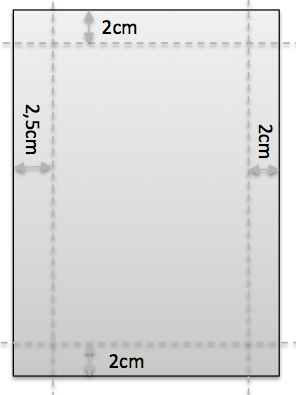
A margin of 2.5 cm must be left on the left side of the sheet (R76(3) EPC and R50(2) EPC).
Preference
A Form 2300 is available on the EPO website.
Preferably, the opposition should comply with the conditions of R49(3) EPC (Guidelines D-III 3.1):
- sheets should preferably be in A4 format and used in portrait orientation (except possibly for drawings, tables or mathematical formulae);
- sheets should preferably be numbered with an Arabic numeral centered at the top of the sheet (but not within the margin);
- for typewritten texts, the line spacing should preferably be 1.5;
- all texts should preferably be in a font where the capital letters are at least 2.1 mm high (the size depends on the font chosen, so care should be taken) and in black;
- margins should preferably not be less than the following diagram:
Filing by electronic means
An opposition may be filed by electronic means (« Decision of the President of the European Patent Office, dated 9 May 2018, concerning the electronic filing of documents« , OJ 2018, A45).
Filing by facsimile
An opposition may normally be filed by facsimile (Guidelines D-III 3.3 and “Decision of the President of the European Patent Office, dated 20 February 2019, concerning the filing of patent applications and other documents by telefax”, OJ 2019, A18).
A confirmation by post may then be requested. If the opponent does not respond to this invitation, the fax is deemed not to have been received and the opposition is deemed not to have been filed (Guidelines D-IV 1.2.1 iii).
If the notice of opposition is transmitted at the deadline, attention must be paid to the time of transmission of the last page: indeed, the EPO considers that the document will be transmitted when the last page is transmitted. If the last page is transmitted at 00:01 on the day after the last day of the time limit, the notice will be late (T858/18) and it will not be possible to consider that the pages received before midnight constitute a valid notice.
Signatures of the notice of opposition
The notice of opposition must be signed by the opponent or the representative (R76(3) EPC together with R50(3) EPC).
A signature stamp or initials are not sufficient (Guidelines D-III 3.4).
If the notice is not signed, the formalities officer will invite the opponent/representative to remedy this irregularity within a specified period (R50(3) EPC).
If the irregularity is not corrected within the specified period, the opposition is deemed not to have been filed (Guidelines D-IV 1.2.1 ii).
The A122 EPC or A121 EPC does not apply to the specified period.
Languages
Notice of opposition
The notice of opposition must be filed in an official language of the EPO (i.e., German, French, English, R3(1) EPC).
However, it is possible to file the opposition in the official language of a member state if the opponent has their residence (or registered office) in that state, or if they are a national of that state residing abroad, and that state has an official language other than German, English, or French (A14(4) EPC).
A translation must be submitted (A14(4) EPC) at the earliest simultaneously with the untranslated document (G6/91) in one of the official languages of the Office, regardless of the language of the proceedings (Guidelines A-VII 2) and within the later of the following time limits:
- A time limit of 1 month from the date of submission of the document (R6(2) EPC, and not from the end of the time limit).
- The opposition period (R6(2) EPC).
These time limits do not benefit from the provisions of A121 EPC or A122 EPC.
If the required translation is not submitted within the time limits, the opposition is deemed not to have been filed (A14(4) EPC, last sentence).
Evidence, prior art, etc.
Other documents serving as evidence may be submitted in any language (even though a translation may also be requested within a time limit that cannot be less than 1 month, R3(3) EPC).
Filing location
The opposition must be filed directly with the EPO (A99(1) EPC): Berlin, The Hague or Munich (Guidelines D-III 1).
If the opposition is filed elsewhere (e.g., national office, Vienna agency, etc.), transmission is possible (though there is no obligation Guidelines D-IV 1.2.2.1 i)), but the key date remains the date of final receipt by the EPO (T522/94).
Content of the notice of opposition
The notice of opposition sets the « scope » of the opposition.
General considerations
It must contain:
- R76(2) a) EPC:
- the name,
- the address,
- the nationality and the State of domicile or registered office of the opponent (R41(2) c) EPC);
- R76(2) b) EPC:
- the number of the European patent against which the opposition is filed,
- the name of the patent proprietor,
- the title of the invention.
- R76(2) c) EPC:
- the numbers of the claims being challenged, including dependent claims (the « extent »);
- the grounds on which the opposition is based (i.e., the grounds of A100 EPC).
- If grounds are omitted, their later introduction will be considered late.
- A late argument is subject to the « prima facie relevance » test, i.e., it is admissible if, at first sight, the patentability is called into question after 10 minutes of consideration (G 10/91 and Guidelines D-V 2.2).
- the facts and evidence relied upon in support of these grounds.
- R76(2) c) EPC:
- Details concerning the representative, if one has been appointed (R41(2) d) EPC).
Issues with the identification of the opponent
A major error in the identification of the opponent (e.g., it is impossible to identify the opponent at all): there is an irregularity (under R77(1) EPC) and the opposition must be rejected as inadmissible (unless the opponent has remedied it within the opposition period, Guidelines D-IV 1.2.2.1 vi)).
A correction of the error may nevertheless be requested beyond the opposition period under R139 EPC (T219/86 or T615/14): the opponent must provide evidence to establish that the original intention was to file the opposition in the name of the corrected opponent.
A minor error in the identification of the opponent (e.g., formal requirements not met): there is an irregularity (under R77(2) EPC) and this may be corrected after invitation by the EPO, even after the opposition period, within a set time limit (Guidelines D-IV 1.2.2.2 i)).
This set time limit does not benefit from A121 EPC or A122 EPC.
Issues with the identification of the patent
If it is truly impossible to identify the patent being challenged (e.g., only the name of the proprietor may be sufficient if they own only one patent), there is an irregularity (under R77(1) EPC) and the opposition must be rejected as inadmissible (unless the opponent has remedied it within the opposition period, Guidelines D-IV 1.2.2.1 ii)).
A minor error in the identification of the patent: there is an irregularity (under R77(2) EPC) and this may be corrected after invitation by the EPO, even after the opposition period (Guidelines D-IV 1.2.2.2 ii)).
Some decisions even go so far as to consider that there is no irregularity if the information provided allows the patent in question to be determined without difficulty (e.g., the patent number is given, but not its title T317/86, only the publication number is provided T335/00).
Issue with the identification of the representative
If the name and professional address of the representative are not indicated in the form required by R41(2)(d) EPC, there is an irregularity under R77(2) EPC.
Focus on the extent
If the opposition does not specify the extent to which the patent is challenged (all claims, only part of them, etc.), there is an irregularity (Guidelines D-IV 1.2.2.1 iii)).
If an independent claim is challenged, the claims dependent on it may be examined (G9/91 and Guidelines D-V 2.1) unless only some of them are explicitly challenged (T653/02).
Similarly, if a process claim is challenged, the product-by-process claim is implicitly challenged if it relates to the same process (T525/96 and Guidelines D-V 2.1).
This extent will bind the opponent in any potential appeal, as the decision will necessarily uphold their submissions for the claims not challenged (A107 EPC).
Focus on the grounds
There is an irregularity if the notice of opposition does not mention at least one ground referred to in A100 EPC (Guidelines D-IV 1.2.2.1 iv).
The mere « lack of patentability » is not sufficient unless it implicitly refers to one of the grounds (Guidelines D-IV 1.2.2.1 iv).
Once we have stated this, we have said nothing regarding the detailed substantiation of the grounds. Indeed, if the opponent raises a ground but does not elaborate on it (or does so insufficiently), this does not mean that the opposition has not been filed (T623/18).
Focus on prior art documents
When drafting an opposition, numerous documents may be cited, as these are the simplest and most indisputable means of evidence.
However, care must be taken, as a document that is merely cited without its relevance being established may be disregarded by the opposition division (T32/10).
Furthermore, it is necessary for the opponent to indicate the parts of the documents on which they rely (unless the documents are very brief, Guidelines D-IV 1.2.2.1 v) and T222/85).
Proof of the content of the document (e.g., translation) or even the documents themselves may be submitted after the opposition period upon request by the EPO, within a specified time limit (R83 EPC and T94/84), although it is advisable to submit them as early as possible (Guidelines D-III 6 iii)). If they are not submitted within the specified time limit, the arguments relying on these documents may be disregarded by the Opposition Division (R83 EPC).
A single copy of the documents is sufficient (Guidelines D-III 6 iii)).
Moreover, documents cited in the examination proceedings (i.e., by the examining division and the search division) will not be automatically included in the opposition proceedings (T198/88). Only the following documents may be included, even if they are not cited in the notice of opposition (Guidelines D-V 2.2):
- the document cited in the application as the closest prior art. The same applies to relevant documents cited in the patent specification, which, if they do not constitute the closest prior art, are nonetheless essential for understanding the problem (T536/88, in particular point 2.1),
- the closest prior art document (e.g., document D1 from the examination proceedings).
If the only documents cited are earlier national rights or documents that do not form part of the prior art, the opposition must be rejected as inadmissible (R77(1) EPC together with R76(2) c) EPC and T550/88).
Focus on prior use or oral description
When prior use/oral description is invoked by the opponent or an intervener, it is necessary to provide evidence enabling, in particular, the determination (Guidelines G-IV 7.2 and T328/87):
- the date of the prior use/oral description,
- the subject matter of the use/description (i.e., identical or similar),
- the circumstances of the use/description (i.e., accessibility to the public).
Such evidence need not necessarily be submitted within the opposition period (T328/87 and T28/93).
The evidence submitted will be examined in a highly critical and strict manner (Guidelines E-IV 4.3), and the certainty of the opposition division must go beyond any reasonable doubt (T97/94).
Focus on the common general knowledge of the person skilled in the art
Although there is no official definition, the common general knowledge of the person skilled in the art (Guidelines G-VII 3.1) may include, in particular:
- basic handbooks and monographs (T171/84),
- articles referenced or cited in basic handbooks and monographs (T206/83),
- articles published in specialized journals (T595/90),
- information contained in patent specifications or scientific publications, if the invention pertains to a field of research so new that no relevant technical information on the subject is yet available in handbooks (T51/87).
If the notice of opposition mentions the common general knowledge of the person skilled in the art, it is not necessary to provide proof of such knowledge within the opposition period (T151/05).
However, if the patent proprietor disputes this knowledge, the opponent must provide proof of their allegations, for example by citing a document addressing this particular subject.
Focus on the language of evidence
Evidence may be submitted in any language (R3(3) EPC), but the EPO may request a translation into one of the official languages within a specified period.
If the translation is not submitted within the time limit, the document may be disregarded by the opposition division (R3(3) EPC).
Formation and admissibility of the opposition
Jurisdiction
Normally, the opposition division has jurisdiction (A19(1) EPC).
However, the formalities officer is responsible for verifying formal requirements (« Decision of the President of the European Patent Office dated 12 December 2013 on entrusting to employees who are not examiners certain tasks incumbent on examining or opposition divisions« , OJ 2014, A6, point 1, issued pursuant to R11(3) EPC).
Of course, the latter does not verify the grounds invoked, the evidence, etc. (i.e., absence or insufficiency, R76(2) c) EPC), as their examination requires a technical expert.
In this context, the opposition division examines this point (Guidelines D-IV 1.2.2).
Partial admissibility
There is no partial admissibility.
The fact that the conditions set out above are met for at least one ground renders the opposition admissible as a whole (Guidelines D-IV 1.2.2.1 v)).
Irregularities resulting in an opposition deemed « not filed »
Cases of « not filed »
An opposition is deemed not filed if (Guidelines D-IV 1.2.1):
- The opposition fee is not paid within the opposition period or is only partially paid (A99(1) EPC, last sentence);
- However, if the unpaid portion is minimal, the opposition may be accepted (Guidelines A-X 7.1.1 and RFees 8);
- The person seeking to file the opposition is not notified of this irregularity.
- The signature at the bottom of the notice of opposition is missing (R50(3) EPC). A notification is then sent to the person seeking to file the opposition, granting a time limit to correct it (2 months as a general rule, Guidelines E-VIII 1.2).
- The opposition was filed by fax, confirmation was requested by the EPO, but this was never received within the time limit (« Decision of the President of the European Patent Office dated 20 February 2019 on the filing of patent applications and other documents by telefax« , OJ 2019, A18);
- The representative’s authorization was not submitted in time (R152 EPC, « Decision of the President of the European Patent Office dated 12 July 2007 on the filing of authorizations« , OJ 2007, Special Edition No. 3, L.1, see above regarding the submission of such authorization);
- The notice of opposition is drafted in a non-official language, and the conditions mentioned above (i.e., the opponent has their residence or principal place of business in one of the contracting states, or is a national of one of these states with their residence abroad, and that state has an official language other than English, French, or German) are not met (e.g., a Chinese national files a notice of opposition in Chinese);
- The notice of opposition is drafted in a non-official language (and if the opponent has their residence or principal place of business in one of the contracting states, or is a national of one of these states with their residence abroad, and that state has an official language other than English, French, or German), and the translation is not provided before the expiration of the later of the following two time limits:
- 1 month after the filing of the notice of opposition;
- 9 months after the publication of the mention of grant.
Notification
If the formalities officer identifies an irregularity (which is not guaranteed, Guidelines D-IV 1.3.3), and if it is still possible to remedy it, the officer notifies the opponent and informs them that it must be corrected within the time limits indicated above (in the absence of a specified time limit, it must be corrected within 9 months from the publication of the mention of grant in the EPO Bulletin) (Guidelines D-IV 1.3.1).
The formalities officer’s only obligation to notify concerns the signature (Guidelines D-IV 1.3.3).
Procedure if the opposition is deemed not to have been filed
The formalities officer notifies the opponent (R112(1) EPC) that the opposition is deemed not to have been filed. It is possible to request a decision.
At the end of the 2-month period to request such a decision, the parties are informed that the proceedings are terminated.
In such situations, if the opposition official fee had been paid, it will be refunded (Guidelines D-IV 1.4.1).
The documents submitted are then treated as third-party observations and are accessible in the file (Guidelines D-IV 1.4.1).
Irregularities leading to an « inadmissible » opposition
Inadmissibility as of the end of the opposition period
Grounds for inadmissibility
The opposition is declared inadmissible if (R77(1) EPC) [Group 1]:
- The notice of opposition is not filed in writing with the EPO within the 9-month period (A99(1) EPC);
- The designation of the patent is insufficient (i.e., it is impossible to unambiguously identify the patent);
- The extent to which the patent is opposed is missing, the grounds for opposition are missing, or the evidence is non-existent (R77(1) EPC together with R76(2)(c) EPC):
- for example, the opponent has not provided identification of the document supporting a novelty attack (even if it is highly relevant);
- care should be taken with evidence here: it is not required to be convincing for admissibility (T2037/18, e.g., a confidential document is submitted and no evidence regarding the absence of an NDA is provided). The probative value of the evidence pertains to the substantive examination.
- It is impossible to identify the opponent.
Notification
If the formalities officer identifies an irregularity (which is not guaranteed, Guidelines D-IV 1.3.3), and if it is still possible to remedy it, the officer notifies the opponent and informs them that it must be corrected within the opposition period (Guidelines D-IV 1.3.2).
Procedure if the opposition is rejected
The existence of an irregularity in [Groupe 1] at the end of the opposition period will render the opposition inadmissible (R77(1) EPC):
- if such irregularities have already been notified to the opponent:
- a rejection is pronounced by the formalities officer (or by the opposition division if it concerns facts and evidence) (Guidelines D-IV 1.4.2).
- if such irregularities have not been notified to the opponent:
- the formalities officer notifies the opponent and generally grants 2 months to respond (A113(1) EPC, this does not mean that the opponent may correct the irregularities) and indicates that the opposition will likely be rejected as inadmissible (Guidelines D-IV 1.4.2).
- the opponent may then contest the existence of such irregularity;
- a rejection is pronounced by the formalities officer (or by the opposition division if it concerns facts and evidence) (Guidelines D-IV 1.4.2).
The opposition official fee is not refunded.
The rejection of the opposition is notified to the proprietor (R77(3) EPC).
Inadmissibility that may be corrected within a new time limit
Grounds for inadmissibility
Furthermore, the opposition is also declared inadmissible if one of the formal requirements other than those of [Groupe 1] is missing (R77(2) EPC) [Groupe 2] (see in particular the formal requirements mentioned above for R76(2) EPC):
- incorrect identification of the opponent (e.g., issue with the form under R41(2) c) EPC, though the opponent may still be identifiable),
- failure to provide the number of the patent against which the opposition is filed (Guidelines D-IV 1.2.2.2 ii)),
- failure to provide the title of the invention (Guidelines D-IV 1.2.2.2 ii)),
- failure to identify the proprietor of the patent (Guidelines D-IV 1.2.2.2 ii)),
- failure to identify the representative (name and address, R41(2) d) EPC), if one has been appointed or must be appointed (A133(2) EPC),
- the notice of opposition does not satisfy the formal requirements of the EPC other than those under R77(1) EPC (e.g., margin issues, not typewritten, etc. R50(2) EPC).
Notification
If the formalities officer identifies an irregularity, they notify the opponent and inform them that it must be corrected within a set time limit or risk rejection (R77(2) EPC and Guidelines D-IV 1.3.2).
Of course, the opponent may, even without notification, submit corrections to the EPO on their own initiative (Guidelines D-IV 1.3.3), even after the opposition period.
A121 EPC or A122 EPC does not apply to these set time limits.
Procedure if the opposition is rejected
At the end of the prescribed period, and if the irregularity has not been remedied, the formalities officer rejects the opposition as inadmissible (R77(2) EPC and Guidelines D-IV 1.4.2).
The opposition official fee is not refunded.
The rejection of the opposition is notified to the proprietor (R77(3) EPC).
If the opposition is declared admissible
Before the opposition is declared admissible or inadmissible, the proprietor receives the notice of opposition (R79(1) EPC).
The proprietor may thus contest the potential admissibility of the opposition (Guidelines D-IV 5.5) by specifying the detailed reasons for the alleged inadmissibility.
In this case, a reasoned decision on admissibility may be issued with the final decision.
- In this case, the acceptance of an opposition at the beginning of the opposition proceedings is not a decision of the EPO (Guidelines D-IV 5.1).
- Thus, a future inadmissibility (i.e. during the opposition proceedings) is entirely possible (T222/85).
If all oppositions are contested, the opposition division may also choose to issue a reasoned decision on admissibility, which is appealable, before any opposition proceedings, provided that the proceedings are not unduly delayed (Guidelines D-IV 5.5).
Furthermore, inadmissibility may be decided at the appeal stage (T289/91), even if this inadmissibility is raised for the first time at this stage (T522/94).
If the opposition is declared inadmissible
If an opposition is declared inadmissible, several situations may arise:
- if there is another admissible opposition, and its examination leads directly to a decision to reject the opposition(s) or to a decision to revoke the patent, the examination of the inadmissibility decision will be issued together with the final decision (Guidelines D-IV 5.5);
- otherwise, the inadmissibility is directly issued in the form of a reasoned decision. An appeal is possible against this decision.
If the inadmissibility decision is issued:
- before the notification referred to in R79(1) EPC is sent to the proprietor, the appeal will be an ex-parte procedure: thus, the person wishing to file an opposition is the only party to the proceedings (T295/01, which is ex-parte).
- after the notification referred to in R79(1) EPC is sent to the proprietor, the appeal will then be an inter partes procedure (i.e. the proprietor and the person wishing to file an opposition will participate in the appeal proceedings, T1062/99, which is inter partes).
If no opposition is admissible, the opposition division must refrain from commenting on the merits (T925/91, indirectly from A101(1) EPC).
When all oppositions are finally rejected, the opposition proceedings are terminated. The parties are informed thereof (Guidelines D-IV 4).
Notification to the proprietor of the opposition
Opposition actions are notified to the proprietor (R79(1) EPC) even if the required translation has not been filed (Guidelines A-VII 5) and are therefore deemed not to have been filed.
Challenging the patent
The opposition division will then examine the grounds under A100 EPC and request the parties to respond to EPO communications or observations from other parties (A101(1) EPC).
The opposition may continue even if:
- The patent has lapsed in all countries: to do so, the opponent must file a request within 2 months from receipt of the notification of such lapse (R84(1) EPC).
- The opposition is withdrawn by the opponent or the opponent dies: the procedure may then be continued ex officio (R84(2) EPC). This situation may, for example, arise if the procedure results in the limitation or revocation of the patent at no cost.
Scope of attacked claims
Principle
The opposition division may only examine the claims attacked by the opponents: an ex officio examination of unattacked claims is not possible (G9/91, ne ultra petita).
It is therefore not possible to revoke a patent if only some of the claims are attacked (T809/21).
Dependent claims
Nevertheless, dependent claims may also be considered even if they were not explicitly mentioned in the notice of opposition, if there is doubt as to their validity (Guidelines D-V 2.1 and G9/91).
This latter principle appears to be challenged if only certain dependent claims are attacked: such conduct may be interpreted by the boards of appeal as a future waiver of attacking other dependent claims (T653/02).
Combination of unattacked claims
If the proprietor combines attacked and unattacked claims, the opposition division cannot rule on the validity of the amended claims and may only maintain the patent in this amended form (T364/18).
Product-by-process
Similarly, a « product-by-process » claim referring to the process of an attacked claim may also be attacked if there is doubt as to its validity (T525/96).
Grounds raised
Possible grounds
The possible grounds for an opposition are set out in A100 EPC:
- the subject-matter of the patent is not (A100 a) EPC):
- new (A52(1) EPC, A54 EPC and A55 EPC),
- inventive (A52(1) EPC, A56 EPC),
- does not have an industrial character (A52(1) EPC, A57 EPC),
- is not considered patentable (A52(1) EPC to A52(3) EPC),
- is excluded from patentability by a specific provision (e.g., therapeutic method, subject-matter contrary to ordre public or morality, etc.) (A53 EPC).
- the patent does not disclose the invention clearly and completely enough for it to be carried out by a person skilled in the art (A100 b) EPC).
- this ground actually covers the insufficiency of disclosure under A83 EPC.
- the content of the patent specification must be examined to make this assessment (Guidelines D-V 4), although the text as filed may be used to remedy this insufficiency of disclosure.
- the subject-matter of the European patent extends beyond the content of the application as filed (A100 c) EPC).
- this ground actually covers
- A123(2) EPC or,
- A76(1) EPC if the patent was granted on the basis of a divisional application, or
- A61(2) EPC together with A76(1) EPC if the patent was granted on the basis of a new application filed in respect of an invention previously filed by a person not entitled under A61(1) EPC.
- this ground actually covers
Distinct grounds
The grounds each constitute a distinct legal basis (Guidelines D-III 5).
In particular, A100 a) EPC is subdivided into several grounds (G1/95): for example, invoking only lack of novelty and inventive step does not validly allow reliance on the other grounds under this paragraph (e.g., exclusion from patentability).
Excluded grounds
In particular, the following cannot serve as a ground for opposition:
- clarity or conciseness (A84 EPC, although this article may be invoked for amended claims during opposition);
- lack of unity of invention (A82 EPC);
- the existence of earlier national rights (A139 EPC, although amendments related thereto are possible);
- entitlement to the patent (A61 EPC);
- the form of the description, claims, or drawings (respectively R42 EPC, R43 EPC and R46 EPC);
- incorrect designation of the inventor (R19 EPC);
- the validity of the priority alone (A87 EPC and A88 EPC);
- the mere failure to amend the filing date following the late submission of missing parts (R56(3) EPC),
- etc.
Vague and insufficiently detailed grounds
These grounds must be detailed in the notice of opposition (R76(1) EPC): a mere attack such as « *the patent is insufficiently disclosed for a person skilled in the art to carry it out* » will be inadmissible.
Presentation of multiple possible attacks relating to inventive step
It may happen that opponents present multiple attacks on inventive step, using each cited document as the closest prior art document.
In practice, after determining the « *true* » closest prior art document, the EPO will only discuss the attacks starting from that document.
The refusal to discuss other attacks does not constitute a violation of the right to be heard, as the problem-solution approach is correctly applied (R13/13).
Grounds raised ex officio by the opposition division
The opposition division is not:
- required to examine all possible grounds for opposition (G10/91);
- required to limit itself to the grounds raised by the parties: the opposition division may, if they appear prima facie relevant, raise them ex officio (A114(1) EPC and R81(1) EPC).
These grounds raised ex officio may arise (Guidelines D-V 2.2):
- from the search report,
- from the examination proceedings,
- from the examiner’s personal knowledge,
- from observations submitted by third parties (A115 EPC).
- while third-party observations may normally be anonymous (« Decision of the President of the European Patent Office, dated 10 May 2011, on the filing of observations by third parties pursuant to Article 115 EPC via an online form« , OJ 2011, 418, Article 2 and « Notice from the European Patent Office, dated 5 July 2017, concerning the filing and processing of third-party observations pursuant to Article 115 EPC« , OJ 2017, A86),
- this does not appear to be the case in ex parte proceedings, such as opposition (T146/07), as such anonymity could constitute an abusive circumvention of the opposition procedure (e.g., it could allow an opponent to introduce a late but relevant document). Thus, it would be necessary to sign these observations in accordance with R50(3) EPC and R86 EPC to enable the EPO to verify that the third party is not a party to the proceedings.
New grounds for opposition may only be considered at the appeal stage with the proprietor’s consent (G10/91).
Burden of proof
As a general rule, each party bears the burden of proof for the facts it alleges. Furthermore, if a party provides convincing evidence, the burden of proof may then shift to the other party (T270/90).
It may occur that an opponent submits evidence or alleges a relevant fact (Guidelines D-V 2.2):
- if an allegation appears plausible and is not contested, it may be taken into consideration without further proof;
- if an allegation is contested or not plausible, the party alleging it must prove it.
In general, the division must reach its decision by determining what is most probable (balance of probabilities, T270/90, Guidelines E-IV 4.3).
However, strengthened evidence is required if:
- the opponent invokes:
- the proprietor asserts that:
- the invention can be carried out, but the opposition division doubts it (demonstration of plausibility, T792/00 and Guidelines F-III 4);
- the amendments made under R139 EPC do not contravene A123(2) EPC (T383/88);
- the invention provides certain advantages, but the opposition division doubts it (T97/00).
Notifications, observations and amendments to the patent
Notification of the notice of opposition by the opponents
Principle
The formalities officer notifies the notice of opposition:
- to the proprietor (R79(1) EPC),
- to the other opponents if there are several (R79(2) EPC).
Observations and possible amendments by the proprietor
Upon notification of the notice of opposition to the proprietor, the latter is invited to file observations and amendments within a set period (A101(1) EPC and R79(1) EPC): most often 4 months (Guidelines D-IV 5.2).
This notification is made by the formalities officer (R11(3) EPC) at the end of the opposition period or the period set for correcting minor irregularities under R77(2) EPC (« The opposition procedure before the EPO« , OJ 2001, 148, §2.2.1 and Guidelines D-IV 5.2), whether or not the question of admissibility has been finally decided.
There is no sanction if no response is filed within the time limit (G1/90).
Thus, neither A121 EPC nor A122 EPC applies to the set period, as no loss of rights is incurred.
Nevertheless, the opposition division may disregard observations filed too late (A114(2) EPC, Guidelines E-VIII 1.8).
Any amendments filed shall form the basis for the opposition (pursuant to A113(2) EPC, Guidelines D-VI 2.1).
Notifications to other opponents
These notifications (R79(2) EPC) do not invite opponents to file observations and do not set any time limit (Guidelines D-IV 5.2).
Notification of the notice of opposition by interveners
There is no obligation on the part of the EPO here (R79(4) EPC). At its discretion:
- the opposition division does nothing, or
- the opposition division acts as if the notice of opposition had been filed by a true opponent (see above).
Notification of the proprietor’s observations/amendments
The proprietor’s observations/amendments are notified to the opponents (R79(3) EPC).
Opponents may be invited to respond within a set period (if the opposition division finds it relevant and requests it, R79(3) EPC, e.g., amendments are filed without oral proceedings being required, « The opposition procedure before the EPO« , OJ 2001, 148 §2.2.2): most often, this period is 4 months (Guidelines D-IV 5.4).
There is no sanction if no response is filed within the time limit (G1/90).
Thus, neither A121 EPC nor A122 EPC applies to the set period, as no loss of rights is incurred.
Nevertheless, the opposition division may disregard observations filed too late (A114(2) EPC, Guidelines E-VIII 1.8).
Other notifications addressed to parties
As a general rule, parties are invited as often as necessary to submit their observations on notifications addressed to them (A101(1) EPC) within a set time limit (R81(2) EPC, often 4 months, Guidelines D-IV 5.4).
Any response to a notification is, in turn, notified to all other parties (R81(2) EPC).
Notifications addressed to the proprietor under A101(1) EPC always include an invitation to amend the application (Guidelines D-VI 4.2).
There is no sanction if no response is provided within the time limits (G1/90). Thus, neither A121 EPC nor A122 EPC applies to the set time limit, as no loss of rights is incurred.
Nevertheless, the opposition division may disregard observations submitted too late (A114(2) EPC, Guidelines E-VIII 1.8).
Interviews and telephone conversations
Informal interviews or telephone conversations are not permitted in opposition proceedings under R81(2) EPC, as not all parties can participate (Guidelines E-III 1) unless they concern only matters that do not affect all parties.
Opinion of the opposition division
In notifications sent to parties, the opposition division may provide its opinion on patentability and may issue a reasoned opinion indicating the grounds that would preclude maintenance of the European patent (R81(3) EPC).
Reasoning is not required for formal matters or for self-evident proposals (Guidelines D-VI 4.1).
The opposition division may conduct a search for new documents in certain exceptional cases (e.g., where a feature previously considered secondary is emphasized, Guidelines D-VI 5).
General admissibility of amendments
Principle
An amendment is admissible only if it is occasioned by a ground for opposition (R80 EPC):
- raised;
- or merely possible.
Thus, tidying up of claims or amendment of dependent claims (T406/86) is not permitted unless such tidying is necessary and appropriate due to an admissible amendment (Guidelines H-II 3.2).
It is not possible to add claims (T295/87, T1764/14) unless such addition is indispensable for the defense of the patent (e.g., where a dependent claim contains two different embodiments and must be split into two independent claims (T233/97 and Guidelines H-II 3.1).
General compliance with the substantive provisions of the EPC
Of course, amendments must comply with the substantive provisions of the EPC (novelty, inventive step, no added subject-matter, etc.) (A101(3) a) EPC).
However, this requirement must not allow the patent to be subjected to a complete re-examination, whether on grounds of clarity (see below) or other requirements of the EPC (G3/14): in particular, it is not possible to raise an objection under A123(2) EPC that was never previously raised where the proprietor merely combines two claims (T128/13).
Aimed at avoiding national rights
It is possible to file amendments aimed at avoiding issues with prior national rights (A123(1) EPC together with R80 EPC together with A138 EPC together with A139(2) EPC).
Auxiliary requests
The filing of auxiliary requests is possible (Guidelines D-VI 7.2.2), but this must remain reasonable (T907/91).
To do so, the proprietor must indicate the order of preference of their requests.
The opposition division examines these sets of claims in order (main then auxiliary, Guidelines D-VI 7.2.2) and if one of the sets appears patentable, the opposition division indicates this (T234/86) and provides the reasons why the preceding sets were not considered patentable (Guidelines H-III 3.4.1).
Clarity
Amendments made during opposition proceedings must be clear (A101(3) EPC together with A84 EPC) even though this is not a ground for opposition (T301/87).
Nevertheless, an extensive interpretation of A101(3) EPC is not possible: clarity objections must originate from the amendments made (G3/14).
Typically, it is not possible to examine the clarity of claims if they result from the incorporation of entire dependent claims into an independent claim or of an entire alternative contained in a dependent claim into an independent claim (G3/14 or T260/13).
In other cases (e.g., the dependent claim contains several interrelated features, and one of these features is incorporated into the independent claim), this appears possible if the alleged lack of clarity is related to the amendment (G3/14 or T1977/13).
The same applies if the feature lacking clarity is present in a non-mandatory branch of the claims and the amendment to the claims has made it mandatory (T2758/17).
Lack of unity
It is not possible to challenge amendments on grounds of lack of unity (G1/91).
Indeed, although unity of invention is a substantive requirement under the EPC, it is in fact merely an administrative provision, and its primary purpose is to prevent applicants from abusing the procedure and paying only a very small number of official fees to the EPO (search fees, filing fees, examination fees, etc.) (Guidelines D-V 2.2).
Multiple independent claims of the same category
The provisions of Rule 43(2) EPC also do not apply to amendments (by analogy with lack of unity, T263/05).
Extension of the scope of the patent
This prohibition is based on Article 123(3) EPC.
To determine whether an extension of scope has been introduced, it is necessary to consider whether an object was « non-infringing » in the original set of claims and suddenly became « infringing » in the amended set.
Once this broad principle is established, certain more complex cases exist. Thus, the following were not considered to extend the scope of a patent:
- the reintroduction during the opposition procedure of definitions deleted during the examination (T1481/05);
- the change of category of a claim from « product » to « use » (G2/88).
Accelerated opposition procedure
Infringement action
If an infringement action has been brought before a national court, a party may file a request for accelerated processing (EPO Notice dated 17 March 2008, OJ 2008, 221, point 1).
This request may be filed at any time.
It must be submitted in writing and be substantiated.
The EPO will then do its utmost to carry out the next procedural step (the latest expiring time limit being taken into account) (« Notice from the European Patent Office dated 17 March 2008 concerning accelerated processing of oppositions where an infringement action has been brought« , OJ 2008, 221, point 1):
- within 3 months from receipt of the request;
- if the request was filed within the opposition period, within 3 months from receipt of the proprietor’s response to the notice of opposition.
This acceleration will also be applied if a competent court or authority notifies the EPO that an infringement action is pending (« Notice from the European Patent Office dated 17 March 2008 concerning accelerated processing of oppositions where an infringement action has been brought« , OJ 2008, 221, point 2).
Cooperation of the parties is essential (« Notice from the European Patent Office dated 17 March 2008 concerning accelerated processing of oppositions where an infringement action has been brought« , OJ 2008, 221, point 3).
Other cases
The EPO will also accelerate the procedure if (Guidelines D-VII 1.2):
- the duration of the examination procedure has significantly exceeded the average;
- the duration of the opposition procedure has significantly exceeded the average;
- other cases (e.g., divisional applications) depend on the outcome of the opposition;
- the next stage of the examination requires only a relatively short time.
Late-filed nature
Principle
As a general rule, and particularly in opposition proceedings, adversarial proceedings are desirable. Consequently, the late submission of information is often viewed with suspicion, and its admissibility in the context of the opposition is frequently debated.
Late grounds
Principle
A ground not present in the notice of opposition constitutes a new ground (G1/95, 5.3): « an opposition ground which was neither raised nor substantiated in the notice of opposition, nor introduced into the proceedings by the opposition division acting under Article 114(1) EPC«
By way of illustration, if the notice of opposition only raises lack of novelty, lack of industrial applicability constitutes a new ground if invoked later in the proceedings.
Admissibility of a new ground
If a new ground is presented (even late), the opposition division must examine it (T736/95) and admit it if it appears prima facie relevant to the patentability of the patent (Guidelines D-V 2.2).
New opposition grounds may only be considered at the appeal stage with the consent of the proprietor (G10/91) except:
- if they were examined ex officio by the opposition division (T309/92).
- if they were presented at the opposition stage and wrongly disregarded (A114(2) EPC) (T986/93).
- It should also be noted that there is a conflicting decision (T1286/14) which states that the board of appeal may only verify whether the opposition division examined the prima facie relevance of the new ground.
Furthermore, an objection regarding lateness may also be late (T755/16).
Exceptions
Nevertheless, if lack of inventive step with document D1 as the closest prior art has been raised, it is possible, even if not previously raised, to challenge the patent for lack of novelty in view of D1 (G7/95).
Furthermore, if a novelty attack is made simultaneously with an inventive step attack, it is normal that the lack of inventive step is not substantiated (as this often amounts to a contradiction). In such a case, the lack of inventive step may be examined without being considered a new ground (T131/01).
Late facts (e.g., publications) and evidence
At the opposition stage
New facts and evidence may be submitted up to the date the decision is handed over to the internal mail service (if written procedure) or until the decision is pronounced (oral proceedings) (Guidelines E-VI 2).
Documents cited in the examination procedure or in the application do not automatically form part of the opposition procedure (T198/88), except for the closest prior art document identified by the examining division to understand the technical problem set out in the description (T536/88).
Such facts and evidence may only be admitted exceptionally if there are prima facie good reasons to believe that these submissions would prejudice the maintenance of the patent (T1002/92 and G9/91).
Furthermore, late-filed submissions may be admitted (Guidelines E-VI 2.1) even if they are not prima facie relevant:
- if the proprietor combines two claims, but the patent contains a large number of claims, the opponent not having been able to foresee all possible combinations;
- if the proprietor combines a claim with the content of the description.
The opposition division is not required to provide detailed reasoning for the « irrelevance » of late-filed prior art if such prior art is submitted late (T156/84), but a brief explanation is still necessary (T1278/14).
Nevertheless, if a document is introduced by the proprietor to support their explanation, the opponent may fully rely on it (T2734/16).
At the appeal stage of opposition proceedings
Similarly, the admission of new submissions is subject to the discretion of the board: they are only admissible if they appear to be prima facie highly relevant.
The arguments of the proprietor, who will likely oppose such admission, must be taken into account (T1002/92 and G9/91).
However, the new submissions must not go beyond the limits (identical or very similar) of the dispute as defined in the opposition proceedings (A114(2) EPC and A111(1) EPC).
If the document is highly relevant, the board of appeal should normally remit the case to the first instance so as not to deprive the proprietor of a means of redress, unless such remittal appears unjustified (T258/84 and T273/84).
Changing the starting point in an inventive step argument constitutes a change of submissions (T1042/18).
Refusal of a document admitted in the proceedings
Even if a document is erroneously admitted, there is no legal basis to reverse the admission decision (T617/16).
Late arguments
New arguments presented in support of previously disclosed facts must always be taken into consideration (T131/01, T1914/12, Guidelines E-VI 2) as A114(2) EPC does not allow them to be disregarded.
A new argument is not a new ground (e.g., introducing an attack under A100 c) EPC where this ground was not present in the notice of opposition, T1875/15), but may be a new line of attack (T395/00).
Late requests
A request (e.g., a new set of amended claims) may be considered late if, for example, it is submitted during the oral proceedings before the opposition division when the proprietor has already had numerous opportunities to file new requests.
However, the discretionary power of the opposition division is not without limits.
Indeed, if the requests are clearly convergent and attempt in good faith to overcome the objections of the division or the opponent, without being considered an attempt to unduly prolong the proceedings, then the request must be admitted (T368/16).
Such a request may, for example, be motivated by a new document or a new line of argument from the opponent.
Furthermore, new requests submitted two weeks before the oral proceedings in response to an unfavorable opinion from the opposition division do not appear abusive and allow the opponent time to react: these requests must therefore be admitted (T43/16), and the opposition division cannot, at its discretion, choose which new requests it will accept or reject (T350/17).
In any event, it is necessary that these late amendments are not, prima facie, inadmissible (e.g., obvious violation of A123(2) EPC, Guidelines E-VI 2.1).
It should be noted that it is not necessarily possible to file convergent requests (T222/16, particularly to address new objections under A123(3) EPC). Thus, the assessment criterion is not convergence but the evaluation of the proprietor’s ability to file the request earlier.
Decision of the opposition division
The decision of the examining division may only be based on a text submitted or approved by the applicant (A113(2) EPC).
Three types of decisions may be taken in this regard.
Revocation
Revocation takes effect retroactively from the outset (i.e., ex tunc, A68 EPC).
On substantive grounds
The opposition division may revoke:
- the patent as granted (A101(2) EPC);
- the patent as amended by the proprietor (A101(3) b) EPC).
A notification is then sent to the proprietor (R81(3) EPC, last sentence) and details the reasons for this revocation. A copy is sent to the opponents (R81(2) EPC).
At the proprietor’s initiative
Where revocation is requested by the proprietor themselves (Guidelines D-VIII 1.2.5 and T237/86), no substantive examination is carried out.
If the proprietor files a request to abandon the patent or to surrender the patent, this request is interpreted as a request for revocation (Guidelines D-VIII 1.2.5).
If there is any possible ambiguity, the applicant is invited to clarify.
The opposition procedure is then closed.
For other reasons
Revocation may also occur if:
- the proprietor disapproves of the amended/granted text but does not propose any relevant new amendments (T73/84 and Guidelines D-VI 7.2.1);
- the proprietor fails to pay the publication official fee in due time or does not submit the translated claims (R82(3) EPC and Guidelines D-VIII 1.2.4).
Rejection of the opposition
The opposition division may decide to reject the opposition if no valid ground appears to it (A101(2) EPC).
The decision to reject the opposition is subject to appeal by the opponent (A106(1) EPC).
Maintenance of the patent in amended form
The opposition division may also, if the proprietor agrees (A113(2) EPC) and if the opponents have had the opportunity to present their arguments (A113(1) EPC), maintain the patent in an amended form (A101(3) a) EPC).
Proposal for maintenance in amended form
If the EPO wishes to make « essential editorial amendments, » the opposition division may notify the parties of a modified text in which it intends to maintain the patent and invite them to submit their observations within a period of 2 months if they do not agree with this text (R82(1) EPC).
If, within the 2-month period, the proprietor (or the opponent, respectively) objects to this text and relevant amendments are made (relevant arguments are raised), the examination may be resumed (Guidelines D-VI 7.2.1).
This notification under R82(1) EPC is not mandatory (Guidelines D-VI 7.2.1, « Notice from the European Patent Office dated 14 July 1989 concerning the application of Rule 58(4) EPC during opposition proceedings« , OJ 1989, 393, point 1.2) if:
- the proprietor has already given their consent, and
- the opponent has had the opportunity to comment on these amendments.
Note that if the proprietor does not comment on these amendments during oral proceedings or states that they do not wish to comment, this does not in any way imply that they have given implicit consent (T861/16).
Intermediate decision
If the opposition division considers that the patent can be maintained on the basis of the text accepted by the proprietor and if the opponent has had sufficient opportunity to comment on this text, the opposition division issues an intermediate decision (Guidelines D-VI 7.2.2, « Notice from the European Patent Office dated 14 July 1989 concerning the application of Rule 58(4) EPC during opposition proceedings« , OJ 1989, 393 point 2.1) subject to appeal to approve the text.
The proprietor’s agreement to the text may be expressed:
- expressly by the proprietor;
- by the fact that it is the proprietor who proposed the text;
- by the proprietor’s failure to respond to the EPO’s proposal.
An independent right of appeal is provided under A106(2) EPC (even if the opponent has agreed to the proposed version or has not commented on it, « Notice from the European Patent Office dated 14 July 1989 concerning the application of Rule 58(4) EPC during opposition proceedings« , OJ 1989, 393, point 2.2).
This intermediate decision may also be based on an auxiliary request filed by the proprietor (Guidelines D-VI 7.2.2).
In this case, the decision must state the reasons why the version of the main request (and of any preceding auxiliary request) does not meet the requirements of the EPC (T234/86).
Otherwise, a substantial procedural violation could be raised. The proprietor may then appeal this decision by contesting the inadmissibility of the previous requests.
The intermediate decision aims to avoid unnecessary translation costs for the proprietor that would result from a potential amendment of the text in case of appeal.
If no appeal is filed within 2 months (A108 EPC), the intermediate decision becomes final (Guidelines D-VI 7.2.2).
Provision of translations and payment of official fees
Once the decision has become final (T89/90 and Guidelines D-VI 7.2.3), the proprietor is invited (R82(2) EPC), within 3 months:
- to provide the various translations of the claims in the official languages of the EPO
- this applies to each set of claims if there are several (Guidelines D-VI 7.2.3),
- to pay the printing fee for the new specification (A2(1).8 RFees): [montant_epo default= »70 € » name= »A2(1).8 RRT »].
No claim fee is payable.
If at least one of the two actions is not completed by the proprietor, the opposition division notifies the proprietor, and this notification triggers a new 2-month period (R82(3) EPC).
If the proprietor still fails to act despite this final notification or if the late payment fee is not paid (A2(1).9 RFees: [montant_epo default= »115 € » name= »A2(1).9 RRT »]), the patent is revoked (G1/90) by a new decision of the opposition division.
A122 EPC applies to both time limits (G1/90 and Guidelines E-VIII 3.1.1).
Final decision
If the proprietor performs these two actions within the time limits, publication will be carried out as soon as possible and a final decision is issued stating that the patent is maintained in amended form (specifying the text on the basis of which it was taken, R82(4) EPC).
This final decision, of course, is subject to appeal, but only with respect to points not established in the interlocutory decision. Indeed, if the interlocutory decision is not appealed, the finding it contains becomes final (Guidelines D-VI 7.2.2).
The opposition proceedings are closed when the final decision is issued (regardless of when it becomes res judicata, G4/91).
Publication of the new patent specification
The EPO publishes, as soon as possible (if possible together with the mention of the decision under R82(4) EPC), the new patent specification (A103 EPC).
The new specification includes (R87 EPC):
- the description,
- the claims,
- the drawings.
A new patent certificate is issued (R87 EPC together with R74 EPC) under the same conditions as for grant.
Summary
Because it is never as clear as with a diagram…
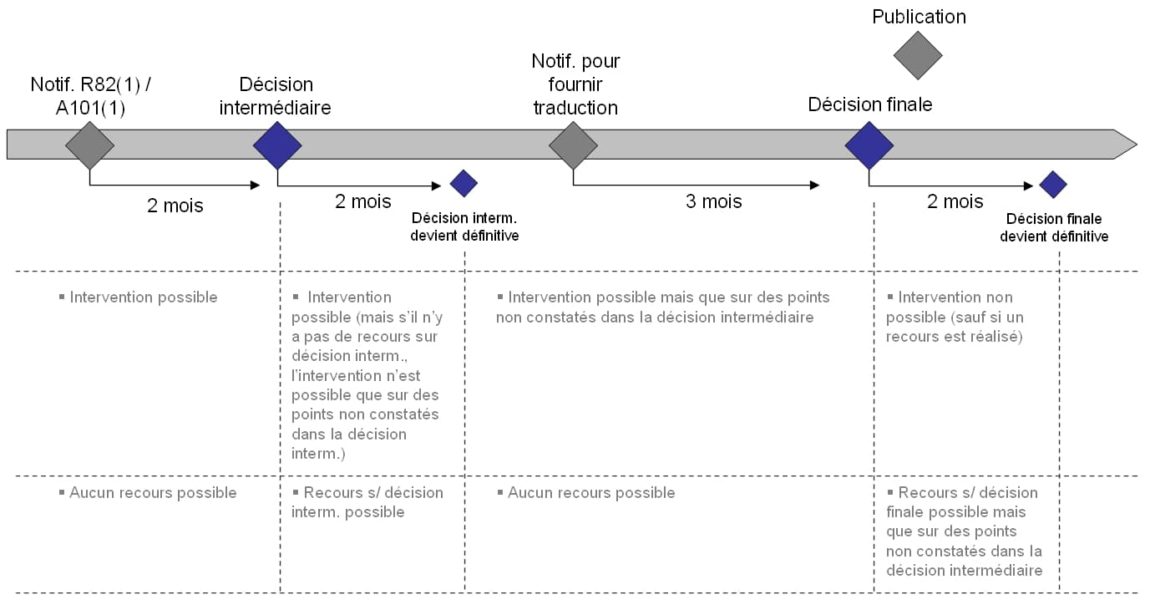
Allocation of costs
Parties to the proceedings
In principle, each party bears the costs it has incurred (A104(1) EPC).
The parties are the proprietor, the opponents, or the interveners (where applicable).
This principle may, however, be moderated for reasons of equity (in this case, only the expenses necessary for an adequate defense are taken into account R88(1) EPC and Guidelines D-IX 1.3): the decision of the opposition division will then include provisions on the allocation of costs.
By way of illustration, an opponent had to pay the full costs and fees of the proprietor’s representative, because the opponent did not attend the oral proceedings and had not even responded to the communications. The opponent, however, had traveled from Japan for the oral proceedings in the opposition (T930/92).
Third parties to the proceedings
With regard to third parties (witnesses, experts, etc.), their costs are reimbursed to them (R122(2) EPC), whether they were summoned by the EPO or even by a party to the proceedings.
These costs are allocated among the parties on the basis of equity (Guidelines D-IX 1.3).
Allocation and fixing of costs
Possible cases
An allocation of costs may be considered in cases where equity so requires (amendment of the wording of A104 EPC, A104 EPC73).
Behaviors that may lead to an apportionment of costs
An apportionment of costs is possible when behaviors are incompatible with the diligence that should be exercised in safeguarding rights (Guidelines D-IX 1.4).
This is notably the case (Guidelines D-IX 1.4):
- in case of negligence;
- in case of bad faith;
- in case of use of inappropriate means and arguments;
- in case of extension of time (A16(1) RPBA);
- in case of act or omission that harmed the oral proceedings or contributed to delaying them (A16(1) RPBA);
- in case of renunciation of the patent shortly before the oral proceedings when the revocation of the patent had been evident for a long time due to a produced document;
- in case of late citation of prior art that is proven to have been known earlier, the oral proceedings being delayed as a result (T117/86);
- in case of late invocation of relevant facts or evidence without valid reason (T867/92);
- in case of non-appearance at the oral proceedings without notifying the EPO in advance (T930/92 and T212/07) or only one day in advance (T937/04);
- conversely, some Boards of Appeal consider that participation in oral proceedings is not mandatory for parties: if a late announcement of an intended absence at the oral proceedings may constitute « reprehensible conduct of an irresponsible or even malicious nature« , it would be necessary to require solid evidence in support of such an allegation (T1079/07 or T383/13 or T1699/15).
- in case of abuse of procedure (A16(1) RPBA).
This is not the case:
- if the proprietor, with malice, omitted to cite a relevant prior art document. Indeed, the apportionment of costs is not a sanction/fine but a compensation for costs (T66/18).
Costs to be taken into account
The costs to be taken into account are (R88(1) EPC) « the expenses necessary to ensure an adequate defense of the rights in question« .
This includes in particular (Guidelines D-IX 1.3):
- costs incurred by witnesses;
- costs of expert opinions;
- remuneration of the parties’ representatives (in case of proceedings, in case of delay attributable to late documents, etc.);
- travel expenses;
- costs incurred by the proprietor to provide evidence in response to very late documents (T416/87);
- costs incurred to give instructions to the authorized representative (T930/92);
- etc.
Unnecessary or irrelevant expenses should not be taken into account (Guidelines D-IX 1.3).
Procedure
1st step: decision on the apportionment of costs
In the opposition decision, the opposition division may order (possibly on its own initiative, Guidelines D-IX 1.2) the apportionment of costs without fixing the amounts at that time (A104(1) EPC and R88(1) EPC).
Otherwise, each party bears its own costs (A104(1) EPC).
A request may thus be filed by a party before the final decision to seek a specific apportionment (preferably with reasons) (Guidelines D-IX 1.2). In this case, the opposition division must necessarily address this point in the reasons for its decision (Guidelines D-IX 1.2).
Appeal against the decision on the apportionment of costs
An appeal against this decision may be filed within 2 months from the notification of the decision (A106(1) EPC and A108 EPC).
The decision on the apportionment of costs is not subject to appeal if it is the sole subject of the appeal (A106(3) EPC together with R97(1) EPC).
If the other party files an appeal against the decision (but not specifically against the apportionment of costs), this does not mean that the apportionment of costs can be reconsidered (T1237/05).
2nd step: fixing of costs
To obtain a fixing of costs, it is necessary to file a request to this effect, attaching the relevant supporting documents (R88(2) EPC).
The formalities officer (by delegation from the opposition division, R11(3) EPC and « Decision of the President of the European Patent Office dated 12 December 2013 on entrusting to non-examining staff certain duties incumbent on the examining or opposition divisions« , OJ 2014, A6) then fixes the costs and notifies the parties (Guidelines D-IX 2.1). This is not a decision.
This fixing is deemed enforceable in the various member states after a period of 1 month from notification, provided no decision has been requested (A104(3) EPC, it being understood that « decision » in this context covers the « fixing of costs » as per Guidelines D-IX 3).
3rd step (optional): decision on the fixing of costs
A decision may then be requested, in writing and with reasons, within a period of 1 month from the notification of the fixing of costs (R88(3) EPC). It is also necessary to pay the corresponding official fee (A2(1).16 RFees: [montant_epo default= »70 € » name= »A2(1).16 RRT »]).
A122 EPC applies only to the proprietor.
Thereafter, the examining division decides on the fixing of costs without oral proceedings (R88(4) EPC) and issues a decision (R88(3) EPC).
Once this decision has become final, it is enforceable in the various member states (A104(3) EPC).
Appeal against the decision on the fixing of costs
An appeal against the fixing of costs in opposition proceedings will only be admissible if the amount in dispute exceeds the appeal fee (A106(3) EPC together with R97(2) EPC).
The amount of the appeal fee is [montant_epo default= »1240 € » name= »A2(1).11 RFees »] (A2(1).11 RFees).
If an appeal is filed without meeting these conditions, it will be rejected (R101(1) EPC).
The principle of non reformatio in pejus applies here (T668/99).