


To properly file a patent application in France, it is essential to comply with the filing location and methods. In other words, the question is: where to file and how to file?
Filing Location
INPI
All patent applications must be filed at the INPI headquarters (R612-1 CPI) located in Courbevoie (regional delegations are no longer authorized to receive filings since July 1, 2014).
Prefectures?
Before March 3, 2007, it was also possible to file patent applications at a prefecture (excluding the one in Paris).
Today, this is no longer possible.
Filing Methods
Physical Filing
It is possible to file a patent application by physically visiting the INPI premises (R612-1 CPI and R614-1 CPI).
Note that INPI has maintained an automated drop box in Paris that accepts filings 24/7 (INPI Examination Guidelines, I-A 1.1).
Postal Mail
Additionally, it is possible to file any application by postal mail if sent via registered letter with acknowledgment of receipt (R614-1 CPI).
Fax
It is no longer possible to file French patent applications by fax since November 19, 2018 (Decision 2018-156 of the INPI Director General).
Electronic Filing
Principle
Electronic filings are possible (R612-1 CPI and R614-1 CPI together with Decision 2018-156 of the INPI Director General) via the E-PROCEDURE service, except for applications concerning national defense.
Patent applications must be filed in a specific format (i.e., DOCX) and comply with particular tagging and keyword formalities (good luck with that!) (Articles 7 and 9, Decision 2018-156 of the INPI Director General).
If an urgent filing is required but the DOCX file is not ready, it is possible to file the text in PDF format and correct it within 2 months (Article 8, Decision 2018-156 of the INPI Director General).
Legality of Decision 2018-156
As mentioned earlier, Article 7 of the decision states that submitted DOCX files must contain « no errors or alerts. »
Well… but how do you avoid alerts or errors?
That is the question: especially since errors and alerts are at the discretion of the INPI’s information system. If the system crashes, you will receive an alert, and consequently, your filing will be non-compliant. How is it acceptable that you have no control over the compliance of your filing?
For illustration, here is what the system outputs during a filing that I personally consider to comply with all INPI technical requirements. What do I do now?
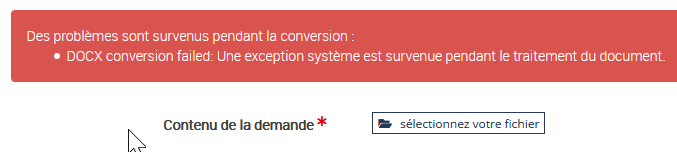
In the name of the principle of legal certainty (or predictability), it is unacceptable for a document that may be considered « compliant » on a given date to become « non-compliant » because the INPI (or another entity) has updated its DOCX conversion engine.
Similarly, the principle of intelligibility of the law should allow us to understand why a document would be considered « non-compliant » and rejected by the INPI.
In short, you will have understood… I am quite upset.
National Defense Cases
In the case of a filing that may concern national defense, it is necessary to file in paper format directly at the INPI premises (Article 2, Decision 2018-156 of the INPI Director General).
It is mandatory to declare to the DGA any filing of a « sensitive » patent application, i.e.:
- war materials and defense weapons and ammunition of categories A (prohibited for acquisition and possession) and B (subject to authorization for acquisition and possession) (L2331-1 of the Defense Code and R311-2 of the Internal Security Code),
- materials
- subject to export authorization (the Order of May 4, 2017 on the obligation to declare the filing of patent applications concerning certain goods and materials, together with Articles L2335-2 of the Defense Code),
- subject to prior transfer authorization (Order of June 27, 2012, on the list of war materials and related materials subject to prior export authorization and defense-related products related to war materials or dual-use goods within the meaning of Regulation (EC) No 428/2009),
This declaration must be made within 8 days from the filing date (L2332-6 of the Defense Code).
« Sensitive » inventions may concern non-traditionally military fields such as software (particularly software designed to control war materials, cryptography software, etc.).