


Who are the persons eligible to file a patent application in France? This article also covers the broad topic of employee inventions.
The Applicant
Persons Eligible to File in Principle
It is quite simple: anyone is entitled to file a French patent application.
Thus, there is no nationality requirement, unlike under the PCT.
Even an incapacitated person may file a patent application provided that their legal representative performs the acts.
Persons Having the Right to File
Principle
However, while anyone may file an application, this does not mean that everyone has the right to do so.
Indeed, Article L611-6 CPI provides:
The right to the industrial property title referred to in Article L. 611-1 belongs to the inventor or to their successor in title.
Employee Invention
Three categories of inventions must be distinguished for employees (L611-7 CPI).
Service Inventions
Inventions are classified as service inventions when they are made (L611-7 CPI, paragraph 1):
- in the performance of an employment contract involving an inventive mission (i.e., a general and early instruction from the employer) corresponding to the employee’s actual duties, and/or within the scope of studies or research explicitly (but not necessarily in writing) assigned to them
The latter case is often more difficult to prove because the instruction to invent given to the employee is late (for example, during a mission) and evidence is harder to gather.
Here, we are squarely within the core of the employment contract. The instruction to invent is given directly by the employer to one of its employees.
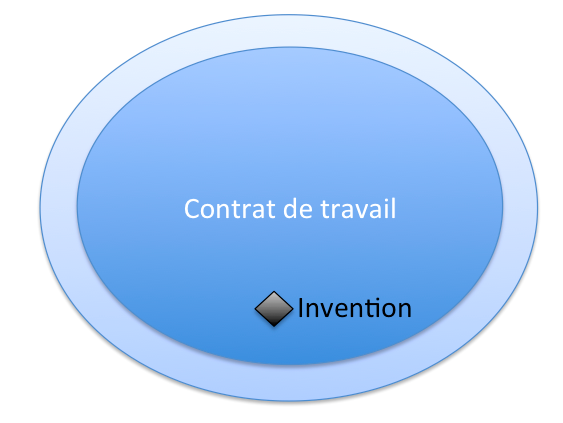
In this situation, the right to the title belongs to the employer. This right is automatically assigned to the employer without any action on their part.
Attributable Non-Service Inventions
Here, it is necessary that the inventions do not fall into the first category and that they are made (L611-7 CPI, paragraph 2, second sentence):
- either in the course of performing the employee’s duties;
- or within the field of activity of the company;
- or through the knowledge or use of the company’s means.
Here, we are at the periphery of the employment contract. Indeed, there is no instruction from the employer to invent, but it turns out that the employee invents something.
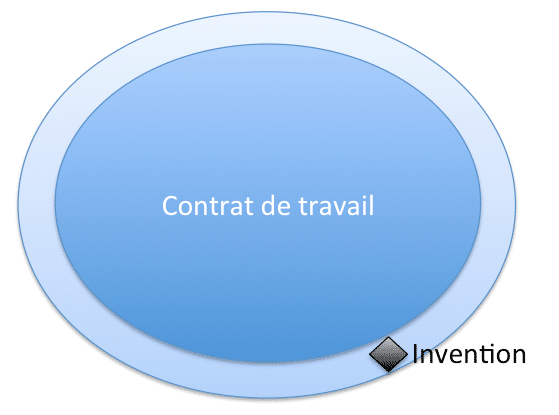
In this situation, the employer may, upon express request, be assigned the right to the patent. However, this assignment is not automatic.
Non-Attributable Non-Service Inventions
The inventions covered by this category are all other inventions not falling into the categories above (L611-7 CPI, paragraph 2, first sentence).

In this situation, the right to the title belongs to the inventor, quite simply.
Multiple persons making the invention independently of each other
If several persons have made the invention independently of each other, the right to the French patent belongs to the one who files an application first (priority date, L611-6 CPI).
Proof of authorization before the INPI
In any event, during the examination procedure, the INPI will not seek to verify whether the applicant is indeed the person entitled to the patent.
The applicant shall be deemed to be duly authorized (L611-6 CPI).
Multiple applicants
In the case of multiple applicants, a common representative must be appointed (R612-2 CPI).
To this end, it may be (R612-2 CPI):
- one of the co-applicants; a representative as mentioned below.
The representative
The applicant may be represented by a representative domiciled in a member state of the EU or the EEA for the filing (R612-2 CPI):
- an IP representative (title regulated by Article L422-1 CPI) with the « patent » mention (L422-4 CPI together with L422-1 CPI, last paragraph);
- an attorney-at-law;
- a person registered on the special list of Article L422-5 CPI (specialist benefiting from the « grandfather » clause, few remain);
- a company or public institution with which the applicant has a contractual relationship;
- a specialized professional organization;
- a foreign counsel domiciled in an EU or EEA member state and authorized to act in that state (if acting before the INPI on an occasional basis).
Unless the representative is an IP representative or an attorney-at-law, it is necessary to provide a power of attorney (R612-2 CPI, last paragraph).