


A divisional application (child application) is a patent application that originates from an earlier patent application (parent application).
The effects of division
Benefit of the earlier filing date
The division of a French patent application allows filing a patent application while benefiting from the filing date of another French application, i.e., the « parent » application (L612-4 CPI, paragraph 2).
File constitution
Upon division, the file of the divisional application is constituted by the file of the earlier application (R612-35 CPI, paragraph 3).
However, if the divisional application is restricted, only the « restricted » description will be accessible in this file (R612-35 CPI, paragraph 3).
The utility of divisional applications
Division is primarily useful where one of your applications contains several inventions and the Examiner has raised a « lack of unity of invention » (L612-4 CPI, paragraph 2): some inventions had to be abandoned for the examination to proceed, but you still wish to protect these inventions.
Filing a divisional application is the ideal solution in this situation.
Conditions for dividing a patent application
Substantive conditions
Description and drawings
When dividing an application, the applicant has two options (R612-35 CPI, paragraph 2):
- reproduce the description and drawings identically (the claims may then be amended to restrict the subject matter); or
- limit the description and drawings to the part of the invention covered by the new claims.
Thus, it is not possible to add any content to the application.
Claims
The claims must always be supported by the description (L612-6 CPI, second sentence).
Formal conditions
Types of parent application
Any French application may be divided.
A utility certificate application cannot be divided into a patent application (INPI Examination Guidelines, I-B III.2): only division into a utility certificate is possible.
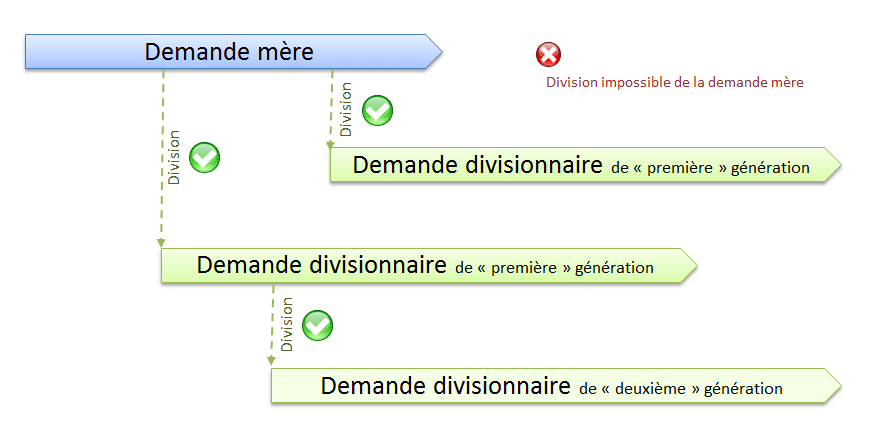
As shown in the diagram above, it is entirely possible (INPI Examination Guidelines, I-B III):
- to divide the same application multiple times; or
- to carry out chain divisions.
Pending parent application
Under L612-4 CPI, R612-34 CPI and R612-35 CPI, only a patent application (i.e., pending) may be divided.
Thus, it appears possible to divide:
- if a deadline has not been met:
- until the expiration of the deadline in question, as the restoration request has no suspensive effect (INPI Examination Guidelines, I-E 3.3.1 d)),
- unless restoration is successful;
- if an application is rejected or deemed inadmissible:
- until the expiration of the appeal period (500 CPC, 1 month under R411-20 CPI) if no appeal is filed;
- until the end of the appeal if an appeal before a Court of Appeal is filed (L411-4 CPI, paragraph 2) due to its suspensive effect (general principle of Article 539 CPC, confirmed by INPI Examination Guidelines, I-E 3.3.1 d)).
- if a renewal fee deadline for an application is not paid, two schools of thought exist (and frankly, I cannot decide):
- either division is only possible until the normal due date for payment of the annual official fee (L613-22 CPI, second paragraph, « The lapse takes effect on the due date of the unpaid annual official fee« ),
- or division is possible as long as the INPI Director has not issued a notification of lapse (since even if the lapse is retroactive, the Director’s decision cannot affect an irrevocably established situation at the time of division, by analogy with Cass. Com., No. 10-24326).
- if the application is withdrawn:
- before the INPI receives all the documents required for withdrawal (declaration, powers of attorney, etc.), as this is the date on which the withdrawal becomes effective and irrevocable (INPI Examination Guidelines, I-F);
- in principle, division on the same day appears impossible (but I have no case law);
- if the INPI decides to grant a patent, division is possible until payment of the grant and printing official fee for the patent specification (R612-35 CPI).
Parent application to be considered
Voluntary division
In the case of a cascading division (i.e., A is divided into B, and B is divided into C), to verify whether the parent application of C is pending (see previous conditions), it is necessary to consider application A (INPI Examination Guidelines, I-B III.2).
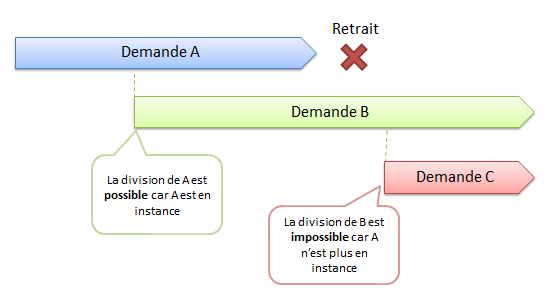
This interpretation by the INPI is highly surprising, as it is exactly the opposite of the European position (I would be interested to know the legal basis allowing the INPI to adopt this position)…
This position even contradicts the possibility of dividing patent applications « in cascade »: this option would be meaningless if the truly important application for assessing the previous conditions were the « initial parent application », would it not?
It should be noted that the judges (Paris Court of Appeal, Division 5, Chamber 2, November 22, 2019, Case No. 18/27433) have validated this interpretation by the INPI. Indeed, according to the judges, the term « patent » in Article R612-34 CPI refers to the term « initial patent application » in the same sentence. Furthermore, according to them, the term « initial application » is the « root » application (since Article L612-4 CPI provides that divisional applications benefit from the filing date of the parent application).
I must admit that I remain skeptical…
Indeed:
- syntactically in French, nothing indicates that the term « patent » refers to the term « initial patent application ». It is entirely possible that the term « patent » means the patent that will be obtained (i.e., the one from the divisional application in the case of cascading divisions)
- « Until payment of the official fee for grant and printing of the patent specification« : this part of the sentence only indicates a time condition;
- « the applicant may, on his own initiative, file divisional applications of his initial patent application« : this part of the sentence only indicates the subject to be divided.
- if the reasoning of the Court of Appeal were correct, this would mean that cascading divisions would not be possible since it would only be possible to divide the initial application according to Article R612-34 CPI (yet, the INPI Guidelines do provide for this case… INPI Examination Guidelines, I-B III.2).
Forced division
It should be noted that Article R612-34 CPI only applies to divisions initiated by the applicant.
Therefore, in the event of a lack of unity of invention, it appears that this article would not be applicable (and thus, the reasoning of the Court of Appeal in the Kubota decision (Paris Court of Appeal, Division 5, Chamber 2, November 22, 2019, Case No. 18/27433) would not apply).
Referring to Article L612-4 CPI, we see that an application that does not satisfy the unity of invention requirement must be divided.
Therefore, I do not see how the INPI could refuse a « forced » divisional application, even if this divisional application is of the second generation and the « initial » application is no longer pending.
If my interpretation is correct, this would mean there is a discrepancy between « forced » divisional applications and « voluntary » divisional applications… which is rarely a good idea…
Furthermore, this could encourage applicants to create a unity of invention issue when filing their first-generation divisional application (or even after receiving the search report) in order to reserve the right to divide subsequently.
Standard conditions
In any event, the filing of a divisional application remains the filing of an application: thus, the standard formal requirements (description, request for grant, etc.) must be complied with (Article R612-35 CPI, paragraph 1).
Specific requirements for divisional applications
The request for grant must specify (INPI Examination Guidelines, I-B III.1):
- in the section regarding the nature of the application: i.e. « divisional application » (R612-10 CPI 1°/ and INPI Examination Guidelines, I-B II.3);
- the number of the parent application.
Otherwise, the application is processed as a « normal » application (and the parent application may be cited as prior art under L611-11 CPI, paragraph 3) (INPI Examination Guidelines, I-B III.1).
Applicants
The applicants for the divisional application must be exactly the same as those of the parent application (R612-34 CPI and INPI Examination Guidelines, I-B III.4), unless an assignment has been duly recorded in the National Register of Patents (RNB).
If the applicant does not match the information in the RNB, the applicant of the divisional application is notified and may justify this by providing evidence of an assignment not yet recorded in the RNB (INPI Examination Guidelines, I-B III.4).
Inventors
As with any patent application, it is possible to designate the inventors within a period of 16 months from the effective filing date (in this case, that of the parent application, R612-11 CPI, paragraph 2 in conjunction with R612-10 CPI, paragraph 1, 3°).
However, for divisional applications, it is always possible to designate the inventors within a period of 2 months from the invitation under R612-11 CPI (R612-35 CPI, paragraph 4).
Official fees to be paid
Filing and search official fees
Deadline
The filing and search official fees must be paid within a period of 1 month from the division (R612-35 CPI, paragraph 1 in conjunction with R612-5 CPI).
Otherwise, the application is rejected (R612-45 CPI, paragraph 1, 2°).
The applicant has a period of 2 months from the date of receipt of the rejection notification to pay the corresponding official fee increased by a surcharge (i.e. 50% of the unpaid official fee, Order of April 24, 2008 on official fees for procedures collected by the INPI, Annex): if nothing is done, the rejection becomes final.
Filing official fee
The amount of the filing official fee is set at (Order of April 24, 2008 on official fees for procedures collected by the INPI, Annex):
- [montant_epo default= »36 € » name= »INPI – filing in paper form »] for a paper filing;
- [montant_epo default= »26 € » name= »INPI – electronic filing »] for an electronic filing.
Search fee
The amount of the search official fee is set at (Order of April 24, 2008 on official fees for procedures collected by the INPI, Annex):
- [montant_epo default= »520 € » name= »INPI – Search report »] for a standard search;
- [montant_epo default= »156 € » name= »INPI – Search report if equivalent report »] for a search if the application is a foreign priority application accompanied by a search report recognized as « equivalent » by the INPI Director General, i.e.:
- under priority of a Swiss application (Decision 92-286 of the INPI Director General), if the content is identical and if the search report is provided when paying the search official fee;
- under priority of a Dutch application (Decision 92-287 of the INPI Director General), if the content is identical and if the search report is provided when paying the search official fee;
- under priority of a Belgian application (Decision 96-408 of the INPI Director General) if the content is identical and if the search report is provided when paying the search official fee.
Claim fees
Principle
If the number of claims provided exceeds 10, a claim fee is due for each claim from the 11th onward (R411-17 IPC).
This fee is [montant_epo default= »40 € » name= »INPI – claim fee, either at the time of filing or following amendment, from the eleventh claim »] for each claim from the 11th onward (Order of April 24, 2008 on official fees for procedures collected by the INPI, Annex).
Deadlines
If the applicant does not pay, a notification is sent to the applicant (R612-46 IPC, paragraph 1) setting a time limit to pay this fee.
Otherwise, the application is rejected (R612-46 IPC, paragraph 3).
Annual fees
When filing a French divisional application, it is necessary to pay the annual official fees (R613-46 IPC).
Regarding already due deadlines, Article R613-47 IPC provides that the annual official fee is considered validly paid if payment is « made no later than the last day of the fourth month following the date of receipt of the divisional application documents« .
The question then is: « Do already due fees benefit from the 6-month grace period under Article L612-19 IPC, paragraph 2? ».
According to INPI guidelines (INPI Examination Guidelines, II-A 2), the answer is unequivocal: the 6-month period should be applied from the end of the preceding 4-month period.
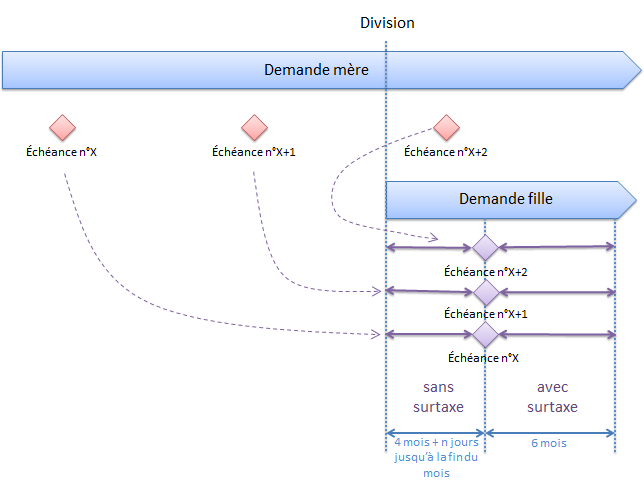
I personally have reservations: in my view, nothing in the code supports this assertion.
If the 4-month period is a period during which payment « is considered validly made » (legal fiction under Article R613-47 IPC), the due date of the annual official fee (i.e., the date on which payment is due) does not appear to be modified.
Thus, in my personal interpretation, the 6-month grace period begins on the « normal » due date of the annuity.
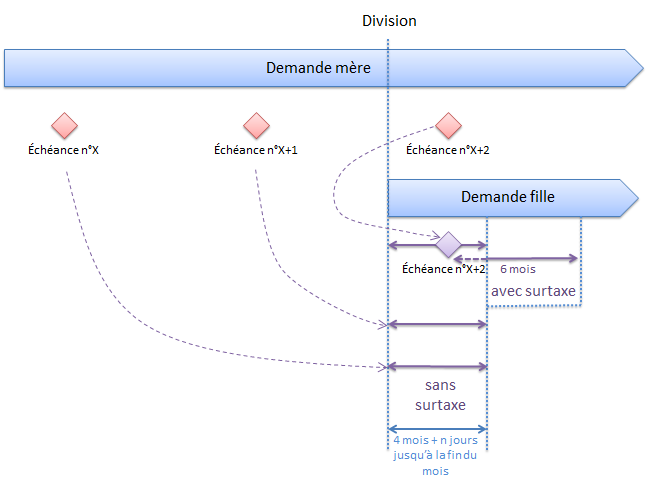
I leave it to you to decide which of the two interpretations is correct.
Official fee reductions
A reduction in official fees is provided if the applicant is (L612-20 CPI together with R613-63 CPI):
- a natural person;
- the reduction is granted as of right and no supporting document is required;
- an SME with fewer than 1,000 employees, whose capital is not held more than 25% by an entity that does not meet these initial conditions;
- it is necessary to provide, within 1 month from the filing of the patent application, a written request for reduction and a sworn statement of eligibility for this category, dated and signed by the legal representative (INPI Examination Guidelines, II-B 2);
- a non-profit organization (NPO) in the education or research sector:
- it is necessary to provide, within 1 month from the filing of the patent application, a written request for reduction and a copy of the articles of association (INPI Examination Guidelines, II-B 2).
Where there are multiple applicants, all applicants must meet these conditions (R613-63 CPI).
The reduction is 50% for (R613-63 CPI together with Order of April 24, 2008 on official fees for procedures collected by the INPI, Art 2):
- the filing official fee;
- the search official fee
- unless the application is a foreign priority application accompanied by a search report recognized as « equivalent » by the INPI Director General;
- the annuities for years 1 to 5.
The reduction is 25% for (R613-63 CPI together with Order of April 24, 2008 on official fees for procedures collected by the INPI, Art 2):
- the annuities for years 6 and 7.
Claim official fees are not eligible for reduction.
Some procedural aspects
Priority
It is possible to claim a priority if it has been claimed in the parent application (INPI Examination Guidelines, I-B III.5).
However, it is not possible to add a priority unless it is added (R612-24 CPI, paragraph 2 and 3):
- either within 4 months of the filing of the parent application;
- or within 16 months of the earliest priority (existing or added).
Merci pour ce très bon article.
L’affaire Kubota précitée a donné lieu à un pourvoi en Cassation. L’arrêt, rendu le 30 août 2023, fait évoluer la pratique française et autorise désormais le dépôt de demandes divisionnaires « en cascade », s’alignant ainsi sur l’OEB, ce dont on ne peut que se féliciter : [Link deleted]
« Les articles L. 612-4 et R. 612-34 du code de la propriété intellectuelle doivent être interprétés en ce sens que, dès lors que le déposant peut procéder au dépôt de demandes divisionnaires de sa demande de brevet d’origine, ainsi qu’au dépôt d’une ou plusieurs demandes divisionnaires sur la base d’une demande elle-même divisionnaire, la date limite pour déposer une seconde demande divisionnaire à partir d’une première demande divisionnaire correspond à la date de paiement de la redevance de délivrance et d’impression du fascicule du brevet issu de cette première demande divisionnaire. Viole ces textes la cour d’appel qui approuve le directeur général de l’INPl d’avoir déclaré irrecevable une seconde demande divisionnaire aux motifs qu’elle a été déposée après le paiement de la redevance de délivrance et d’impression du fascicule du brevet initial. »
Merci beaucoup pour ce très bon résumé des faits !!!
Il n’y a pratiquement pas de littérature sur le droit des brevets sur le net.
Vous êtes d’une aide incroyable !
Merci encore !