


One of the most important things for an applicant is the filing date of their application.
Indeed, it determines the prior art that can be cited against it (as we will see later).
To verify that the application meets the minimum requirements set by the EPC, the filing section examines the filing documents (A16 EPC).
Conditions for Granting a Filing Date
General
A80 EPC simply refers to the Implementing Regulations for the requirements to obtain a filing date.
The EPO verifies these conditions (A90(1) EPC), and it is the filing section that is responsible for this verification (Guidelines A-II 4.1).
The Three Minimum Requirements
Since December 13, 2007 (entry into force of the EPC 2000), the requirements have been significantly relaxed.
Only three remain (R40(1) EPC):
- an indication that a European patent is sought (R40(1) a) EPC);
- indications allowing the applicant to be identified or contacted (R40(1) b) EPC);
- a description or a reference to a previously filed application (R40(1) c) EPC).
Indication that a Patent is Sought
This requirement is set out in R40(1) a) EPC.
No formal requirements apply. Thus, it may be submitted on plain paper (Guidelines A-II 4.1), handwritten (provided the indication is legible).
Of course, you may also use the Form 1001 for a request for grant provided for this purpose by the EPO (Guidelines A-II 4.1.1). This form already contains the required wording.
If this indication is missing, a notification will be sent to the applicant to correct this irregularity within a period of 2 months (R55 EPC). Note that the filing date will be the date on which this requirement is met (if the other two are also met, R55 EPC second sentence).
If this irregularity is not corrected, the application will not be processed as a European patent application (R55 EPC), and any official fees paid will be refunded (Guidelines A-II 4.1.4).
Identification of the applicant
This condition is provided for in R40(1) b) EPC.
It should be noted that this identification is quite flexible (Guidelines A-II 4.1.2, unlike the requirements that may be found in R41(2) c) EPC).
The Examination Guidelines (Guidelines A-II 4.1.2) state that this identification must:
- either enable the applicant to be identified,
- or enable contact to be made with the applicant.
Thus, EPO case law considers the following information to satisfy this requirement (Guidelines A-II 4.1.2):
- the name and address of the applicant’s representative;
- a fax number;
- a signature with a legible name (J25/86);
- a post office box number.
If this condition is not met, it is not possible to notify the applicant.
However, if the applicant is insufficiently identified, they have 2 months from the filing of the initial documents to correct the error (Guidelines A-II 4.1.4).
The filing date is the date on which this condition is met (if the other two are, R55 EPC second sentence).
If this irregularity is not corrected, the application will not be processed as a European patent application (R55 EPC) and any official fees paid will be refunded (Guidelines A-II 4.1.4).
Description and drawings
This condition is provided for in R40(1) c) EPC.
There is no requirement regarding:
- the language of the description (A14(2) EPC);
- the presence of claim(s) (Guidelines A-II 4.1, if the claims are not filed at the filing date, this is indicated in the publication R68(4) EPC).
In short, only a text (and optionally drawings) is required…
In decision T382/94, the Board of Appeal held that if the annotations of the drawings were in a different language from that of the description, this had no impact on the filing date (the claims and description had been filed in German, but the drawings included text in English).
What if part of the description or a claim is in a different language from the rest of the description?
Before the entry into force of the EPC 2000, the EPO refused to accord a filing date in such situations (J18/96) on the grounds that the wording of A14 EPC73 was:
European patent applications shall be filed in one of these languages
Today, the wording is different, but similarities can be found:
Every European patent application shall be filed in one of the official languages or, if filed in any other language, translated into one of the official languages in accordance with the Implementing Regulations.
I therefore believe that the EPO’s position would remain the same: the principle of unity of language for European patent applications would be the rule.
That said, nothing is certain: for example, some argue that if the claims are in a different language, this does not pose a problem (since claims are not mandatory to obtain a filing date).
If this indication is missing, a notification will be sent to the applicant to correct this irregularity within a period of 2 months (R55 EPC). Note that the filing date will indeed be the date on which this condition is fulfilled subject to the detailed provisions below in the chapter « Errors concerning the description or the drawings » (if the other two are, R55 EPC second sentence).
If this irregularity is not corrected, the application will not be processed as a European patent application (R55 EPC) and any official fees paid will be refunded (Guidelines A-II 4.1.4).
Reference to an earlier application
Principle
It is possible to replace the requirement to provide a description with a reference to an earlier application (R40(1)(c) EPC, the priority of which does not necessarily have to be claimed, Guidelines A-II 4.1.3.1).
This earlier application may be a utility model (Guidelines A-II 4.1.3.1).
Requirements at the time of filing
For this reference, it is necessary to provide (R40(2) EPC and Guidelines A-II 4.1):
- the filing date of the earlier application,
- its filing number,
- the office with which it was filed,
- the statement that this reference replaces the description and, where applicable, the drawings.
This reference may be presented in any form, provided it is legible (Guidelines A-II 4.1.3.1).
It is not possible to make a reference to several applications.
If the reference is not compliant, a notification will be sent to the applicant to correct this irregularity within a period of 2 months (R55 EPC).
The filing date is the date on which this condition is fulfilled (if the other two are, R55 EPC second sentence).
Provision of a certified copy
To benefit from the filing date, it is also necessary to submit a certified copy of the earlier filed application within a period of 2 months (R40(3) EPC).
This period does not benefit from further processing under A121 EPC, but from restitutio in integrum under A122 EPC.
If this requirement is not met within the time limit, the applicant will be invited to provide the copy within a period of 2 months (R55 EPC).
If the applicant submits the certified copy within this 2-month period, the application retains its initial filing date, provided it meets all other conditions for according a filing date (Guidelines A-II 4.1.5).
Otherwise, the application will not be processed as a European patent application (R55 EPC and Guidelines A-II 4.1.4).
This latter period does not benefit from further processing under A121 EPC, but from restitutio in integrum under A122 EPC.
Cases where the provision of the copy is not mandatory
R53(2) EPC applies where the earlier application is available to the Office. This rule stipulates that « The copy of the earlier application shall be deemed to have been duly filed if a copy of that application, which is available to the European Patent Office, is to be included in the file of the European patent application under the conditions determined by the President of the European Patent Office ».
The conditions in question are as follows. The applicant does not need to provide this copy in the following two cases only (« Notice from the European Patent Office dated 14 September 2009 concerning the filing of a certified copy of the earlier application when a priority claim is made« , OJ 2009, 486):
- if the earlier filed application is an EP application, or
- if the earlier filed application is a PCT application and if the RO is the EPO.
Translation of the priority claim
The R40(3) EPC also states that a translation of the application must be provided within the same 2-month period if the earlier filed application is not drafted in an official language (i.e., French, English, or German, A14(1) EPC).
The A121 EPC does not apply to this time limit.
The provision of the translation is not mandatory if the EPO is already in possession of it (R53(2) EPC).
If the translation is not provided within the time limit, the EPO notifies the applicant and grants an additional 2-month period to provide this translation (R58 EPC, R57 a) EPC also providing for this translation).
However, the absence of a translation has no impact on the filing date (Guidelines A-II 4.1.4, last paragraph). This is due to the absence of language requirements for the description in order to secure a filing date.
The sanction for failure to provide the translation is that the application is deemed to be withdrawn (A14(2) EPC).
In the proceedings, and until proven otherwise, this translation is presumed to be correct (R7 EPC).
Authentic text
Normally, the text that is authentic in all proceedings before the EPO is the text drafted in the language of the proceedings (A70(1) EPC).
However, if the application was not filed in an official language of the EPO, the original text is authentic (A70(2) EPC).
The translated text may be brought into conformity with the text as filed during the entire proceedings (A14(2) EPC).
This latter possibility is debatable if the filing merely refers to an application drafted in a language that is not an official language of the Office, as R40(3) EPC does not provide for correction (however, this seems logical, particularly in view of R7 EPC).
Special case of a filing on a public holiday
If a patent application is filed on a public holiday or a day when an EPO office is closed (e.g., filing by fax on a Sunday), it may be questioned whether the filing date is postponed to the next working day.
The answer is no: the filing date may very well be a public holiday or a day when the EPO is closed.
The correction of irregularities
Failure to meet minimum requirements
Failure to comply with one of the three minimum requirements mentioned above results in the EPO sending a notification to the applicant (R55 EPC).
Upon receipt of this notification, the applicant then has a period of 2 months (R55 EPC) to remedy the filing:
- if the filing is remedied, the filing date is then the date on which the EPO receives the correction;
- if the filing is not remedied, there is no filing date.
If the identification of the applicant is insufficient to allow the sending of this notification, the 2-month period is considered to run from the filing date itself (since the applicant cannot be notified, Guidelines A-II 4.1.4): it is up to the applicant to realize this!
Special case of missing parts in the description or drawings
Principle
As explained above, it may happen that the applicant makes a mistake when filing the description or the drawings.
For example (and God knows this happens!), only every other page was provided to the EPO due to a photocopy made on the front side of the sheets instead of both sides…
In this case, a correction may be possible under certain conditions.
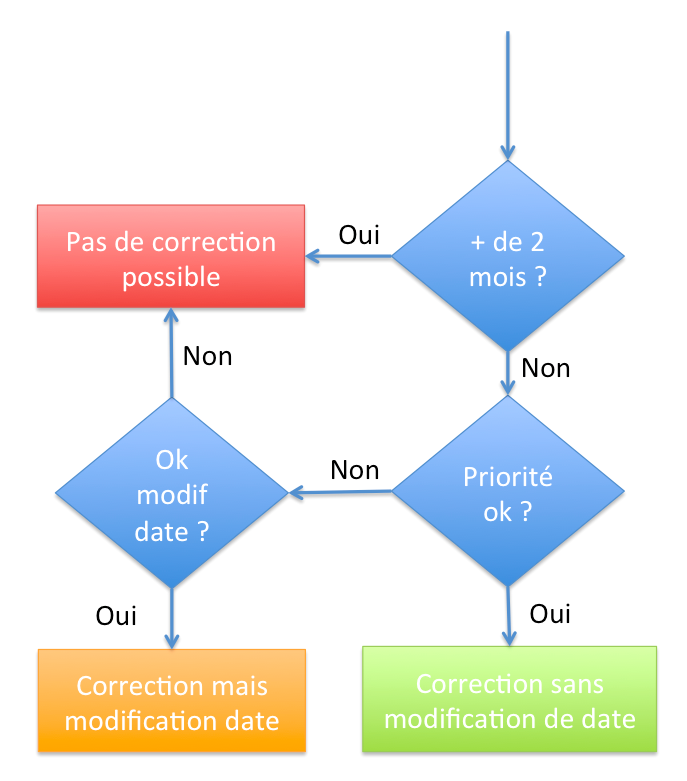
Identification of the error/omission and time conditions
Initially, correction is only possible:
- if the applicant realizes the error and requests a correction within 2 months of the filing date (R56(2) EPC), or
- if the EPO notices the applicant’s error (though this is not guaranteed, R56(1) EPC) and the applicant then requests the correction within 2 months of receiving the EPO’s notification (R55 EPC, total omission or R56(2) EPC, partial omission of the description).
Correction using a priority document
Correction of an omission (page, part, element) in the description and drawings
If one of the above conditions is met, it is then necessary to check whether the omitted part exists in its entirety in any document from which priority is claimed (note, moreover, that a new priority document may be added if desired under R52(3) EPC).
If so, a correction is possible (R56(3) EPC).
The following elements must then be provided to the formalities officer:
- a request for correction (R56(3) EPC);
- a copy of the priority application (R56(3) a) EPC, unless the priority application is (OJ 2020, A57):
- a European application,
- an international application if the RO is the EPO;
- a US application (regular or « provisional »)
- for « provisional » applications, a PTO/SB/39 form must be filed with the USPTO to authorize communication of this application (« Notice from the European Patent Office dated 27 June 2007 concerning practical aspects of the electronic exchange of priority documents between the EPO and the United States Patent and Trademark Office (USPTO)« , OJ 2007, 473),
- a Korean application (for a patent or utility model),
- a Chinese application (for a patent or utility model),
- a translation if the priority application is not in an official language of the EPO (R56(3) b) EPC);
- if the priority application is in a language different from the language of the proceedings, but is nonetheless an official language of the EPO, it is necessary (Guidelines A-II 5.4.4):
- to provide a translation of the missing parts in the language of the proceedings (to comply with R56(1) EPC and R3(2) EPC) (Guidelines A-II 5.4.4 i);
- to provide the missing parts along with a statement that the missing parts are a faithful translation of the parts of the priority application (Guidelines A-II 5.4.4 ii).
- an indication of the exact location where the missing parts of the description or the missing drawings appear in full (R56(3) c) EPC).
In this case, the correction will be accepted, and the filing date will not be changed (R56(3) EPC).
Correction of claims?
In theory, the wording of R56(1) EPC does not allow for the correction of an omission in the claims.
The idea was presumably that the provisions of A90(4) EPC together with R58 EPC together with R57 c) EPC should be sufficient.
However, as a last resort, it may be possible to correct the description by adding the claims of the earlier application to it (this will avoid violating A123(2) EPC if claims need to be added subsequently).
Correction of an erroneous element?
In principle, it is not possible to correct an erroneous element using the provisions of R56 EPC (J27/10).
Rectification is only possible under R139 EPC in the event of an error (J19/80).
However, if it is clearly apparent that the filed figures are incorrect (e.g., numerous references are not described), such correction appears possible (J2/12) if it can be established without applying technical knowledge:
- that the Figures initially filed are not those to which the description refers, and
- that the Figures provided later are those to which the description refers.
Correction of an illegible element?
It is not possible to correct an illegible element using the provisions of R56 EPC (e.g., illegible figures, J12/14).
Other corrections
In all other cases, correction will not be possible without modifying the filing date (i.e., which will become the date on which the correction is made).
Upon receipt of the correction documents, the EPO will notify the applicant that this correction results in a change to the filing date (R56(5) EPC).
The applicant will then have a period of 1 month to oppose this (R56(5) EPC) and thus waive the corrections they themselves proposed.
If no modification is ultimately made (or accepted by the applicant), a « clean-up » of the application is required (R56(4) EPC): all references to missing drawings must then be removed from the description (Guidelines A-II 5.5) so that third parties can understand the application when it is published!