


Step 1: Identify the Starting Point of the Deadline
Principle
The starting point of the deadline normally begins on the day after the reference event (R80.1 PCT, R80.2 PCT and R80.3 PCT).
If the reference event is the sending of a document or letter by an office or administration (R80.6 PCT), the date to be taken into account is therefore the date of sending and not the date of receipt of the letter by the applicant or the addressee.
Local Date (Time Zone)
The date to be taken into account for determining the starting point (to resolve time zone issues) is the date of the place where the event in question occurs (R80.4.a PCT).
Step 2: Determine the Expiration Date/Time
Expiration Date
Deadline Expressed in Years
R80.1 PCT provides (as under the EPC):
When a period is expressed in one or more years, it shall start on the day following the day on which the event in question occurred and shall expire, in the subsequent year to be considered, in the month having the same name and on the day having the same number as the month and the day on which the said event occurred; however, if the subsequent month to be considered has no day with the same number, the period in question shall expire on the last day of that month.
To simplify, let us consider a few examples assuming we have a one-year deadline:
- if the starting point is 05/03/12, the deadline expires on 05/03/13;
- if the starting point is 29/02/12, the deadline expires on 28/02/13 (February does not have a 29th day in the year 2013).
Deadline Expressed in Months
R80.2 PCT provides (as under the EPC):
When a period is expressed in one or more months, it shall start on the day following the day on which the event in question occurred and shall expire, in the subsequent month to be considered, on the day having the same number as the day on which the said event occurred; however, if the subsequent month to be considered has no day with the same number, the period in question shall expire on the last day of that month.
The principle is quite similar to that for deadlines expressed in years.
Let us examine this through a few examples assuming we have a one-month deadline:
- if the starting point is 06/03/12, the deadline expires on 06/04/12;
- if the starting point is 31/01/12, the deadline expires on 29/02/12 (since February does not have a 31st day, the last day of February is taken).
Deadline Expressed in Days
R80.3 PCT provides:
When a period is expressed in a certain number of days, it shall start on the day following the day on which the event in question occurred and shall expire on the day on which the last day of the count is reached.
Local Date (Time Zone)
The date to be taken into account for determining the expiration of the deadline (to resolve time zone issues) is the date of the place where the required document must be filed or the required official fee must be paid (R80.4.b PCT).
Expiration Time
The deadline expires at the time when the office where the required document must be filed or the required official fee must be paid closes (R80.7.a PCT).
Any office may derogate from this rule by extending the deadline until midnight (R80.7.b PCT).
Step 3: Potentially Extend a Deadline
Step 3.a: 7-day rule (transmission)
If correspondence sent by the competent authority takes more than 7 days to be transmitted (R80.6 PCT), the time limit running from such correspondence is extended by the number of days of transmission exceeding 7.
The number of days must be added to the end of the time limit and not to the beginning.
Step 3.b: Non-working day or a public holiday
The time limit calculated above is extended if the time limit expires:
- on a day when the office or organization is closed (R80.5.i PCT) (for at least one of the offices, if provided for by national legislation for national applications, R80.5.iii PCT));
- on a day when ordinary mail is not delivered in the locality where that office or organization is situated (R80.5.ii PCT);
- on a day which is a public holiday in a part of the Contracting State concerned, and where national legislation provides for an extension in respect of national applications (R80.5.iv PCT).
Graphical summary
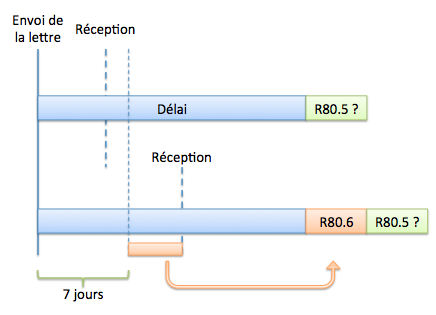 Calculation of PCT time limit extension
Step 4: Excusing a delay
5-day rule
If a letter sent by a party arrives late or is lost, it may be possible for such delay or loss to be excused by the competent authority (A48.1 PCT together with R82.1 PCT):
- if the correspondence was sent at least 5 days before the expiration of the time limit (R82.1.a PCT);
- if the correspondence was sent
- by registered mail (R82.1.a PCT);
- by a delivery service, if the competent authority has accepted that delivery service (R82.1.d PCT and R82.1.e PCT);
- if the dispatch was made by airmail (R82.1.a PCT) unless:
- it is not possible to send by airmail;
- the dispatch by land or sea normally arrives within two days;
- if the party provides evidence of the above facts (R82.1.c PCT):
- within 1 month from the date of noticing (or the date on which a diligent party would have noticed) the loss or delay,
- but no later than 6 months.
In the case of loss, it is also necessary to submit a new copy of the correspondence as well as convincing evidence that this copy is identical (R82.1.b PCT).
Force majeure
In the event of force majeure (e.g., war, revolution, civil disorder, strike, natural disaster, etc.), the delay may be excused if the necessary measures were taken as soon as reasonably possible (R82quater.1.a PCT).
Evidence of force majeure must be submitted within 6 months from the expiration of the time limit (R82quater.1.b PCT).
These provisions do not apply:
- to the priority time limit (set in the Paris Convention);
- to the time limit for entry into the national phase (set in the Articles).