


Appealable decisions
Decision
Principle
It can be complex to identify decisions during the various exchanges with the EPO.
It is the content of a document, not its form, that determines whether the document actually contains a decision (J8/81).
For example, a notification, objectively interpreted in its context, may be understood by its recipients as a final and binding determination of substantive or procedural matters (e.g., the meaning of the date of resumption of proceedings, J12/19).
Not a decision
The minutes of oral proceedings (T838/92) are not a decision.
A notification under R71(3) EPC, indicating that the main request is rejected but that the auxiliary request meets the requirements of the EPC, is not a decision (T1377/15) subject to appeal.
Final decisions
A final decision is one that terminates the proceedings (A106(2) EPC).
An appeal may be filed against such decisions provided the conditions below are met.
Interlocutory decisions
An appeal may be filed against an interlocutory decision (A106(2) EPC) if said decision provides for an independent right of appeal.
An independent right of appeal is admitted, according to the constant practice of the Boards of Appeal:
- against interlocutory decisions concerning the admissibility of the opposition, and
- against interlocutory decisions concerning the maintenance of the patent in an amended form.
In this case, the possibility of filing an appeal against this decision must be included in the operative part (T756/14).
Issued by…
An appeal is possible against decisions (A106(1) EPC):
- of the Receiving Section,
- of the Examining Division,
- of the Opposition Division (even if the patent is surrendered or lapsed in all designated states R98 EPC), and
- of the Legal Division.
Thus, no appeal is possible against decisions:
- of the Search Division,
- of the President of the EPO.
Indication of possible appeal
Normally, appealable decisions must be reasoned and include a statement indicating that an appeal is possible (R111(2) EPC).
The parties may not rely on the omission of this statement (R111(2) EPC), and this does not constitute a substantial procedural violation (T42/84).
Types of decisions
Not granting the requests
Principle
An appeal is only possible against decisions that have prejudiced the party wishing to appeal (A107 EPC together with R101(1) EPC).
Cases of requests
Regarding auxiliary requests:
- an appeal is possible if an auxiliary request is granted while the main request is not abandoned (T234/86);
- Nevertheless, the appeal must be analyzed in concreto: in the appeal, the proprietor must defend the main request that was rejected (otherwise the appeal will be deemed inadmissible).
- The proprietor cannot merely present a new request (possibly based on the main request) (T327/13);
- no appeal is possible if the party has abandoned the main request and accepted an auxiliary request (T541/00);
- to truly abandon the main request, it is necessary to submit the complete text of the application/patent to align it with the request (T977/02).
If an opponent has requested partial revocation of the patent and this request has been granted, they cannot file an appeal to request full revocation (T299/89).
Case of the text intended for grant
If the applicant mistakenly agrees to the text intended for grant, it cannot be said that the decision does not meet their claims (T1795/15): therefore, the appeal will be inadmissible.
It may happen that the text under Rule 71(3) EPC is manifestly erroneous (e.g., every other page is missing) but the proprietor nonetheless agrees to the text.
Under this hypothesis, the boards of appeal may still accept an appeal against the grant decision by considering that the EPO’s practice of making minor amendments to the text and justifying these amendments would not be followed: the text annexed to the communication under Rule 71(3) EPC could not be the text according to which the examining division intended to grant the patent (T1003/19). Nevertheless, some other decisions (T2277/19, T265/20) criticize this approach as there would be no legal basis to justify such a deviation.
Terminating the proceedings
Furthermore, an appeal is only possible if the decision terminates the proceedings (i.e., final, A106(2) EPC).
For decisions that do not terminate the proceedings, an appeal is only possible (A106(2) EPC):
- if the decision so provides;
- or together with the final decision.
For example, an appeal is only possible together with the final decision against:
- the refusal of an extension of time (J37/89);
- the refusal of a priority is not subject to appeal.
Special case of the apportionment/fixing of costs
The decision on the apportionment of costs is not subject to appeal if it is the sole subject of the appeal (A106(3) EPC together with R97(1) EPC).
Furthermore, if an appeal is filed concerning the fixing of costs, this appeal will only be admissible if the amount at stake exceeds the appeal fee (A106(3) EPC together with R97(2) EPC).
Standing of persons entitled to file an appeal
Principle
Only parties who have not obtained what they requested may file an appeal (A107 EPC).
This means a party whose « requests have not been allowed » in a decision:
- at least the main request has been rejected;
- a decision has been issued where the party did not respond to a communication (T457/89, G1/88): the principle that silence implies tacit consent (« Qui tacet consentire videtur« ) does not apply;
- a previous main request has been rejected (this is debatable but accepted… T537/05).
If the patent is maintained in amended form based on the first main request of the party in question, that party may not file an appeal (T332/06).
If a person is no longer a party to the proceedings at first instance (e.g., withdrawal of an opposition), that person may not file an appeal (T789/89).
Similarly, it is not possible to file an appeal if, at first instance, the party declared that they had no arguments regarding the request that was to be granted by the EPO (T735/13).
Applicant or proprietor
The applicant or the proprietor may file an appeal.
Representative
The representative of a party may not file an appeal in their own name (J1/92).
If they file an appeal, it must be on behalf of their client(s).
Opponent / intervener
An opponent may, of course, file an appeal as they are a party to the proceedings.
An intervener at the opposition stage may also file an appeal (G3/04).
Focus on other possible appellants
While the proprietor, applicant, or opponent are often considered, the following persons may also file an appeal:
- the inventor regarding a decision on the correction of the designation of inventors (R21 EPC);
- the assignee or the licensee regarding a decision on the registration (R22 EPC) of an assignment or a license (R23 EPC);
- a third party regarding a decision on public inspection (A128 EPC, e.g., a refusal, J27/87).
Case of co-applicants, co-proprietors, or co-opponents
There may be several parties filing an appeal.
Co-applicants or co-opponents who have filed a joint opposition may file an appeal if it is submitted by the common representative (G3/99).
If the appeal is not submitted by the common representative, the board of appeal will consider that the signature (R50(3) EPC) is missing. In this case (G3/99), a communication will be sent to the common representative giving them the opportunity to comply with the requirements of the EPC.
The appeal must be filed in the name of all the applicants by the duly appointed common representative (G3/99, T1154/06, R18/09). Otherwise, the appeal must be considered inadmissible.
If the common representative files an appeal in the name of only one of the co-applicants, the appeal will be inadmissible, and the EPO will not send any communication to the common representative to give them the opportunity to correct (T755/09).
If an appeal is filed jointly by an authorized person and an unauthorized person (not being a party to the first-instance proceedings), this joint appeal must be interpreted as an appeal filed by only the authorized person (T158/19).
Non-appealing parties
The other parties to the proceedings are, as of right, parties to the appeal proceedings (A107 EPC).
However, if the last person who filed an appeal withdraws, the other parties who have not filed an appeal cannot continue the proceedings (G2/91).
Case of an assignment
If an assignment (other than universal succession, T15/01) has taken place after the decision, it is necessary to record this assignment in the EPR before filing an appeal (T656/98), i.e., before the end of the appeal period, the documents establishing the transfer must be provided, the transfer must be requested, and the transfer official fee must be paid (R22 EPC).
In the case of a partial assignment, the right to appeal may a priori be assigned as an accessory to the assigned part, if the action was brought in the interest of the assigned asset (by analogy with G4/88, T563/89).
Being economically linked is not sufficient to have the right to file an appeal (T298/97).
Case of dissolution
Consider the following situation: a company X that has been dissolved (without a successor) following bankruptcy files an appeal in opposition proceedings.
Is this appeal admissible?
To answer this question, it is necessary to examine the national law of company X to determine whether it can be considered a legal entity with the capacity to act (T796/12).
Indeed, some laws allow a dissolved company to perform procedural acts such as initiating litigation if the dispute is related to any form of economic interest (e.g., under German law).
Correction of the appellant
Principle
According to the Enlarged Board of Appeal (G1/12), it is entirely possible to correct the name of the appellant:
- by means of R101(2) EPC, if, within the period for filing the appeal, the appellant is identifiable:
- the true intention of the appellant must be assessed, which is evaluated according to the principle of free evaluation of evidence;
- by means of R139 EPC, under the conditions provided by case law even outside the appeal period:
- the appellant bears the burden of proof, which must be of a high standard.
Subsidiary appellant
If there is justifiable legal uncertainty regarding the interpretation of the law, it is possible to file an appeal with one appellant and, subsidiarily, another appellant under a different interpretation (if the legal interpretation was incorrect, G2/04).
Competent body
Principle
The board of appeal has jurisdiction to hear appeals (ohhhh… surprise!! A21 EPC).
The boards of appeal are subject to the Rules of Procedure of the Boards of Appeal (RPBA). These rules codify the case law of the Boards of Appeal regarding procedural practices. Furthermore, the fact that the Praesidium adopts the RPBA (R12(3) EPC) does not deprive it of a legal basis since the RPBA is also approved by the AC of the EPO (T1100/10).
Composition
This board is composed:
- for ex parte proceedings:
- against decisions of the Receiving Section or the Legal Division:
- of 3 legally qualified members for appeals (A21(2) EPC);
- against decisions of the examining division:
- 2 technically qualified members and 1 legally qualified member
- (if refusal of an application, grant, limitation or revocation of a patent and if the decision was taken by fewer than 4 members) (A21(3) a) EPC);
- (if the appeal concerns the rejection of a request for the refund of search fees under R64(2) EPC taken by fewer than 4 members) (G1/11);
- 3 technically qualified members and 2 legally qualified members
- (if the decision was taken by 4 members or if the board of appeal considers that the nature of the appeal so requires) (A21(3) b) EPC);
- (if the appeal concerns the rejection of a request for the refund of search fees under R64(2) EPC taken by 4 members) (G1/11);
- 3 legally qualified members otherwise (A21(3) c) EPC).
- 2 technically qualified members and 1 legally qualified member
- against decisions of the Receiving Section or the Legal Division:
- for inter partes proceedings:
- against decisions of the opposition division:
- 2 technically qualified members and 1 legally qualified member (if the decision was taken by 3 members) (A21(4) a) EPC);
- 3 technical members and 2 legal members (if the decision was taken by 4 members or if the board of appeal considers that the nature of the appeal so requires) (A21(4) b) EPC).
- against decisions of the receiving section or the legal division:
- by 3 legal members for appeals (A21(2) EPC).
- against decisions of the opposition division:
This board has the status of a judicial body, and the independence of its members is therefore guaranteed.
In particular, they may not be part of the receiving section or any other division.
Recusal of a member of a board of appeal
If a member of the board of appeal is suspected of partiality, a party may request the recusal of that member (A24(3) EPC), but only before any procedural act if, prior to that act, the party was aware of the grounds for recusal.
As a rule, the fact that a member of the opposition division is a former employee of the applicant is not sufficient grounds to declare that member partial (T143/91). This applies as a rule to members of the board of appeal.
If a member of a board has a close family relationship with a party, that member should withdraw (G1/05). This applies as a rule to members of the board of appeal.
It may also be suspected that the entire opposition division is partial if it informs only one party of the existence of a procedural defect (e.g., an employee of one of the parties attends a private discussion of the division and only that party is informed, T2274/22).
Form and time limit
Notice of appeal
Time limit
The notice of appeal must be filed within 2 months (A108 EPC) from the date of written notification of the decision (R111(1) EPC, and not its pronouncement during oral proceedings, Guidelines E-III 9).
It is even possible to file an appeal after oral proceedings but before receipt of the written notification of the decision (T389/86).
The decision must be served by registered letter with advice of delivery, in accordance with R126(1) EPC: if this is not the case (but, for example, by means of UPS), there is a defect in notification (the first sentence of R126(2) EPC cannot be satisfied) and no time limit can begin to run, even if it is established that the addressee received the document (G1/14).
A122 EPC is applicable to the 2-month time limit, but only for the applicant or the proprietor (Guidelines E-VIII 3.1.1), but not for the opponent (Guidelines E-VIII 3.1.2 and T210/89).
If the notice of appeal is filed out of time, the appeal is deemed not filed (A108 EPC and T41/82), even if the appeal fee has been duly paid (G1/18).
Place of filing
The notice of appeal must be filed with the EPO (A108 EPC).
Form
The notice of appeal must be signed by the responsible person (R99(3) EPC together with R50(3) EPC). If the notice of appeal is not signed, the formalities officer invites the appellant (or, where applicable, their representative) to remedy this irregularity within a set period (often 2 months Guidelines E-VIII 1.2 i).
Furthermore, and preferably, the conditions of R49 EPC should be complied with.
- sheets should preferably be in A4 format and used in portrait format (except possibly for drawings, tables or mathematical formulae);
- sheets should preferably be numbered with an Arabic numeral centered at the top of the sheet (but not in the margin);
- for typewritten texts, the line spacing should preferably be 1.5;
- all texts should preferably be in a font where the capital letters are at least 2.1 mm high (the size depends on the font chosen, so care should be taken) and in black;
- the margins should preferably not be less than the following scheme:
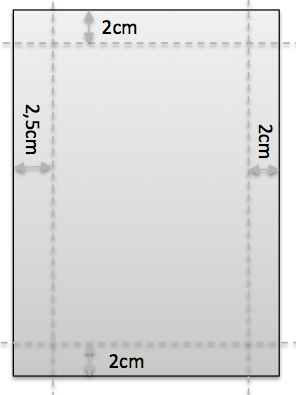
If the notice of appeal does not comply with the formal requirements (e.g., in writing, etc.), there is an irregularity but no sanction appears to have been provided for (as R101(1) EPC does not mention R99(3) EPC).
However, if the signature is missing, the appeal is a priori deemed not filed (by analogy with Guidelines D-IV 1.2.1 ii).
Neither A122 EPC nor A121 EPC is applicable to the set period.
Filing method
The notice of appeal must be submitted in writing (A108 EPC), should in principle be typewritten or printed, and must include a 2.5 cm margin on the left side of the sheet (R99(3) EPC together with R50(2) EPC).
Furthermore, the notice of appeal may be filed:
- electronically (« Decision of the President of the European Patent Office, dated 9 May 2018, on the electronic filing of documents« , OJ 2018, A45 together with R2 EPC);
- by telefax (« Decision of the President of the European Patent Office, dated 20 February 2019, on the filing of patent applications and other documents by telefax« , OJ 2019, A18).
- a confirmation by mail may then be requested.
- If the opponent does not respond to this invitation, the fax is deemed not to have been received and the appeal is deemed not to have been filed (R2(1) EPC).
It is theoretically not possible to file a valid appeal via the online form filing system (unless the EPO acts as if the appeal were validly filed, T1633/18).
Language
The notice of appeal may be drafted in an official language of the EPO (R3(1) EPC).
If the appellant has their residence (or registered office) in one of the contracting states (or is a national of one of those states with their residence abroad) and that state has an official language other than German, English, or French, they may file the notice of appeal in that language (A14(4) EPC).
A translation must be submitted (A14(4) EPC) at the earliest simultaneously with the untranslated document (G6/91) in one of the official languages of the Office, regardless of the language of the proceedings (Guidelines A-VII 2) and within the later of the following time limits:
- A time limit of 1 month from the date of submission of the document (R6(2) EPC, and not from the end of the time limit).
- The time limit for filing the appeal (R6(2) EPC).
A121 EPC applies to these time limits if the appeal is an ex parte appeal relating to the grant procedure (i.e., for the applicant).
A122 EPC applies to these time limits, but only for the proprietor and not for the opponent or the applicant.
In other cases, these time limits do not benefit from A121 EPC or A122 EPC.
If the translation is not submitted within the time limits, the appeal is deemed not to have been filed (A14(4) EPC and T323/87).
Content of the notice of appeal
General considerations
The notice of appeal contains (R99(1) EPC):
- The name and address of the appellant (in accordance with the provisions of R41(2)(c) EPC);
- The indication of the decision under appeal;
- A request defining the subject of the appeal (e.g., « the appeal seeks the revocation of patent No. EPxxxx« ).
Furthermore, case law requires that the notice of appeal contain an indication that the appellant intends to file an appeal (T653/15): merely paying the appeal fee and stating « Following the decision of refusal dated 27.10.2014, we are proceeding with the payment of the appeal fee for European patent application No. 09737080.3 » is not sufficient to explicitly manifest the intention to appeal.
Identification of the appellant
As mentioned above, the notice of appeal must identify the appellant.
If the name of the appellant is incorrect, there is a minor irregularity (under R101(2) EPC) (G1/12) and this may be corrected after invitation by the EPO, even after the time limit for filing the appeal.
It should be noted that the omission of the appellant’s name is also considered a minor irregularity that can be corrected under R101(2) EPC (T2561/11 or T624/09).
The appellant is considered sufficiently identified (and thus there is no irregularity):
- if the appellant is presented as the former opponent, even if the name in the notice of appeal is incorrect and the address is not provided (T483/90).
- if the letter was signed by the representative of the opponent in the first instance and indicated the patent number and the decision under appeal (T350/13).
It is not necessary for the EPO’s invitation to explicitly mention R101(2) EPC: even if this invitation states it is for the proper administration of the file, the invitation is valid, and failure to respond results in the appeal being deemed inadmissible (T719/09).
Identification of the decision under appeal
If the decision is not identified, the appeal is rejected as inadmissible (R101(1) EPC and R99(1)(b) EPC).
In the event of the absence of any mention of the decision under appeal, the fact that the EPO registry was able to associate an appeal with a particular file does not mean that the appeal is necessarily admissible (T620/13).
The fact that the date of the decision is incorrect does not affect the identification of the decision (T2561/11).
Subject of the appeal
Principle
The initial notice of appeal defines the subject of the appeal (G9/92 and G4/93): is the decision under appeal contested in whole or in part?
However, it is not necessary for the notice of appeal to contain the exact grounds underlying the challenge to the decision (this is the purpose of the statement of grounds).
Unclear subject
If the subject is insufficiently clear, the board must attempt to deduce it from the notice of appeal (T7/81).
For example:
- if a decision of refusal is simply challenged, it is likely that the appellant maintains the last request on which the decision under appeal was based (T49/99 and T407/02).
- if the appellant requests the setting aside of the decision in its entirety (which had revoked the patent) and, at the same time, requests the revocation of the patent, it is likely that only the first request is valid (T413/13).
Some decisions even consider that the subject of an appeal, if not mentioned, is necessarily:
- the setting aside of the decision if it is an appeal against a revocation decision (T653/15).
- the revocation of the patent if it is an appeal against a decision rejecting an opposition (T2561/11).
Absurd or unrelated subject matter
If the subject matter of the appeal is « absurd » or unrelated to the decision under appeal, this does not mean that the appeal is inadmissible: the admissibility of the appeal is distinct from the admissibility of the requests (T2599/11).
Nevertheless, in other decisions, it has been held that an appeal failing to indicate why the first-instance decision should be set aside must be declared inadmissible: this is the case where the appellant merely submits a new request (possibly based on the request rejected at first instance but never previously submitted) (T327/13, T1738/11 or T399/13).
Thus, if the proprietor submits four new requests that have never been submitted before, it is highly likely that these requests will be deemed inadmissible or that the appeal itself will be (T438/12).
Missing subject matter
Even if the subject matter of the appeal is considered implicit, it is not permissible to omit any mention of the subject matter of the appeal.
Such a practice would amount to admitting that an appeal could be filed merely by paying the appeal fee accompanied by the application or publication number, which is contrary to the case law established in decision J19/90 (T620/13 or T371/92 or T653/15).
In the absence of a subject matter for the appeal, the appeal is rejected as inadmissible (R101(1) EPC and R99(1) c) EPC).
Subject matter already decided in a previous appeal
A board of appeal may issue a decision and remit the case to the first instance for other matters.
In such a case, the first instance is bound by the decision of the board of appeal and cannot contradict it (see below).
However, it is not possible to appeal the first-instance decision maintaining a patent by challenging, in particular, an alleged lack of novelty or inventive step: only an appeal regarding the other matters is possible here (T2047/14).
Appeal fee
Principle
The appeal is deemed filed only after payment of the appeal fee within the 2-month period (A108 EPC and R101(1) EPC): [montant_epo default= »2255 € » name= »A2(1).11 RRT »] (A2(1).11 RRT).
The A122 EPC is applicable to the 2-month period, but only for the applicant or the proprietor (Guidelines E-VIII 3.1.1), but not for the opponent (Guidelines E-VIII 3.1.2 and T210/89).
Reduced rate
Nevertheless, this official fee is only [montant_epo default= »1880 € » name= »A2(1).11 RRT – reduced rate for small entities »] (A2(1).11 RRT) for:
- natural persons;
- small and medium-sized enterprises (see the Commission Recommendation 2003/361/EC of 6 May 2003);
- non-profit organizations, universities and public research bodies.
To benefit from this reduced rate, the declaration to obtain this reduced rate must be submitted no later than the payment of the reduced amount of the appeal fee (« Notice from the European Patent Office dated 18 December 2017 concerning the reduction of the appeal fee (Article 108 EPC) for an appeal filed by a natural person or an entity referred to in Rule 6(4) EPC« , OJ 2018, A5). However, decision T1060/19 notes that this requirement appears to be ultra vires by adding requirements where there are none. Therefore, it would seem possible to file the declaration until the end of the appeal period.
If the appellant is a group of several persons, the reduction of the official fee is only granted if each of them meets the above criterion (« Notice from the European Patent Office dated 18 December 2017 concerning the reduction of the appeal fee (Article 108 EPC) for an appeal filed by a natural person or an entity referred to in Rule 6(4) EPC« , OJ 2018, A5).
If the criterion is met before the filing of the notice of appeal but changes afterwards, this does not affect the validity of the payment (« Notice from the European Patent Office dated 18 December 2017 concerning the reduction of the appeal fee (Article 108 EPC) for an appeal filed by a natural person or an entity referred to in Rule 6(4) EPC« , OJ 2018, A5).
In case of late payment
In case of late payment of the appeal fee, some boards have held that the appeal must be declared inadmissible (T1289/10, T1535/10, T2210/10, T79/01). In this case, the appeal fee is not refunded.
Other decisions (which now appear to be the majority, T1325/15 or T2406/16) take the opposite view, holding that the appeal is not filed and that the fee must be refunded.
The Enlarged Board of Appeal (G1/18) has therefore ruled: the appeal is not filed under this hypothesis.
The refund of the appeal fee is ordered ex officio (G1/18).
No notification of irregularity
The EPO has no obligation to notify the appellant of the failure to pay unless the EPO can deduce that the appellant will miss the deadline for paying the fee (G2/97).
Payment missing/incomplete
Principle
Since the appeal is not filed (see above), it is then inadmissible (A108 EPC and R101(1) EPC).
Minor error
If only a small part of the amount is missing (approx. 10%, J11/85), the formalities officer may nevertheless consider, for reasons of equity, that the payment has been made in time (A8 RFees and Guidelines D-IV 1.2.1 i).
Undetected Error
If the appellant makes a mistake regarding the amount of the appeal fee (e.g., payment with a reduction when not entitled to it), the appeal is normally inadmissible if the EPO or the other party notices it promptly (T642/12).
However, if no one notices the error for several years and the issue is only raised belatedly, the board of appeal considers that, under the « principle of legitimate expectations, » the appeal will be deemed validly filed (T595/11).
Refund
If the appeal is deemed not to have been filed (e.g., appeal document filed too late or fee paid too late), any official fees paid are refunded without the need to request it (as it constitutes a payment without legal basis).
See also below.
Special Case of an Appeal Against a Decision Affecting Multiple Patent Applications / Patents
Situations may arise where an EPO decision has implications for multiple patent applications / patents.
In such a case, an appeal number will be created for each patent application / patent. How many official fees must then be paid?
Rest assured: only a single official fee will need to be paid since only one decision is being challenged (J18/14).
Submission of the Statement of Grounds
Time Limit
The statement of grounds must be submitted within 4 months from the date of written notification of the decision (A108 EPC).
A122 EPC applies to the 4-month time limit for the applicant or proprietor, as well as for the opponent (G1/86).
If the statement of grounds is filed out of time, it is rejected as inadmissible (R101(1) EPC together with A108 EPC).
However, if the statement of grounds is submitted partially on time (e.g., transmission by fax begins at 23:58 and ends at 00:16), the EPO considers the appeal to be admissible (since, formally, some pages of the statement were received in time). The belatedly filed pages must be admitted to give meaning to the pages filed on time (a rejection would constitute an incorrect exercise of the discretionary power under A13(1) RPBA) (T2317/13).
Form
The notice of appeal must, in principle, be typewritten or printed and have a 2.5 cm margin on the left side of the sheet (R99(3) EPC together with R50(2) EPC).
Furthermore, and preferably, the conditions of R49 EPC should be complied with.
- sheets should preferably be in A4 format and used in portrait orientation (except possibly for drawings, tables or mathematical formulae);
- sheets should preferably be numbered with an Arabic numeral centered at the top of the sheet (but not within the margin);
- for typewritten texts, the line spacing should preferably be 1.5;
- all texts should preferably be in a font where the capital letters are at least 2.1 mm high (the size depends on the font chosen, so care should be taken) and in black;
- margins should preferably not be less than the following scheme:
Furthermore, the notice of appeal may be filed:
- electronically (« Decision of the President of the European Patent Office, dated 9 May 2018, on the electronic filing of documents« , OJ 2018, A45 together with R2 EPC);
- by telefax (« Decision of the President of the European Patent Office, dated 20 February 2019, on the filing of patent applications and other documents by telefax« , OJ 2019, A18).
- a confirmation by mail may then be requested.
- If the opponent does not respond to this invitation, the fax is deemed not to have been received and the appeal is rejected as inadmissible (R101(1) EPC together with A108 EPC).
Language
The notice of appeal may be filed in an official language of the EPO (R3(1) EPC).
If the appellant has their residence (or registered office) in one of the contracting states (or is a national of one of those states residing abroad) and that state has an official language other than English, French, or German, they may file the notice of appeal in that language (A14(4) EPC).
The language of the notice is entirely irrelevant for the reduction of the appeal fee (G6/91) (and if the application was filed or entered the national phase before April 1, 2014, « Decision of the Administrative Council of 13 December 2013 amending Rule 6 of the Implementing Regulations to the European Patent Convention and Article 14(1) of the Rules relating to Fees« , OJ 2014, A4, as otherwise, no reduction applies).
A translation must be submitted (A14(4) EPC) at the earliest simultaneously with the untranslated document (G6/91) in one of the official languages of the Office, regardless of the language of the proceedings (Guidelines A-VII 2) and within the later of the following time limits:
- A time limit of 1 month from the date of submission of the document (R6(2) EPC, and not from the end of the time limit).
- The time limit for filing the notice of appeal (R6(2) EPC).
A121 EPC applies to these time limits if the appeal is an ex parte appeal relating to the grant procedure (i.e., for the applicant).
A122 EPC applies to these time limits, but only for the proprietor and for the opponent (G1/86), but not for the applicant.
In other cases, these time limits do not benefit from A121 EPC or A122 EPC.
If the translation is not submitted within the time limits, the appeal is rejected as inadmissible (R101(1) EPC and A108 EPC).
Content
The statement of grounds of appeal sets out the reasons why the contested decision should be set aside or the extent to which it should be amended, as well as the facts and evidence on which the appeal is based (R99(2) EPC).
This statement must clearly and concisely set out the reasons why amendment or setting aside of the decision is requested (A12(2) RPBA). It must expressly and precisely set out the facts, arguments, and justifications relied upon.
There is no obligation to challenge each of the dependent claims (T750/18).
In any event, it is normally necessary to rely on these first-instance arguments (A12(2) RPBA).
The arguments contained in the statement of grounds must enable the Board and the other parties to immediately understand why the first-instance decision would be incorrect (T220/83, T213/85, T145/88, T1581/08).
This does not amount to a mere challenge of the contested decision or a general citation of the guidelines without sufficiently clarifying the intended conclusion (T220/83).
The content must be related to the contested decision.
A statement of grounds of appeal is inadmissible (R101(1) EPC and R99(2) EPC):
- if it is insufficiently substantiated (T1649/10), or more precisely, if none of the requests underlying the decision is sufficiently substantiated (i.e., it is sufficient that the admissibility requirements are met with respect to one request, T778/16);
- if it merely repeats the arguments developed at first instance (T2012/16 or T2061/19);
- if it only supplements an insufficiently substantiated (and thus inadmissible) notice of opposition without demonstrating the admissibility of the opposition (T213/85);
- if it only presents a new ground for opposition based on a new document, as this is contrary to the principles of G9/91 (T1007/93);
- if it provides a very lengthy demonstration of the inventive step of the invention but fails to explain why the first-instance reasoning on this subject was erroneous (T2536/12);
- if it does not contain arguments against certain grounds for refusal (T899/13);
- if it simply presents new sets of claims without challenging the first-instance decision (T2532/11).
If the statement of grounds merely indicates that the irregularity that justified the refusal at first instance has now been corrected (e.g., designation of a previously missing representative J18/08 or deletion of a dependent claim found to be insufficiently disclosed T935/12), the Board of Appeal accepts the appeal as admissible.
If there is a new fact, it must be sufficiently substantiated to satisfy the requirement of sufficient reasoning, and if confirmed, it must remove any legal basis for the decision (J902/87, e.g., a time limit must be suspended due to the incapacity of the representative). Insufficient reasoning does not suffice (T559/20).
Submission of evidence
Principle
Normally, documents referred to in the statement of grounds must have been submitted at first instance (A12(2) RPBA) and will be rejected if submitted for the first time on appeal (T241/18).
However, if new documents are submitted, they must be appended as an annex (A12(3) RPBA) and an explanation for their late introduction must be provided (T2182/17, A12(4) RPBA).
In any event, they must be filed to the extent requested by the board (A12(3) RPBA).
Evidence admitted at first instance
Normally, a document admitted at first instance must necessarily (T617/16 and T487/16) be admitted during the appeal proceedings.
This principle is notably motivated by the fact that an invalid patent should ultimately not be maintained (T2049/16).
Re-examination
It may happen that evidence submitted at first instance was not deemed convincing.
To the extent that there is no error in the application of the law (for example, an incorrect standard of proof was applied), a Board of Appeal should not reconsider the assessment of evidence by the first instance (T1418/17) and replace it with its own unless it can be demonstrated that it:
- failed to take into account certain material considerations (T1553/07), or
- included considerations extraneous to the case, or
- made reasoning errors, such as logical errors and contradictions in the statement of reasons (T2565/11).
It should be noted that there is a divergent decision at this stage: decision T1604/16 considers that the board of appeal has full discretion to reconsider the examination of evidence without restriction.
Language
Evidence may be provided in any language, but the EPO may require a translation (R3(3) EPC).
Focus on restitutio requests
Decided during interlocutory revision
Where the conditions for interlocutory revision are met (Guidelines E-VIII 3.3), the department whose decision is challenged may grant a requested restitutio in integrum:
- if the conditions for granting restitutio in integrum are met (Guidelines E-VIII 3.1.1 to Guidelines E-VIII 3.2);
- if the decision can be issued within 3 months (A109(2) EPC);
- and if the conditions for allowing the appeal (i.e., appeal admissible and well-founded) are met (T1973/09).
In all other cases, this matter must be decided by the board of appeal (Guidelines E-VIII 3.3).
Decided by the board of appeal
The decision on restitutio is not subject to appeal, as it is issued by the board of appeal (A106(1) EPC).
Composition and admissibility
Non-formation
Irregularities
The irregularities resulting in the appeal not being deemed filed are:
- The appeal fee has not been paid (or has been paid insufficiently) within 2 months from the notification of the decision (A108 EPC);
- The notice of appeal has not been filed within 2 months from the notification of the decision (A108 EPC and T1325/15);
- The missing signature has not been corrected within the prescribed time limit (R99(3) EPC and R50(3) EPC);
- The confirmation of the notice of appeal, if requested after filing by fax, has not been filed within the prescribed time limits (R100(1) EPC and R2(1) EPC and “Decision of the President of the European Patent Office dated 20 February 2019 on the filing of patent applications and other documents by telefax”, OJ 2019, A18);
- The authorization of the representative or employee, if requested, has not been filed within the prescribed time limit (R152(1) EPC and R152(6) EPC);
- No representative has been appointed where required (A133(2) EPC, unless the appeal concerns the filing date, J7/89).
- If the language of the notice of appeal is not an official language:
- The notice has not been filed by a person under A14(4) EPC.
- The notice has been filed by a person under A14(4) EPC, but the translation has not been submitted within the prescribed time limit.
Thus, merely paying the appeal fee within the time limit is not sufficient (T371/92).
Prior notification (by analogy with opposition)
If the formalities officer notes such an irregularity and it can still be corrected within the 2-month period from the notification of the decision (or within the 1-month period from the filing of the notice of appeal in a non-official language for the translation, or within the time limit set for correcting the missing signature), a notification is sent to the appellant.
The appellant cannot rely on the absence of notification.
However, for a missing signature, a notification is systematically sent.
Procedure
If the appeal is deemed not to have been filed, the formalities officer notifies the appellant (A119 EPC) and informs them that a decision may be requested under R112(2) EPC.
Any appeal fees paid are refunded (as paid without cause, J21/80, published in OJ 1981, 101).
Inadmissibility and major irregularities
Irregularities
If the appeal contains a major irregularity (R101(1) EPC), the appeal is inadmissible:
- the decision under appeal is not subject to appeal (A106 EPC);
- the appellant is not entitled to file an appeal (A107 EPC);
- the identity of the appellant could not be established by the end of the appeal period (major irregularity);
- the appeal was not filed in writing;
- the statement of grounds of appeal was not filed within the 4-month period (A108 EPC);
- the notice of appeal does not identify the decision under appeal (R101(1) EPC and R99(1)(b) EPC);
- the notice of appeal does not sufficiently identify the subject of the appeal (R101(1) EPC and R99(1)(c) EPC) or is not sufficiently linked to the decision under appeal (e.g., does not explain why the decision is incorrect but proposes new inventive step attacks, T399/13);
- if the language of the statement of grounds of appeal is not an official language:
- this statement not being filed by a person under A14(4) EPC.
- this statement being filed by a person under A14(4) EPC, but the translation is not submitted within the prescribed time limits.
Prior notification (analogy with opposition)
If the formalities officer identifies such an irregularity and it can still be corrected within the 2-month period (or 4-month period for the statement of grounds) from the notification of the decision (or within the 1-month period from the filing of the statement of grounds of appeal in a non-official language for the translation), a notification is sent to the appellant.
The appellant cannot rely on the absence of notification.
Procedure
If the formalities officer identifies irregularities that can no longer be corrected:
- if these irregularities have already been notified to the appellant:
- a rejection is pronounced by the formalities officer (or by the board of appeal if it concerns facts and evidence).
- if these irregularities have not been notified to the opponent:
- the formalities officer notifies them and generally grants 2 months to respond (A113(1) EPC, this does not mean that the appellant may correct them) and indicates that the appeal will likely be rejected as inadmissible.
- the appellant may then contest the existence of this irregularity;
- a rejection is pronounced by the formalities officer (or by the board of appeal if it concerns facts and evidence).
If the appeal is deemed inadmissible, the appeal is rejected.
The appeal fee is not refunded (T84/89), except in cases provided above.
Inadmissibility and minor irregularities
Irregularities
If the appeal contains a minor irregularity (R101(2) EPC), the appeal is inadmissible:
- the requirements for the designation of the appellant are not complied with.
Prior notice (analogy with opposition)
If the formalities officer notes this irregularity, they notify the appellant and request correction of the errors within a set period (R101(2) EPC).
A121 EPC applies to this set period for the applicant only.
A122 EPC applies to this set period for the proprietor only.
Procedure
If, despite this notification, the irregularity is not corrected, the formalities officer rejects the appeal as inadmissible (R101(2) EPC).
Of course, the appellant may correct this irregularity even before receiving this notification, at any time (even after the 2 or 4 month period) without prejudice.
The appeal fee is not refunded (T84/89).
Admissibility
If the appeal is admissible, a notification is sent, but this does not constitute a decision and therefore does not preclude a subsequent rejection (T222/85).
Examination of the appeal
Suspensive effect
Appeals have a suspensive effect (A106(1) EPC).
In particular, it suspends entry in the EPR or publication in the EPO Bulletin or the publication of the patent specification (Guidelines E-XII 1).
In principle, only admissible appeals have this effect (J28/03).
Nevertheless, if it is known that an application is pending until the end of the appeal period (and thus the suspensive effect applies at least until then, G1/09), one may wonder what happens if the appeal is merely filed but inadmissible.
Interlocutory revision
Principle
Interlocutory revision is the review of the decision by the body that issued it.
This revision is only possible for ex-parte proceedings (A109(1) EPC) where the appeal is admissible and well-founded.
Exclusion and exceptions to the exclusion
Interlocutory revision is therefore excluded for:
- appeals in opposition proceedings except:
- all opponents have withdrawn their opposition and the proprietor files an appeal (Guidelines E-XII 7.1);
- if an opposition/intervention is rejected as inadmissible before the notification under R79(1) EPC is sent to the proprietor, so that the admissibility procedure does not yet involve the opponent or intervener as a party.
- appeals relating to a decision on the stay of proceedings (R14 EPC);
- appeals relating to a decision on the registration of a transfer (R22 EPC);
- appeals relating to the correction of an inventor where this involves two inventors (one replacing the other, R21 EPC).
Cases of revision
Principle
If the competent instance (the one whose decision is challenged, i.e., the first-instance instance) considers the appeal to be admissible and well-founded, it shall allow it (A109(1) EPC).
Indeed, it may be that:
- The competent instance finds that it made an error:
- e.g., it considered a document as 54(2) whereas it was 54(3);
- The instance did not duly take into account certain documents (Guidelines E-XII 7.1 i or ii);
- The appellant proposes amendments overcoming the last objections of the competent instance:
- e.g., amendment of the claims (T139/87, T47/90 and Guidelines E-XII 7.1 iii);
- e.g., presentation of an auxiliary request considered patentable as the main request.
It should be noted that if the amendments made address the initial objections, the interlocutory revision must be granted, even if new objections may be raised (T682/22).
Case of obiter dictum
In the case of an obiter dictum (i.e., an indication attached to the decision concerning an element but which does not form part of the decision itself, e.g., « in addition to lack of novelty, the claim is not clear« ), the appeal will be considered well-founded (and thus the interlocutory revision must be granted) even if the grounds of the obiter dictum are not overcome (T1060/13, in contradiction with the Guidelines E-XII 7.1 and the Guidelines E-XII 7.4.2).
Revision to improve its rejection?
It should be noted that the Examining Division may indeed realize it made an error but cannot « improve » the reasoning of its rejection (T955/20).
Cases of no revision
The appeal is referred to the board of appeal (A109(2) EPC):
- if the competent instance does not allow the appeal within a period of 3 months;
- if the competent instance considers that the appeal is not admissible and/or not well-founded.
In the case of auxiliary requests and if only one of them is allowable, the competent instance cannot allow the appeal (Guidelines E-XII 7.4.3 and T919/95).
Furthermore, maintaining its objections cannot give rise to a decision by the first instance. In this case, there is a procedural violation (T691/91). An appeal against this « decision » would then be possible.
Appeal against interlocutory revision
No appeal is possible against an interlocutory revision complying with the provisions of A109 EPC, because:
- if it allows the appellant’s requests, no appeal is possible (A106 EPC);
- the referral to the board of appeal is not a decision.
Dismissal of the appeal
The competent department cannot dismiss the appeal, even if it is clearly inadmissible: only referral to the board of appeal is possible (A109(2) EPC).
Request for reimbursement of the appeal fee
The competent department may grant reimbursement of the appeal fee (see below).
Dismissal of the request for reimbursement of the appeal fee
The competent department cannot dismiss the request for reimbursement of the appeal fee even if it has allowed the appeal (J32/95 and G3/03): only referral to the board of appeal is possible (A109(2) EPC) to decide this matter.
The request for reimbursement of the appeal fee will only be referred to the board of appeal if it was filed together with the appeal (Guidelines E-XII 7.3 and T21/02).
Withdrawal of the opposition / appeal
Withdrawal of the opposition
An opponent who has not filed an appeal may declare that they do not intend to maintain their opposition; they cease to be a party to the appeal proceedings (except with regard to the apportionment of costs, T789/89 and T340/05).
The proceedings continue if there is still an appellant (even if it is only the proprietor, T789/89).
If the last opponent who has filed an appeal withdraws their opposition, the appeal proceedings are closed even if the non-appealing proprietor objects (G8/93 and G7/91), as the withdrawal of an opposition is equivalent to the withdrawal of the appeal.
Withdrawal of the appeal
An appeal may be withdrawn at any time until the decision (e.g., before the closure of oral proceedings, T406/00), as there is no obstacle to doing so.
It is even possible to partially withdraw an appeal with respect to a specific issue distinct from the decision under challenge (J19/82).
If the sole appellant or the last appellant withdraws their appeal, the appeal proceedings must be closed (G7/91). If there are still appellants remaining, the proceedings may continue (G2/91), but only with respect to the subject-matter of the appeals of the remaining appellants (T233/93).
It is recalled that an intervener at the appeal stage is not considered to be an appellant (G3/04).
After the withdrawal of the appeal, it is possible to decide on ancillary matters such as the apportionment of costs (T117/86) or the reimbursement of the appeal fee (T41/82).
If the proprietor indicates during the appeal that they are no longer interested in maintaining the patent, the appeal proceedings are closed by a decision revoking the patent (T820/94).
Effects of withdrawal on interveners at the appeal stage
If the intervention occurs at the appeal stage, the intervener is treated as an appellant who has not filed an appeal (G3/04). Thus, if all those who have filed an appeal withdraw, the proceedings are terminated.
If the last appellant withdraws their appeal on the same day as the intervener files their declaration, the exact chronological order of these events must be examined to determine whether the intervention is admissible (T517/97):
- if the intervention is declared admissible, the appeal proceedings are terminated (G3/04) and the opposition official fee is not refunded;
- otherwise, the opposition official fee is refunded, as the intervention is not admissible.
Examination by the board of appeal
Conclusion of the admissibility examination
Once the board of appeal has assumed jurisdiction over an appeal, the admissibility of the appeal can no longer be challenged by a third party, in accordance with the principle of good faith (T303/05).
Independence of the boards of appeal
The examining boards are not bound by any instructions (A23(3) EPC).
The examination proper
The examination aims to determine whether, on the merits of the case, the appeal may be allowed (A110 EPC).
Any amendment to the framework of the appeal after the filing of the statement of grounds is then considered late (A13(1) RPBA) and a justification for this amendment must be provided.
Late filing is not entirely excluded but remains difficult, particularly if new issues are raised that require additional examination:
- general case:
- discretionary power of the board of appeal, taking into account procedural economy: A13(1) RPBA or
- after the dispatch of the communication inviting the parties to present their observations / informing them of oral proceedings:
- exceptional circumstances justified by the party: A13(2) RPBA;
- or admitted ex officio by the board of appeal, even without justification by the party (T1294/16).
Examination ex officio
The board may raise certain grounds ex officio (A114(1) EPC), even though the subject of the appeal is to discuss the contested decision (T996/18 and T862/16).
Admissibility of requests
Late-filed requests
A request is often considered inadmissible if it contains facts, evidence, or requests that could have been submitted (A12(4) RPBA, T2061/19) or were not admitted during the first-instance proceedings (T556/13), even if it clearly overcomes the objections raised (T1802/12).
From the moment any party has already presented a request, argument, evidence, etc., in the first instance, the latter cannot be considered late-filed (T920/20).
The proprietor must not only have had the abstract possibility of filing the request in the first instance but must rather have had a clear opportunity to do so (T419/12).
In particular, if a request was withdrawn in the first instance, it is unlikely that the board of appeal will admit the reintroduction of that request (T935/12, T523/11) since no reasoned decision will have been taken on it. The same applies to objections that were not maintained (T2769/19).
This does not mean, however, that amendments to the claims presented at the appeal stage must be systematically excluded from the proceedings, their admissibility being assessed under A13(1) RPBA or A13(2) RPBA.
Exceptional circumstances may include:
- A substantial procedural violation committed by the examining division due to the fundamental importance of the right to be heard (T545/18);
- An appropriate response to an objection raised for the first time in the communication under A15(1) RPBA 2020 (T545/18), but only to the extent that it addresses the objection (T1869/18).
However, the following is not considered exceptional:
- The change of a representative (T615/17).
If the proprietor submits four new requests that have never been presented before, it is highly likely that these requests will be deemed inadmissible or that the appeal will be (T438/12, T123/17).
In cases where exceptional reasons (under A13(2) RPBA) are invoked, it is incumbent upon a party to explain not only the exceptional circumstances but also why its amendment constitutes a justified response to those circumstances, both in terms of content and timing.
When amendments are proposed at an extremely late stage, the compelling reasons under A13(2) RPBA must include the reasons why it was not possible to file the amendments earlier (T1707/17). For example, a new request that is a direct reaction to the exchange of arguments during oral proceedings and addresses the objections of the opposition division should be admitted (T1790/17).
It should be noted that decision T339/19 provides a rather flexible definition of exceptional circumstances: these are circumstances that neither compromise the procedural rights of the other party nor the economy of the proceedings (though it is uncertain whether all boards adhere to this definition).
Substantiated requests
For a request to be admissible, it is imperative that it be substantiated (T1090/14).
Convergent requests
The EPO’s common practice is to accept sets of claims only if they are more restricted than the set of claims pending (i.e., sets of claims in a « funnel » format).
This practice is also referred to as « convergence of requests. »
The first level of convergence is that requests filed in appeal must be based on those from the first instance (A12(2) RPBA, T1120/20).
However, this is not systematic, and the EPO may accept a new set of claims that is broader if the amendments are not fundamental and do not create a « new case » or « fresh case » (T2599/11, T123/17).
It should be noted that the convergence of requests is assessed during the admissibility examination of the request (T649/14): thus, a request initially convergent may no longer be so if additional requests are filed.
Furthermore, a request may be considered non-convergent and therefore inadmissible, even if it had been filed in the first instance and in the statement of grounds of appeal (T1280/14).
Finally, convergent requests may become non-convergent after the introduction of intermediate auxiliary requests (T1185/17).
Requests not admitted in the first instance
For the reasons mentioned above, requests not admitted in the first instance will be considered late, but the board of appeal may verify whether their non-admission is correct or still applicable (T490/13 or T2344/15).
It may happen that the first instance declares a request inadmissible, but the board of appeal actually considers it admissible (T2026/15): this may occur if the reasons given in the first instance are so detailed that they are actually substantive arguments.
Requests not related to the decision under appeal
In reality, these requests are very similar to late requests.
A request is considered inadmissible if it is not sufficiently related to the decision under appeal: for example, if a patent is maintained following an attack on inventive step (combination of documents D1 and D2), it is not possible to request revocation in appeal for lack of inventive step based on the combination of documents D3 and D4, which was not previously discussed (T1738/11).
Requests not explaining why the decision is erroneous
Each request must demonstrate why the decision is erroneous.
For example, if a request is a copy-paste of the notice of opposition without explaining why the opposition decision is unfounded, this request will be inadmissible (T2227/14 or T2061/19).
Requests not presented explicitly
If the applicant presents requests that may subsequently choose to rely upon, these requests will be considered not filed (T1440/12).
Indefinite requests
It is not possible to make a vague request such as « the maintenance of the patent with any claim that would be deemed acceptable » (T1138/12).
Similarly, it is not possible to make a request by stating « the term xxx is replaced by yyy in the main request or by any other acceptable term » (T1773/10).
Under A113(2) EPC, the EPO is bound by the text submitted by the proprietor. Pursuant to A101(3) EPC, the EPO may maintain a patent in amended form only if it meets the requirements of the EPC. If a claim of a request does not meet said requirements, the patent cannot be maintained in that form: that is the end of the matter.
Renumbered requests during the proceedings
If a request is renumbered during the appeal proceedings, it will be considered as an amendment of the case and its admissibility must be assessed under A13(2) RPBA (T1297/16).
Requests aiming to dismiss an attack
If an attack is made by an opponent, and the proprietor responds on the merits, it is not possible to request the dismissal of that attack unless it is considered an amendment of the case: its admissibility must be assessed under A13(2) RPBA (T1774/21).
Requests deleting claims
In a number of decisions, the deletion of claims was not seen as changing the factual situation and therefore did not constitute an amendment of the case under A13(2) RPBA (T1480/16), but this is not always the case (T2222/15, T482/19). In particular, if the deletion of a claim allows avoiding revocation, there is clearly an amendment of the case (T355/19).
If the deletion clearly addresses the existing objections without creating new ones and contributes to procedural economy, it could even be considered as constituting exceptional circumstances under A13(2) RPBA (T1857/19).
If all requests are inadmissible
If all requests are inadmissible, the appeal is simply dismissed (T1162/12, T2061/19).
Absence from possible oral proceedings
If a party is absent from the oral proceedings, this will not prevent (A15(3) RPBA):
- the pronouncement of the decision;
- the submission of a new document/argument, since the absence of a party is equivalent to its waiver of the right to be heard (G4/92 states that late documents could no longer be added during oral proceedings in which a party is absent, but this decision no longer appears to be applicable since the RPBA postdates this decision).
Appeals during the examination proceedings
Procedure
The board of appeal may, where necessary, invite the appellant to file observations on communications from the EPO (R100(2) EPC) within a time limit.
A121 EPC is applicable to this time limit.
If the applicant fails to respond to this invitation, the application shall be deemed to be withdrawn (unless the decision is a decision of the Legal Division, e.g., validity of a priority, R100(3) EPC), even if the decision under appeal did not refuse the application (e.g., non-designation of an additional state, J29/94).
A mere request for oral proceedings constitutes a valid response to this communication (T1382/04).
In any event, the board of appeal has the power to examine all requirements of the EPC, including those not considered by the examining division or considered to have been met (G9/92 and G10/93).
Reformatio in pejus
The appeal during the examination procedure may well result in a reformatio in pejus (i.e., for the worse for the applicant, G10/93): indeed, the board may examine of its own motion certain grounds which it deems relevant.
Appeal during the opposition procedure
Procedure
The board of appeal may, where necessary, invite the parties to file observations on communications from the EPO and on communications from other parties (R100(2) EPC) within a time limit of 4 months (A12(1) RPBA, c)), which may exceptionally be extended upon reasoned written request (A12(7) RPBA).
Neither A121 EPC nor A122 EPC is applicable to this time limit, but a late response may, under certain circumstances, be taken into account.
No sanction exists for failure to respond.
The board of appeal must examine and decide whether the appeal may be allowed, even if no request has been filed or no response has been provided (T501/92).
The appeal may not be continued ex officio by the board of appeal if all appellants withdraw (even if the patent does not satisfy the requirements of the EPC, G8/93).
Reformatio in pejus
The appeal during the opposition procedure cannot result in a reformatio in pejus if:
- the appellant is the only party to have filed an appeal (G9/92 and G4/93);
- this « non reformatio in pejus » is invoked by the appellant (T1544/07).
If there are multiple appellants (a priori, an opponent and the proprietor), a reformatio in pejus may occur.
Challenging for A123(2) Issues
Nevertheless, this principle of « non reformatio in pejus » (G9/92 and G4/93) may be challenged where (G1/99):
- the opponent files an appeal;
- the opponent raises an A123(2) EPC issue concerning the claims as maintained.
Indeed, the proprietor must resolve this issue by following, in order, the steps of the following process (G1/99):
- attempt to limit the scope of the claims as maintained with features from the application;
- if such a limitation is not possible, extend the scope of the claims as maintained by adding certain features from the application, without contravening A123(3) EPC;
- if such an extension is not possible, delete the amendment contrary to A123(2) EPC, without contravening A123(3) EPC.
We understand that the resulting claims may, under this process, have a broader scope than the claims as maintained by the opposition division: the prohibition of reformatio in pejus will not be respected since the opponent’s position will be worse than before.
In case T61/10, the board states that to challenge the principle of non reformatio in pejus, there must be a causal link between:
- the new objection of the sole appellant and
- the limiting feature to be deleted.
Challenging for A84 Issues
Furthermore, decision T809/99 (followed by T1380/04 or T648/15) extends this challenge to cases where:
- the opponent files an appeal;
- the opponent raises a clarity issue under A84 EPC concerning the amendments introduced.
The same process as described above must be followed by the non-appealing proprietor (point 2.3 of decision T809/99).
Challenging for A83 Issues
In case T1979/11, the board of appeal accepted a challenge to the principle of non-reformatio in pejus if the opponent raises for the first time an objection of insufficient disclosure at the appeal stage.
Challenging in Case of an Unsupported Disclaimer
If a disclaimer is unsupported, it somewhat reverts to the A123(2) case (T2277/18).
Challenging to Counter New Facts/Arguments
Finally, decision T1843/09 extends this challenge to all cases where:
- the proprietor limited the patent before the appeal,
- and where the application of non reformatio in pejus would prevent the proprietor from adequately defending the patent against new facts and objections introduced at the appeal stage.
Interveners
If the intervention occurs at the appeal stage, the intervener is treated as an appellant who has not filed an appeal (G3/04). Thus, if all appellants withdraw their appeals, the proceedings are terminated.
The intervener must pay the opposition official fee (A105(1) EPC and R89(2) EPC and A2(1).10 RFees : [montant_epo default= »745 € » name= »A2(1).10 RRT »]).
If the last appellant withdraws their appeal on the same day the intervener files their declaration, the exact chronological order of these events must be examined to determine whether the intervention is admissible (T517/97) :
- if the intervention is declared admissible, the appeal proceedings are terminated (G3/04) and the opposition official fee is not refunded;
- otherwise, the opposition official fee is refunded, as the intervention is not admissible (Guidelines A-X 10.1).
The intervener may present new arguments and new grounds under A100 EPC that were not previously raised (G1/94). If new grounds are introduced, the case is generally remitted to the opposition division (except in special cases G1/94).
Similarly, the intervener may introduce new documents, which will not be considered late-filed (T1235/14).
However, if certain aspects of the opposition have already been decided, the intervener may no longer challenge what has already been settled (T694/01).
Thus, if the board of appeal has decided to maintain the patent in amended form, the intervener may only address issues of compliance of the description and drawings with the claims (even if the case is remitted to the opposition division, A111 EPC, res judicata).
Late-filed grounds
Principle
A ground not present in the notice of opposition is a late-filed ground.
The following are not considered late-filed grounds, even if they arise in the opposition proceedings:
- but incorrectly substantiated;
- but abandoned during the opposition proceedings (T274/95, although there is also a conflicting decision T1491/07);
- but presented by another party who is no longer a party to the appeal proceedings (T520/01).
A new attack against an auxiliary request will be considered a late-filed ground (T124/16).
A ground presented in the first instance but whose admissibility was not decided will also be considered late-filed (T77/18).
Admission of late-filed grounds
Late-filed grounds for opposition cannot normally be taken into consideration at the appeal stage (G10/91) except:
- if the proprietor explicitly agrees (G10/91) and the document is prima facie relevant;
- if the claims have been amended with the appeal (G10/91, A13(3) RPBA);
- if these grounds are presented by an intervener who did not participate in the first instance (G1/94);
- in this case, the case is remitted to the first instance, unless there are special circumstances (e.g., request by the proprietor, G1/94)
- if they were filed late during the opposition stage and wrongly disregarded (A114(2) EPC) (T986/93);
- if they were examined ex officio by the opposition division (T309/92).
Nevertheless, the Board of Appeal retains discretion under A13(1) RPBA to disregard late-filed grounds pursuant to A114(2) EPC. In particular, it is free to admit late-filed grounds not submitted by the previous representative who was seriously ill when drafting the statement of grounds of appeal (and who has since passed away, T336/11).
Distinct grounds
Normally, novelty and inventive step are two distinct grounds.
Nevertheless, if the lack of inventive step with document D1 as the closest prior art was raised, it is possible, even if not explicitly invoked, to attack the patent for lack of novelty over D1 (G7/95).
Furthermore, it is common that the lack of inventive step is not substantiated when the notice of opposition also includes an attack on novelty using the same documents (as this often amounts to a contradiction). In such a case, the lack of inventive step may be examined without being considered a late-filed ground (T131/01 or T184/17), as this does not alter the factual framework.
Late-filed arguments
Previous case law
Similarly, late-filed arguments may be rejected under the discretionary power of the board under A13(1) RPBA (T1621/09), provided that the proprietor could have reasonably foreseen that such arguments might be discussed (T607/10, where, in that case, the closest prior art had been changed).
For example, a new combination of prior art documents (where 10 other combinations have already been submitted) may be rejected (T1019/13) under A13(1) RPBA.
Similarly, a new inventive step attack based on document D17 (where a novelty attack based on the same document D17 had already been presented) may be considered late-filed (T181/17): care must therefore be taken, as even though T131/01 holds that this is not a late-filed ground, it may very well be a late-filed argument …
The absence of one of the parties at oral proceedings is a factor to be taken into account when exercising the discretionary power of the board, but it should not prevent the board from admitting amendments and reaching a decision based on the amended submissions (T1621/09).
Shift in case law
It should be noted that decision T1914/12 calls this previous position into question.
According to the board of appeal (T1914/12), A114(2) EPC does not provide for arguments to be disregarded. While, during the initial discussions of the EPC, late-filed arguments could be disregarded, the preparatory work shows that the legislator ultimately abandoned this idea.
The question may therefore be raised as to the conformity of A12(3) RPBA or A13(1) RPBA with A114(2) EPC.
Consequently, boards have no discretionary power to disregard late-filed arguments (provided they are based on facts already present in the proceedings – otherwise, they will be inadmissible T1684/18).
If such arguments are in fact late-filed allegations of facts (i.e., facts not already in the proceedings), these arguments may be rejected (T1684/16).
Development of previously presented arguments
It may happen, particularly during oral proceedings, that a party refines or develops its arguments.
This is entirely acceptable as long as it does not constitute an amendment to the grounds (T247/20).
Late-filed evidence/documents
Principle
Regarding late-filed evidence/documents, the board of appeal may exceptionally admit them if they are prima facie relevant and the party submitting them explains the late submission (A13(1) RPBA or A13(2) RPBA).
The board of appeal must in any event take into account the arguments of the proprietor opposing such admission (T1002/92).
Nevertheless, this does not mean that a document that is prima facie relevant will always be admitted: the board of appeal retains full discretion to prevent any “circumvention” of the procedure (T712/12). Thus, even if a document is highly relevant, but its late submission is not justified, it may not be admitted (T2696/16).
In principle, if a document/evidence is highly relevant, the case should normally be remitted to the first instance in order not to unjustly deprive the proprietor of a double level of jurisdiction (T258/84 or T1810/13).
If the item could have been submitted before the opposition division, it should, in principle, be rejected as inadmissible (T85/93 or T712/12).
However, if the submitted documents aim to address a new argument (e.g., identification of an additional difference), they may be admitted (T263/12).
Prior use and abuse of procedure
In the case of late submission of prior use, this will often be considered an abuse of procedure (Guidelines E-III 8.6 and T534/89, T1955/13).
Under these circumstances, the prima facie relevance of the prior use may not be examined (Guidelines E-III 8.6 and T534/89, T1955/13).
It should also be noted that this does not depend at all on whether the person invoking this prior use has only just become aware of it or not (T1955/13): insofar as an internal prior use was not raised, whether deliberately or through negligence, and no amendment justified conducting searches in a particular direction, the principles of fairness and equal treatment of the parties lead the Board not to admit the late-filed internal prior art.
Rejection of a document admitted by the opposition division
We may wonder whether the board of appeal can consider as ultimately late a document that was admitted by the opposition division when it should not have been.
In reality, this is not possible: there is no legal basis for rejecting a document that was previously admitted (T487/16 contra T960/15).
Amendments
If the proprietor wishes to submit amendments, they must do so as soon as possible. In any event, late amendments (e.g., during oral proceedings) may only be admitted if such late submission is unambiguously justified by exceptional circumstances (T93/83).
To be admitted, amendments must be timely and necessary (T295/87).
In the case of substantial amendments requiring re-examination, the case must be remitted to the first instance (T63/86).
If all parties agree to the proposed amendments (i.e., no party raises an objection), the board of appeal must examine the amendments (R100(1) EPC).
Apportionment and fixation of costs
The situations that may lead to an apportionment of costs are similar to those in opposition proceedings. The same applies to the procedure (R100(1) EPC).
However, in appeal proceedings:
- it is not possible to file such a request (related to opposition proceedings) if it was not filed during the opposition (T1059/98);
- the board of appeal may not decide on the apportionment of costs of its own motion: a request must be filed to that effect (A16(1) RPBA).
Furthermore, a decision on the apportionment of costs in opposition proceedings is not subject to appeal if it is the sole subject of the appeal (A106(3) EPC together with R97(1) EPC). Thus, if the decision has granted the proprietor’s requests on the merits, it is not possible to have this apportionment modified (even if the other party files an appeal T1237/05).
In this situation, the appeal will be rejected as inadmissible (R101(2) EPC).
An appeal concerning the fixation of costs in opposition proceedings will only be admissible if the amount at stake exceeds the appeal fee (A106(3) EPC together with R97(2) EPC). The amount of the appeal fee is [montant_epo default= »1240 € » name= »A2(1).11 RFees »] (A2(1).11 RFees). If an appeal is filed without meeting these conditions, it will be rejected (R101(1) EPC). The principle of non reformatio in pejus applies here (T668/99).
Decision
Principle
Following the examination, the board of appeal may (A111(1) EPC):
- either issue a final decision;
- or remit the case to the first instance to complete the examination.
Date of the decision
The date of the decision is:
- in written proceedings:
- stated in the notification of the decision (R102 b) EPC);
- the fiction of delivery to the internal mail service (i.e., 3 days before the date indicated on the letter) set out in G12/91 does not apply.
- in oral proceedings:
- the date of the pronouncement of the decision (R111(1) EPC).
Reasons
Decisions must be reasoned (R102 g) EPC).
Remittal to the first instance
Article A11 RPBA provides that remittal to the first instance is only possible in exceptional circumstances.
This may occur, in particular:
- if a substantial procedural violation has occurred;
- if a further search is required (T943/16);
- if grounds were not decided upon in the first instance (T1966/16, T731/17);
- if the claims require a different interpretation (T607/17).
However, the mere citation of a new document is not sufficient to justify a remittal (T1089/17).
Binding effect of the decision
Principle
The decision of the board of appeal has a binding effect on the first instance (A111(2) EPC) or on a subsequently seized board of appeal (T961/18).
The first instance cannot revisit what has been decided (T843/91(v2) or T2047/14).
However, only the first instance (e.g., the examining division) is bound by this decision: another instance (e.g., an opposition division) is not bound (T21/89).
However, if the first instance is the receiving section, the examining division is bound by the decision of a board of appeal (A111(2) EPC).
Limits of the binding effect
The binding effect is limited if the facts of the case remain unchanged.
Indeed, if new documents are introduced, it is possible that the first instance may no longer be bound by the analysis of the board of appeal that had identified a document as the closest prior art (T2337/16).
Res Judicata
If the board of appeal remits the case to the first instance with the order to maintain the pending claims (but requests that the description be brought into conformity with the claims), it is not possible to file an appeal against the first instance’s decision on the grounds that claim 1 lacks novelty (for example) (T2047/14).
Indeed, this would amount to appealing the board of appeal’s decision, which is not possible (res judicata)…
Furthermore, it is not possible to challenge a board of appeal’s decision (e.g., clarity of a measurement method because the board considers that all measurement methods yield the same results) by raising a different ground based on the same facts (e.g., the description is insufficiently disclosed because the measurement methods would yield different results) (T308/14).
Of course, the principle of res judicata does not prevent the first instance from rejecting an application on grounds not decided by the board of appeal (T736/16): even if it is likely that the board of appeal reviewed the EPC as a whole before remitting the case to the first instance, the authority of res judicata applies only to the operative part of the decision (there is therefore no implicit res judicata).
The authority of res judicata applies to all parties, including interveners who may have joined later (T689/19).
Decision of the Board of Appeal
Timing of the Decision
The board may decide on the case (A12(8) RPBA):
- if the proceedings are ex parte, at any time after the filing of the statement of grounds (provided that this party has had sufficient opportunity to present its comments on the board’s arguments, A113(1) EPC);
- if the proceedings are inter partes, within a period of 4 months from the notification of the grounds of appeal (A12(1) c) RPBA) (provided that this party has had sufficient opportunity to present its comments on the board’s arguments, A113(1) EPC).
Authentication of the Decision
The decision must be authenticated (R102 EPC):
- by the chairman of the board of appeal, and
- by the registrar of that board.
This authentication may be carried out (R102 EPC) by signature or other means (such as electronic means, « Notice dated 1 April 1999 concerning the amendment of the European Patent Convention, its Implementing Regulations and the Rules relating to Fees« , OJ 1999, 301, points 10 and 11, and « Notice from the Vice-President Directorate-General 3 of the European Patent Office dated 15 December 2011 concerning the electronic authentication of decisions of the EPO boards of appeal« , OJ 2012, 14).
Content and Form of the Decision
Decisions must be reasoned (R102 EPC), particularly if there appears to be (or there is) a divergence from the Guidelines (A20(2) RPBA) or a previous decision (A20(1) RPBA).
If a board considers it necessary to depart from a decision/opinion of the Enlarged Board of Appeal, it should normally refer the matter to the latter (A21 RPBA).
Refund of the appeal fee
Full refund
A full refund of the appeal fee is available:
- if the appellant succeeds (whether by interlocutory revision or otherwise) and there was a substantial procedural violation (R103(1) a) EPC):
- there is a procedural violation if:
- a request for oral proceedings is not considered or is refused (T808/94);
- not all parties are summoned to oral proceedings (T209/88);
- the right to be heard (A113(1) EPC) has been infringed (T14/82);
- the application is refused for failure to respond to a communication where the EPO does not provide proof of transmission of that communication (J14/14), as the applicant did not have the opportunity to present comments before the decision was issued;
- the opponent is given only 10 minutes to study the new wording of claim 1 (T783/89);
- the first instance does not give the parties the opportunity to comment following the remittal of an appeal on the basis of new grounds, even if those new grounds were already discussed during the appeal proceedings (T892/92);
- the decision is not sufficiently reasoned (T243/86);
- the decision does not provide reasons for the rejection of previous requests in order of preference before the one that is allowed (T5/89);
- the decision rejects a late-filed request merely by stating that it was filed late (T755/96);
- the first instance does not set a time limit for submitting documents in support of a request for correction under R139 EPC (J4/82);
- the composition of a first instance is not in conformity with the Convention (T392/92);
- the decision is taken by an unauthorized formalities officer (J10/82);
- the first instance makes its acceptance of a new request conditional upon the withdrawal of all previous requests (T1105/96 and T155/88);
- a reasoning on inventive step was developed only during oral proceedings in which the applicant did not participate (T1448/09);
- the closest prior art document adopted is not the one proposed by the proprietor/opponent without explanation or justification (T427/11);
- the duration of the proceedings is abnormally long (e.g., 5 years between the RREE and the first communication, then 2 years between subsequent communications, T823/11) (contrary decision, T1824/15), but only if the applicant has been more proactive (e.g., inquiring about the status of the application or requesting acceleration of the proceedings, T2707/16).
- there is no procedural violation if:
- at least one of the grounds for appeal is not tainted by procedural violations (T4/98);
- there is a divergence from the consistent case law of the boards of appeal (T208/88);
- the board wrongly concluded that no request for oral proceedings was made (T19/87, as this is an error of judgment);
- failure to consider a request for an interview with the examiner (T182/90);
- the first instance erred in its assessment of the prior art (T367/91);
- a document was misinterpreted (even grossly, T860/93);
- there is a procedural violation if:
- if the appeal is withdrawn before the filing of the statement of grounds and before the expiry of the period for filing such statement (R103(1) b) EPC) (T89/84, the appeal must be expressly withdrawn – merely indicating that the appellant will not file a statement of grounds is insufficient T193/20);
- if the appeal is not filed (note: not filed is different from inadmissible J18/82);
- if the appeal was filed following a breach of the principle of legitimate expectations (J30/94, J38/97 and T308/05).
Refund of 75%
The appeal fee is refunded at 75% when, in response to a communication from the board of appeal indicating its intention to begin substantive examination of the appeal, the appeal is withdrawn within a period of 2 months from notification (R103(2) EPC).
Refund of 50%
The official fees are also refunded at 50% (R103(3) EPC) if the appeal is withdrawn:
- in the case of oral proceedings
- within a period of 1 month from the notification of a communication issued to prepare oral proceedings;
- in cases without oral proceedings
- before the expiry of the period set by the board of appeal inviting the appellant to file observations;
- before the decision is issued, in all other cases.
Refund of 25%
The official fees are also refunded at 25% (R103(4) EPC) if the appeal is withdrawn:
- in the case of oral proceedings
- after the 1-month period, but before the decision is announced during oral proceedings;
- in cases without oral proceedings
- after the expiry of the period set by the board of appeal inviting the appellant to file observations, but before the decision is issued;
- within a period of one month from the notification of the communication to prepare oral proceedings and if no oral proceedings take place
- if only one party withdraws its appeal within this period and oral proceedings ultimately do not take place, the fee is then refunded to that party only, T1610/15 (conversely, T488/18 holds that the fee should be refunded to everyone);
- in the event of an announcement of non-attendance at oral proceedings (as this is equivalent to a withdrawal of the request for oral proceedings T517/17).
Instance ordering the refund
The refund is ordered by the Enlarged Board of Appeal in the context of a petition for review (if the petitioner prevails before that instance) or otherwise by the board of appeal.
This refund may be ordered ex officio (J7/82) even without a request from the petitioner.
Acceleration of the appeal procedure
See the article on accelerated processing.