


The interruption of proceedings is provided for under R142 EPC.
Conditions
Jurisdiction
The interruption of proceedings falls under the jurisdiction of the Legal Division (R11(2) EPC together with « Decision of the President of the European Patent Office, dated 12 July 2007, on the competence of the Legal Division » OJ 2007, Special Edition No. 3, G.1).
Cases of Interruption
The proceedings are interrupted in three strictly enumerated cases (R142(1) EPC):
- Death or incapacity of the applicant, the proprietor, or the person representing them under national law (e.g., guardian, curator, etc.) (R142(1)(a) EPC):
- if this person has a representative, it is necessary for the representative to request the interruption of the proceedings;
- the incapacity of the applicant or the proprietor is determined according to national laws (J900/85);
- Legal impossibility of continuing the proceedings due to an action taken against the assets of the applicant or the proprietor (R142(1)(b) EPC):
- e.g., insolvency proceedings;
- Death or incapacity of the representative or legal impossibility of the representative continuing the proceedings due to an action taken against their assets (R142(1)(c) EPC).
The incapacity of the applicant or the applicant to attend oral proceedings due to snowfall is not a valid reason (J7/20).
Types of Proceedings Interrupted
This procedure is not necessarily the grant procedure but any proceedings before the EPO (opposition, appeal, limitation, etc.).
However, the death or incapacity of the opponent or the appellant (who is neither the proprietor nor the applicant) does not appear to allow for the suspension of the proceedings (only the terms « applicant » and « proprietor » are used in R142(1) EPC).
Procedure
Commencement of Interruption
The date of interruption is the date of the event listed above.
However, if the event is the death or incapacity of the applicant or the proprietor (R142(1)(a) EPC) and if they had a representative, the interruption only appears to occur on the day the representative requests it (unless a clause under R152(9) EPC states that the authorization terminates upon the death of the principal, R142(1)(a) EPC, second sentence).
This interruption is automatic.
This date is recorded in the European Patent Register (R143(1)(t) EPC).
Notification of Interruption
When the EPO becomes aware of the event interrupting the proceedings, the interruption and its cause are notified to the parties (Guidelines E-VI 1.1).
Effect of the interruption
In addition to the consequence on time limits (see below), it should be borne in mind that the interruption has a retroactive effect: thus, if a decision (or any procedural act) was to be taken after the date of interruption, it would be deemed never to have occurred (T1389/18).
Annulment of the interruption?
The decision establishing the interruption may be challenged.
What happens if, on appeal, it is found that the interruption should not have been granted?
This will undoubtedly end the interruption but without retroactive effect. Thus, the interruption will indeed have taken place (J10/19).
End of the interruption
Cause of the interruption related to the applicant/proprietor
If the issue that led to the interruption was related to the applicant/proprietor (R142(1) a) EPC or R142(1) b) EPC), and if the European Patent Office is aware of the identity of a person authorized to continue the proceedings (e.g., heir, guardian, trustee, etc.), the EPO informs that person that the proceedings will be resumed upon expiry of a set time limit (R142(2) EPC).
Similarly, the EPO may resume the proceedings ex officio if the EPO is not aware of the person who can continue the proceedings 3 years after the interruption of the proceedings (R142(2) EPC). The proceedings will be continued with the applicant or the patent proprietor recorded in the European Patent Register (OJ 5/2020, A76).
Cause of the interruption related to the representative
If the issue that led to the interruption was related to the representative (R142(1) c) EPC), the EPO resumes the proceedings as soon as a new representative is appointed (in practice, the EPO sets a future resumption date).
If, within a period of 3 months from the start of the interruption, no new representative is appointed (R142(3) EPC):
- and if the applicant/proprietor is required to be represented (A133(2) EPC),
- the EPO requests the applicant/proprietor to appoint a representative within 2 months;
- a copy of the notification is also sent to the other parties (Guidelines E-VI 1.2).
- in the absence of the appointment of a representative within the time limit, the application is deemed withdrawn or the patent is revoked (R142(3) a) EPC);
- otherwise,
- the proceedings are resumed with the applicant/proprietor (R142(3) b) EPC).
A121 EPC applies to the 2-month time limit of the notification for the applicant.
A122 EPC applies to the 2-month time limit of the notification for the proprietor.
In all other cases, the EPO must wait until the issue has been resolved to resume the proceedings.
This date is recorded in the EPR (R143(1) t) EPC).
Consequence on time limits
Principle
All interrupted time limits begin to run again in their entirety from the date of resumption of the proceedings (R142(4) EPC).
Exception: the suspension of time limits
There are, however, two exceptions for which time limits are suspended (and not interrupted) (R142(4) EPC):
- time limit for filing the request for examination:
- this time limit may, however, not be less than 2 months (J7/83) (R142(4) EPC, second sentence);
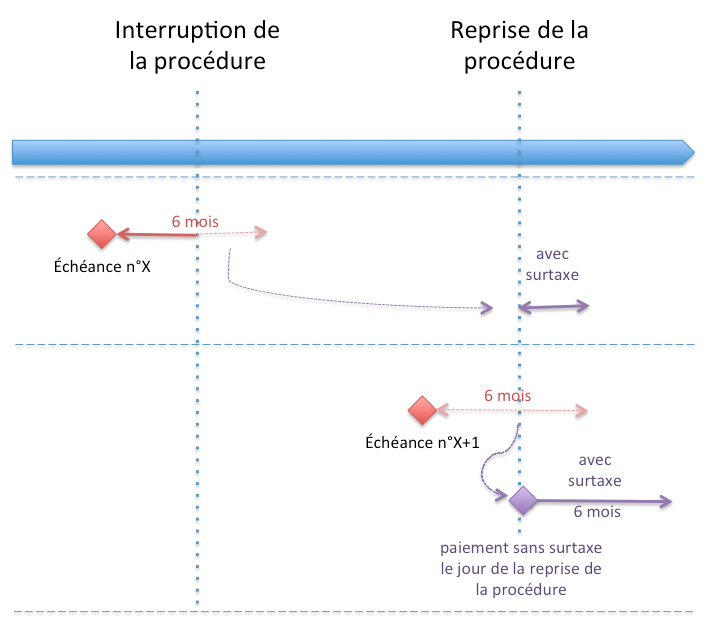
- time limits for payment of renewal official fees (i.e., 6-month time limit for payment with additional fee J902/87=J ../87, « Decision of the Legal Board of Appeal, dated 17 August 1987 J ../87« , OJ 1988, 323):
- renewal official fees that fell due during the interruption may thus be paid:
- without additional fee, on the day of resumption or
- with additional fee during the following 6 months;
- there is no minimum 2-month time limit in the case of renewal official fees.
- renewal official fees that fell due during the interruption may thus be paid:
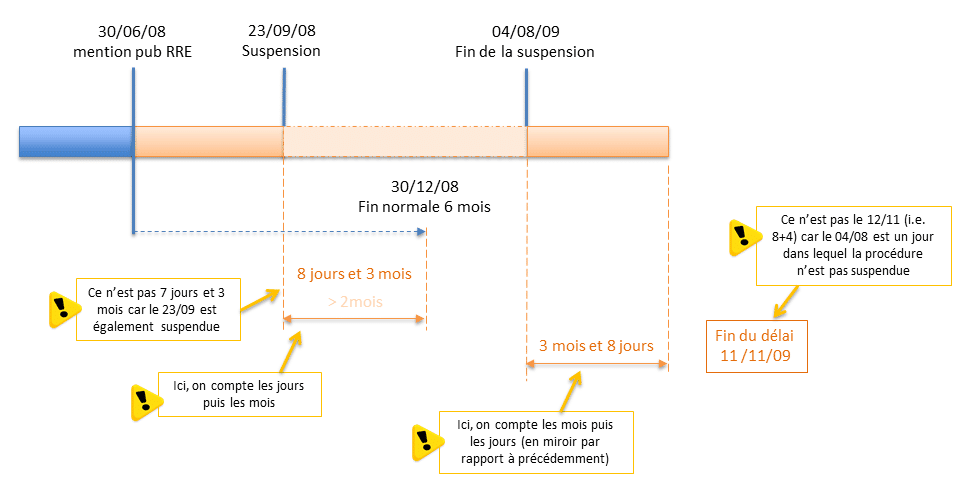
Suppose a procedural interruption occurs during the 6-month time limit under R70(1) EPC for filing the request for examination.
As indicated above, the time limit for filing the request for examination is simply suspended:
Here is an example with renewal official fees:
Focus on the time limit for re-establishment under A122 EPC
The procedural interruption also interrupts the time limit for re-establishment under A122 EPC.
Thus, if an appeal is filed against a decision based on such a loss of rights, that decision must be set aside and the case must be remitted to the first instance (J902/87=J ../87, OJ 1988, 323).