


First and foremost, it is essential to determine who actually has the right to file the patent application. For this, I invite you to consult the article « Persons entitled to file an application ».
How to establish the unauthorized filing?
The EPO is somewhat cautious and does not dare to rule on this matter itself. Thus, the EPO requires that a competent national court settle this question.
Competent courts
The competent national courts are those determined by the Protocol on Recognition of 5 October 1973 (hereinafter referred to as PR) (J6/03 citing G3/92), i.e.:
- the courts of the Contracting State designated in writing by the parties (A5(1) PR). This situation is only possible between an employee and an employer if the national law governing the employment contract permits it (A5(2) PR),
- failing that, if the invention is an employee invention (A4 PR):
- the courts of the Contracting State in which the employee carries out his or her main activity, or
- if this cannot be determined, the courts of the Contracting State in which the employer’s establishment is located (A60(1) EPC),
- failing that, the courts of the Contracting State in which the proprietor is domiciled or has its registered office (A2 PR),
- failing that, the courts of the Contracting State in which the person claiming entitlement to the patent is domiciled or has its registered office (A3 PR),
- failing that, the courts of Germany (A6 PR).
The court seized must verify whether it is indeed competent (A7 PR).
The EPO has no discretionary power on this matter (A9.2 PR).
I draw your attention to the fact that the competent courts can only be a court of a Contracting State: no U.S., Chinese, or other court may be competent.
Note, however, that if such a court were to render a decision, it would be possible to have the decision recognized by a court of a Member State through exequatur. Nevertheless, the suspension of proceedings under R14 EPC (described below) will not be possible.
Conditions for exercising the right before the EPO
To exercise the right before the European Patent Office, three conditions must be met (R16(1) EPC):
- the patent must not yet have been granted,
- the decision of the competent court must have become final and binding within the last 3 months,
- the decision must be recognized under the Protocol on Recognition (Articles 9 and 10) in the states designated by the patent application (in general, no action is required, except in certain special cases).
However, if an application is no longer pending (e.g., refused), it still appears possible to benefit from the option of refiling a patent application (G3/92).
Suspension of the grant procedure
Principle
Where a national court of a contracting state (J6/03) is seized with an action to recognize that the proprietor of a filing was not entitled to file it, a suspension of the proceedings may be requested before the European Patent Office pursuant to R14(1) EPC.
The EPO does not have to verify whether the court seized is actually competent (see rules above) to decide this question (J10/02, J36/97, A9.2 PR).
Ex officio suspension
The suspension takes effect ex officio on the day on which proof of the judicial action is provided (R14(1) EPC) and no decision is required (J28/94).
If the proprietor challenges this suspension, the Legal Division will then issue a decision subject to appeal (J28/94).
Objective
The objective of this suspension is to protect the rights of the true proprietor and to prevent the applicant from sabotaging the filing upon realizing that ownership thereof is about to be lost.
In particular, the filing (or a designation of a contracting state in the filing) cannot be withdrawn (R15 EPC).
Effect of the suspension
Principle
During the suspension of the proceedings, all time limits are suspended (R14(1) EPC).
Nevertheless, it remains necessary to pay the annual official fees (R14(4) EPC), given that anyone may pay them (Guidelines A-X 1).
Upon resumption, the time limits (which were suspended) resume, but without these being less than 2 months (R14(4) EPC, last sentence).
Example of time limit calculation
Principle
It should be noted that:
- the number of days remaining is calculated in days then months since the Guidelines provide examples of this type (see, for example, Guidelines D-VII 4.3);
- the resumption period until expiration is also calculated in days then months.
This is not entirely arbitrary (especially since in previous guidelines, it was indicated that the calculation was done in days-months then months-days…).
This method of calculation, however, poses a problem if the expiration of the time limit falls on July 31 and the time limit was suspended on June 25: June only has 30 days, so how should one count? 5 days + 1 month + 1 day? In short… if you have the answer, do not hesitate!
Example 1
Suppose a suspension of the proceedings occurs during the 6-month time limit under R70(1) EPC for filing the request for examination.
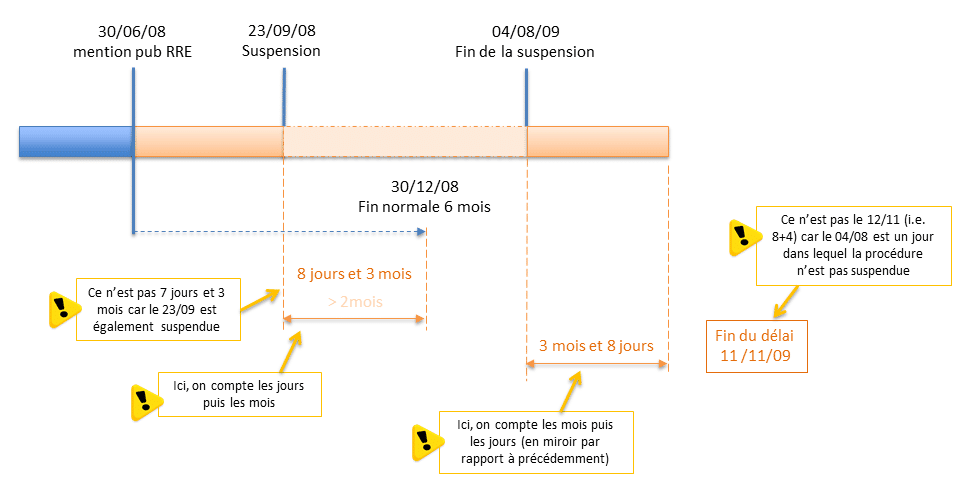
Example 2
Suppose the opposition division notifies the proprietor that its patent is maintained in amended form under R82(2) EPC: the proprietor has 3 months to provide a translation of the claims.
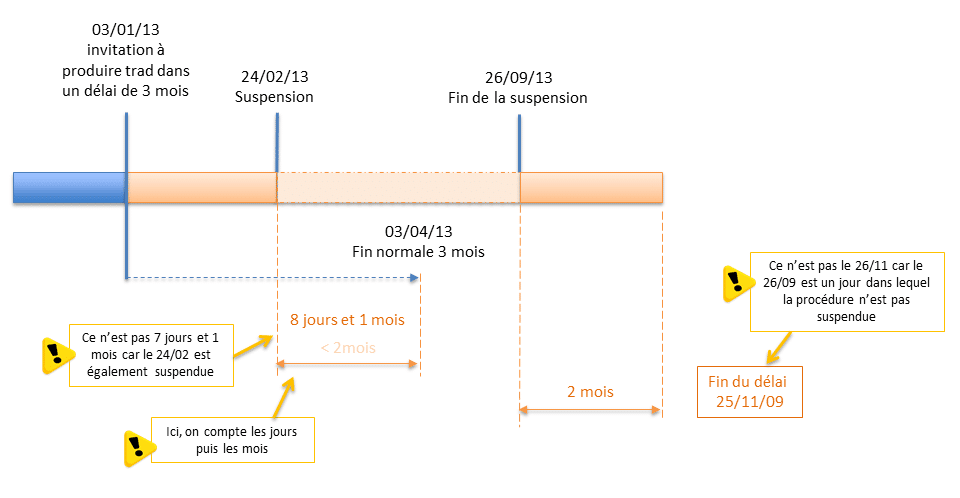
Competent body
It is the Legal Division that verifies whether the conditions for the stay are met (Guidelines A-IV 2.2, « Decision of the President of the European Patent Office, dated 12 July 2007, on the competence of the Legal Division« , OJ 2007, Special Edition No. 3, G.1).
Decision on the stay
The decision to grant a stay is normally allowed, but it is not automatic.
To decide whether to grant a stay, the EPO must verify whether the action meets the following three points (J15/13):
- The person who initiated the action is the one who requested the stay;
- The action is brought against the applicant for the patent;
- The action is indeed an entitlement action within the meaning of A61(1) EPC and whether the action is not an obvious abuse:
- The EPO will then examine the title of the action and the nature of the action.
- However, its merits are not examined.
- Abuse = if the exercise of the rights is primarily intended to cause harm and other legitimate purposes (here, safeguarding the interests of the third party) are secondary (J14/19).
- The abuse must be unequivocal and requires careful examination and weighing of the individual circumstances. The burden of proof lies with the party alleging the abuse.
Form of the stay
As such, the Legal Division does not take a decision since the stay takes effect as soon as the conditions of R14(1) EPC are met. If the applicant, once notified, contests the stay, only then does the EPO issue a decision.
This decision is then subject to appeal, and the third party is a party to the appeal (J28/94).
Caution, as the Guidelines A-IV 2.2 consider that the stay must be ordered in a decision (interlocutory decision subject to appeal together with the final decision).
Relevant dates
Date of the stay
The day on which the third party provides proof (R14(1) EPC) that it has initiated proceedings against the applicant to have its right to the invention recognized, the proceedings are stayed.
The date of the stay is recorded in the EPR (R143(1)(s) EPC).
Existence of the proceedings to have the right to the patent recognized
Regarding the point in time from which the proceedings actually exist, the national law governing those proceedings must be considered (J7/00, J14/19).
For example, depending on the country, this may be:
- The filing of the statement of claim with the registry;
- The service of that document on the applicant;
- etc.
Date by which suspension can no longer be requested
Suspension may be requested as long as no patent has been granted (R16(1) b) EPC).
It must be understood that this request for suspension must be made before the publication of the mention of grant in the Bulletin (J7/96).
Furthermore, if an application is no longer pending (e.g., refusal), it still appears possible to benefit from the possibility of refiling a patent application (G3/92) even if suspension no longer makes sense.
Limits of suspension
Authorized by the third party
It is unclear why, but the third party may consent to the continuation of the proceedings (R14(1) EPC). This consent is irrevocable.
This is relatively dangerous, as the applicant could withdraw the application or withdraw certain designated states (with R15 EPC no longer applying).
Nevertheless, in the event of withdrawal, the third party may a priori file a new application if they subsequently obtain the right to the patent (G3/92).
Annual official fee
If the grant procedure is suspended, it is important not to forget to pay the annual official fees to avoid the lapse of the application (R14(4) EPC).
Anyone may pay these annual official fees: thus, if the proprietor of the application does not pay them, it is still possible for the person believing themselves to be the rightful proprietor to pay them (Guidelines A-X 1).
Publication of the application
Furthermore, to prevent a malicious party from concealing an application for several years by preventing its publication, suspension of the proceedings may only occur after the publication of the application (R14(1) EPC, last sentence).
Discretionary lifting
Finally, the suspension of the proceedings may be lifted at the discretion of the Office (R14(3) EPC), particularly if it considers that the proceedings before the national courts are purely dilatory (Guidelines A-IV 2.3, J4/17) or excessively lengthy (T24/13).
The resumption date (in the event of lifting of the suspension) may be modified upon request (T146/82).Caution
Even if the applicant may then withdraw the application or withdraw certain designated states (with R15 EPC no longer applying), this will not prevent the third party from filing a new application if they subsequently obtain the right to the patent (G3/92).
Suspension of the opposition proceedings
Most of the above applies.
However, the opponent or intervener cannot request this suspension: it must indeed be a third party (R78(1) EPC).
Furthermore, this suspension may only be decided if the opposition division considers the opposition admissible (R78(1) EPC and Guidelines D-VII 4.1).
Exercising one’s right following recognition
Once the three conditions mentioned previously are met, the person who requested that their right to the patent be recognized may (A61(1) EPC):
- either file a new patent application (A61(1) b) EPC);
- or take over the existing application (A61(1) a) EPC);
- or request the refusal of the existing application (A61(1) c) EPC).
This choice is available for a period of 3 months from the final decision recognizing their right to the patent (R16(1) a) EPC).
The A121 EPC does not apply to this period, but restitutio in integrum (A122 EPC) is possible.
Filing of a new application
Filing
The filing of a new application (A61(1) b) EPC) follows the rules of a standard filing (Guidelines A-IV 2.7), even though it can only be filed before the EPO: indeed, R15(3) EPC73 was deleted in the EPC 2000.
Of course, it will be necessary to pay the filing and search official fees within 1 month (R17(2) EPC, i.e., as for a « normal » application) and to pay the designation official fees within a period of 6 months from the publication of the search report (R17(3) EPC, i.e., as for a « normal » application).
The A121 EPC applies to these two periods.
The request for grant must include the number of the initial application (R41(2) f) EPC).
Language of the new application
As with divisional applications, the language of filing of the new application must be that of the initial filing or, at the applicant’s choice, the language of the proceedings of that initial application (R36(2) EPC).
Designated states
Only the states designated in the initial application may be validly designated in the new application (R16(2) EPC and G3/92).
Original application
In this case, the existing application is deemed withdrawn (R17(1) EPC) as of the filing date of the new application.
If the existing application is no longer pending (i.e., abandoned, deemed withdrawn, etc.), it is still possible to file a new application (even if this may seem shocking for third-party rights, G3/92). No contrary decision has been issued to contradict this (Guidelines C-IX 2.2).
Benefit of the filing date of the original application
Furthermore, A61(1) EPC together with A76(1) EPC specifies that the new application will benefit from the filing date of the existing application, but also that no additional matter may be added compared to the existing application (thus, the description must not extend the content of the application beyond that of the initial application).
Resumption of the existing application
In this scenario (A61(1) a) EPC), the person who has requested that their right to the patent be recognized effectively takes over the history of the application. They must also request this in writing from the EPO.
From that point, the proceedings are resumed with this person (and, where applicable, with the other parties if they exist, who are notified R14(2) EPC, e.g., opponents).
The advantage of this option is primarily financial: the official fees already paid by the previous applicant are no longer due.
However, to avoid overwhelming the new proprietor (who is discovering the application and the file):
- the Office allows at least a 3-month period to elapse between the decision of the court becoming final and the resumption of the proceedings (R14(2) EPC, last sentence);
- time limits (which had been suspended) resume, but without being less than 2 months (R14(4) EPC, last sentence).
Rejection of the existing application
There is not much to say: the EPO will simply reject the existing application (A61(1) c) EPC)…
Special case in the event of partial right transfer
If a final decision has recognized the right to the patent for a third party for only part of the application, that third party may only file a new application (R18(1) EPC, i.e., rejection and resumption of the application are not possible, Guidelines C-IX 2.3).
It is also possible that the final decision recognizes the right to the patent only for certain contracting states (R18(2) EPC).
This may occur, in particular, if a co-development agreement provided for such a right.
In this situation, the third party may:
- either file a new application,
- or proceed with the application for those states (in this case, there will be an exception to the principle of unity of the A118 EPC: the descriptions and drawings may differ Guidelines C-IX 2.4 and Guidelines H-III 4.3.1).