


Requirements
Provision of a Title
Requirement
The application must include a title (R4.1.a PCT, request and R5.1.a PCT, description).
It must be brief (2 to 7 words) and precise (R4.3 PCT).
Sanction
If the title is missing (A14.1.a.iii PCT), the RO invites the applicant to provide it (A14.1.b PCT) within 2 months from the date of the invitation (A14.1.b PCT together with R26.1 PCT together with R26.2 PCT).
This time limit may be extended, upon request, even after the expiration of the time limit, as long as no decision on this matter has been taken by the RO (A14.1.b PCT together with R26.1 PCT together with R26.2 PCT).
If the correction is not made in time, the international application is deemed withdrawn (A14.1.b PCT).
Title Established or Confirmed by the ISA
If the ISA finds that the application does not contain a title and the RO has not notified it that the applicant was invited to provide one, the ISA establishes the title itself (R37.2 PCT).
If the title was previously provided by the applicant, the ISA approves the title (R44.2 PCT).
Provision of an Abstract
Requirement
The application must include an abstract (A14.1.a.iv PCT) comprising a summary of what is disclosed in the application (R8 PCT).
The abstract must be concise (approximately 50 to 150 words) (R8.1.b PCT).
Sanction
If the abstract is missing (A14.1.a.iv PCT), the RO invites the applicant to provide it (A14.1.b PCT) within 2 months from the date of the invitation (R26.2 PCT).
This time limit may be extended, upon request, even after the expiration of the time limit, as long as no decision on this matter has been taken by the RO (R26.2 PCT).
If the correction is not made in time, the international application is deemed withdrawn (A14.1.b PCT).
Abstract Established or Confirmed by the ISA
If the ISA finds that the application does not contain an abstract and the RO has not notified it that the applicant was invited to provide one, or if the ISA finds that the abstract is not compliant, the ISA establishes the abstract itself (R38.2 PCT).
If the abstract was previously provided by the applicant, the ISA approves it (R44.2 PCT).
Signature of the Application
Requirement
Normally, the request must be signed by the applicant (A14.1.a.i PCT together with R4.1.d PCT) or their representative (R2.1 PCT and R90.3 PCT).
While the request should normally be signed by all applicants (R4.15.a PCT), this does not constitute an irregularity at the international stage if only one of them has signed it (R26.2bis.a PCT).
Seals
Some receiving offices (ROs) may accept « seals » in place of signatures (R2.3 PCT).
This may notably be the case for the Chinese, Japanese, or Korean offices (Applicant’s Guide §5.091).
Sanction
If the signature is missing (A14.1.a.i PCT), the RO invites the applicant to provide it (A14.1.b PCT) within 2 months from the invitation (R26.2 PCT).
This time limit may be extended, upon request, even after the expiration of the time limit, as long as no decision on this matter has been taken by the RO (R26.2 PCT).
If the correction is not made in time, the international application is considered withdrawn (A14.1.b PCT).
Designation of the Applicant
Requirement
The applicant must be identified by indicating (R4.5.a PCT):
- their name:
- surname followed by first name (R4.4.a PCT),
- official designation for legal entities (R4.4.b PCT),
- without titles or degrees (R4.19.a PCT).
- their address:
- written to allow proper postal delivery (R4.4.c PCT),
- a telephone or fax number may supplement this address.
- their nationality (the name of the State, R4.5.b PCT) and their residence (the name of the State, R4.5.c PCT):
- this information is useful to determine whether the applicant is eligible to file an application with that RO (R19.1.a PCT),
- when the country of residence is not indicated, it is assumed to be the country listed in the address.
- The name of the State is indicated (Administrative Instructions 115)
- either in full
- or in abbreviated form
- or by its two-letter code.
Different applicants may exist for different States (R4.5.d PCT).
Sanction
If the designation of the applicant is missing (A14.1.a.ii PCT) (at least for the one enabling filing with the RO, R26.2bis.b PCT), the RO invites the applicant to provide it (A14.1.b PCT) within 2 months from the invitation (R26.2 PCT).
This time limit may be extended, upon request, even after the expiration of the time limit, as long as no decision on this matter has been taken by the RO (R26.2 PCT).
If the correction is not made in time, the international application is considered withdrawn (A14.1.b PCT).
Later evidence
During the national phase, the designated or elected Offices may request evidence of the inventor’s identity (R51bis.1.a.i PCT).
Languages of the abstract, drawings and request
Translation of the abstract and drawings
If the abstract or the text contained in the drawings is not drafted in the language of the filing (i.e., of the description and the claims) and if these elements are not already in the language in which the application is to be published, the RO will invite the applicant to submit a translation of these elements in the language in which the application is to be published (A3.4.i PCT and R26.3ter.a PCT).
However, some Offices do not accept that certain elements be in a language other than that of the description (R26.3ter.b PCT).
Translation of the request
Regardless of the language of the description and the claims, the request must be filed in a publication language accepted by the RO (R12.1.c PCT).
The publication languages are (R48.3.a PCT):
- Arabic, Chinese, English, French, German, Japanese, Korean, Portuguese, Russian or Spanish.
If the request does not comply with this requirement, the RO will notify the applicant (R26.3ter.c PCT) and invite them to remedy this irregularity and/or submit observations within a period of 2 months from the invitation (R26.3ter.c PCT together with R26.1 PCT together with R26.2 PCT).
Priority claims
Requirement
Any application may include a declaration claiming one or more priorities of earlier applications filed in a Paris Convention (A8.1 PCT) or WTO member state (R4.10.a PCT).
Any priority claim must be included in the request (R4.10.a PCT) and must specify, for the earlier application:
- the filing date (R4.10.a.i PCT);
- the filing number (R4.10.a.ii PCT);
- the place of filing:
- The Paris Convention or WTO member state in which the filing was made (R4.10.a.iii PCT);
- the authority responsible for grant (if a regional application, R4.10.a.iv PCT) and at least one Paris Convention or WTO member state for which that application was filed (R4.10.b.ii PCT) if the regional application does not cover only such states;
- the RO (if an international application, R4.10.a.v PCT).
If a state is not a WTO member and a priority is claimed outside the Paris Convention, that state may disregard the priority claim (Applicant’s Guide, §5.057).
Correction or addition of priority
Principle
It is possible to correct an existing priority claim or to add one by sending a communication to the IB or the RO (R26bis.1.a PCT).
Time limit
This correction or addition may be made (R26bis.1.a PCT):
- within a period of sixteen months from the earlier of:
- the earliest priority date before correction/addition and
- the earliest priority date after correction/addition;
- within a period of four months from the international filing date.
Furthermore, the time limit shall be deemed to have been met if the correction is received within one month following the notification from the RO or the IB indicating that the priority claim is considered not to have been made (R26bis.2.b PCT, for correction only).
Late submission
If a correction or addition is received by the IB after the expiration of this time limit but before the expiration of 30 months from the priority date, the IB may publish this information upon payment of an official fee (R26bis.2.e PCT).
Impact of early publication
Any request for correction/addition shall be considered not to have been received if it is made after the applicant’s request for early publication of the application (unless such request for early publication is withdrawn before completion of the technical preparations, R26bis.1.b PCT, i.e., 15 days before publication, applicant’s guide, §9.013).
Content
Any correction or addition of priority must comply with R4.10.a PCT and must specify, for the earlier application:
- the filing date (R4.10.a.i PCT);
- the application number (R4.10.a.ii PCT);
- the place of filing:
- The Paris Convention (PC) State or WTO member in which the filing was made (R4.10.a.iii PCT);
- the authority responsible for grant (if a regional application, R4.10.a.iv PCT) and at least one PC State or WTO member for which the application was filed (R4.10.b.ii PCT) if the regional application does not designate only such States;
- the RO (if an international application, R4.10.a.v PCT).
Effects on time limit calculations
Any time limit calculated from the priority date that has not yet expired shall be recalculated (R26bis.1.c PCT).
Restoration of the right of priority by the RO
The RO may decide to restore the right of priority if the period between the priority date and the accorded filing date exceeds 12 months but does not exceed 14 months (R26bis.3.a PCT).
To do so, the RO must apply at least one of the following restoration criteria (R26bis.3.a PCT):
- due care required by the circumstances;
- the unintentional nature of the failure to meet the time limit.
A restoration official fee may be required (R26bis.3.d PCT).
Certain countries have, of course, entered a reservation to these provisions (R26bis.3.j PCT):
- BE Intellectual Property Office (Belgium)
- BR National Institute of Industrial Property (Brazil)
- CO Superintendence of Industry and Commerce (Colombia)
- CU Cuban Industrial Property Office
- CZ Industrial Property Office (Czech Republic)
- DE German Patent and Trademark Office
- DZ Algerian National Institute of Industrial Property
- GR Industrial Property Organisation (OBI) (Greece)
- ID Directorate General of Intellectual Property (Indonesia)
- IN Patent Office (India)
- IT Italian Patent and Trademark Office
- JP Japan Patent Office
- KR Korean Intellectual Property Office
- NO Norwegian Industrial Property Office
- PH Intellectual Property Office (Philippines)
Requirement concerning the submission of the certified copy
Principle and time limit
An official copy of the priority document must also be provided to the IB or the RO:
- within a time limit of 16 months from the priority date (R17.1.a PCT, if the application reaches the IB while the application is not yet published, such copy is deemed to have arrived within this time limit) or before the request for early processing (R17.2.a PCT, as otherwise the designated or elected Offices may disregard the priority R17.1.c PCT).
Format of the copy
The copy must be certified as correct by the authority with which the earlier application was filed.
Exception regarding the submission of the earlier application
It is not necessary to provide the copy of the earlier application:
- when the RO is the Office with which the earlier application was filed, and if a request is made (within the applicable time limits above) to that Office to transmit it to the IB (R17.1.b PCT);
- an official fee may be required;
- a box is provided for this purpose in the form (R4.1.c.ii PCT).
- when the earlier application is accessible from a « digital library » and if a request is made to the IB to obtain the document from that library (R17.1.b-bis PCT). The Offices participating in this library are (PCT Newsletter n°1/2010):
- Austria;
- Spain;
- United Kingdom;
- International Bureau;
- Japan;
- Republic of Korea;
- United States.
Irregularity notice and corrections
Notice
Where the RO or the IB finds that a priority claim does not comply with the requirements of R4.10 PCT (mention of the date, number and place), that authority invites the applicant to correct the irregularity (R26bis.2.a.ii PCT).
The same invitation is sent if the authority finds a discrepancy between the priority document provided and the indications given (R26bis.2.a.iii PCT).
Invalidity of the priority claim
If the applicant does not correct the priority claim with respect to the mention of the date and the place of filing of the priority within the time limit provided for the correction or addition of priority, the irregular priority claim is considered not to have been made (R26bis.2.b PCT) and the authority notifies the applicant. The time limit for correction is extended until the notification by the authority, but without exceeding one month after the time limit provided for the correction or addition of priority (R26bis.2.b PCT).
Non-invalidity of the priority claim
Certain irregularities do not result in the invalidity of the priority claim (R26bis.2.c PCT):
- the filing number is missing;
- the information in the priority document is inconsistent with the indications given;
- the priority date is more than 12 months after the international filing date (but without exceeding 12+2 months, as there is a possibility of restoration).
Provision of a translation of the priority document?
If the validity of a priority is relevant to the patentability of an international application and if that priority is not in a language accepted by the ISA or the IPEA, that authority may invite the applicant to submit a translation of the priority in an appropriate language within 2 months (R43bis.1.b PCT for the ISA, R66.7.b PCT for the IPEA).
Failing this, the priority is considered invalid for the purposes of establishing the search and examination reports (R43bis.1.b PCT for the ISA, R66.7.b PCT for the IPEA).
Verification of the validity of the priority claim
The validity of a priority claim is not determined during the international phase.
This validity must be decided during the national phase. For example, if a State is not a member of the WTO and a priority is claimed outside the Paris Convention, that State may disregard the priority that was claimed (Applicant’s Guide, §5.057).
Sanction
If no submission of the priority document is made, any designated or elected Office may disregard the priority claim, but not before having given the applicant the opportunity to correct this irregularity within a reasonable time limit (R17.1.c PCT), unless the priority application was filed with that national Office or is accessible to it (R17.1.d PCT).
Official fees
Principle
Each international application is subject to the payment of prescribed official fees (A3.4.iv PCT).
These official fees are (R27.1 PCT):
- the transmittal official fee (A3.4.iv PCT together with R14 PCT),
- the international filing official fee (A3.4.iv PCT together with R15.1 PCT),
- the search official fee (A3.4.iv PCT together with R16 PCT), and,
- where required, the late payment official fee (A3.4.iv PCT together with R16bis.2 PCT).
Official fees to be paid
Transmittal official fee
The transmittal official fee is collected by the RO for the RO (A3.4.iv PCT together with R14.1.a PCT) to cover the costs incurred in performing its tasks.
The amount is set by the RO (R14.1.b PCT), which also sets the currency in which this official fee must be paid.
This official fee is due within 1 month from the filing date (R14.1.c PCT).
Search official fee
The search official fee is collected by the RO for the ISA (A3.4.iv PCT together with R16.1.a PCT) to cover the costs of the search.
The amount is set by the ISA (R16.1.a PCT) but must be paid to the RO (R16.1.b PCT), which sets the currency in which this official fee must be paid.
This official fee is due within 1 month from the filing date (R16.1.f PCT).
International official fee
The international filing official fee is collected by the RO for the IB (A3.4.iv PCT together with R15.1 PCT) to cover its miscellaneous costs.
The amount is set by the Schedule of Fees (R15.2.a PCT):
- 1330 Swiss francs (approximately 1090 euros);
- 15 Swiss francs per additional page from the 31st (including: the request including declarations, the description, the drawings, the claims, the abstract, the sequence listing).
The RO sets the currency in which this official fee must be paid (R15.2.b PCT).
This official fee is due within 1 month from the filing date (R15.3 PCT).
Reduction
Developing Countries
A 90% reduction of the processing official fee is possible if the applicant is a national or domiciled:
- in a country whose national income per capita is less than US$ 3,000 (Schedule of Fees, item 5.a) or
- in a country classified as a least developed country by the United Nations (Schedule of Fees, item 5.b).
For an applicant benefiting from this reduction, and if the RO is the IB, there will be no transmittal official fee.
All applicants (even if they are not part of the PCT system) must satisfy this criterion to benefit from the reduction (Schedule of Fees, item 5).
This reduction applies after the reduction concerning the means of filing if applicable (Schedule of Fees, item 5).
Currently, WIPO indicates that the following states benefit from this reduction (90% official fee reduction for the PCT):
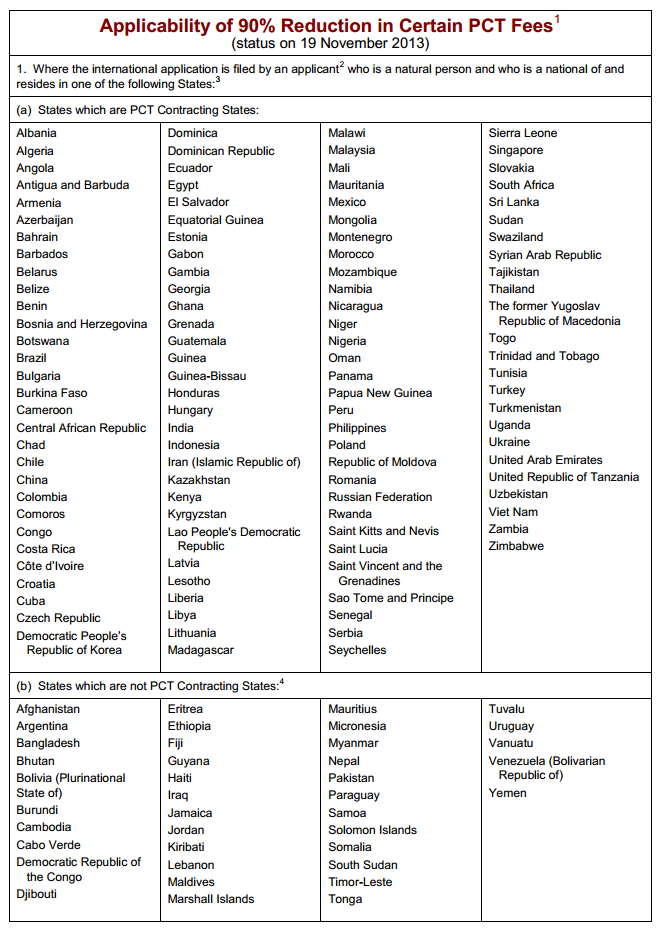 States benefiting from a reduction under the PCT
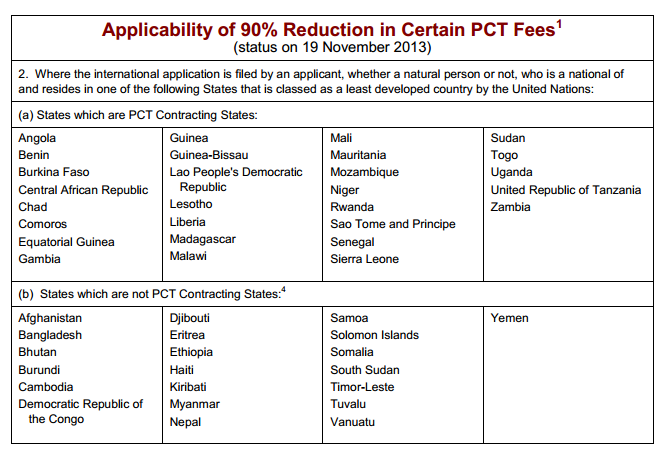 States benefiting from a reduction under the PCT (based on the United Nations list)
Electronic Filing Means
A reduction of the international filing official fee is provided if (Schedule of Fees, item 4):
- the request and the abstract are filed in the form of a paper printout produced using the PCT-EASY software (Schedule of Fees, item 4.a): an electronic copy (diskette) in character-coded format (e.g., XML) must be attached. This mode is referred to as « request in PCT-EASY presentation mode »;
- the reduction is 100 Swiss francs;
- the reduction is 100 Swiss francs;
- the reduction is 200 Swiss francs;
- the reduction is 300 Swiss francs;
This reduction applies before the reduction concerning developing countries if applicable (Schedule of Fees, item 5).
Late payment
In case of late payment (or insufficient payment), the RO invites the applicant to pay the outstanding amount within a period of one month from the date of notification (R16bis.1.a PCT).
A payment is not considered late if the payment is received by the RO before it sends the notification indicating the late payment (R16bis.1.d PCT).
A late payment official fee may be required by the RO (R16bis.2.a PCT) for its benefit. This late payment official fee is the greater of the following two official fees:
- 50 % of the lesser of:
- the amount remaining to be paid;
- the international filing official fee (R16bis.2.b PCT).
- the amount of the transmittal official fee.
Sanction
If, despite the notification, the applicant does not pay within the prescribed period, the international application is considered withdrawn and the RO informs the applicant (A14.3.a PCT together with R16bis.1.c.i PCT together with R27.1 PCT together with R29 PCT).
The payment is considered valid (even if a late payment official fee may be due) if the RO receives the payment before sending the notification informing the applicant that the application is deemed withdrawn (R16bis.1.e PCT).
Refund of official fees
Transmittal official fee
Nothing in the PCT provides for a refund of the transmittal official fee.
Search official fee
The search official fee is fully refunded if:
- no filing date is accorded by the RO (R16.2.i PCT);
- the application is withdrawn or deemed withdrawn before the copy of the application is transmitted to the ISA (R16.2.ii PCT);
- the international application is not processed as such for reasons of national defense (R16.2.iii PCT).
The search official fee is partially refunded if:
- a prior search is taken into account for the establishment of the ISR (but the conditions and modalities are set out in an agreement binding the ISA and WIPO) (R16.3 PCT) and R41.1 PCT.
The search official fee may be partially or fully refunded if:
- the application is withdrawn or deemed withdrawn after the copy of the application is transmitted to the ISA but before the ISA begins its work (applicant’s guide §5.198), but this depends on the provisions applicable to that ISA.
International filing official fee
The international filing official fee is fully refunded if:
- no filing date is accorded by the RO (R15.4.i PCT);
- the application is withdrawn or deemed withdrawn before the copy of the application is transmitted to the ISA (R15.4.ii PCT);
- the international application is not processed as such for reasons of national defense (R15.4.iii PCT).
Formal requirements
The formal requirements prescribed by the Regulations must be complied with (A14.1.a.v PCT), failing which the application shall be refused (A14.1.b PCT).
Request
Form
The request must be prepared, at the applicant’s choice:
- on a printed form PCT/RO/101 (R3.1 PCT). Copies of this form are provided free of charge (R3.2 PCT);
- on an electronic form (R3.1 PCT together with Administrative Instructions 102.h.i);
- using the PCT-EASY software (Administrative Instructions 102.i)
Language
Normally, all elements of the international application must be drafted in the same language.
However, the request must be drafted in a publication language accepted by the receiving Office (RO) for this purpose (R12.1.c PCT) from among (R48.3.a PCT):
- Arabic, Chinese, English, French, German, Japanese, Korean, Portuguese, Russian or Spanish.
Content of the request
The request shall contain a petition indicating that the application is to be processed in accordance with the PCT (A4.1.i PCT and R4.1.a.i PCT), preferably worded as follows: « The undersigned requests that the present international application be processed in accordance with the Patent Cooperation Treaty » (R4.2 PCT).
It must also contain (R4.1.a PCT):
- the title of the invention;
- particulars concerning the applicant and, where applicable, the representative;
- particulars concerning the inventor, where the national law of at least one designated State requires the name of the inventor to be furnished at the time of filing a national application.
It must contain, where applicable (R4.1.b PCT):
- a priority claim;
- particulars concerning an earlier search;
- a reference to a parent application or parent patent;
- the indication of the competent International Searching Authority chosen by the applicant.
It may contain (R4.1.c PCT):
- particulars concerning the inventor;
- a request to the RO to prepare and transmit the priority document to the IB (if the priority was filed with the RO);
- statements made to comply with national requirements (R4.17 PCT);
- a statement of incorporation by reference (R4.18 PCT);
- a request for restoration of the right of priority;
- a declaration that the international application is the same, or substantially the same, as the application for which the earlier search was carried out (R4.12.ii PCT).
Special case of the request sheet
Normally, the applicant must complete the request sheet (R3.3 PCT), even though the sanction is minor: if the request sheet is incomplete, the RO must complete it (R3.3.b PCT).
The information that must appear on the request sheet is:
- the total number of sheets of the application;
- the number of sheets of each element of the application:
- request,
- description (treating separately any sequence listing),
- claims,
- drawings,
- abstract;
- the fact that the following are attached:
- a power of attorney,
- a copy of a general power of attorney,
- a priority document,
- a sequence listing,
- a document relating to the payment of official fees,
- any other document;
- the number of the figure which the applicant proposes to be published with the abstract.
Form of the Application
The description must begin with the title of the invention as indicated in the request (R5.1.a PCT).
Furthermore, the application must comply with certain formal requirements (R11 PCT), including:
- being filed in the number of copies prescribed by the RO (R11.1.b PCT);
- allowing for reproduction (R11.2 PCT);
- being filed on paper that is « flexible, strong, white, smooth, non-glossy, and durable » (R11.3 PCT);
- using white A4-size sheets (R11.5 PCT);
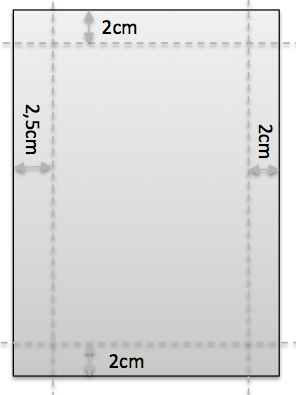
- the margins may not be smaller than the following diagram (R11.6 PCT) for the description, claims, and abstract:
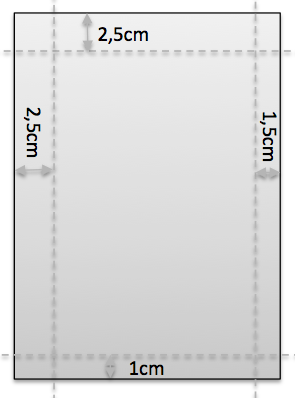
- the margins may not be smaller than the following diagram (R11.6 PCT) for the drawings:
- pages must be numbered consecutively in Arabic numerals, outside the margin, at the top or bottom (R11.7 PCT);
- line numbers may appear in the right half of the left margin (R11.8 PCT);
- the request, description, claims, and abstract must be typewritten or printed with 1.5 line spacing (R11.9 PCT);
- all text must be in characters where the capital letters are at least 0.28 cm in height (R11.9 PCT).
Requirements Specific to the RO
Appointment of a Representative
Possibility
The applicant may appoint a representative (who is entitled to practice before the RO) to represent them before the RO, IB, ISA, and IPEA (A49 PCT together with R90.1.a PCT).
If the IB is the RO, any person who could have been a representative for an RO based on the nationality or domicile of an applicant may be a representative before the IB (R83.1bis PCT).
It is also possible to specifically appoint a representative (though this is never mandatory, A27.7 PCT):
- before the ISA (R90.1.b PCT, and who is entitled to practice before the ISA),
- before the SISA (R90.1.b-bis PCT, and who is entitled to practice before the SISA), or
- before the IPEA (R90.1.c PCT, and who is entitled to practice before the IPEA).
Subsidiary Representative
A representative may, in turn, appoint subsidiary representatives (R90.1.d PCT). This representative must be entitled to act as a representative before:
- either the RO (R90.1.d.i PCT), in which case they may act before the RO, IB, ISA, IPEA, or SISA;
- or before the ISA, IPEA, or SISA (R90.1.d.ii PCT), in which case they may act before that authority.
Requirement
During the national phase, only the RO may require representation (A27.7 PCT) if its national law so provides.
Designation
In order to designate the representative, it is possible:
- to indicate it in the request (R4.7.a PCT, mandatory if the RO requires a representative for the filing),
- to provide a separate power of attorney filed with the RO, the IB, the ISA, the IPEA, or the SISA (R90.4.b PCT).
Providing the power of attorney may be optional if the office has waived this requirement (R90.4.d PCT).
A reference to a general power of attorney may be possible (R90.5.a PCT).
Sanction
There is no sanction under the PCT for a lack of representation, but the RO may apply sanctions under its national law (A27.7 PCT).
Designation of a common representative
In the case of multiple applicants and if no common representative has been appointed, it is necessary to designate a common representative (R90.2.a PCT).
If no common representative is designated by the applicants (R90.2.a PCT), the first applicant who is entitled to file an application with the RO is considered the common representative (R90.2.b PCT).
Requirements related to the ISA
Translation
Translation languages
If the language of filing of the application is not accepted by the ISA, the applicant must submit a translation of the application in a language that is both:
- a language accepted by the ISA (R12.3.a.i PCT);
- a language of publication (R12.3.a.ii PCT); and
- a language accepted by the RO (R12.3.a.iii PCT, unless the language of filing is a language of publication).
The languages of publication are (R48.3.a PCT):
- German, English, Arabic, Chinese, Korean, Spanish, French, Japanese, Portuguese, or Russian.
Time limit
This translation must be submitted within 1 month from the filing of the application with the RO (R12.3.a PCT), noting:
- that an extension with an additional official fee is provided (see below « Notification »);
- that a fiction of timely receipt is provided (see below « Sanction »).
Notification
Upon notification of the filing number, the RO invites the applicant to provide, if applicable, this translation:
- within 1 month from the filing of the application with the RO (R12.3.c.i PCT together with R12.3.a PCT) without paying an additional official fee;
- within the longer of the following two time limits, possibly upon payment of an additional official fee (R12.3.c.ii PCT):
- 1 month from the notification;
- 2 months from the filing.
Sanction
If no translation is submitted despite the notification, the application is deemed withdrawn (R12.3.d PCT), and the RO declares it as such.
However, as long as the RO has not yet declared anything and if the 15-month time limit from the priority has not expired, the submission of the translation and/or the payment of the additional official fee will be considered valid (R12.3.d PCT).
Late submission fee
The late submission fee is collected by the RO.
This fee (mentioned above) amounts to 25% of the fixed amount (i.e., excluding any additional amount from the 31st page onward) of the international filing fee (R12.3.e PCT).
Requirements related to publication
Translation
Translation Language
If the language of the filing of the application is not a publication language, the applicant must submit a translation of the application in a publication language (R12.4.a PCT).
The publication languages are (R48.3.a PCT):
- German,
- English,
- Arabic,
- Chinese,
- Korean,
- Spanish,
- French,
- Japanese,
- Portuguese or
- Russian.
Time Limit
This translation must be submitted within 14 months from the priority date to the RO (R12.4.a PCT).
Notification
If no translation is submitted within this time limit, the RO will invite the applicant to submit the translation within a period of 16 months from the priority date (R12.4.c PCT) and to pay a late submission official fee.
Sanction
If no translation is provided despite the notification, the application shall be deemed withdrawn (R12.4.d PCT) and the RO shall so declare.
However, as long as the RO has not yet made such a declaration and if the 17-month period from the priority has not expired, the submission of the translation and/or the payment of the surcharge will be considered valid (R12.4.d PCT).
Late Submission Official Fee
The late submission official fee is collected by the RO.
This official fee (mentioned above) amounts to 25% of the fixed amount (i.e., excluding any additional amount from the 31st page) of the international filing official fee (R12.3.e PCT).
Specific Requirements for Certain National Phases
Designation of Inventors
Requirement
For countries whose national legislation requires it (A4.1.v PCT, R51bis.1.a.i PCT, R4.17.i PCT), inventors may be identified at the time of filing in the request by indicating (R4.6.a PCT):
- Their name:
- surname followed by first name (R4.4.a PCT),
- without titles or degrees (R4.19.a PCT).
- Their address (which is not necessarily their personal address, PCT Newsletter No. 10/2008):
- written so as to permit proper postal delivery (R4.4.c PCT),
- a telephone or fax number may supplement this address.
When the applicant is also the inventor, it is sufficient to check a box in the request (R4.6.b PCT).
If the legislation of the States differs on how to identify inventors, it is possible to mention several groups of inventors according to the States (R4.6.c PCT).
Sanction
There is no sanction (A4.4 PCT), whether this information is required or not by the national legislation.
This requirement simply allows the provision of this information after the filing (A4.4 PCT), but it remains possible to satisfy this requirement upon entry into the national phase (A22.1 PCT).
Special Case of the US
Before March 16, 2013, it was mandatory to mention the inventors, as they were the applicants for the US national phase.
Correction of an Erroneous Inventor Designation
If the applicant wishes to correct the inventor designations, it is necessary to file a request for change with the IB or the RO, which forwards it to the IB (R92bis.1.a.ii PCT), the request having to reach the IB within a time limit of 30 months from the priority (R92bis.1.b PCT).
Statement Concerning the Applicant’s Right to File an Application
This statement is provided for under R51bis.1.a.ii PCT and R4.17.ii PCT.
Statement Concerning the Applicant’s Right to Claim Priority
This statement is provided for under R51bis.1.a.iii PCT and R4.17.iii PCT.
Statement Concerning Inventorship
This statement is provided for under A27.3 PCT, R51bis.1.a.iv PCT and R4.17.iv PCT.
It applies for the purposes of US designation.
It must be signed (R4.17.iv PCT).
Statement Concerning Non-Prejudicial Disclosures
This statement is provided for under R51bis.1.a.v PCT and R4.17.v PCT.