


Lack of Unity of Invention
Principle
The purpose of this requirement is to enable effective classification of inventions and to prevent the payment of a single search official fee from covering a search for 1,000 inventions (G1/91).
Thus, Article 82 EPC provides:
A European patent application shall relate to one invention only or to a group of inventions so linked as to form a single general inventive concept.
This requirement must be complied with from the filing of the application until grant (T178/84).
Opposition
Article 101(3) EPC normally provides that a patent maintained in amended form must comply with the requirements of the EPC.
However, the Enlarged Board of Appeal has stated (G1/91) that the requirement of unity of invention is not one of these « requirements ».
Similarly, Rule 43(2) EPC does not apply in opposition proceedings (T263/05).
Assessment of Unity of Invention
Rule 44(1) EPC and the Guidelines F-V 2 propose a method for determining whether there is unity of invention:
- For each independent claim, identify the technical differences with the prior art; verify that there is at least one (identical or corresponding) difference common to all independent claims; if not, there is a unity issue.
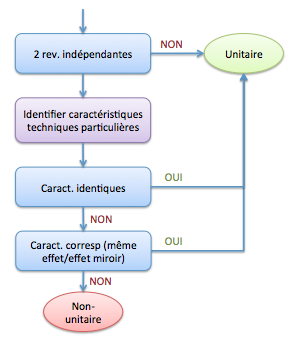
The difference (referred to as « special technical features« ) may be (Guidelines F-V 2):
- identical in each of the independent claims:
- a transistor in two independent claims;
- corresponding:
- features having the same technical effect, for example, for elasticity:
- a metal spring,
- a rubber block;
- features having a mirror technical effect, for example, for data exchange:
- a transmitter,
- a receiver.
- features having the same technical effect, for example, for elasticity:
For claims of different categories, it is further required that the general inventive concept between the claims be the same (Guidelines F-V 2).
Thus, it is indeed on the basis of the technical problem to be solved as described in the application that unity of invention should be assessed (W11/89, T756/14, T1414/18).
It is also worth noting that the EPO, pragmatically, does not encourage its Examiners to raise objections on this ground indiscriminately (Guidelines F-V 4): this requirement is simply intended to prevent the filing of manifestly non-unitary applications!
Literal assessment?
In practice, the EPO emphasizes that the assessment must be flexible, particularly if a new search is not necessary (Guidelines, F-V 2.2).
Therefore, considering the circumstances and in light of the subject matter already searched and the prior art already found, it must be determined whether it is reasonable to require an additional official fee to extend the search to the other claims (T806/18): thus, a lack of unity does not necessarily mean an additional official fee.
Examples of unity
Case law and the Guidelines allow us to list a number of situations in which unity of invention will be satisfied:
- claims relating to (Guidelines F-V 2):
- a product,
- a process specifically adapted for / capable of leading to the manufacture of said product
- the fact that the manufacturing process is not limited to the manufacture of the claimed product is not sufficient to destroy unity of invention (Guidelines F-V 2).
- a use of this product;
- claims relating to (Guidelines F-V 2):
- a process,
- an apparatus or a means specifically designed for the implementation of this process;
- the fact that the apparatus may implement another process is not sufficient to destroy unity of invention (Guidelines F-V 2), but it is not sufficient for unity of invention that the apparatus is merely capable of being used for the implementation of the process.
- the fact that the process may be implemented by another apparatus is not sufficient to destroy unity of invention (Guidelines F-V 2);
- claims relating to (Guidelines F-V 2):
- a product,
- a process specifically adapted for the manufacture of said product,
- an apparatus or a means specifically designed for the implementation of this process;
- claims relating to (Guidelines F-V 2.2.2.4 and T110/82, T470/91):
- a final product,
- intermediate product:
- if it is indispensable for obtaining the final product through transformation or
- if the link with the final product is sufficiently close;
- claims relating to variants (Guidelines F-V 2.2.2.1) of a similar nature (Markush grouping, Guidelines F-V 2.2.2.2):
- the variants must share a common feature or activity; and
- the variants must share a common structure.
- claims for the use of a product for several new therapeutic methods (Guidelines G-VI 7.1)
- etc.
Competence
The lack of unity must be raised as soon as possible, either by the Search Division or by the Examination Division.
A priori / a posteriori
A priori
Lack of unity a priori (Guidelines F-V 4.1) is a lack of unity detectable without analyzing the validity of the claims in view of the prior art.
Thus, lack of unity a priori only appears between independent claims.
A posteriori
Principle
A posteriori lack of unity (Guidelines F-V 4.1, Guidelines F-V 4 and Guidelines F-V 5) is a lack of unity detectable after analyzing the validity of the claims in view of the prior art (G1/89).
Thus, if claim 1 is not novel (or inventive), and the dependent claims (Guidelines F-V 5) present non-unitary fallback positions, an a posteriori lack of unity objection will be raised.

Procedure to be followed by the Examiner
For each group of inventions, the Examiner must identify the « special technical features » (i.e., the features determining a contribution to the prior art) and establish the respective technical problem solved in relation to the cited prior art (T129/14).
If a group of inventions is considered to be fully anticipated by the cited documents, there can be no « special technical feature » since nothing distinguishes this group from the prior art as stated in R44(1) EPC (T129/14): thus, the Examiner cannot form a group with claims that he or she considers to be fully anticipated.
This is recalled by the Guidelines F-V 4.2 (if a group is not novel and inventive, it cannot have an inventive concept):
As a rule, the following steps consist in identifying the claims that are novel and non-obvious in view of the relevant prior art available when the requirement of unity is examined for the application. The « remaining claims » are the claims that still appear novel and non-obvious after this identification.

Since inventive links can only exist between claims having a « special technical feature« , the groups of inventions indicated as non-unitary are necessarily novel and inventive.
Documents under A54(3) EPC
Documents under A54(3) EPC cannot be used for the assessment of a posteriori unity of invention (Guidelines F-V 4.1).
Thus, the Examiner must limit himself or herself to documents under A54(2) EPC when seeking to destroy the novelty or inventive step of the « independent » claims (T1168/02 or T496/03).
Indeed, it appears that the intention of the EPO is to use documents under A54(3) EPC only to prevent double patenting and thus ensure the first filer’s exclusive protection (G1/03).
Thus, any other use would be contrary to the spirit of the treaty.
For completeness, however, it should also be noted that there is a decision that appears to go in the opposite direction: T0525/03 (see point 5.2, bearing in mind that document D1 is a document under A54(3) EPC).
Consequences
At the search stage
As stated in the article « Types of searches« , the Search Division establishes a search report for the first invention mentioned in the claims (R64(1) EPC): this is referred to as a partial search report.
This partial report is not published, even though it is available for public inspection (A128(4) EPC) after the publication of the application (Guidelines B-X 1).
A notification is then sent to the applicant to allow 2 months to request, if desired, an additional search for the inventions that were not searched (R64(1) EPC).
This notification must include the reasons why the Examiner considers there to be a lack of unity; otherwise, the notification has no legal effect (W7/86).
Of course, a new search official fee will have to be paid (A2(1).2 RFees, [montant_epo default= »840 € » name= »A2(1).2 RRT – recherche demande déposée avant 1er juillet 2005″] if the application was filed before July 1, 2005, [montant_epo default= »1165 € » name= »A2(1).2 RRT – recherche demande déposée après 1er juillet 2005″] otherwise) for each invention: these must be paid within the same time limit. In exceptional cases (e.g., a search can be conducted on all inventions without particular effort), no additional official fees will be required (Guidelines B-VII 2.2), and the search will be carried out in full.
In principle (W1/97), the Search Division (acting as ISA or not) can only request once that the applicant pay additional official fees for a new search: its initial analysis must therefore be as precise as possible.
No refusal of the application or request to limit the claims is possible at this stage (Guidelines F-V 6).
At the examination stage
Reconsideration of the Search Division’s opinion
The Examining Division must always examine the question of unity of invention, even if the Search Division raised no objections (T631/97, Guidelines F-V 7.1).
In any event, it is possible to request that the Examining Division reconsider the Search Division’s opinion regarding lack of unity and refund the additional search official fees (Guidelines F-V 7.3, although in practice this is unlikely to succeed, as the Examiner is the same in both situations).
The Examining Division’s decision is subject to appeal together with the final decision (e.g., refusal). This appeal must be based solely on the grounds invoked by the Search Division (T188/00).
If the applicant has not paid the official fee, they are deemed to have agreed that the examination should proceed on the application that was searched (G2/92, T631/97, Guidelines C-III 3.1.1).
However, if the Examiner, after examining the matter, considers that the invention was in fact unitary, an additional search is carried out by the Examining Division (Guidelines C-III 3.1.1).
Selection of the invention
If several inventions have been searched, the applicant is invited at the beginning of the examination to select the invention that will be the subject of the examination and to limit the application accordingly (Guidelines C-III 3.1.2).
This selection is irrevocable, and if the applicant amends the claims to cover a different subject-matter, such amendment will be refused:
- under R137(3) EPC (if the subject-matter was searched but not selected) or
- under R137(5) EPC (if the subject-matter was not searched and does not form a single inventive concept with the searched invention).
It may be necessary to amend certain parts of the description and drawings (R42(1)(c) EPC, R42(1)(d) EPC disclosure of the invention and R48(1)(c) EPC extraneous or superfluous matter).
It is possible to file divisional applications for the deleted parts.
If the applicant refuses to limit the application, it will be refused (A82 EPC, Guidelines H-II 7.3).
Lack of unity raised during examination
Furthermore, lack of unity may arise during examination (new document, lack of unity a posteriori, etc.), and it is therefore useful for the Examining Division to be able to raise it.
Once the objection is raised by the Examining Division, the applicant must be invited to present observations or to amend the claims in order to continue the examination with a single invention (A94(3) EPC together with R71(1) EPC).
Amendments to the claims
When a lack of unity is raised by the Search Division, not all inventions are searched.
If, subsequently, the application is limited to an unsearched or unselected element, the application may be refused:
- under A82 EPC;
- under R137(3) EPC (if the subject-matter was searched but not selected) or
- under R137(5) EPC (if the subject-matter was not searched and does not form a single inventive concept with the searched invention).
Under the PCT
At the EPO/ISA level
An additional official fee is provided for under R158(1) EPC (and authorized by A17.3.a PCT, [montant_epo default= »1875 € » name= »A2(1).2 RRT – additional international search »] for PCT applications, A2(1).2 RRT).
It must be paid for each further invention to be the subject of an international search.
In the PCT procedure, if the ISA’s opinion on unity of invention is not shared, the additional official fees should be paid « under protest » together with a reasoned statement demonstrating that the PCT application meets the requirement of unity of invention (R40.2.c PCT).
This protest fee is provided for under R158(3) EPC ([montant_epo default= »830 € » name= »A2(1).21 RRT »], A2(1).21 RRT).
If this protest is paid, an examination procedure is initiated to verify whether there is indeed a unity issue (see « Decision of the President of the European Patent Office dated 24 March 2010, establishing boards of review for the implementation of the protest and review procedures under the PCT« , OJ 2010, 320).
If no issue is ultimately found, the protest fee is refunded (R40.2.e PCT).
At the EPO/IPEA level
A request for an international preliminary examination on several searched inventions may be filed.
An examination fee is provided for under R158(2) EPC (and authorized by A34.3.a PCT, [montant_epo default= »1850 € » name= »A2(1).19 RRT »], A2(1).19 RRT).
In the PCT procedure, if the ISA’s opinion on unity of invention is not shared, the additional examination fees should be paid « under protest » together with a reasoned statement demonstrating that the PCT application meets the requirement of unity of invention (R40.2.c PCT).
This protest fee is provided for under R158(3) EPC ([montant_epo default= »830 € » name= »A2(1).21 RRT »], A2(1).21 RRT).
If this protest is paid, an examination procedure is initiated to verify whether there is indeed a unity issue (see « Decision of the President of the European Patent Office dated 24 March 2010, establishing boards of review for the implementation of the protest and review procedures under the PCT« , OJ 2010, 320).
If no issue is ultimately found, the protest fee is refunded (R40.2.e PCT).
In the context of a Euro-PCT application
Cases where a supplementary search must be carried out by the EPO
If the EPO considers that there is no unity of invention, the supplementary search report is drawn up only for the first invention (partial supplementary search report, R164(1) a) EPC).
This partial supplementary search report is not accompanied by a written opinion (« Notice from the European Patent Office dated 10 June 2014 concerning the amendment of Rules 164 and 135 EPC« , OJ 2014, A70, point 8).
Since 1 November 2014 (« Decision of the Administrative Council of 16 October 2013 amending Rules 135 and 164 of the Implementing Regulations to the European Patent Convention« , OJ 2013, 503), a notification is sent to the applicant to ask whether they wish, within 2 months from the date of notification, to pay a supplementary search official fee for each unsearched invention (R164(1) b) EPC).
This time limit is excluded from further processing (R135(2) EPC) and only restitutio in integrum under A122 EPC is applicable.
A supplementary search report (covering all inventions for which an official fee has been paid) is then drawn up accordingly (R164(1) c) EPC) with a written opinion.
Cases where the EPO has waived a supplementary search
If the EPO has waived the performance of a supplementary search but the invention claimed upon entry into the national phase has not been searched, the EPO notifies the applicant to pay a supplementary search official fee within a period of 2 months (R164(2) a) EPC).
This time limit is excluded from further processing (R135(2) EPC) and only restitutio in integrum under A122 EPC is applicable.
The results of this search will be communicated to the applicant in a notification under A94(3) EPC or a notification under R71(3) EPC (R164(2) b) EPC). This notification also gives the applicant a time limit to comment on the conclusions of the examining division and on the results of the annexed search, as well as to amend the description, claims and drawings on their own initiative (« Notice from the European Patent Office dated 10 June 2014 concerning the amendment of Rules 164 and 135 EPC« , OJ 2014, A70, point 16).
This supplementary search will not include a written opinion (R164(4) EPC together with R62 EPC).
Where applicable, the EPO will also invite the applicant to limit the application to one invention among the searched inventions (either at the international stage or at the supplementary search stage, R164(2) c) EPC and R164(3) EPC together with R62bis EPC).
Prohibition of claims of the same category
This prohibition is not related to unity of invention: it is merely complementary to it.
The principle
R43(2) EPC prohibits, in principle, having more than one independent claim of the same category (product, process, apparatus or use) in an application.
However, as with any principle, there are a number of exceptions.
There is also a « Notice dated 9 January 2002 concerning the amendment of Rules 25(1), 29(2) and 51 EPC« , OJ 2002, 112 on this subject.
This prohibition applies during the grant procedure but not during the opposition procedure (analogy with G1/91).
Exceptions
Link between two products
As indicated in R43(2) a) EPC, if two products are linked, then this prohibition does not apply.
This refers to a « link » rather than « technical relationships » as in R44 EPC: a link is a priori less restrictive.
The following examples may illustrate this exception:
- a transmitter and a receiver
- a plug and socket.
However, formally, a link between two processes should not be accepted: there must be a link between two products.
However, pragmatically, the EPO also accepts (in most cases) two processes that are linked (typically, a transmission process and a reception process).
Different uses of a product or device
For example, it is possible to claim (R43(2) b) EPC):
- a medicine for treating colds, and
- the same medicine for treating prostate cancer in the same application.
Alternative solutions to the same problem
This exception applies only if it is impossible to create a common preamble for these two alternatives (R43(2) c) EPC).
This may occur, for example, when two manufacturing processes for the same chemical product are found in an invention concerning a group of new compounds.
Sanction
At the search stage
If this irregularity is raised at the search stage, the EPO invites the applicant to indicate, within a period of 2 months, the claims complying with R43(2) EPC that are to be searched (R62bis(1) EPC).
A121 EPC does not apply to this period.
Note that if all claims of the same type have been deemed abandoned due to the non-payment of claim fees, this notification will not be sent (Guidelines B-VIII 4.4).
If the applicant does not respond, the search is carried out on the first claim of each category (R62bis(1) EPC).
The applicant may, of course, contest the opinion of the Search Division by prioritizing certain claims in case of disagreement with the Examiner (e.g., claims 10 and 15 but no search on claim 1, Guidelines B-VIII 4.2.2).
Naturally, for this to be done, the claim fees must have been paid for the prioritized claims… otherwise, this prioritization will be ignored (Guidelines B-VIII 4.4).
The search report will indicate the claims that have been searched and invite the applicant to limit the application (Guidelines B-VIII 4.3).
At the examination stage
The examining division then invites the applicant to limit the application (R62bis(2) EPC) unless it finds that the objections were not justified (in which case a new search is carried out).
This limitation may consist of deleting unsearched claims or making such claims dependent (subject to A123(2) EPC, Guidelines H-II 5).
An objection at the examination stage may well be raised even if the search division did not raise any objection (Guidelines F-IV 3.3).
If the applicant does nothing, the application may be refused (A97(2) EPC), but the applicant must be given sufficient opportunity to present their comments before any refusal (Guidelines F-IV 3.3).