


The search enables the European Patent Office to assess the existing prior art that may be cited against your application (Guidelines B-II 2).
Competence
The Search Division is responsible for this search (A17 EPC).
The examiner responsible for this search is normally the first member of the Examining Division for this application (Guidelines B-I 2): this principle was established by the EPO’s « BEST » program (1990, « Bringing Examination and Search Together« ).
However, the examiner may consult other examiners (Guidelines B-I 2.1) or request that the Search Division be supplemented by one or two additional examiners if the nature of the invention so requires (Guidelines B-I 2.1).
It is also possible to entrust a search to certain national offices, particularly to conduct searches in databases of documents written in a non-official language.
Basis of the Search
Positive Basis
The search is conducted on the basis of the claims as filed (A92 EPC).
It is not possible to amend the claims before the search (R137(1) EPC), even under R139 EPC (it is necessary to wait for the competence of the Examining Division, J4/85).
The search must cover:
- dependent claims, particularly if the corresponding independent claim is not considered novel or inventive (Guidelines B-III 3.8);
- subject-matter of the description for which it may be assumed that it will be introduced into the claims (Guidelines B-III 3.5).
Inability to Conduct a Search
Principle
If the EPO considers that it is impossible to conduct a meaningful search of the prior art with respect to all or part of the claimed subject-matter, it invites the applicant to file, within a period of 2 months, a declaration indicating the subject-matter to be searched (R63(1) EPC).
This period does not benefit from A121 EPC.
The notification may guide the applicant by indicating the subject-matter that could be searched (Guidelines B-VIII 3.1).
Special Cases – A123(2) EPC or A76 EPC
This notification may also raise issues under A123(2) EPC or A76 EPC, particularly if these elements significantly alter the search results (Guidelines B-VIII 6): this is possible, in particular, during entry into the national phase or for a divisional application.
This is rather « helpful » on the part of the EPO because if, unfortunately, an examiner were to issue the search report based on a set of claims contrary to the requirements of A123(2) EPC, we could find ourselves in a situation where it would be impossible to subsequently correct the A123(2) EPC issues without contravening R137(5) EPC: this would be rather problematic.
Response and indication of elements to be searched
If, in response to this notification, the applicant submits a set of clarified/amended/modified claims, these may only be taken into account at the stage of the response to the ESR (« Communication from the European Patent Office, dated 15 October 2009, concerning amendments to the Implementing Regulations to the European Patent Convention« , OJ 2009, 533, point 3.2).
Indeed, it is not possible to amend before this stage in view of R137(1) EPC.
If the applicant does not respond to this notification (or does not respond sufficiently), the EPO will establish (R63(2) EPC):
- a partial search report;
- a reasoned declaration stating why no search is possible
Negative basis
There are certain elements that will not be searched (Guidelines B-VIII or Guidelines B-III 3.11).
These are mainly:
- subject-matter excluded from patentability (A52(2) EPC, A53 EPC, A57 EPC, or for the PCT, A17.2 PCT together with R39.1 PCT):
- scientific and mathematical theories;
- plant varieties, animal breeds;
- plans, principles or methods for doing business, purely intellectual or gaming activities;
- methods of treatment by surgery or therapy;
- diagnostic methods;
- mere presentations of information;
- computer programs.
- subject-matter that is unclear or too broad.
If the Office determines that a reformulation of the claims would allow a search to be carried out (e.g., reformulation of a therapeutic method into a device), the Search Division must perform this search (Guidelines B-VIII 2.1) without having to request the applicant to indicate the elements to be searched under R63(1) EPC.
Consequence of a partial search
In the case of a partial search, the Examining Division must invite the applicant to limit the application to the subject-matter that has been searched (R63(3) EPC and Guidelines H-II 5) unless it finds that the objection was not justified.
If the applicant does not limit the application, it may be refused (A97(2) EPC).
Subsequently, it will not be possible to reintroduce elements that were not searched (R137(5) EPC).
Amendment of the application
Principle
In principle, it is not possible to amend the application before receiving the ESR (R137(1) EPC).
Exception
However, there are certain exceptions provided for in the Implementing Regulations:
- corrections of deficiencies in the filing (R58 EPC):
- absence of claims (R57 c) EPC),
- absence of abstract (R57 d) EPC),
- form and margins of the description and drawings (R57 i) EPC).
- correction of obvious errors (R139 EPC, unless the correction of errors requires a technical analysis, J4/85).
It is also possible to provide amendments before receipt of the ESR (for information purposes) and to confirm them upon receipt of the ESR (Guidelines A-V 2.2).
How searches are conducted
Procedure
Initially, the Examiner reviews the filing and the claims (Guidelines B-IV 1.1).
Formal irregularities that may have been overlooked by the Receiving Section are referred to the Receiving Section (Guidelines B-IV 1.2).
Documents cited in the filing are reviewed, and if a document is unavailable, the examining division requests it from the applicant (Guidelines B-IV 1.3).
The abstract is verified, and a classification of the filing is carried out (Guidelines B-X 7).
The subject matter of the search is determined (Guidelines B-IV 2).
The search is conducted for all independent claims. However, if a product claim is not novel, there is no need to search for claims:
- relating to a manufacturing process that inevitably leads to that product;
- relating to the use of that product.
Search documentation
The documentation used includes the PCT minimum documentation (R34 PCT) and other documents accessible to the EPO (Guidelines B-IX 1.1).
Unpublished filings are not cited by the Search Division: this is the responsibility of the Examining Division (Guidelines B-VI 4.1).
Internet searches are possible, particularly in fields related to information technology (Guidelines B-III 2.4).
Content of the extended European search report (EESR)
Language of the EESR
The EESR is drafted in the language of the proceedings (A14(3) EPC and R61(5) EPC).
If the EPO acts as ISA, the search report is generally drafted in the language of the international publication (R43.4 PCT).
European Search Report (ESR)
The European Search Report (or ESR) is a report containing all the documents known to the EPO (R61(1) EPC).
As an illustration, an ESR (or RRE in French for « Rapport de recherche européen« ) may look like this file (randomly selected from the European Register).
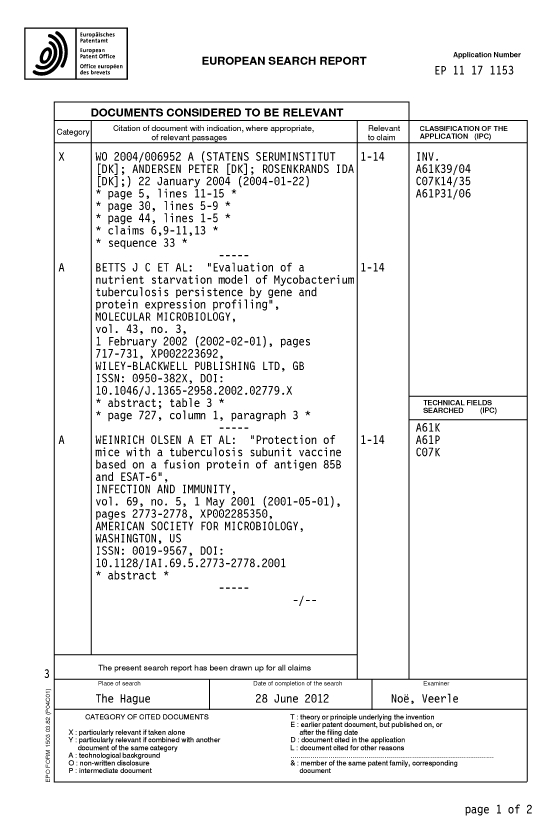
The various documents are classified according to their relevance (R61(3) EPC, R61(4) EPC and Guidelines B-X 9.2):
- Common classifications:
- X means that the document is particularly relevant on its own (i.e., it would destroy the novelty of the application);
- Y means that the document is relevant if combined with another document of the same type (i.e., it would destroy the inventive step of the application);
- A means that the document is simply cited as it is in a related field but does not anticipate the application;
- Less common classifications:
- T means that the document presents the scientific theory underlying the application (but without anticipating it);
- D means that the document is cited in the application itself. This classification may be combined with another classification (e.g., « DX »);
- P means that the document is an intermediate document: it would be relevant if the priority were not valid. This classification may be combined with another classification (e.g., « PY »);
- E means that the document is not opposable (but may still provide certain information);
- Rare classifications:
- O means that the disclosure is not a written disclosure;
- L means that the document is cited for another reason (often, this classification serves as a « catch-all » classification).
In addition, each cited document is linked to the claims against which it is relevant (R61(2) EPC).
Furthermore, the search report may list the claims that were not searched (Guidelines B-X 8):
- lack of unity;
- official fee not paid;
- multiple independent claims of the same category;
- non-patentable subject matter.
The search report also includes a translation of the title in the other two official languages (Guidelines B-X 7 iv).
The abstract is finalized at the same time as the transmission of the ESR. It is transmitted to the applicant simultaneously (R66 EPC).
Languages of cited documents
In principle, the EPO may provide documents in any language (Guidelines B-X 9.1.3).
It is nevertheless recommended to provide a translation of the document when available or at least a partial translation of the relevant paragraphs (Guidelines B-X 9.1.3).
In any case, if the applicant contests the technical content of a document, the EPO must provide this translation (Guidelines G-IV 4 and T655/13).
Written Opinion
Principle
Since July 1, 2005, the search report includes a « written opinion » or « opinion » (R62(1) EPC) and is now called the « Extended European Search Report » or EESR (or even EESR in English, for « Extended European Search Report« , « Decision of the Administrative Council of 9 December 2004 amending the Implementing Regulations to the European Patent Convention and the Rules relating to Fees« , OJ 1/2005, p5).
This written opinion (or opinion on patentability) indicates all substantive or formal irregularities in the application (e.g., lack of novelty, clarity issues, etc., Guidelines B-XI 3).
If, following the filing of missing parts of the description or drawings, the filing date has not been changed, but the examiner responsible for the search considers that the conditions of R56(3) EPC or R20.6 PCT are not met, the examiner will conduct the search as if the filing date had been changed and will state the reasons in the opinion (Guidelines B-XI 2.1).
Conversely, if the filing date has been changed, but the examiner responsible for the search considers that the conditions of R56(3) EPC or R20.6 PCT are met, this will be indicated in the opinion for subsequent review by the examining division (Guidelines B-XI 2.1).
If the claims were filed late (under R58 EPC), the examiner responsible for the search verifies that the provisions of A123(2) EPC are complied with (but still attempts to conduct a search, Guidelines B-XI 2.2).
If the priority document or its translation has not been provided, the priority will be considered valid for the search stage (Guidelines B-XI 4).
The written opinion invites the applicant to correct the irregularities identified within a period of 6 months from the date of publication of the EESR in the EPO Bulletin (R70bis(1) EPC together with R70(1) EPC).
If the opinion contains no objections, it is not necessary to respond, and the applicant will be informed accordingly (« Notice from the European Patent Office dated 15 October 2009 concerning amendments to the Implementing Regulations to the European Patent Convention« , OJ 2009, 533).
Waiver of confirmation of examination
If the applicant has waived confirmation of examination (e.g., PACE, where the request for examination was filed before transmission of the search report), the written opinion may be omitted: a communication under A94(3) EPC (Guidelines C-VI 3 and R62(1) EPC) will be issued a few days later.
Possible grant
In favorable cases, this written opinion may be omitted: a communication under R71(3) EPC indicating the intention to grant a patent (R62(1) EPC) will be issued a few days later.
Transmission of the EESR
The search report is transmitted by the filing section (R10(1) EPC) to the applicant along with a copy of all cited documents (R65 EPC and Guidelines B-X 11.1) and the Written Opinion (also referred to as « Search Stage Opinion », Guidelines B-X 12).
The cited documents do not need to be in an official language of the EPO (Guidelines B-X 9.1.3).
If the applicant contests the relevance of a cited document by presenting specific reasons, the examiner must, if they wish to maintain the document, provide a translation (at least partial) of the document (Guidelines G-IV 4).
A machine translation may be used, and the applicant must provide an improved translation if they wish to contest its content (Guidelines G-IV 4.1).
Publication of the EESR
Principle
The publication of the patent application is accompanied (as an annex), if available, by the search report (A92 EPC and R68(1) EPC).
If the search report is not published with the application, the ESR is published separately (R68(1) EPC).
The opinion is not published with the ESR (R62(2) EPC). However, it is accessible in the file after the publication of the application (Guidelines A-XI 2.1).
The publication date is recorded in the EP Register (R143(1) l) EPC).
Importance of the Mention of Publication in the EP Bulletin
The date of the mention in the EP Bulletin of the publication of the ESR is notified to the applicant (R69(1) EPC) as it triggers a number of time limits:
- the 6-month period to pay the designation official fees (A79(2) EPC and R39(1) EPC);
- if the request for examination has not yet been filed:
- the 6-month period to request examination (if not already done, Form 1001 has a pre-checked box requesting it) and pay the examination official fee (R70(1) EPC);
- the 6-month period to respond to any objections raised in the opinion accompanying the European search report (R70bis(1) EPC together with R70(1) EPC);
- if examination has already been requested before the transmission of the ESR:
- if the applicant has not waived receipt of the R70(2) EPC notification requesting confirmation of examination:
- the 6-month period to confirm examination and pay the examination official fee (R70(2) EPC together with « Notice from the European Patent Office dated 15 October 2009 concerning amendments to the Implementing Regulations to the European Patent Convention« , OJ 2009, 533, point 5.1.4);
- the 6-month period to respond to any objections raised in the opinion accompanying the European search report (R70bis(2) EPC together with R70(2) EPC together with « Notice from the European Patent Office dated 15 October 2009 concerning amendments to the Implementing Regulations to the European Patent Convention« , OJ 2009, 533, point 5.1.4).
- the legality of this time limit, which does not run from the notification, may be questioned in light of R131(2) EPC;
- if the applicant has not waived receipt of the R70(2) EPC notification requesting confirmation of examination:
- if the applicant has waived receipt of the R70(2) EPC notification requesting confirmation of examination:
- no time limit;
- no opinion on patentability will be issued (see above) and therefore no response will be required;
- a notification under A94(3) EPC or R71(3) EPC will be issued and a response will be required under the usual conditions.
For the supplementary search report established for a Euro-PCT application, the 6-month period under R70(2) EPC and R70bis(2) EPC mentioned above runs from the notification indicating the date of publication of the report in the EPO Bulletin (« Notice from the European Patent Office dated 15 October 2009 concerning amendments to the Implementing Regulations to the European Patent Convention« , OJ 2009, 533, point 5.1.5).
A121 EPC applies to all these time limits.
If the applicant does not respond to the objections raised in the opinion (a substantive response is required, Guidelines B-XI 8), the application will be deemed withdrawn (R70bis(3) EPC).
At this stage of the procedure, it is possible to make amendments unrelated to the objections raised (R137(2) EPC), and this will be the last opportunity to do so…
Communication of foreign search reports
Applicability
This principle applies only to European applications filed on or after January 1, 2011 (« Decision of the Administrative Council of 28 October 2009 amending the Implementing Regulations to the European Patent Convention« , OJ 2009, 585) or to divisional applications received by the EPO on or after that date (Guidelines A-III 6.12).
Principle
If a foreign priority is claimed, the Examining Division may request the submission of the search report for that priority application (A124(1) EPC together with R70ter(1) EPC).
Type of information requested
The EPO may request any information on the prior art taken into account:
- at the search stage concerning the priority application (R141(1) EPC) (« Notice from the European Patent Office dated 28 July 2010 concerning amended Rule 141 EPC and new Rule 70ter EPC – system for the use« , OJ 2010, 410):
- including the results of the ISA, if the priority application is a Euro-PCT application;
- the results of all searches carried out on all priority applications must be provided;
- the fact that the priority has been withdrawn, corrected or added after the filing does not change anything (Guidelines A-III 6.12);
- or more generally, in foreign patent proceedings and relating to the same invention (even if a priority is not claimed, A124(1) EPC).
A copy of the cited documents is not required (« Notice from the European Patent Office dated 28 July 2010 concerning amended Rule 141 EPC and new Rule 70ter EPC – system for the use« , OJ 2010, 410).
Format of the information
The documents provided must be in the form in which they were issued by the office, i.e. a copy of the official document (« Notice from the European Patent Office dated 28 July 2010 concerning amended Rule 141 EPC and new Rule 70ter EPC – system for the use« , OJ 2010, 410):
- search report;
- list of cited prior art;
- relevant part of the examination report;
- etc.
A translation of this document is not required (« Notice from the European Patent Office dated 28 July 2010 concerning amended Rule 141 EPC and new Rule 70ter EPC – system for the use« , OJ 2010, 410).
Exceptions
There are certain exceptions allowing non-compliance with this requirement:
- the European application is a divisional application, the prior art information for the parent application having already been submitted before the examining division became competent (« Notice from the European Patent Office, dated 28 July 2010, concerning amended Rule 141 EPC and new Rule 70ter EPC – utilisation scheme« , OJ 2010, 410, Guidelines A-III 6.12);
- the priority claimed is that of a first filing made:
- for applications filed on or after 1 January 2011 (« Decision of the President of the European Patent Office, dated 9 December 2010, exempting applicants claiming the priority of a first filing made in the United States of America, Japan or the United Kingdom from filing a copy of the search results under Rule 141(1) EPC – utilisation scheme« , OJ 2011, 62):
- in the USA,
- in Japan,
- in the United Kingdom;
- for applications that had not received an invitation under R70ter(1) EPC by 1 October 2012 (« Decision of the President of the European Patent Office, dated 19 September 2012, exempting applicants claiming the priority of a first filing made in Austria from filing a copy of the search results under Rule 141(1) EPC – utilisation scheme« , OJ 2012, 540):
- in Austria
- for applications that had not received an invitation under R70ter(1) EPC by 1 April 2013 (« Decision of the President of the European Patent Office, dated 27 February 2013, exempting applicants claiming the priority of a first filing made in the Republic of Korea from filing a copy of the search results under Rule 141(1) EPC – utilisation scheme« , OJ 2013, 216):
- in South Korea
- for applications that had not received an invitation under R70ter(1) EPC by 1 April 2015 (« Decision of the President of the European Patent Office, dated 10 December 2014, exempting applicants claiming the priority of a first filing made in Denmark from filing a copy of the search results under Rule 141(1) EPC – utilisation scheme« , OJ 2015, A2)
- in Denmark
- for applications filed on or after 1 January 2011 (« Decision of the President of the European Patent Office, dated 9 December 2010, exempting applicants claiming the priority of a first filing made in the United States of America, Japan or the United Kingdom from filing a copy of the search results under Rule 141(1) EPC – utilisation scheme« , OJ 2011, 62):
- the European application was filed after 1 January 2011 and the search report of the priority application (« Decision of the President of the European Patent Office, dated 5 October 2010, concerning the filing of copies of search results under Rule 141(1) EPC – utilisation scheme« , OJ 2010, 600) was carried out by the EPO in the context of:
- a European application,
- an international application (i.e. EPO = ISA),
- an international-type search (A15.5 PCT),
- a national application:
- Belgium,
- Cyprus,
- France,
- Greece,
- Italy,
- Luxembourg,
- Malta,
- the Netherlands,
- Turkey.
Time limit and sanction
Obligation to provide the information on one’s own initiative
Normally, the applicant must file on their own initiative this information (R141(1) EPC):
- upon filing of a European application;
- upon entry into the European phase of a Euro-PCT application;
- or without delay, as soon as this information is available (and as long as the application is still pending « Notice from the European Patent Office, dated 28 July 2010, concerning amended Rule 141 EPC and new Rule 70ter EPC – utilisation scheme« , OJ 2010, 410).
However, there is no sanction if this requirement is not fulfilled.
Obligation to provide information upon request
When the examining division becomes competent, the EPO invites the applicant to provide it within 2 months, if such information has not been provided earlier (R70ter(1) EPC for priorities, R141(3) EPC for other information):
- the information on the prior art mentioned above;
- a statement that such information is not yet available.
If the applicant fails to respond to this notification, the application is deemed withdrawn (R70ter(2) EPC for priorities or A124(2) EPC for other information).
A121 EPC applies to this 2-month period (whether it is the one under R70ter(1) EPC for priorities or under R141(3) EPC for other information).
Types of searches
Standard searches
These are the searches most frequently conducted by the EPO: searches carried out upon the filing of a European patent application (Guidelines B-II 4.1).
Special standard searches
Partial European searches
A partial search is conducted when the examiner cannot perform a standard search (R63(1) EPC).
This search will not include a written opinion, but only the search results for the elements that allow it (Guidelines B-XI 5).
This report is not published, even though it is available for public inspection (A128(4) EPC) after the publication of the application (Guidelines B-X 1).
Due to substantive problems
If the application contains issues such that a meaningful search cannot be performed (e.g., significant clarity problems), the EPO notifies the applicant and invites them to indicate within a 2-month period the elements that should be searched (R63(1) EPC).
In the absence of a response or in case of an unsatisfactory response, the search division will do its best (R63(2) EPC):
- either a search is carried out (if only part of the subject-matter of claim 1 has issues),
- or a reasoned declaration is issued by the EPO to explain why no search could be performed… a search (even partial) must be carried out (T1242/04), except:
- in case of a fundamental lack of clarity, or
- in case of a complete absence of technical character.
Due to lack of unity
In case of a lack of unity of invention, the EPO will issue a partial search report for the first invention mentioned in the claims (R64(1) EPC).
A notification is then sent to the applicant to allow them 2 months to request, if desired, an additional search for the inventions that were not searched (R64(1) EPC).
Only restitutio in integrum under A122 EPC is possible for the 2-month period.
Euro-PCT – Cases where a supplementary search must be carried out by the EPO
If the EPO considers that there is no unity of invention, the supplementary search report is drawn up only for the first invention (partial supplementary search report, R164(1) a) EPC).
This partial supplementary search report is not accompanied by a written opinion (« Notice from the European Patent Office dated 10 June 2014 concerning the amendment of Rules 164 and 135 EPC« , OJ 2014, A70, point 8).
Since 1 November 2014 (« Decision of the Administrative Council of 16 October 2013 amending Rules 135 and 164 of the Implementing Regulations to the European Patent Convention« , OJ 2013, 503), a notification is sent to the applicant to ask whether, within 2 months from the date of notification, they wish to pay a supplementary search official fee for each invention not searched (R164(1) b) EPC).
This time limit is excluded from further processing (R135(2) EPC) and only restitutio in integrum under A122 EPC is applicable.
A supplementary search report (covering all inventions for which an official fee has been paid) is then drawn up accordingly (R164(1) c) EPC) with a written opinion.
Euro-PCT – Cases where the EPO has waived a supplementary search
If the EPO has waived the supplementary search but the invention claimed upon entry into the national phase has not been searched, the EPO notifies the applicant to pay a supplementary search official fee within a period of 2 months (R164(2) a) EPC).
This time limit is excluded from further processing (R135(2) EPC) and only restitutio in integrum under A122 EPC is applicable.
The results of this search will be communicated to the applicant in a communication under A94(3) EPC or a communication under R71(3) EPC (R164(2) b) EPC). This communication also gives the applicant a time limit to comment on the examining division’s findings and on the results of the annexed search, as well as to amend the description, claims and drawings on their own initiative (« Notice from the European Patent Office dated 10 June 2014 concerning the amendment of Rules 164 and 135 EPC« , OJ 2014, A70, point 16).
This supplementary search will not include a written opinion (R164(4) EPC in conjunction with R62 EPC).
Where applicable, the EPO will also invite the applicant to limit the application to one invention among the searched inventions (either at the international stage or at the supplementary search stage, R164(2) c) EPC and R164(3) EPC in conjunction with R62bis EPC).
Additional European searches
These searches are conducted, during the examination, where the « standard » search (Guidelines C-IV 7.2):
- could not be carried out but is now possible following amendments (Guidelines C-IV 7.2 i);
- was carried out incompletely, but the reason for this incomplete search is, in fact, erroneous:
- only one claim per category (Guidelines C-IV 7.2 ii);
- lack of unity of invention (Guidelines C-IV 7.2 iii);
- was not carried out, but the reason for this non-search is, in fact, erroneous:
- all features had been considered notorious (e.g., computer, Guidelines C-IV 7.2 v);
- all features had been considered part of the prior art without search (Guidelines C-IV 7.2 vi);
- did not cover elements newly added to the claims (without exceeding the same inventive concept so as not to violate the provisions of R137 EPC) (Guidelines C-IV 7.2 iv);
- was not as extensive as the examiner would have wished (e.g., new search in another technical field, Guidelines C-IV 7.2 vii);
- was incorrect due to a change or addition of a priority (Guidelines C-IV 7.2 viii).
Supplementary European searches
Principle
The international search report normally replaces the European search report (A153(6) EPC).
However, a supplementary search must be carried out upon entry into the national phase (A153(7) EPC).
Indeed, upon entry into the European phase, even if a search was conducted during the international phase, the EPO wishes to verify that it was of good quality: a supplementary search report is therefore established.
Exceptions
There is an exemption from the supplementary search if:
- the ISA or the SISA is the EPO (« Notice from the European Patent Office dated 6 February 2012 concerning search and examination fees« , OJ 2012, 212, point 3.a);
- the ISA, for an application filed before 1 July 2005, was (« Notice from the European Patent Office dated 6 February 2012 concerning search and examination fees« , OJ 2012, 212, point 3.b):
- the Swedish Patent Office,
- the Austrian Patent Office,
- the Spanish Patent Office.
These provisions were adopted by the Administrative Council pursuant to A153(7) EPC.
Basis of the supplementary search report
The supplementary search report is based on the documents indicated by the applicant at the time of entry into the regional phase (R159(1) b) EPC) or amended in response to the communication under R161(2) EPC (Guidelines B-II 4.3.3).
Nature of the supplementary search report
The supplementary search report is not published but is accessible via public inspection.
This search report includes a search opinion.
PCT international searches
Principle
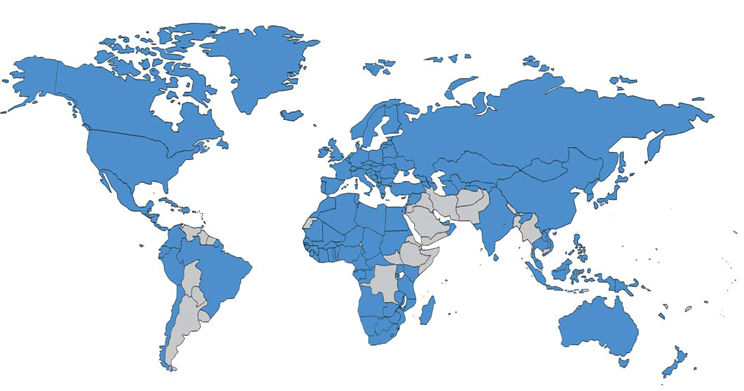
The EPO is also an « International Searching Authority » (or ISA) within the meaning of the PCT Treaty (A16.1 PCT).
Of course, the issues mentioned above remain relevant (A17 PCT and R158 EPC):
- substantive problems preventing a search;
- lack of unity of invention under the PCT (R13 PCT).
There are certain differences with the European procedure:
- The EPO has a time limit for conducting this search (R42 PCT, the latest expiry date is taken into account):
- 3 months from receipt of the search copy;
- 9 months from the priority date.
- There are no additional official fees for claims beyond the 15th: a search must be carried out on all claims;
- The unity of invention is slightly different;
- Interfering applications are mentioned in the international search report (R33.1.c PCT), but are not taken into account for the international preliminary examination (R64.3 PCT).
Limitation of Competence
The EPO has indicated that it is not obliged to perform its function as an ISA or IPEA where it considers that the international application relates to subject matter referred to in R39.1 PCT or R67.1 PCT (« New Agreement between the European Patent Organisation and the International Bureau of the World Intellectual Property Organization concerning the functions of the European Patent Office as an International Searching Authority and an International Preliminary Examining Authority under the Patent Cooperation Treaty« , OJ 2017, A115, A4) unless, for a European application, it would carry out the search or examination (« New Agreement between the European Patent Organisation and the International Bureau of the World Intellectual Property Organization concerning the functions of the European Patent Office as an International Searching Authority and an International Preliminary Examining Authority under the Patent Cooperation Treaty« , OJ 2017, A1157, Annex B).
This limitation is in accordance with A16.3.b PCT (ISA) or A32.3 PCT (IPEA).
Thus, the excluded subject matter would likely include:
- scientific and mathematical theories (equivalent to A52(2)(a) EPC);
- plant varieties, animal races, essentially biological processes for the production of plants or animals, other than microbiological processes and the products thereof (equivalent to A53(b) EPC);
- plans, principles or methods for doing business, performing purely mental acts or playing games (equivalent to A52(2)(c) EPC);
- methods of treatment of the human or animal body by surgery or therapy, and diagnostic methods (equivalent to A53(c) EPC);
- mere presentations of information (equivalent to A52(2)(d) EPC);
- computer programs as such (equivalent to A52(2)(c) EPC).
Therefore, the following should not be excluded, contrary to the EPO’s practice for a European application:
- aesthetic creations (A52(2) b) EPC);
- inventions contrary to public policy or morality (A53 a) EPC).
Redirection of applications?
Since January 1, 2015, applications (« PCT – Agreement between the EPO and WIPO under the PCT« , OJ 2014, A117 amending Annex A of this agreement) filed by a U.S. national or a person domiciled in the United States of America with the USPTO or the IB as RO are processed by the EPO regardless of the technical field (i.e., without redirection).
For applications filed before January 1, 2015, they are « redirected » to the USPTO as ISA or as IPEA if the application contains a claim relating to the field of business methods (G06Q and subclasses).
However, this does not mean that business methods will be searched by the EPO (« Notice from the European Patent Office, dated October 1, 2007, concerning methods in the field of economic activities« , OJ 2007, 592).
PCT supplementary international searches
Principle
The EPO may also act as a « Supplementary International Searching Authority » (or SISA) under the PCT (R45bis PCT).
Without going into too much detail, you should know that « the supplementary PCT search » is roughly the same as « the PCT search » except that it is optional 🙂 (R45bis PCT).
There are some differences from the European procedure:
- The EPO has a time limit for conducting this search (R45bis.7.a PCT):
- 28 months from the priority date.
- There are no additional official fees for claims beyond the 15th: a search must be conducted on all claims;
- The unity of invention is slightly different;
- Interfering applications are mentioned in the supplementary international search report (R45bis.5.c PCT), but are not taken into account for the international preliminary examination (R64.3 PCT).
Number of searches for the SISA
The EPO as SISA does not perform more than 700 supplementary searches per year (« WIPO-EPO Agreement« , OJ 2010, 304, Annex E.5).
Certain national searches
Some national offices of contracting states delegate their search to the EPO (Guidelines B-II 4.6, for example, France).
Search official fee
Standard searches
Principle
The search official fee is due (A78(2) EPC) within a period of 1 month from:
- in the case of a standard application (R38(1) EPC);
- the filing of a divisional application (R36(3) EPC);
- the filing of a new application for an invention previously filed by an unauthorized person (R17(2) EPC).
There will be no notification regarding this irregularity (R58 EPC).
The 1-month period is calculated from the date of filing of the initial documents (even if a filing date cannot be accorded, G3/98).
The search official fee is set out in A2(1).2 RFees ([montant_epo default= »1165 € » name= »A2(1).2 RRT – recherche demande déposée après 1er juillet 2005″] for a standard application filed after July 1, 2005, [montant_epo default= »840 € » name= »A2(1).2 RRT – recherche demande déposée avant 1er juillet 2005″] for a standard application filed before July 1, 2005).
Sanctions
The EPO verifies that these official fees have been paid (A90(3) EPC together with R57 e) EPC).
If the search official fee is missing upon expiry of the 1-month time limit, the application is deemed withdrawn (A78(2) EPC for standard applications, R17(2) EPC for applications filed by an unauthorized person, and R36(3) EPC for divisional applications).
This time limit benefits from the further processing under A121 EPC.
Supplementary searches
Principle
An official fee for search must be paid if a search report is to be carried out (see below for the exemption, A153(7) EPC together with R159(1) e) EPC).
This official fee must be paid within the 31-month time limit from the priority date (R159(1) e) EPC).
By default, the amount of this official fee is [montant_epo default= »1165 € » name= »A2(1).2 RFees – search for application filed after 1 July 2005″] (A2(1).2 RFees) for applications filed on or after 1 July 2005 and [montant_epo default= »840 € » name= »A2(1).2 RFees – search for standard application filed before 1 July 2005″] for a standard application filed before 1 July 2005.
Reduction
There is an exemption from the supplementary search (i.e., 100% reduction) if:
- The ISA or the SISA is the EPO (« Notice from the European Patent Office dated 6 February 2012 concerning search and examination fees« , OJ 2012, 212, point 3.a));
- The ISA, for an application filed before 1 July 2005, was (« Notice from the European Patent Office dated 6 February 2012 concerning search and examination fees« , OJ 2012, 212, point 3.b)):
- The Swedish Patent Office,
- The Austrian Patent Office,
- The Spanish Patent and Trademark Office.
Furthermore:
- There is a reduction of [montant_epo default= »1100 € » name= »Reduction of A2(1).2 RFees – search for application filed after 1 July 2005 – Reduction if ISA is Austrian, Finnish, Swedish, Spanish, Nordic, or Visegrad »] of the supplementary search official fee if the application was filed after 1 July 2005 and if the ISA is (« Decision of the Administrative Council of 16 December 2015 reducing the fee due for the supplementary European search when the international search report or the supplementary international search report has been drawn up by the Austrian Patent Office, the Spanish Patent and Trademark Office, the Finnish Patent and Registration Office, the Swedish Patent and Registration Office, the Nordic Patent Institute or the Visegrad Patent Institute (CA/D 8/15)« , OJ 2016, A2):
- The Austrian Patent Office,
- The Finnish Patent and Registration Office,
- The Swedish Patent and Registration Office,
- The Spanish Patent and Trademark Office,
- The Nordic Patent Institute,
- The Visegrad Patent Institute.
- There is a reduction of [montant_epo default= »1100 € » name= »Reduction of A2(1).2 RFees – search for application filed after 1 July 2005 – Reduction if ISA is Turkish »] of the supplementary search official fee if the application was filed after 1 July 2005 and if the ISA is the Turkish Patent and Trademark Office (« Decision of the Administrative Council of 28 June 2017 reducing the fee due for the supplementary European search when the international search report or the supplementary international search report has been drawn up by the Turkish Patent and Trademark Office (CA/D 9/17)« , OJ 2017, A57).
These provisions were adopted by the Administrative Council pursuant to A153(7) EPC.
Sanction
If the search official fee is not paid within the 31-month time limit, the application is deemed to be withdrawn (R160(1) EPC).
The EPO then notifies the applicant of this loss of rights (R160(2) EPC).
A121 EPC applies to the 31-month time limit (Guidelines C-II 1.2).
PCT International Searches
Principle
The search official fee provided for under R16 PCT is set by the EPO at [montant_epo default= »1875 € » name= »A2(1).2 RRT – international search »] (R158(1) EPC together with A2(1).2 RRT).
The search official fee is collected by the RO for the ISA (A3.4.iv PCT together with R16.1.a PCT) to cover the costs of the search.
The amount is set by the ISA (R16.1.a PCT) but must be paid to the RO (R16.1.b PCT), which determines the currency in which this official fee must be paid.
This official fee is due within 1 month from the filing date (R16.1.f PCT).
Reduction
A 75% reduction of the search official fee is granted for certain developing countries (OJ 2020, A4).
The list of these « low-income or lower-middle-income countries » is established by the World Bank.
To benefit from this reduction, all applicants must meet this criterion.
The same applies if a natural or legal person has nationality and is domiciled in a state where a validation agreement concluded with the European Patent Organisation is in force (OJ 2020, A4).
Sanction
In case of late payment (or insufficient payment), the RO invites the applicant to pay the outstanding amount within 1 month from the notification (R16bis.1.a PCT).
A payment is not considered late if the payment is received by the RO before it sends the notification indicating the late payment (R16bis.1.d PCT).
A late payment official fee may be required by the RO (R16bis.2.a PCT) for its benefit. This late payment official fee is the higher of the following two amounts:
- 50% of the lower of the following two amounts:
- the amount outstanding;
- the international filing official fee (R16bis.2.b PCT).
- The amount of the transmittal official fee.
If, despite the notification, the applicant does not pay within the time limit, the international application is deemed to be withdrawn, and the RO informs the applicant (A14.3.a PCT together with R16bis.1.c.i PCT together with R27.1 PCT together with R29 PCT).
The payment is considered valid (even if a late payment official fee may be due) if the RO receives the payment before sending the notification informing the applicant that the application is deemed to be withdrawn (R16bis.1.e PCT).
PCT Additional International Searches
Principle
The additional search official fee provided for under R45bis PCT is set by the EPO at [montant_epo default= »1875 € » name= »A2(1).2 RRT – additional international search »] (R158(1) EPC together with A2(1).2 RRF).
This official fee is set by the EPO but collected by the IB for its own benefit (R45bis.3.b PCT).
This official fee is due within a period of 1 month from receipt of the request for additional search (R45bis.3.c PCT together with R45bis.2.c PCT).
Sanction
In the event of late payment, the IB invites the applicant to pay within a period of 1 month from the invitation:
- the search official fee as indicated above (R45bis.4.b PCT);
- a late payment official fee of 50% of the processing official fee (and not of the search official fee, R45bis.4.c PCT).
Failing this, the request for additional search is deemed not to have been filed (R45bis.4.d PCT).
Refund of the search official fee
Full refund
European or supplementary searches
The search official fee is refunded in full if:
- the application is not forwarded (R37(2) EPC) by a contracting state to the EPO within 14 months from the priority;
- the application is withdrawn, refused or deemed withdrawn before the EPO has begun to draw up the ESR (A9(1) RRF);
- the application is not accorded a filing date (Guidelines A-II 4.1.4).
The fact that the search has begun must be based on clear and transparent elements (« Notice from the European Patent Office dated 29 January 2013 concerning the adaptation of the system for refunding search and examination official fees« , OJ 2013, 153): the date on which the prior art search algorithm was launched by the examiner in charge of the search is thus recorded in the file for verification purposes.
PCT international searches
Any amount collected in error, in excess, etc. is refunded (« WIPO-EPO Agreement« , OJ 2010, 304, Annex C, Part II, point 1).
The EPO refunds the search official fee (« WIPO-EPO Agreement« , OJ 2010, 304, Annex C, Part II, point 2) if the international application is withdrawn or considered withdrawn under A14.1 PCT, A14.3 PCT, A14.4 PCT before the start of the international search (mainly due to formal deficiencies or failure to pay an official fee).
Additional PCT international searches
Any amount unduly collected, overpaid, etc. is refunded (« WIPO-EPO Agreement« , OJ 2010, 304, Annex C, Part II, point 1).
The additional search official fee is refunded by the IB (R45bis.3.d PCT):
- if the international application is withdrawn or considered withdrawn before the search copy is transmitted to the EPO,
- if the request for additional search is withdrawn or deemed not to have been filed before the search copy is transmitted to the EPO.
The EPO refunds the additional search official fee if, before it has started the additional international search, the EPO finds that the request for additional search is deemed not to have been filed because the search is entirely excluded due to a limitation (R45bis.5.g PCT) (« WIPO-EPO Agreement« , OJ 2010, 304, Annex C, Part II, point 7).
The EPO refunds the additional search official fee (« WIPO-EPO Agreement« , OJ 2010, 304, Annex C, Part II, point 8):
- if the international application is withdrawn or considered withdrawn before the EPO starts the search,
- if the request for additional search is withdrawn or deemed not to have been filed before the EPO starts the search.
Full or partial refund
European or supplementary searches
If the search is facilitated by a prior search, part of the search official fee may be refunded (« Decision of the President of the European Patent Office, dated 21 December 2018, on the refund of the search fee pursuant to Article 9(2) of the Rules relating to Fees« , OJ 2019, A4).
This refund applies to European searches or supplementary searches (« Decision of the President of the European Patent Office, dated 21 December 2018, on the refund of the search fee pursuant to Article 9(2) of the Rules relating to Fees« , OJ 2019, A4):
- and if the prior search was carried out with a written opinion,
- and if this prior search is a European search for an EP application filed as from 1 July 2005, the refund is:
- 100 % in case of full reuse or
- 25 % in case of partial reuse.
- and if this prior search is a PCT search for a PCT application filed as from 1 January 2004, the refund is:
- 84 % in case of full reuse or
- 21 % in case of partial reuse.
- and if this prior search is an additional PCT search, the refund is:
- 84 % in case of full reuse or
- 21 % in case of partial reuse.
- and if this prior search is a national search for BE, CY, FR, GB, GR, IT, LT, LU, LV, MC, MT, NL, SM, TR, the refund is:
- 84 % in case of full reuse or
- 21 % in case of partial reuse.
- and if this prior search is a European search for an EP application filed as from 1 July 2005, the refund is:
- and if the prior search was carried out without a written opinion,
- and if this prior search is a European search for an EP application filed before 1 July 2005, the refund is:
- 70 % in case of full reuse or
- 17.5 % in case of partial reuse.
- and if this prior search is a PCT search filed before 1 January 2004, the refund is:
- 70 % in case of full reuse or
- 17.5 % in case of partial reuse.
- and if this prior search is an international-type search, the refund is:
- 70 % in case of full reuse or
- 17.5 % in case of partial reuse.
- and if this prior search is a standard search (the EPO no longer carries out this type of search as from 1 September 2007), the refund is:
- 70 % in case of full reuse or
- 17.5 % in case of partial reuse.
- and if this prior search is a national search for BE, CY, FR, GR, LU, NL, TR, the refund is:
- 70 % in case of full reuse or
- 17.5 % in case of partial reuse.
- and if this prior search is a European search for an EP application filed before 1 July 2005, the refund is:
International Searches (EPO/ISA or EPO/SISA)
If the search is facilitated by a prior search conducted by the EPO for the priority application (including a « standard » search requested privately), part of the search official fee may be refunded (R16.3 PCT, « Agreement« , OJ 2010, 304, Annex C, Part II, point 3 and A9 RFees together with « Decision of the President of the European Patent Office, dated 21 February 2014, on the refund of the international search official fee by the EPO acting as International Searching Authority« , OJ 2014, A30):
- and if the prior search was conducted with a written opinion,
- and if this prior search is a European search, the refund is:
- 100 % in case of full reuse or
- 25 % in case of partial reuse.
- and if this prior search is a PCT search, the refund is:
- 100 % in case of full reuse or
- 25 % in case of partial reuse.
- and if this prior search is a supplementary PCT search, the refund is:
- 100 % in case of full reuse or
- 25 % in case of partial reuse.
- and if this prior search is a national search for BE, CY, FR, GR, IT, LU, MT, NL, TR, the refund is:
- 100 % in case of full reuse or
- 25 % in case of partial reuse.
- and if this prior search is a European search, the refund is:
- and if the prior search was conducted without a written opinion,
- and if this prior search is an international-type search, the refund is:
- 70 % in case of full reuse or
- 17.5 % in case of partial reuse.
- and if this prior search is a standard search (the EPO no longer conducts this type of search since 1 September 2007), the refund is:
- 70 % in case of full reuse or
- 17.5 % in case of partial reuse.
- and if this prior search is a national search for BE, CY, FR, GR, LU, NL, TR, the refund is:
- 70 % in case of full reuse or
- 17.5 % in case of partial reuse.
- and if this prior search is an international-type search, the refund is:
Full/Partial Reuse Criteria
Normally, a search report will be fully reused if the claims presented (« Notice from the European Patent Office, dated 9 January 2009, concerning the criteria for refund of search official fees« , OJ 2009, 99, point 2.1):
- are identical to the previously searched claims; or
- represent a limitation of the previously searched claims:
- deletion of claims,
- deletion of alternative features of a claim,
- addition of a limitation through claim merging.
Normally, a search report will be partially reused if the claims presented (« Notice from the European Patent Office, dated 9 January 2009, concerning the criteria for refund of search official fees« , OJ 2009, 99, point 2.2):
- are broader than the previously searched claims (and constitute a generalization); or
- represent a limitation of the previously searched claims with a feature that was not disclosed in the earlier application (but relates to the same invention).
No refund is due, i.e., the search report will not be reused, when the claimed invention is different (« Notice from the European Patent Office, dated 9 January 2009, concerning the criteria for refund of search official fees« , OJ 2009, 99, point 2.3).
Refund Procedure
The refund is made after the communication of the search report, the amount of this refund having been previously communicated to the applicant (« Notice from the European Patent Office, dated 9 January 2009, concerning the criteria for refund of search official fees« , OJ 2009, 99, point 3).