


For Novelty
Definition
The prior art consists of:
- the common general knowledge of the person skilled in the art, any public disclosure (written or oral), any public use before the filing date of the patent application (A54(2) EPC);
- European patent applications filed before the filing date and published thereafter (A54(3) EPC).
Definition of the « filing date »
By « filing date » (under A54(3) EPC or A54(2) EPC), the earliest priority date is meant (A89 EPC).
For A54(3) EPC documents benefiting from a priority, it is necessary to verify that the assignment of the priority right has been made (T382/07).
Determination of the Relevant Prior Art
In the following diagram, the relevant prior art consists of all A54(2) EPC and A54(3) EPC documents.
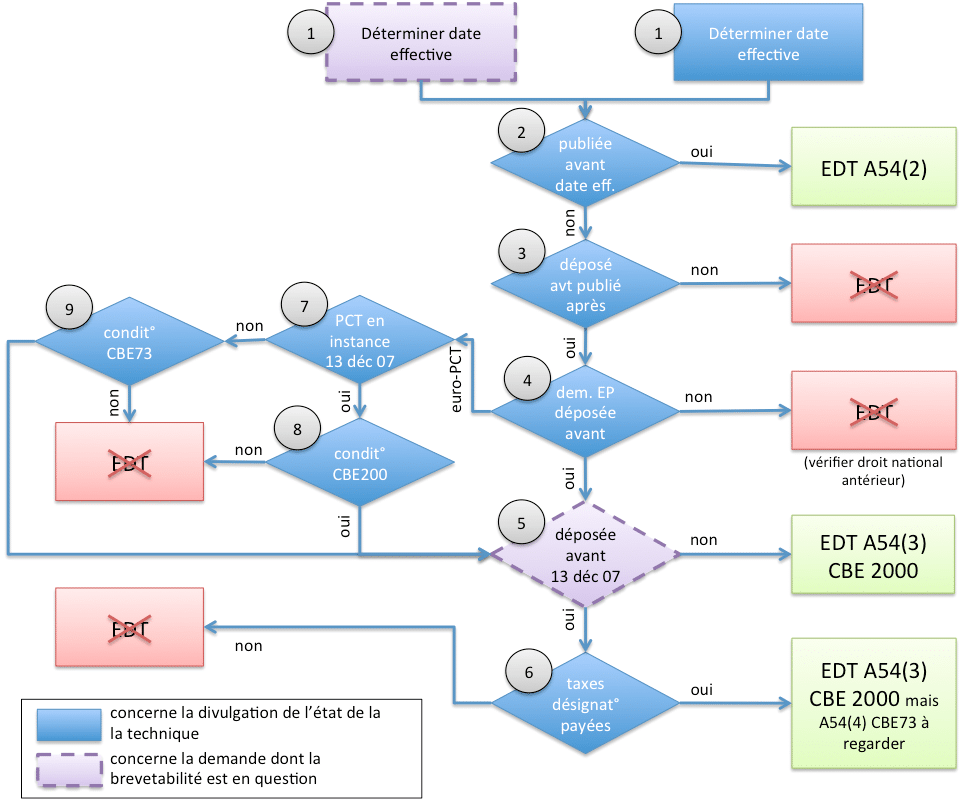
Here is the explanation of this somewhat complex diagram:
- Determine the effective date of the application whose patentability is in question and the disclosure of the prior art:
- this date is determined claim by claim (for the application whose patentability is in question);
- it is the filing date (or the priority date, if applicable) of the application.
- Determine whether the publication date of the prior art document is strictly before the effective date of the application whose patentability is in question.
- if this is verified, then the prior art document is an A54(2) EPC document;
- If the disclosure is not an application filed before and published after, then it is not a prior art document;
- If the disclosure is not a European or Euro-PCT application, then it is not a prior art document (but it may be a national prior right under A139(2) EPC or A139(2) EPC73);
- If the disclosure is a European application (or Euro-PCT, meeting points 7 to 9 below), then it must be determined whether the application whose patentability is in question was filed in Europe (or at the international level) before 13 December 2007 (i.e., the entry into force of the EPC 2000): if not, the document is an A54(3) EPC document.
- If the application whose patentability is in question was filed before 13 December 2007 (and meeting points 7 to 9 below), then it is necessary to verify that the conditions set by the EPC73 are met regarding the prior art application:
- The opposability of the prior art application is assessed country by country: to be opposable in a country, it is necessary that this prior art application validly designated that country (A54(4) EPC73).
- If the prior art application is a simple EP application:
- It is necessary to pay the national official fee under R106 EPC73, i.e., the filing official fee and the designation official fees;
- The designation official fees may in any case be paid within a period of 31 months (R107(1) EPC73) or within a period of 6 months from the date of publication of the mention of the international search report (whichever period expires later).
- It is necessary to file a translation of the PCT application if it is not in one of the official languages of the EPO;
- It is necessary to pay the filing official fee under R159(1)(c) EPC (A153(5) EPC and R165 EPC together with R159(1)(c) EPC).
- It is necessary to file a translation of the PCT application if it is not in one of the official languages of the EPO;
- It is necessary to pay the national official fee under R106 EPC73, i.e.:
- the filing official fee and
- the designation official fees;
- The designation official fees may in any case be paid within a period of 31 months (R107(1) EPC73) or within a period of 6 months from the date of publication of the mention of the international search report (whichever period expires later).
Special case of A54(3) EPC applications
Principle
As previously stated, European patent applications filed before the filing date and published thereafter (A54(3) EPC) form part of the prior art.
To verify whether the European patent application was filed earlier, its priority date must be taken into account (if this priority is valid, Guidelines G-IV 5.1.1).
Publication and withdrawal
Therefore, if the application is withdrawn before its publication, then the application is not citable as prior art (J5/81).
If an application is published despite having been withdrawn (either in error or because the application was withdrawn after the completion of technical preparations, A93 EPC), it is not citable as prior art (Guidelines G-IV 5.1.1).
Priority and withdrawal of priority after publication
Withdrawing a priority after the publication of an application does not affect its citability as prior art for another application under A54(3) EPC (Guidelines G-IV 5.1).
This can lead to rather « surprising » outcomes, as illustrated in the following diagram:
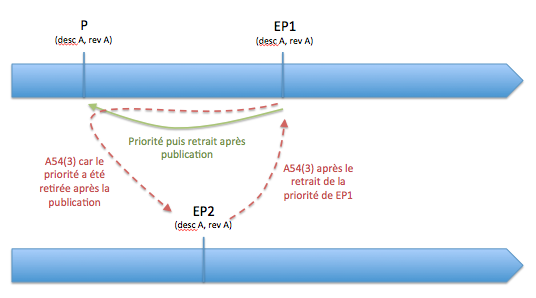
Thus, neither of the two applications EP1 and EP2 is novel: they mutually anticipate each other under A54(3) EPC.
Application pending as of December 13, 2007
For such applications, it is also necessary to consider the countries designated in common (A54(4) EPC73 and transitional provisions of the EPC 2000).
In this case, it is possible to have multiple sets of claims to avoid prior art (R87 EPC73).
It is even possible to have multiple sets of descriptions and/or drawings if the Examiner deems it necessary (Guidelines H-III 4.1).
If the disclosure is a Euro-PCT application, it is necessary that the designation fees have been paid for that application (R23bis EPC73).
The withdrawal of a validly designated country is irrelevant (Guidelines G-IV 5.1.1).
For inventive step
Principle
The prior art to be considered for assessing inventive step is the same as that for novelty (public written or oral disclosures, public uses, etc. before the filing date of the patent application), but excluding documents under A54(3) EPC, i.e., European patent applications filed before the filing date and published thereafter (A56 EPC together with A54(2) EPC).
Accordingly, the citable prior art consists of all documents available to the public before the filing date (or priority date) of the application in question (A54(2) EPC).
Must the prior art be technically relevant?
The prior art must be interpreted as relating to information:
- in closely related technical fields to the invention (T28/87) and
- that is relevant to a technological field (T172/03 and Guidelines G-VII 2).
Thus, if the person skilled in the art would not expect to find technically relevant information there, it should be excluded.
However, this approach is rejected by decision T2101/12: in this decision, the board of appeal finds no justification in the EPC for limiting the prior art in this way for inventive step.
Therefore, the prior art may well be a commercial activity or, more generally, a non-technical activity (T2101/12).
Dates to consider
In order to determine whether an inventive step exists, the priority date of the application in question must be considered (T24/81, Guidelines G-VII 4).
Regarding the date of prior art documents, this is the date of disclosure (A54(2) EPC).
If this date is too old, it may happen that the document is not taken into account, as the person skilled in the art would rather tend to follow recent developments (T366/89, T479/00).
Taking context into account
It is not possible to extract a part of a document from its context (T56/87, T768/90 and T115/96).
Public availability of a disclosure
Common general knowledge of the person skilled in the art
The common general knowledge of the person skilled in the art, as of the filing date, is of course considered to be publicly available.
This knowledge may be proven by any means (dictionary, encyclopedia, basic technical manual, scientific articles).
Nevertheless, this common general knowledge does not usually include patent literature (T263/12 or T1540/14) unless:
- this literature contains contextual elements identified as representative of the common general knowledge of the person skilled in the art;
- if the technical field in question is novel and this common general knowledge had not yet found its place in manuals or monographs, but due to its innovative nature, this knowledge spread rapidly within the relevant scientific community (T1117/14).
The EPO states that an Examiner may well choose not to cite a document if they consider a feature to be common general knowledge (« Notice from the European Patent Office dated 1 October 2007 concerning business method inventions« , OJ 2007, 592).
Fortunately, you may challenge this (T766/91 or Guidelines G-VII 3.1): if someone asserts that a feature forms part of the common general knowledge of the person skilled in the art or that the feature is obvious, you may ask them to demonstrate it (I must admit I have not had much success before the Examining Divisions, but still…).
It should be noted, however, that there is a contrary decision (T1090/02) which states that it is the applicant’s responsibility to prove that the alleged common general knowledge postdates the priority date (good luck providing such proof).
Written disclosure
Principle
Public availability
A written disclosure is considered to have been made available to the public (Guidelines G-IV 1 and Guidelines G-IV 7.2.1) if, on the relevant date, members of the public could have accessed it (excluding confidentiality clauses or restrictions on use or dissemination).
Effective consultation
Thus, it is irrelevant whether a person actually consulted the document (T381/87).
Number of persons constituting the public
There is no requirement for a minimum number of members of the public to have had knowledge of the disclosure (T165/96), and accessibility by a single person is sufficient (T1829/06).
Competence of the public
Some case law requires that the persons who had knowledge of the disclosure possess a minimum level of expertise in the field (T877/90 and T406/92), but this is debatable.
Other case law considers that a disclosure is novelty-destroying as soon as the « person in the street » has knowledge of it (T482/89).
Special case of a thesis
If a thesis is defended, it only becomes part of the prior art if the public could attend the defense or if the members of the jury were not bound by a confidentiality agreement (T1817/08).
A thesis is in any case considered accessible from the moment it has an order number and can be ordered (T1266/11): whether the thesis was actually ordered is irrelevant.
Special case of a letter
A letter is considered prior art from the date of its receipt by the addressee, not its dispatch (T381/87).
Special case of an Internet document
Such Internet citations may be perfectly valid (T286/10):
- pages extracted from a standard website;
- pages cached in the tool « archive.org » (as this tool « provides sufficient guarantees to benefit from a presumption of being a reliable and trustworthy source of information« ).
Examples of disclosure / non-disclosure
A document is considered publicly accessible not upon receipt by the librarian, but on the day the librarian places the document on the library shelves (or assigns it a reference, T729/91 or T176/02). However, the Board of Appeal ruled in T834/09 that the librarian was part of the public, and thus the date of receipt by the librarian was the date on which the document was considered publicly accessible…
A company’s internal documents are a priori not public (T37/96).
The sending of an unencrypted email does not make that email publicly accessible, as confidentiality agreements exist with access providers (T2/09).
Internship or thesis reports prepared for the purpose of obtaining a diploma are most often considered publicly accessible, especially if references to these reports are made in subsequent works (T151/99).
Oral disclosure
In principle, the Examiner should not cite an oral disclosure unless they have written evidence proving such disclosure (Guidelines B-VI 2).
When an oral disclosure is invoked (by an intervener, a third party, or an opponent), it is necessary to provide elements enabling, in particular, the determination of (Guidelines G-IV 7.2 and T328/87):
- the date of the prior use/oral description,
- the subject matter of the use/oral description (i.e., identical or similar),
- the circumstances of the use/oral description (i.e., public accessibility).
Prior Use
Indeed, certain uses may constitute disclosures under specific conditions. Such uses may include (Guidelines G-IV 7.1):
- for a product:
- its manufacture,
- its offer,
- its placing on the market (sale or exchange),
- its use;
- for a process:
- its offer,
- its application.
Thus, subject to the points below, a sale to a single buyer is novelty-destroying if that buyer is not bound by a confidentiality agreement (T1022/99, T482/89, T1024/18 and Guidelines G-IV 7.2.1).
In the case of use in a non-public place, it is considered that no disclosure has occurred (Guidelines G-IV 7.2.3).
Intrinsic Features
Principle
The composition of a product forms part of the prior art as soon as the product is made available to the public and can be analyzed and reproduced by a person skilled in the art. It is irrelevant whether the person skilled in the art had reasons to analyze the composition/structure of the product (G1/92).
Possible Analysis
The product must therefore have been capable of being analyzed:
- a mere display at a trade fair may be insufficient if the public cannot access or freely handle the product (Guidelines G-IV 7.2.1);
- a very brief presentation of the product to the public (e.g., a few seconds from more than 5 meters away) may be insufficient if it appears that its features could not be clearly and directly distinguished within that short timeframe (T1410/14).
Certain case law requires that the analysis does not involve undue burden to discover the composition/structure of a product (G1/92, point 1.4).
However, other case law considers that the degree of difficulty, the amount of work, or the time required for the analysis is immaterial (T952/92).
Possible Reproduction
Knowing the exact composition of a product does not always enable its reproduction.
Indeed, the process and manufacturing conditions may have a significant impact on the ability of a person skilled in the art to reproduce the invention (e.g., in the field of polymers, T1833/14).
Extrinsic Features
Extrinsic features include:
- the manufacturing characteristics of the product,
- the specific effect of a product’s composition on the human body (e.g., a second therapeutic effect),
- effects that only appear when there is interaction between the product and specifically chosen external conditions (T1409/16).
These extrinsic features are, unless otherwise specified, considered not to have been disclosed (G1/92, and Guidelines G-IV 7.2.1).
Public and Confidentiality
If a confidentiality clause expires, this is not sufficient to render the disclosure public. It must be examined whether the third party, who was previously bound by the confidentiality clause, has effectively disclosed the information in question (T1081/01).
If any member of the public can access the document (T50/02), even if that person must pay and is subject to a dissemination restriction (e.g., a paid standard such as MPEG or DVDs, T2239/15), then that document will be considered publicly accessible (contra T1155/12).
In the context of business relationships, a tacit confidentiality agreement may be accepted (T830/90 and Guidelines G-IV 7.2.2).
If the opponent argues that there was no confidentiality agreement, the burden of proof lies with them (T37/96).
In the context of clinical trials, we may question whether the individuals participating in such trials are members of the public or if a certain level of confidentiality exists. Even if no confidentiality agreement exists regarding the trial itself, if participants cannot freely dispose of the medications, then they cannot be considered members of the public (T670/20).
Non-Opposable Disclosures
In Case of Evident Abuse
A55(1)(a) EPC provides that disclosures made during a period of 6 months prior to the filing of the application shall not be taken into consideration if they result from « an evident abuse in relation to the applicant or their predecessor in title« .
The date to be considered for calculating this 6-month period is the effective date of the documents at the EPO (and not the priority date or the filing date, G3/98 and G2/99).
Since this 6-month period is not a time limit (within the meaning of A120 EPC), the extension of time limits is not applicable (R134 EPC).
There must truly be, on the part of the person who disclosed the invention (Guidelines G-V 3, T585/92):
- a genuine intent to harm; or
- knowledge (actual or presumed) of the damage that will/could be caused.
For example, the accidental publication of a patent application before the intended date does not necessarily constitute abuse (T585/92).
There is abuse if the person disclosing the invention has violated (intentionally or inadvertently) a confidentiality agreement (T173/83).
In the case of officially recognized exhibitions
A55(1) b) EPC provides that disclosures made during a period of 6 months before the filing of the application shall not be taken into account if they result from an officially recognized exhibition (see the website of the International Exhibitions Bureau).
The date to be considered for calculating this 6-month period is the effective date of the documents at the EPO (and not the priority date or the filing date, G3/98 and G2/99).
Since this 6-month period is not a time limit (within the meaning of A120 EPC), the extension of time limits is not applicable (R134 EPC).
Note that not all exhibitions qualify (and, in reality, they are quite rare): it is necessary to check the list of recognized international exhibitions on the website of the International Exhibitions Bureau.
They are also published in the OJ (in April, in the « International Treaties » section):
- 2017 (JO 2013, 252):
- 10 June to 10 September 2017: The Energy of the Future: Answering Humanity’s Major Challenge (ASTANA, KZ)
- 2015 (JO 2012, 342):
- 01 May to 31 October 2015: Feeding the Planet, Energy for Life (MILAN, IT)
- 2012 (JO 2012, 342):
- 05 April to 21 October 2012: Floriade 2012 – Living Nature (World Horticultural Exhibition) (VENLO, NL)
- 12 May to 12 August 2012: Living Oceans and Coastal Zones: Diversity of Resources and Sustainable Activities (YEOSU, KR)
- 2010 (JO 2006, 326):
- 01 May to 31 October 2010: Better City – Better Life (SHANGHAI, CN)
- 2008 (JO 2006, 326):
- 14 June to 13 September 2008: Water and Sustainable Development (ZARAGOZA, ES)
- 2006-2007 (JO 2006, 326):
- 01 November 2006 to 31 January 2007: Royal Flora Ratchaphruek 2006/2007 (CHIANG MAI, TH)
- 2005 (JO 2003, 161):
- 25 March to 25 September 2005: The Wisdom of Nature (AICHI, JP)
- 2003 (JO 2003, 161):
- 25 April to 12 October 2003: IGA 2003 – Horticultural Exhibition (ROSTOCK, DE)
For the disclosure made during the conference to be unopposable, it is necessary:
- at the filing to make a declaration of exhibition (A55(2) EPC, this cannot be corrected subsequently);
- within a period of 4 months from the filing date (R25 EPC) (or at entry into the regional phase for Euro-PCT applications, R159(1)(h) EPC) to provide a certificate which must:
- be issued during the exhibition;
- certify that the invention was actually exhibited;
- mention the opening date of the exhibition and, where applicable, the date of first disclosure of the invention;
- be accompanied by authenticated documents (by the person who issued the certificate) enabling identification of the invention.
The 4-month deadline benefits from A121 EPC.
Content of disclosures
The content of a disclosure is anything that follows directly and unambiguously from that disclosure (Guidelines G-VI 2 and T411/98).
Explicit features
Naturally, the explicit content of disclosures (e.g., the description) is part of the prior art.
Drawings
The prior art document must be considered as a whole, including its drawings.
However, the dimensions of the figures should not be taken into account (T204/83) unless the dimensions are presented in the description as being of particular importance (i.e., importance that would have led the draftsman to represent these dimensions realistically, T1488/10).
The same applies to dimensional ratios. Unless there are special circumstances, drawings are not of great assistance (T1943/15).
Claims
Where a combination of features is found only in the claims, careful consideration must be given as to whether this combination truly corresponds to the technical teaching of the document as it would be understood by the person skilled in the art, or whether it is merely an artifact of the claim drafting process intended to obtain the broadest protection (T312/94, T969/92, T42/92, T1658/12).
Abstract
The EPO considers that disclosures made in the abstract of a patent or application should not be taken into account if this disclosure is contradictory to that of the description (T1080/99).
Furthermore, abstracts should not be taken into account for A54(3) EPC applications (Guidelines G-IV 5.1).
Sufficient / defective disclosure
For a disclosure to destroy the novelty of a claim, it is necessary that the information provided to the person skilled in the art be sufficient to enable them, at the date of publication (or the filing date for an A54(3) EPC document), to put the technical teaching into practice (T206/83, T26/85 and Guidelines G-VI 4).
However, it is possible to take into account a description containing errors (and where such errors are not detectable by the person skilled in the art, T591/90, T171/84, Guidelines G-VI 9).
Accidental disclosure
An accidental disclosure is a relevant disclosure even though the technical problem is quite different (T161/82).
In any event, such a disclosure is opposable, but a disclaimer is possible.
References to other documents
If the relevant content of a document incorporated by reference (i.e., cited) is not clearly identified in the disclosure, it will not be taken into account for the novelty analysis (T689/90, Guidelines G-IV 8).
In the opposite case and if the document is an A54(3) EPC application (Guidelines F-III 8):
- if the reference was publicly available at the filing date, it is taken into account.
- if the reference was not publicly available at the filing date, it is taken into account only if:
- at the filing date of that application, the reference was available to the Office;
- at the publication date of that application, the reference is publicly available.
« The specific anticipates the general »
As a general rule (Guidelines G-VI 5), a general disclosure (e.g., metal) does not anticipate a specific feature (e.g., copper).
Conversely, a specific disclosure (e.g., a rivet) anticipates a general feature (e.g., a fastening system).
Non-explicit features
It may happen that certain features of one of the claims are not found in the same disclosure: does this necessarily mean the invention is novel?
Not necessarily!
Implicit disclosures
If a feature is implicit in a disclosure, then it forms part of the prior art (Guidelines G-VI 6).
A feature is « implicit » if it follows « directly and unambiguously » from the disclosure (i.e., there was no other choice than the existence of that feature).
By way of illustration, in the disclosure of a shoe, there is no implicit disclosure of laces, as other fastenings are possible (such as hook-and-loop fasteners).
However, this does not involve assessing the likelihood that the person skilled in the art would have paid attention to this implicit feature and thus knew of it, but rather determining in a purely objective manner whether the prior art discloses it (e.g., a ratio between several values exceeding a threshold, T1456/14).
Equivalent disclosures
Novelty is not destroyed by the disclosure of equivalent features (e.g., « natural rubber » and « polybutadiene, » both of which are elastomers) (see also T167/84, Guidelines G-VI 2).
Simply juxtaposed features
It may also occur that these undisclosed features do not technically interact with the disclosed features. This is referred to as a juxtaposition of features.
In Europe, such juxtaposition will confer novelty to the application (T1918/09).
Personally, I strongly disagree with this position, as I believe it may create a bias: to circumvent a potential EPC A54(3) document, it would suffice to add an unlikely but entirely trivial feature (e.g., « and wherein the world comprises a bolt« ).
This feature is unlikely to have been disclosed (unless one argues that it is implicit).
French case law shares this view: in such situations, each « group » of independent features must be analyzed separately (Cass. ch. com. 29 November 1967).
Interpretation of features
A disclosure under EPC A54(3) must be interpreted as of the filing or priority date of the application whose novelty is in question (T233/90).
A disclosure under EPC A54(2) must be interpreted as of the publication date of the application whose novelty is in question (T205/91 and T305/94).
A document published after the relevant date may be taken into account (T1110/03), particularly if it is a dictionary or reference work.
The common general knowledge of the person skilled in the art may be taken into account (T206/83): most often, such knowledge may be proven by technical manuals.
In exceptional cases (highly specialized technical fields), it may be accepted that the common general knowledge of the person skilled in the art be proven by patent specifications (Guidelines F-II 4.1, T51/87, T772/89).
« Hidden » features
This is a relatively complex concept to grasp.
Imagine that a prior art document discloses a feature that is not immediately apparent but must be « revealed » through a demonstration, such as a mathematical one—does this constitute a disclosure?
According to the Board of Appeal, the answer is yes, even if there is no objective reason to perform such a demonstration (T2517/11).