


Time Limits
A120 EPC is quite succinct and merely refers to the Implementing Regulations. Reference must therefore be made to R131 EPC to R136 EPC for the calculation of time limits.
However, it should be borne in mind that when we say that a time limit expires on a certain day « D », the required action remains valid if performed on the day of expiry (i.e., day D).
On the other hand, the action will not be valid if performed on day D+1.
Step 1: Determine the starting point of the time limit
Principle
There are several situations:
- The time limit runs from the day following the actual notification of the document triggering the time limit (R131(2) EPC). For example:
- Notification under A94(3) EPC triggering a set time limit;
- Notification under R71(3) EPC triggering a 4-month time limit;
- Notification indicating a lack of unity under R64(1) EPC and triggering a 2-month time limit;
- The time limit runs from the day following the occurrence of a legal event. For example:
- Payment of the filing and search official fees within 1 month from the filing of the application (A78(2) EPC and R38(1) EPC);
- Payment of the designation official fees within 6 months from the publication of the European search report in the EPO Bulletin (A79(2) EPC and R39(1) EPC);
- Opposition within a 9-month time limit from the publication of the mention of grant in the EPO Bulletin (A99(1) EPC);
- The time limit runs from the end of another time limit (i.e., a composite time limit). There are only four such « composite » time limits:
- The 1-year time limit for restitutio in integrum running from the expiry of the unobserved time limit (A122 EPC and R136 EPC);
- The 2-month time limit to request restitutio in integrum concerning the priority time limit or the request for review, running from the expiry of the unobserved time limit (A122 EPC and R136 EPC); and
- The 6-month grace period for the payment of renewal fees for Euro-PCT applications running from the 31-month time limit from the PCT filing date (R159(1)(g) EPC (A86 EPC and R51(2) EPC, Guidelines A-X 5.2.4)).
- The 2-month time limit to request validation with an additional official fee in a non-EPC contracting state (Guidelines A-III 12.2).
Focus on service by post
The EPO considers that, in the case of service by post, the time limit starts to run from the day following the receipt of the document by the addressee (R131(2) EPC).
To simplify the calculation of time limits, the EPC provides, in an arbitrary and fictitious manner, that the postal transmission period is 10 days (R126(2) EPC), unless it is longer.
In case of dispute, it is for the Office to provide proof of the date of receipt of the document (R126(2) EPC): a simple statement from the postal service indicating that the mail was delivered is not sufficient (J14/14).
Notifications sent by post are (R126(1) EPC):
- decisions which set a time limit for filing an appeal,
- decisions which set a time limit for filing a request for review,
- summonses.
To date, the President of the EPO has not designated any other documents for which registered mail with advice of delivery must be used (Guidelines E-II 2.3).
Focus on service via « Mailbox »
This mode of service is provided for by R125(2) b) EPC.
Certain notifications may be served electronically via a tool called « Mailbox ».
- the RREE and the RRI (« Notice from the European Patent Office dated 13 December 2011 concerning the EPO’s online services« , OJ 2012, 22);
- other notifications (« Decision of the President of the European Patent Office dated 11 March 2015 concerning the pilot project to introduce new means of electronic communication for proceedings before the European Patent Office« , OJ 2015, A28), the list of which can be found on the EPO website (list of notifications available via Mailbox).
The 10-day period under R126(2) EPC is retained even via this mode of transmission from the date of notification or from the date of actual delivery in the Mailbox (the later date is taken into account (R127(2) EPC), and « Decision of the President of the European Patent Office dated 11 March 2015 concerning the pilot project to introduce new means of electronic communication for proceedings before the European Patent Office », OJ 2015, A28, A9(4)).
Step 2: Determining the expiry date
A time limit is always expressed in years, months, weeks or days.
Time limit expressed in years
R131(3) EPC provides:
When a period is expressed in one or more years, it shall expire in the relevant subsequent year in the month having the same name and on the day having the same number as the month and the day on which the said event occurred; if the subsequent month has no day with the same number, the period shall expire on the last day of that month.
To simplify, let us take a few examples assuming we have a time limit of 1 year:
- if the starting point is 05/03/12, the time limit expires on 05/03/13;
- if the starting point is 29/02/12, the time limit expires on 28/02/13 (the month of February not having a 29th day in the year 2013).
Time limit expressed in months
Under R131(4) EPC:
When a time limit is expressed in one or more months, it shall expire in the relevant subsequent month on the day having the same number as the day on which the said event occurred; if the relevant subsequent month has no day with the same number, the time limit shall expire on the last day of that month.
The principle is quite similar to that of time limits expressed in years.
Let us examine this through a few examples, assuming we have a time limit of 1 month:
- if the starting point is 06/03/12, the time limit expires on 06/04/12;
- if the starting point is 31/01/12, the time limit expires on 29/02/12 (since February does not have a 31st day, the last day of February is taken).
There is an exception concerning the 6-month time limit for paying an annual fee with a surcharge (see the article « Payment of annual fees » detailing this subject).
Time limit expressed in weeks
Under R131(5) EPC:
When a time limit is expressed in one or more weeks, it shall expire, in the relevant week, on the day having the same name as that on which the said event occurred.
Here, I do not see much difficulty; if the time limit is 1 week and:
- if the starting point is 06/03/12 (Tuesday), the time limit expires on 13/03/12 (Tuesday);
- if the starting point is 30/03/12 (Friday), the time limit expires on 06/04/12 (Friday).
Time limit expressed in days
This is so obvious that R131 EPC did not even address the subject 🙂
Step 3: Possibly extend the time limit
Time limits to which this extension applies
R134 EPC applies to all time limits defined as such in the EPC (including priority, Guidelines A-III 6.6).
Even if, in theory, official fees could be paid even when the EPO is closed, the principle of extension also applies to the payment of official fees on such days (J1/81).
Reasons for the extension
Related to EPO offices
This extension may be related to the closure of one of the EPO offices (Munich, The Hague or Berlin) (R134(1) EPC):
- these closures correspond to:
- the non-delivery of mail at one of these offices;
- public holidays in Germany or the Netherlands;
- Saturday-Sunday;
- exceptional cases of disruption to one of the EPO’s receiving services (such as fax servers).
- the non-delivery of mail at one of these offices;
- these closure dates are the subject of communications from the President of the Office (for example, « Notice from the President of the European Patent Office, dated 6 September 2011, concerning the days on which EPO filing offices are closed in 2012 » OJ 2011, 506 for the days of non-delivery of mail in 2012);
Related to competent authorities
The foregoing provisions also apply to acts performed before a national authority competent for the filing of an application (R134(3) EPC).
This provision is important as it allows a party missing its priority period to file a European application with one of the competent national authorities that is closed (e.g., July 14) during the period following the priority (possible if this concerns only a few days).
Related to mail delivery issues
This extension may be due to a general disruption affecting the delivery or dispatch of mail (R134(2) EPC):
- in Germany or the Netherlands (for all);
- in a contracting state (but only for parties or representatives having their residence or place of business in that state).
For a general disruption to occur, it is not necessary that the entire territory of a state be affected, but the public must be impacted (and not only certain categories of persons/recipients, J3/90).
In the event of a general disruption, the EPO publishes, for legal certainty, the start and end dates of such disruption (R134(4) EPC).
It appears that a party may invoke a disruption even in the absence of a notice from the President (J11/88).
Procedure
It is normally not necessary to make a specific request since this extension is automatic (« operation of law« , J11/88).
New date
The time limit is extended to the next working day (following the date calculated in step 2) on which none of the four foregoing conditions is met.
« September 11 » Clause
For completeness, it is also necessary to mention the (very rare) case where the delivery or dispatch of mail has been disrupted due to exceptional circumstances (natural disaster, war, civil unrest, general failure of the Internet, telephone, fax, or postal services, etc.) in the locality where the applicant or their representative resides (R134(5) EPC).
In this latter scenario, the following conditions must be met (R134(5) EPC):
- provide the evidence of such disruption to the EPO (in a convincing manner),
- this disruption must have occurred within the last 10 days preceding the expiration date of the previously calculated time limit,
- the dispatch of the mail (e.g., response to the official letter, etc.) was effected no later than the 5th day following the end of the disruption.
If these three conditions are met, the document received late will be deemed to have been received in due time.
This rule applies to all localities worldwide and not only to those in the contracting states.
This rule has been applied in the following cases:
- for the September 11, 2001 attacks in New York
- (« Notice from the President of the European Patent Office dated 19 October 2001 concerning the events of 11 September 2001 in the United States« , OJ 2001, 563);
- for the July 7, 2005 attacks in London
- (« Notice from the President of the European Patent Office dated 1 August 2005 concerning the events of 7 July 2005 in London (United Kingdom)« , OJ 2005, 476);
- for Hurricane Katrina
- (« Notice from the President of the European Patent Office dated 19 September 2005 concerning the problems caused in the United States by Hurricane Katrina on 28 August 2005« , OJ 2005, 519);
- for the Southern California wildfires
- (« Notice from the President of the European Patent Office dated 15 November 2007 concerning the wildfires of 22 October 2007 in Southern California, United States« , OJ 2007, 671);
- for the earthquakes in Japan
- (« Notice from the European Patent Office dated 15 March 2011 concerning the situation in Japan following the earthquake of 11 March 2011« , OJ 2011, 272);
- for the floods in Thailand
- (« Notice from the European Patent Office dated 13 January 2012 concerning the situation in Thailand following the floods at the end of 2011« , OJ 2012, 58);
- for Hurricane Sandy
- (« Notice from the President of the European Patent Office dated 5 November 2012 concerning the problems caused by Hurricane Sandy in the United States from 29 October 2012« , OJ 2012, 618).
Step 3 (bis): Taking into account an additional time limit
Let’s imagine that we are given an additional time limit to perform the expected action. How should it be taken into account?
Should it be taken into account before or after Step 3? Indeed, this can make a big difference.
The answer is… it depends!
- If we are dealing with a composite time limit, it should be taken into account after Step 3;
- If we are dealing with a non-composite time limit, it should be taken into account before the step.
There are, a priori, only four so-called « composite » time limits:
- the 1-year time limit for restitutio in integrum running from the expiry of the unobserved time limit (A122 EPC and R136 EPC),
- the 2-month time limit to request restitutio in integrum concerning the priority time limit or the request for review, running from the expiry of the unobserved time limit (A122 EPC and R136 EPC),
- the 6-month grace period for the payment of renewal fees for Euro-PCT applications running from the 31-month time limit from the PCT filing date (R159(1)(g) EPC (A86 EPC and R51(2) EPC, see in particular the example given in the Guidelines A-X 5.2.4)), and
- the 2-month time limit to request validation with an additional official fee in a non-EPC contracting state (Guidelines A-III 12.2).
Let’s summarize graphically…
In the case of composite time limits, we have the following situation (see former OJ 1993, 229):

In the case of non-composite time limits, we have the following situation:

Step 3 (ter): Taking into account a request for extension of time
For set time limits, we may request an « additional period » to respond (for example, to reply to a communication under Article 94(3)).
However, be aware that this is a misnomer: what is actually requested is an extension of the initial time limit.
You might say it’s the same thing? No, it changes everything!
Indeed, the extended time limit is calculated from the starting point of the initial time limit (Guidelines E-VIII 1.6).
For example, imagine you receive a communication on October 20, 2012, under EPC Article 94(3) and are given a 4-month time limit to respond.
Feeling overwhelmed, you request a 2-month extension of time.
Is there a difference between considering that the time limit expires after 4+2 months or considering that it expires after 6 months?
- Hypothesis 4+2: you are deemed to have received the communication on 10/30/12; the end of the 4-month time limit expires on 02/39/12; the end of the 4+2-month time limit expires on 04/29/12;
- Hypothesis 6: you are deemed to have received the communication on 10/30/12; the end of the 6-month time limit expires on 04/30/12.
You can see there is a difference!
The correct hypothesis is hypothesis 6, which calculates the extended time limit from the starting point of the initial time limit.
Step 4: Excusing a delay
5-day rule (late-filed documents)
Principle
If documents are dispatched more than 5 days before the expiration of the time limit and are received late by the EPO, they are deemed to have been received in time (EPC Rule 133(1) together with « Decision of the President of the European Patent Office dated 11 March 2015 concerning the application of Rule 133 EPC regarding late-filed documents« , OJ 2015, A29, Article 1).
However, with regard to the filing under priority, the filing date remains the date on which the documents arrived at the EPO (J 4/87), even if the delay concerning the priority period is excused under EPC Rule 133(1).
Conditions
The conditions are as follows (R133(1) EPC and « Decision of the President of the European Patent Office, dated 11 March 2015, on the application of Rule 133 EPC concerning documents received late« , OJ 2015, A29):
- The documents must be dispatched more than 5 days before the end of the period:
- R134(1) EPC not applying to the day before which the letter must have been posted, this day therefore being able to be a public holiday;
- R134(1) EPC applying to the end of the period.
- These documents must not have been received more than 3 months after the period (R134(1) EPC not applying, J12/05);
- These documents must be sent by registered mail or via one of the following delivery companies (but this list does not appear to be exhaustive) (this list is also valid for the international phase before the EPO, PCT Newsletter No. 3/2006, which also adds Deutsche Post Express and LTA):
- Chronopost,
- DHL,
- Federal Express,
- Flexpress,
- TNT,
- SkyNet, and
- UPS,
- Transworld
- If these documents are dispatched from a country outside Europe, it is necessary that the dispatch be made by air:
- The following are considered part of Europe: non-European countries belonging to the « European Conference of Postal and Telecommunications Administrations CEPT » (« Notice dated 1 April 1999 concerning the amendment of the European Patent Convention, its Implementing Regulations and the Rules relating to Fees« , OJ 1999, 301, point 32, footnote):
- Andorra,
- Azerbaijan,
- Belarus,
- Bosnia and Herzegovina,
- Georgia,
- Moldova,
- Russian Federation,
- Ukraine,
- Vatican.
- The following are considered part of Europe: non-European countries belonging to the « European Conference of Postal and Telecommunications Administrations CEPT » (« Notice dated 1 April 1999 concerning the amendment of the European Patent Convention, its Implementing Regulations and the Rules relating to Fees« , OJ 1999, 301, point 32, footnote):
- Timely submission must be proven, upon request by the EPO, by presenting the dispatch receipt.
This rule also applies if these documents concern the filing of an application under priority and are dispatched to a national office (R133(2) EPC together with A75(1)(b) EPC and A75(2)(b) EPC).
Periods to which this rule applies
R133(1) EPC applies to all periods to be observed before the EPO or before a national office (e.g., priority period) (Guidelines E-VIII 1.7).
Lost documents
If a document is lost, the provisions of R133 EPC do not apply (OJ 1999, 301, point 25): indeed, the document must have been received within 3 months.
Effects of R133 EPC
The document is deemed to have been received in time (i.e., there is no sanction), but the document is actually received on the date of its receipt (« Notice dated 1 April 1999 concerning the amendment of the Convention on the European Patent, its Implementing Regulations and the Rules relating to Fees« , OJ 1999, 301, point 25).
For example, if a document is posted before the expiration of the priority period and received after, the priority is valid, but the filing date remains the date of receipt by the EPO of the documents (J13/05).
Exclusion of payment of official fees
There are specific provisions regarding late payment of official fees (see below), and thus R133 EPC does not apply (« Notice dated 1 April 1999 concerning the amendment of the Convention on the European Patent, its Implementing Regulations and the Rules relating to Fees« , OJ 1999, 301, point 25).
Care must therefore be taken when two acts must be performed simultaneously, one of which is a payment.
10-day rule (payment of official fees)
Principle
Normally, a payment is validly made when the money is in the EPO’s account (A7(1) RFees).
Delay
However, the following may occur:
- a transfer made before a deadline may not be considered as validly made in time due to interbank transfer delays, or
- a payment order may not be received in time by the EPO due to postal delays.
Deemed paid in time
To avoid any issues, a payment shall be deemed to have been made in time if the following conditions are met (A7(3) RFees):
- if, as the case may be:
- the transfer was made or ordered from a banking institution in a contracting state;
- the letter containing a current account debit order was posted at a post office in a contracting state and if the current account was sufficiently funded at the expiration of the time limit (6.5 CA/DR, « Regulations on Current Accounts« , OJ 3/2015, supplementary publication, p13);
- if this was done no later than ten days before the expiration of the time limit;
- if the person who made the payment can provide proof of the two preceding conditions.
Possible additional fee
Furthermore, a simple additional fee of 10% of the amounts due (without exceeding [montant_epo default= »150 € » name= »none »]) must be paid if:
- if, as the case may be:
- the transfer was made or ordered from a banking institution in a contracting state;
- the letter containing a current account debit order was posted at a post office in a contracting state and if the current account was sufficiently funded at the expiration of the time limit (6.5 CA/DR, « Regulations on Current Accounts« , OJ 3/2015, supplementary publication, p13);
- if this was done less than (strictly) ten days before the expiration of the time limit.
Procedure
A decision must be requested in this case pursuant to R112(1) EPC, and evidence must then be provided (Guidelines A-X 6.2.6).
The EPO then invites, where applicable, the applicant to pay the additional official fee within a set period (A7(4) RFees) (a set period that must respect a minimum of 2 months, since R132 EPC applies, J7/07).
A121 EPC applies to the set period (for the applicant) and A122 EPC applies to the set period (for the proprietor).
Case of payment of an official fee with additional fee
If an official fee may be paid with an additional fee within an additional period, the 10-day rule applies to the normal period, but also to the additional period with the additional fee (Guidelines A-X 6.2.4).
The 10-day rule also applies to the further processing period (Guidelines A-X 6.2.4).
Case of replenishing a current account
The 10-day rule applies, by analogy, to payments made for replenishing a current account. Such payments are deemed to be effective no later than 10 days after the completion of the necessary acts (Guidelines A-X 6.2.2).
A small example to put into practice
You receive a notification from the office on 20 January 2012 indicating that you have 3 months to respond. This notification is dated 18 January 2012.
By which date, inclusive, can you respond?
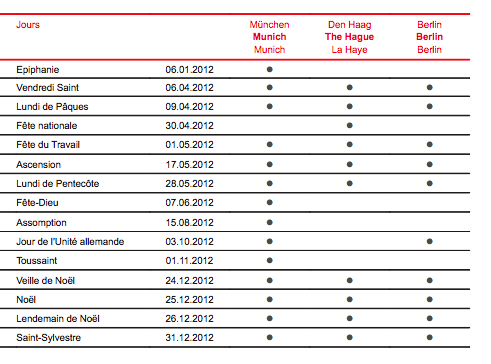
To help with the reasoning, here is the list of public holidays in 2012 at the EPO’s receiving offices:
Here is also a small 2012 calendar:
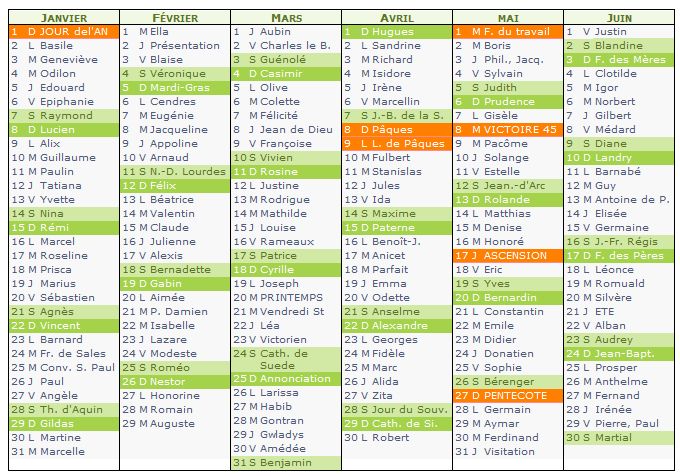
We therefore received this notification 2 days after it was sent, so we can apply R126(2) EPC (the so-called « 10-day rule »). Thus, the date from which the period starts to run is 28 January 2012.
Even if 28 January is a Saturday, do nothing!! This is a virtual date, and R134 EPC on extension of periods does not apply here.
So, we must apply the 3 months: we therefore arrive at 28 April 2012 (Saturday).
Since this day is a Saturday, we must look for the first following working day for all offices… Here, R134(1) EPC applies 🙂
- 29/04 is a Sunday, so closed according to the communication of the President of the Office: we continue therefore…
- 30/04 is a Monday, but this day is a public holiday for the EPO office in The Hague: we continue therefore…
- 01/05 is a Tuesday, but this day is a public holiday in all EPO receiving offices (i.e. Labor Day in France): we continue therefore…
- 02/05 is a Wednesday… not a public holiday!
Phew!! We found our date! The last day on which it is possible to respond is 02 May 2012.
The special case of time limits
Normally, the time limits (R132(1) EPC) set by the EPO are (Guidelines E-VIII 1.2):
- 2 months if the notification raises minor/formal issues;
- 4 months if the notification raises substantive issues.
In certain special cases, the time limit may be extended upon request. The request must be submitted in writing (possibly by fax, without the need for confirmation Guidelines E-VIII 1.6) before its expiry (R132(2) EPC).
Normally, such an extension is granted, even if the request does not provide a reason (Guidelines E-VIII 1.6):
- if the notification raises substantive issues, and
- if the total time limit does not exceed 6 months.
An extension exceeding 6 months may only be granted exceptionally if the reasons given convincingly demonstrate that the response cannot be provided within the set time limit (but holidays or workload pressure are not considered exceptional reasons, R132(2) EPC and Guidelines E-VIII 1.6).
Similarly, a 2-month extension will be granted for notifications raising formal issues.
The EPO informs the requester whether the request is accepted or warns of the sanction that has taken or will take effect (Guidelines E-VIII 1.6).
A refusal of the extension is not subject to appeal (A106(2) EPC and J37/89).
The special case of annual official fees
See the article « Payment of annual official fees » for details on this topic.