
Territoriality of Protection
Principle
Only acts carried out in France (including overseas territories and Mayotte) may be sanctioned (with rare exceptions discussed below).
Indeed, the monopoly right conferred by a French patent ends at the French borders (Law No. 92-597 codifying the Intellectual Property Code, July 1, 1992, Art. 4): no infringer can exist beyond our borders.
Exceptions
The use of an infringing device on a ship (excluding cargo), an aircraft (or an aircraft part), a vehicle (or a vehicle part), etc., temporarily or accidentally entering French territory is not considered infringement (Art. 5ter Paris Convention).
Product/Process Distinction
Article L613-3 IPC distinguishes between acts of infringement relating to:
- claims for a « product », and
- claims for a « process ».
In reality, the Intellectual Property Code does not limit claim categories to these two (products and processes), as suggested by Article L613-3 IPC (see R612-19 IPC, which mentions products, processes, devices, and uses).
It should therefore be understood that the terms in Article L613-3 IPC are broader:
- « products » would include devices and products,
- « processes » would include uses and processes.
Having made this distinction, let us now examine what constitutes these « infringing » acts.
Date When Acts Become Infringement
French Patent Application/Patent
Normally, only acts carried out after the publication of the patent application or notification of the application to the alleged infringer may be actionable (L615-4 IPC).
Note that notification cannot be « unofficial« : a certified copy of the application must be notified (L615-4 IPC).
Mere knowledge of the application other than through formal notification has no effect (Paris Court of Appeal, Division 5, Chamber 2, March 6, 2015, Case No. 2012/13939).
European Patent Application/Patent
For European patent applications (in English or German), the INPI must publish a translation of the claims. Before such publication, acts cannot be considered infringement (L614-9 IPC together with L615-4 IPC) (Caen Court of Appeal, 2nd Civil and Commercial Chamber, September 11, 2014).
There is no provision for notifying a European application to the alleged infringer before European publication… regrettably… but a request for early publication may be filed with the EPO (Art. 93(1)(b) EPC) if the filing and search fees have been paid (Guidelines A-VI 1.1).
Special case of co-ownership
In the case of co-ownership, and in the absence of contractual provisions, Article L613-29 of the Intellectual Property Code applies.
Non-exclusive license granted by a co-proprietor
In this case, this article (L613-29 CPI c)) provides that each co-proprietor may grant a non-exclusive license to a third party, subject to notifying the other co-proprietors.
In the absence of notification, the third party holding a license will have a valid but unenforceable license against the uninformed co-proprietors: they will therefore be an infringer with respect to the latter (Paris Court of Appeal, September 19, 2014).
Exclusive license granted by a co-proprietor
If an exclusive license is granted to a third party by a co-proprietor without the agreement of the others (L613-29 CPI d)), it will be null and void.
Consequently, the third party will have no license and will be an infringer with respect to all.
Infringement of products
Principle
According to Article L613-3 CPI a), the following are therefore acts of infringement for a product claim:
- making,
- offering,
- putting on the market,
- using,
- importing,
- exporting,
- transshipping,
- stocking for the aforementioned purposes the product that is the subject of the patent.
Making
Principle
Making a patented product is prohibited (L613-3 CPI a)).
Making covers acts of manufacturing the infringing product within French territory (Law No. 92-597 codifying the Intellectual Property Code, July 1, 1992, Art. 4).
Thus, making in Germany is not actionable.
Making abroad, sale in France and knowledge
Note that if a person makes an infringing product in Germany and then sells it in France, it is not necessary to prove their knowledge (even though sale is a secondary act of infringement, which normally requires such proof).
Indeed, their status as manufacturer, regardless of the country of making, exempts them under the wording of Article L615-1 CPI.
Repair/replacement of essential elements
Is the repair of an object protected by a patent considered equivalent to making an infringing product?
According to case law (Paris Court of First Instance, 3rd Chamber, 3rd Section, November 9, 2004), if the repair of the object involves all essential elements (i.e., reconstruction), then it constitutes making and therefore infringement.
Subcontracting
If a subcontractor manufactures an object on behalf of its client, the latter remains a manufacturer (Cour d’appel de Paris, Pôle 5, 2e ch. , 21 October 2011 or C. Cass. com. No. 12-14803, 13 November 2013).
The subcontractor is therefore, by operation of law, an infringer if the manufactured object is protected by a patent.
At most, the subcontractor and its client may be declared joint infringers (Cour d’appel de Paris, Pôle 5, ch. 01, 22 May 2013).
The subcontractor may call its principal into warranty:
- if there is a warranty clause in the contract (Cour d’appel de Paris, Pôle 5, 2e ch. , 21 October 2011);
- in the case of public contracts (Article 8.1 of the decree of 8 September 2009 approving the general administrative clauses applicable to public works contracts);
- if the client provided the subcontractor with a « detailed » specification, i.e., if the subcontractor was not free to choose the technical means to achieve the required result (Article 1240 of the French Civil Code).
Employees
Employees of the manufacturer cannot be sued for infringement even if they are the « actual » manufacturers (only the company may be sued, Article 1384 of the French Civil Code).
Offering
Offering a patented product is prohibited (Article L613-3 CPI a)).
An offer is any material act aimed at putting the product into circulation (without it being necessary for there to be actual commercialization or physical presentation to customers, Paris Court of First Instance, 3rd Chamber, 28 May 2008).
For example, the following may constitute infringement:
- advertising,
- canvassing,
- a proposal on the Internet,
- exhibition of a prototype at a trade show for promotional purposes.
The offer must have been made and/or received in France (Article L613-3 CPI a) or c)).
The targeted market is irrelevant: the targeted market may well be abroad; only the location of the offer matters (C. Cass. com. 30 January 2001).
An application for marketing authorization or inclusion on the list of reimbursable medicines does not constitute an offer for sale (Paris Court of First Instance, 3rd Chamber, 9 January 1998).
Placing on the market
Placing a patented product on the market is prohibited (L613-3 CPI a)).
Placing on the market is characterized by any material operation intended to bring the product into contact with the French market, even if the commercialization is not immediately effective. This placing on the market may include:
- sale,
- loan for use,
- various acts of distribution,
- acts of packaging and conditioning,
- rental,
- leasing (C. Cass com. n°91-21228 and n°91-21419 26 April 1994),
- including the product reproducing the characteristics of the patent in a catalog (even if no product is held by the alleged infringer, Regional Court of Paris, 3rd ch., 2nd sect., 29 November 2013).
Use
Use of a patented product is prohibited (L613-3 CPI a)).
Importation
Importation of a patented product is prohibited (L613-3 CPI a)).
Any person who participates in the importation is considered an importer.
Thus, the exporter to France will also be considered an infringer (Regional Court of Paris, 3rd ch., 1st sect., 3 May 2006 and Court of Appeal of Paris, 4th ch., sect. B, 19 September 2008).
Exportation
Since 11 March 2014, the act of exporting a patented product from France to a foreign country is also prohibited (L613-3 CPI a) or c)).
For exportation from a foreign country to France, see the paragraph on importation.
Transshipment
Principle
Since 11 March 2014, transshipment of a patented product is also prohibited (L613-3 CPI a)).
History of transit sanctions
Prior to 11 March 2014, and despite certain hesitations, judges appeared to interpret transit as importation and thus sanction it in the same way (Court of Appeal of Pau, crim. ch., 14 October 1998).
Focus on intra-Community transit
Regarding intra-Community transit, judges had ruled that this type of intra-Community transit did not constitute infringement in light of the requirements of free movement within Europe (C. Cass. crim. n°01-87631, 3 September 2002).
Will this case law be maintained in light of the new prohibition of transshipment?
Possession for the aforementioned purposes
Possession must be for the purpose of offering, using, importing, exporting, transshipping, or placing the infringing product on the market (L613-3 CPI a)).
Thus, the « mere possession » of a product enabling the implementation of the invention is not an act of infringement (Regional Court of Lyon, 10th ch., 14 February 2008, e.g., a carrier).
Infringement of products directly obtained by a patented process
Principle
To prevent a third party from manufacturing a product abroad using a patented process in France and importing the manufactured products without any issues, the French legislator added an additional prohibition (L613-2 CPI c)): protection for « products directly obtained by that process. »
The following are prohibited (L613-2 CPI c)):
- offering,
- placing on the market,
- using,
- importing,
- exporting,
- transshipping, and
- stocking for the aforementioned purposes the product directly obtained by the process
In short, all classic acts of infringement are prohibited except for manufacturing (though the latter is covered by the process itself).
What is a product?
Yes, I am indeed asking this question.
While it may seem trivial at first glance (e.g., thinking of the manufacture of a table), the question is justified when addressing « borderline » cases:
- Is an image a product in relation to an image compression process?
- Is a trained AI model a product in relation to a neural network training process?
- Is a GO/NOGO decision a product in relation to a decision-making process (e.g., a drilling decision)?
- Is a number a product in relation to a constrained optimization process?
It is clear that the question is complex, and I believe each of you may have different answers to these questions (in the absence of case law)…
Infringement of processes
Principle
The following constitute acts of infringement for a process:
- using the patented process (L613-3 CPI b)),
- offering the use of the process within French territory (L613-3 CPI b)),
- acts of infringement relating to product claims (except manufacturing) for the product directly obtained by the process (L613-3 CPI c)):
- offering,
- placing on the market,
- using,
- importing,
- exporting,
- transshipping, or
- stocking for the aforementioned purposes.
Use of the process
Principle
The use of a patented process is prohibited (L613-3 CPI b)).
Offering the use of the process within French territory
Principle
Offering the use of a patented process is prohibited (L613-3 CPI b)).
Form of this offer
This offer of use may take several forms:
- an offer to supply machines incorporating a patented process, the operation of which would constitute a primary act of infringement (Tribunal de grande instance de Paris, 3e ch., 4e sect., 28 January 2010);
- an offer made to a third party to implement the process in France on behalf of that third party (e.g., in the context of a tender, Cour d’appel de Paris, 4e ch., sect. A, 24 November 2004).
Territoriality Issue
How should the expression « on French territory » in Article L613-3 CPI b) be interpreted?
Should it be interpreted as:
- the offer in France to use the process;
- the offer to use the process in France;
It appears that the second interpretation is the most logical since it is already established that acts of infringement (i.e., the offer) must be carried out (or received in the context of the offer) in France (Law No. 92-597 codifying the Intellectual Property Code, July 1, 1992, Art. 4): why else would this precision be included?
Thus, if you propose in France (for example, at a forum) to implement a process outside France, there is no infringement.
Infringement by Supply of Means
Background
Faced with the impossibility of manufacturing a product covered by a patent, some wondered: what if a « kit for assembly » was supplied instead of a fully assembled product?
Would this constitute infringement?
The case that highlighted this loophole was the so-called « multi-crystalline waxes » case (Paris Court of Appeal, November 28, 1960). In this case, the subject matter of the invention was delivered as a kit to end users.
Since the law at the time did not provide for any sanction, the judge was forced to conclude that such manufacture and delivery did not constitute acts of infringement.
Considering that the acts constituting infringement are exhaustively listed in Articles 40 and 41 of the amended Law of July 5, 1844, on patents for invention; […]
Considering therefore that only the manufacture of beehive foundations with the mixtures described in the patent […] could constitute an act of infringement.
Considering that by manufacturing the criticized wax mixture and putting it on sale, the company Tisco may have facilitated the commission of acts of infringement by a number of beekeepers by providing them with the means to commit such acts.
Considering that such conduct must not be confused with the « use of the means forming the subject of the patent » provided for in Article 40 of the Law of 1844.
Current Legal Rule
Article L613-4 CPI was then introduced in 1968 to fill this gap.
Thus, it is prohibited to deliver or offer to deliver on French territory elements enabling the implementation of the invention (product or process), if the following conditions are met:
- if you know that these means are suitable for such implementation (or when the circumstances make it obvious, Article L613-4 CPI, paragraph 1);
- if you know that these means are intended for such implementation by the person to whom you deliver these means (or when the circumstances make it obvious, Article L613-4 CPI, paragraph 1);
- if the delivery AND this implementation take place on French territory (Article L613-4 CPI, paragraph 1);
- if the means of implementation are not commonly available in commerce (at least one) OR if you induce the third party to commit an act of infringement (Article L613-4 CPI, paragraph 2).
This supply of means may only concern certain essential means of the invention.
Exceptions
The supply of means is not considered an infringement if they are supplied:
- to the patent proprietor themselves (since there exists the « consent of the patent proprietor, » L613-4 CPI, first paragraph),
- to licensees (non-exclusive, exclusive, statutory, holders of a compulsory license, etc., L613-4 CPI, first paragraph),
- to persons seeking to obtain a marketing authorization (MA) (L613-4 CPI, third paragraph in conjunction with L613-5 CPI d)),
- to persons seeking to obtain advertising authorization for a medicinal product from healthcare professionals (L613-4 CPI, third paragraph in conjunction with L613-5 CPI d-bis)),
- to persons sending objects into space (L613-4 CPI, third paragraph in conjunction with L613-5 CPI e)).
Issue of the multi-territoriality of the act or issue of multiple actors
Multi-territoriality
As we have seen, many acts of infringement require presence on French territory (e.g., manufacture, use, etc.).
But let’s imagine a scenario where the patented process is carried out in part in France (with the other part of the process being carried out abroad). For example:
- the manufacturing plant straddles the border, and certain steps of the manufacturing process are carried out on one side of the border while others are carried out on the other side.
- the protected process is implemented in part (e.g., transmission of a signal) on one side of the border, while another part (e.g., reception and decoding of the signal) is implemented on the other side.
Does this constitute infringement?
I would be inclined to say no, but unfortunately, there does not appear to be much case law on this point.
We may, however, note some interesting foreign case law on the subject:
- USA: NTP v RIM of December 14, 2004
- Where the beneficiary of a service is in the USA, even if the service is implemented outside the USA, the principle of territoriality applies (in this case, a mail relay located in Canada was used by Americans).
- Germany: Regional Court of Munich (decision 7 O 16945/15) of April 21, 2016
- If there is an economic link with the country in which the steps are carried out (there is an economic link if the steps carried out abroad can be associated with an entity performing the other steps on German territory), then infringement may be found.
- UK: Menashe Business Mercantile and Julian Menashe v. William Hill Organisation Ltd of March 15, 2002
- The fact that the server is located outside the UK does not negate the fact that the effect of the server remains on UK territory (i.e., gaming server).
- Thus, the player is indeed using the server from within the UK.
Multi-party Infringement
Now, let us consider that the patented process is carried out entirely in France, but by two different persons.
Is it possible to consider a sort of coherent group of infringers acting in concert?
Is this direct infringement or contributory infringement?
In France, the Paris Court of Appeal (CA Paris, 19 September 2012, Pole 5, Chamber 1, RG No. 11/04655) holds that infringement exists even in cases involving multiple parties, provided that they « act in concert and pursue the common objective of achieving the result promised by the invention« .
It is therefore necessary to demonstrate a sort of intent or willful conduct. Needless to say, this is more complicated 🙂
Requirement of Intent?
In Civil Proceedings
Without Knowledge of the Patent
The following are acts of direct infringement (product):
- importation,
- exportation,
- transshipment,
- manufacture, and
- possession for the purpose of importation, exportation, or transshipment.
The following is a act of direct infringement (process):
- use of the process.
Indeed, for these acts of infringement, it is not necessary to establish that the alleged infringer had knowledge of the patent (L613-3 CPI together with L615-1 CPI).
With Knowledge of the Patent
Principle for Products
The following are acts of indirect infringement (product):
- offering,
- placing on the market,
- use,
- possession for the purpose of use or placing on the market.
The alleged infringers must then be put on notice, with the infringement action being available from the date of such notice (L613-3 CPI together with L615-1 CPI).
Principle for Processes
The following is an act of indirect infringement (process):
- offering the use of the process in French territory.
The alleged infringers must then know (or the circumstances must make it evident) that the use of the process is prohibited due to the patent (L613-3 CPI b)).
Meaning of « Knowledge of the Patent »
Knowledge of the patent is not limited to mere awareness of its existence but requires knowledge that the scope of the patent covers the product in question (« knowledge of the infringing nature« , Paris Court of Appeal, 4th Chamber, Section B, 19 September 2003).
Cease and desist letter
A cease and desist letter may serve as a means to inform an alleged infringer (Tribunal de grande instance de Paris, 3e ch., 4e sect., 23 June 2011).
However, avoid drafting your cease and desist letters in an overly aggressive manner (Tribunal de Grande Instance de Paris, 3e ch, 16 May 2000): for example, a « very vigorous warning » sent to all of a manufacturer’s customers, as well as a preventive seizure aimed at pressuring them not to purchase competing products, will be deemed excessive!
Thus, cease and desist letters should warn of a potential infringement (without assertively stating that infringement has indeed occurred). They should merely provide objective information and present the opposing arguments if known: otherwise, such a cease and desist letter could be considered unfair competition (C. Cass. com., 27 May 2015, No. 14-10800).
Similarly, sending a warning letter to a distributor without suing the manufacturer may be actionable if the manufacturer’s identity was well known.
Summons or infringement seizure
A summons (Tribunal de grande instance de Paris, 3e ch., 23 June 2000) or an infringement seizure may also serve as a means of notification.
Presumed knowledge?
In certain specific cases, case law accepts that knowledge may be presumed: this applies, for example, to knowledgeable professionals in a highly specialized market (Cass. com. of 12 March 2002, No. 99-16926) or even just a specialized market if the distributor has a connection with the manufacturer, for instance (Cass. com. of 6 November 2012, Case No. 11-19375).
In criminal proceedings
In criminal proceedings, the mental element is stronger: it is necessary that the infringer committed the acts of infringement « knowingly » (L615-14 CPI).
Exceptions and absence of infringement
The acts under Article L613-5
Article L613-5 CPI provides for several exceptions to infringement, guided by a certain pragmatism.
The following acts cannot be considered as infringement (L613-5 CPI):
- acts performed in a private context and for non-commercial purposes;
- an agricultural cooperative does not benefit from this exception (Cass. com., 15 Apr. 1964);
- acts performed for experimental purposes (typically scientific research);
- this exception covers technical testing of a machine (C. Cass. com. No. 11-27686, 14 May 2013),
- this exception does not cover commercial testing (Paris Court of Appeal, 4th ch., sect. B, 7 October 2005),
- this exception covers clinical trials, even Phase III (Paris Court of Appeal, 27 January 1999);
- the preparation of medicines made on demand in pharmacies, upon medical prescription;
- studies and tests required for obtaining a marketing authorization (MA) for a medicine, as well as the acts necessary for their implementation and for obtaining the authorization;
- this exception covers bioavailability studies aimed at demonstrating the bioequivalence of the generic with the reference medicine,
- including the manufacture of pilot batches for obtaining the MA,
- inclusion on the list of reimbursable medicines does not constitute acts of infringement (Regional Court, 3rd ch., 9 January 1998).
- acts necessary for obtaining advertising authorization to physicians (see Article L5122-9 of the Public Health Code);
- the introduction of satellites into French territory prior to their launch into space.
Exhaustion of rights
Consider the following situation:
- You own a patent in France;
- You sell products in Germany;
- A German buys these products and sells them in France.
Is he allowed to do so? Can you prevent him?
The answer is no! This is called « exhaustion of rights » (L613-6 CPI).

In short, if you place a product on the market (or consent to its placement on the market) within the European Economic Area, you can no longer oppose its circulation within that area.
This exception stems from the free movement of goods within this area (Articles 28 to 31 of the Treaty on European Union and the Treaty on the Functioning of the European Union).
It should be noted, however, that this principle does not apply to other countries in the world. Thus, the patent proprietor may prohibit the importation into France of products that he himself placed on the market in the USA (which may offend « common sense, » as these products are infringing even though they were sold by the patent proprietor… yet, this is logically unassailable).
Prior personal possession
Principle
Prior personal possession (dating back to the time of Louis XVI) is the fact of holding the invention before the filing of the patent application by a third party. Since you held the invention, the law will allow you to continue using it without being hindered by the patent (L613-7 CPI).
Conditions
The possessor
There are no specific conditions regarding the person of « the possessor » (L613-7 CPI):
- as to the number of persons holding this right (1, 2, 100 persons);
- as to the status of these persons (natural persons, legal entities, etc., Cour de Paris, 5 March 1896, in this case, the state was recognized as having prior personal possession);
- as to their nationality;
- as to their status (they need not necessarily be the inventor, TGI Paris, 3rd ch. 9 March 2001).
Of course, this person must be of good faith according to the principle « fraus omnia corrumpit« . Thus, if the possession results from a disclosure made by an inventor under a confidentiality agreement (e.g., in a contractual relationship, C. Cass. com. No. 04-15694, 25 April 2006), then prior personal possession cannot be invoked.
Time of possession
The elements of possession must be established (L613-7 CPI):
- at the filing date of the patent (Cass. com. 18 December 1973 No. 72-12090), or
- where applicable, at the priority date of the patent.
Place of possession
Possession must be on French territory… and not abroad (for example, through implementation in a foreign country, L613-7 CPI).
Content of the required possession
Is it necessary to implement the invention? Must one be ready to implement the invention? Is mere « intellectual » possession sufficient?
In reality, several case law trends conflict…
One line of case law holds that it is sufficient to have perfect knowledge (even theoretical) of the invention to justify prior personal possession (Cour de Paris, 5 March 1896).
Indeed, when filing a patent application, only a description is required, and no implementation is demanded. Why, then, be stricter regarding prior possession?
Some case law accepts as proof of prior possession serious preparations (TGI Paris, 3rd ch., 4 Sept. 2001) or prior exploitation (Cass. crim., 30 May 1849): it is not entirely clear whether these judges would have accepted « weaker » evidence and mere intellectual knowledge of the invention…
Other countries (such as the USA) reserve their national « prior personal possession » for persons who have made serious preparations.
Subject matter of the required possession
Possession must relate to the invention as claimed in the granted patent or, where applicable, in the limited patent.
Events subsequent to the filing
Any event subsequent to the filing date has no impact on prior personal possession, even if these events include:
- a modification of the claims of the patent application (even an extensive one);
- the cessation of exploitation by the person having prior personal possession (Cass. ch. des requêtes, 28 April 1938)
The right conferred
The person who benefits from a « prior personal possession » right may raise an exception (Cass. crim., 23 February 1856) in the event of an infringement action.
The patent will then not be enforceable (L613-7 CPI).
Transfer of the right
The « prior personal possession » right is not a right that can be easily assigned.
For example:
- it is not possible to purchase the right of a third party having « prior personal possession« ;
- a subsidiary does not possess a prior personal possession right even if its parent company or its director did.
The only possible assignment (provided for in Article L613-7 CPI) is an assignment with the company or with the department (the part of the business) that is concerned by this prior personal possession: this right may therefore be assigned as an ancillary right, but not as a principal right.
Delegation of the right
The wording of Article L613-7 CPI appears to prohibit the person having prior personal possession from ordering the reproduction of the invention from a subcontractor (unless, of course, the subcontractor also had knowledge of the invention prior to the filing).
However, the subcontractor producing only a part of the invention cannot be sued for supply of means, as the person having prior personal possession is considered to be authorized to implement the invention under L613-4 CPI.
Secrecy of the possession
Of course, this prior personal possession may be secret (Cass. crim., 23 February 1856)
Proof of this possession may be relatively complex due to this secrecy: I therefore advise you to describe your « secret invention » in a Soleau envelope in the most precise manner possible, or to deposit its description with a notary in order to be able to prove a certain date.
Provocation of infringement?
If the proprietor of a patent provokes an act of infringement by a third party (e.g., ordering a counterfeit product from abroad, or ordering the manufacture of an infringing product CA Paris, 4 December 1862), this act will be dismissed by the courts and will not be considered as infringement.
Tolerance by the patent proprietor?
Unlike trademark law (L716-5 CPI), if the patent proprietor is aware of wrongful acts and allows them to continue, even for a fairly long period, this does not constitute a waiver of the right to enforce their rights (analogous to the decision Tribunal de Grande Instance de Paris, 3e ch. 05 April 1995 for designs).
Failure to work?
Similarly, the fact that the patent proprietor (or the licensee, respectively) does not work the subject matter of their patent (or license, respectively) does not constitute an excuse or authorization for a third party to infringe (Cour d’appel de Paris, 4e ch., sect. A, 15 December 2004).
Only a compulsory license may be requested if there has been no exploitation during the last 3 years (though this remains rare, L613-11 CPI).
Obligation to infringe?
Being under an obligation to infringe a patent to comply with a standard (e.g. Tribunal de grande instance de Paris, 3e ch., 1re sect., 09 September 2008) is not a legitimate excuse.
Grant of a patent?
Furthermore, the mere fact of obtaining a patent does not constitute infringement of an earlier patent, as it is the mere exercise of a right (C. Cass. civ., 16 August 1861).
Graphic summary
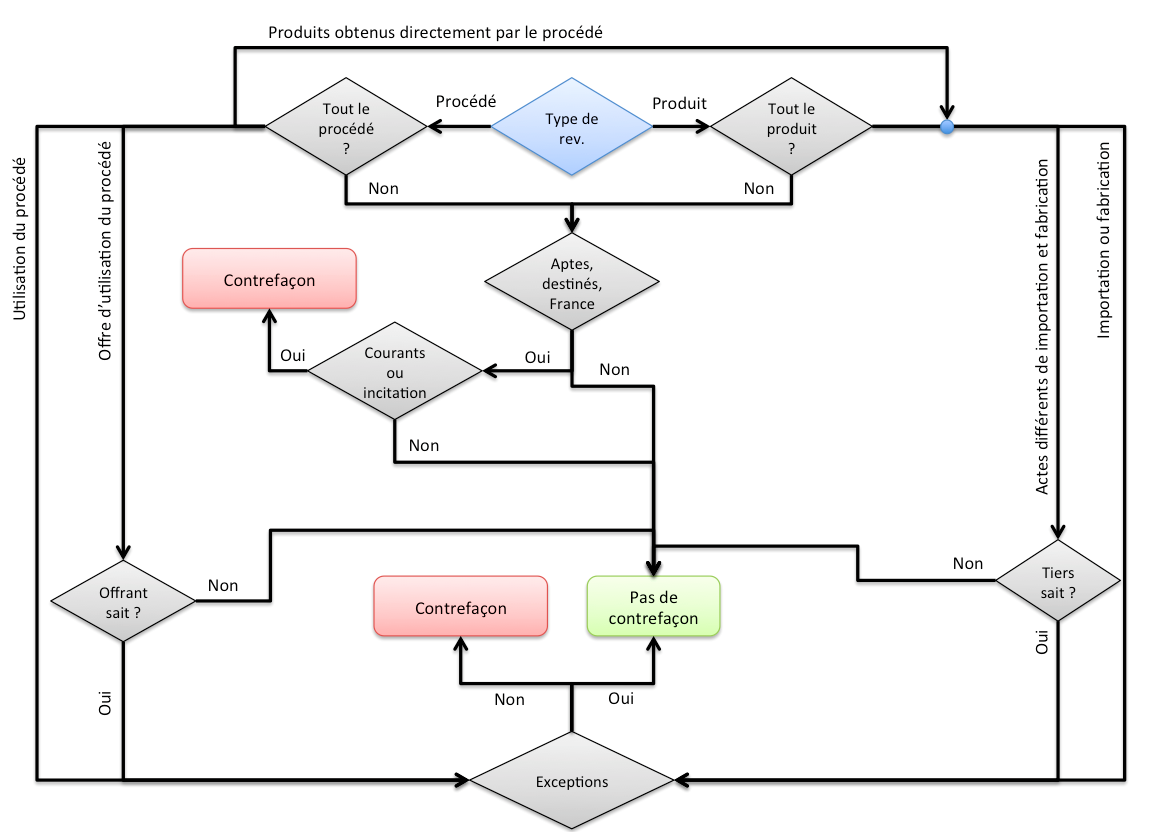
Here is a small diagram summarizing what we have just discussed about infringement:
Bonjour,Une offre de concession de licence peut-elle est considérée comme un acte d\’Offre (section 4.3) ?Merci de votre réponse,