
While obtaining a filing date is relatively straightforward, this does not mean there are no other filing requirements.
Filing Requirements
Provision of the Translation of the Application
Requirements
A translation must be provided if:
- The description is not drafted in French (R612-21 CPI, paragraph 2):
- The INPI informs the applicant of this fact and requests the translation to be provided within a period of 2 months (R612-21 CPI, paragraph 2);
- The wording of Article R612-21 CPI is not entirely clear as to whether this period runs from the notification or the filing (but INPI notifications state that this period runs from receipt of the notification);
- The patent application was filed by reference, and the reference is not drafted in French (R612-8 CPI, paragraph 5):
- The period for providing this translation is 2 months (R612-8 CPI, paragraph 5) from the filing date.
Sanction
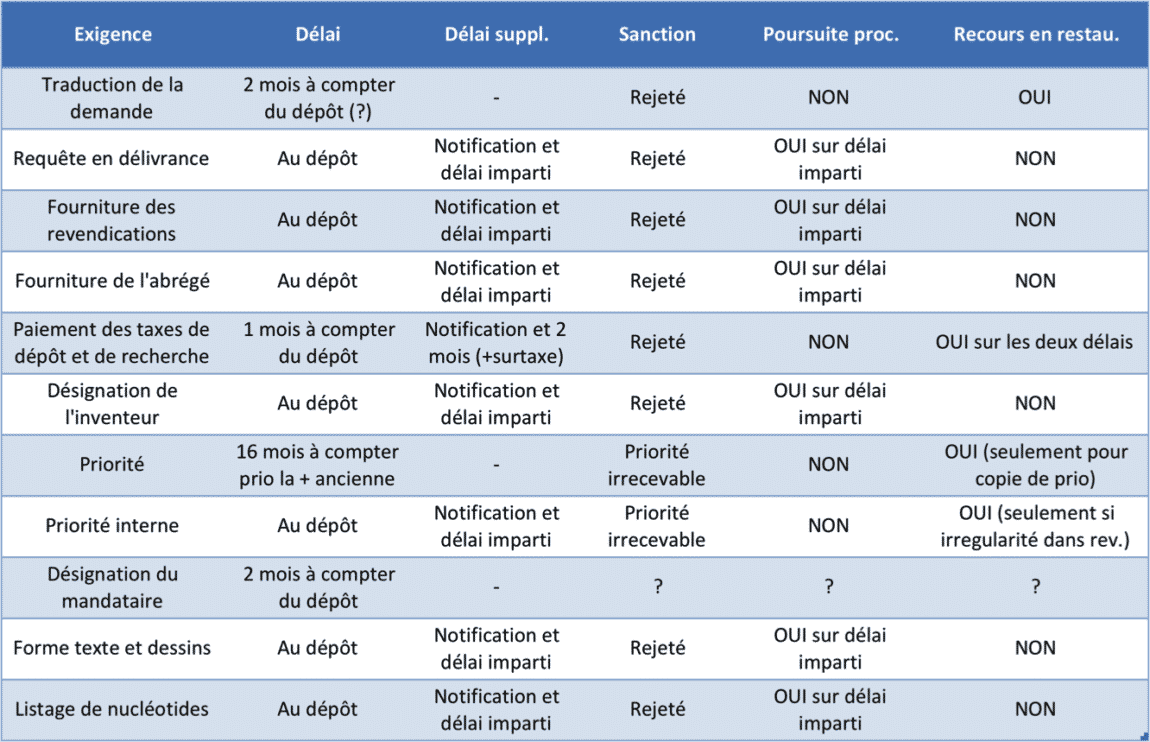
If no translation is provided within this period, the application is refused (R612-45 CPI, 1°).
The refusal decision is notified to the applicant, who has a period of 2 months from the date of receipt of the notification to submit observations (R612-45 CPI, paragraph 4).
These periods may be subject to reinstatement: the request for reinstatement must be filed within 2 months from the cessation of the impediment, but no later than 1 year from the expiration of the missed period (L612-16 CPI). The omitted acts must be completed within this period.
Provision of the Request for Grant
Requirements
A request for grant must be filed (R612-3 CPI) using the form provided by the INPI (Decision 2005-469 of the INPI Director General).
This request must be signed by the applicant or the representative (R612-10 CPI) and must include:
- the statement that a patent is sought;
- the title of the invention:
- it must be clear and concise;
- for technical reasons, it must not exceed 200 characters and spaces (INPI Examination Guidelines, I-C I.1);
- it must indicate the technical designation of the invention;
- it must not include a fancy name;
- the designation of the inventor:
- even though this designation may in fact be made on a separate sheet if the applicant is not the inventor or the sole inventor;
- the name and first names of the applicant, their nationality, their domicile or registered office;
- if it is a natural person, no pseudonym, title, etc. should be mentioned (INPI Examination Guidelines, I-B II.3.5);
- if it is a legal entity, the corporate name or business name, the legal form, the SIREN number and the APE code should be mentioned, excluding any other information such as the trade name or commercial name (INPI Examination Guidelines, I-B II.3.5);
- Companies in the process of formation are represented by a founding partner (INPI Examination Guidelines, I-B II.3.5) and a note such as « Mr./Ms. X, acting in the name and on behalf of company Y in the process of formation » should be included. Once the company is incorporated, it must take over the filing made by the founder and request the registration of this change in the National Register of Patents by providing an excerpt from the commercial register (Kbis) and a copy of the deed of assignment of the filing;
- the name and address of the representative, if one has been appointed.
The request may also include (R612-11 CPI) the following information:
- the reduction of the official fees rate granted to or requested by the applicant;
- earlier filings from which elements have possibly been incorporated;
- claimed priorities;
- the presentation of the invention at an official or officially recognized exhibition.
Sanction
In the event of a missing or non-compliant request, a notification is sent to the applicant, who then has a set period to provide a compliant request for grant (L612-12 CPI together with R612-46 CPI).
Failing this, the application is rejected (R612-46 CPI).
The applicant may then file a request for further processing within a period of 2 months from the notification of the rejection decision (R612-52 CPI; a further processing fee must be paid and the omitted act must be completed within this period).
Filing of claim(s)
Requirements
As we saw in the article « Obtaining a filing date« , claims are no longer required to obtain a filing date with the INPI.
Nevertheless, they must still be provided for the remainder of the procedure, particularly for the search (R612-3 CPI, 2°).
Sanction
In the absence of a claim, a notification is sent to the applicant, who then has a set time limit to provide at least one claim (L612-12 CPI together with R612-46 CPI).
Otherwise, the application is rejected (R612-46 CPI).
The applicant may then file a request for further processing within a 2-month period from the notification of the rejection decision (R612-52 CPI; a further processing official fee must be paid, and the omitted act must be completed within this period).
If the number of claims exceeds 10
Principle
If the number of claims exceeds 10, the applicant must pay an additional official fee to the INPI for each claim exceeding this number (i.e., from the 11th claim onwards) (R411-17 CPI, 1°).
This official fee is 40 € for each claim from the 11th onwards (Order of April 24, 2008 on official fees for procedures collected by the INPI, Annex).
Time limits
This official fee is normally due upon filing or amendment of new claims.
Sanction
If the applicant does not pay, a notification is sent to the applicant (R612-46 CPI, paragraph 1), setting a set time limit to pay this official fee.
Otherwise, the application is rejected (R612-46 CPI, paragraph 3).
Provision of the abstract
Requirements
An application must contain an abstract (R612-3 CPI, 3°).
Form
The abstract must restate the title of the invention and include a concise summary of what is disclosed in the application (Order of September 19, 1979 on the filing formalities for patent applications, Article 15).
The applicant also proposes the drawing they wish to have published with the abstract (Order of September 19, 1979 on the filing formalities for patent applications, Article 16), but the INPI may choose another if it so wishes (Article 9, Decision 2018-156 of the Director General of the INPI): oddly, in this case, the INPI sends a notification entitled « irregularity notice » with a proposed correction, which is deemed accepted within 2 months under R612-46 CPI (I don’t see how this constitutes an irregularity, but oh well)…
The abstract must not exceed 150 words when accompanied by a drawing and 250 words otherwise (Article 9, Decision 2018-156 of the Director General of the INPI).
The abstract must include references to the accompanying drawings, if relevant (Order of September 19, 1979 on the filing formalities for patent applications, Article 16).
Sanction
In the event of a missing or non-compliant abstract, a notification is sent to the applicant, who then has a set time limit to provide a compliant abstract (L612-12 CPI together with R612-46 CPI).
Failing this, the application is rejected (R612-46 CPI).
The applicant may then file a request for further processing within a 2-month period from the notification of the rejection decision (R612-52 CPI; a further processing official fee must be paid, and the omitted act must be completed within this period).
Payment of the filing and search official fees
Requirements
The filing and search official fees must be paid within a 1-month period from the filing date (R612-5 CPI).
Amount
The amount of the filing official fee is set at (Order of April 24, 2008 on the official fees for procedures collected by the INPI, Annex):
- 36 € for a paper filing;
- 26 € for an electronic filing.
The amount of the search official fee is set at (Order of April 24, 2008 on the official fees for procedures collected by the INPI, Annex):
- 520 € for a standard search;
- 156 € for a search if the application is a foreign priority application accompanied by a search report recognized as « equivalent » by the Director General of the INPI, i.e.:
- under priority of a Swiss application (Decision 92-286 of the Director General of the INPI), if the content is identical and if the search report is provided when paying the search official fee;
- under priority of a Dutch application (Decision 92-287 of the Director General of the INPI), if the content is identical and if the search report is provided when paying the search official fee;
- under priority of a Belgian application (Decision 96-408 of the Director General of the INPI) if the content is identical and if the search report is provided when paying the search official fee.
Reduction of official fees
A reduction of official fees is provided if the applicant is (L612-20 CPI together with R613-63 CPI):
- a natural person;
- the reduction is granted as of right and no supporting document is required;
- an SME with fewer than 1,000 employees, whose capital is not held more than 25% by an entity that does not meet these initial conditions;
- it is necessary to provide, within 1 month from the filing of the patent application, a written request for reduction and a sworn statement of eligibility for this category, dated and signed by the legal representative (INPI Examination Guidelines, II-B 2);
- a non-profit organization (NPO) in the education or research sector:
- it is necessary to provide, within 1 month from the filing of the patent application, a written request for reduction and a copy of the articles of association (INPI Examination Guidelines, II-B 2).
Where there are multiple applicants, all applicants must meet these conditions (R613-63 CPI).
The reduction is 50% for (R613-63 CPI together with Order of April 24, 2008 on official fees for procedures collected by the INPI, Art 2):
- the filing fee;
- the search fee:
- unless the application is a foreign priority application accompanied by a search report recognized as « equivalent » by the INPI Director General.
In my opinion, the date/signature requirements are ultra vires: only the INPI Examination Guidelines mention them, and I do not see how the INPI could refuse a written declaration that does not meet these criteria. I have even heard that the INPI would request the original document… any legal basis to point me to?
Sanctions
Otherwise, the application is rejected (R612-45 CPI, 2°).
The applicant has a period of 2 months from the date of receipt of the rejection notification to pay the corresponding official fee plus a surcharge (i.e., 50% of the unpaid official fee, R612-45 CPI, 2° and Order of April 24, 2008 on official fees for procedures collected by the INPI, Annex): if nothing is done, the rejection becomes final.
The 1-month and 2-month deadlines benefit from a restitutio in integrum remedy: this remedy must be filed within 2 months from the cessation of the impediment, but without exceeding 1 year from the expiration of the missed deadline (L612-16 CPI). The omitted acts must be performed within this period.
Designation of the inventor
Requirements
It is necessary, at the time of filing, to designate the inventor(s) (L611-9 CPI together with R612-10 CPI 3°), i.e., natural person(s).
However, it remains possible to designate inventors within a period of 16 months from the earliest claimed priority (R612-11 CPI, paragraph 2).
Non-publication
The inventor may oppose the publication of their name on the patent application / on the patent (R611-16 CPI): the applicant then submits to the INPI a waiver signed by the inventor.
The INPI will not mention their name on the application if the non-publication request is received before the end of the technical preparations for publication (INPI Examination Guidelines, I-B II.4.4).
Correction
A correction of inventor may be made upon request.
This correction may be made at any time, even after grant (in the latter case, registration in the National Register of Patents must be requested, INPI Examination Guidelines, I-B II.4.3).
Corrections may include:
- The addition of an inventor (R611-16 CPI):
- either upon request by the applicant or the proprietor of the patent or with their consent (R611-16 CPI, paragraph 1);
- or upon request by a third party producing a final and binding decision recognizing their right to be designated (R611-16 CPI, paragraph 2);
- The removal of an incorrectly designated inventor (R611-17 CPI):
- their written consent is then required.
Sanction in case of failure to designate or irregularities
If no designation is made at the time of filing, the INPI sends a notification accompanied by a « designation of inventor(s) » form to the applicant (R612-11 CPI, paragraph 6, and INPI Examination Guidelines, I-B II.4.1) allowing them to designate inventors within a period of 16 months from the earliest claimed priority.
If no designation is made within this 16-month period, a decision of refusal is notified to the applicant (R612-45 CPI).
The applicant then has a period of 2 months from the date of receipt of the notification to submit observations (this is not a period for regularization), particularly if the designation did in fact take place.
The 16-month period also benefits from reinstatement: the request for reinstatement must be filed within 2 months from the cessation of the impediment, but no later than 1 year from the expiration of the missed deadline (L612-16 CPI). The omitted acts must be completed within this period.
Sanction in case of incorrect designation
If « Mickey Mouse » is designated as the inventor, it does not appear that the INPI may refuse the application: the INPI does not verify the accuracy of this information (R611-15 CPI) and no sanction is then incurred.
Priority claim
Requirements for the priority declaration
If a priority claim is made, a priority declaration must be submitted (L612-7 CPI paragraph 1).
This declaration includes (R612-24 CPI, paragraph 1):
- the filing date;
- the State in which the filing was made;
- The State is a State party to the Paris Convention or a member of the WTO or a State granting an equivalent right of priority for French applications (L611-12 CPI);
- the filing number.
Multiple priority claims may be made (L612-7 CPI paragraph 2).
This declaration must be completed at the time of filing or:
- within a period of 16 months from the earliest priority date claimed (for an addition, R612-24 CPI, paragraph 2).
- within a period of 16 months from the earliest date among (for a correction, R612-24 CPI, paragraph 3):
- the earliest priority date before correction and,
- the earliest priority date after correction;
- within a period of 4 months from the filing date (for a correction, R612-24 CPI, paragraph 3).
However, these time limits no longer apply if a request for early publication is submitted under Article L612-21 CPI, 1° (R612-24 CPI, paragraph 4).
Furthermore, these time limits do not benefit from reinstatement or further processing.
Requirement for providing the copy
Principle and time limit
A copy of the priority document must also be provided (L612-7 CPI, paragraph 1, together with R612-24 CPI, paragraph 5) within a period of 16 months from the priority date (this time limit is not affected by early publication, a priori).
This time limit benefits from reinstatement: the request must be submitted within 2 months from the removal of the impediment, but no later than 1 year from the expiration of the unobserved time limit (L612-16 CPI). The omitted acts must be completed within this period.
Format of the copy
Before January 1, 2009, the copy of the application had to be certified by the authority that received the earlier application and accompanied by a certificate from that authority indicating its filing date.
However, this requirement no longer applies.
A simple printout/photocopy therefore appears to be sufficient.
Requirement to provide an authorization to claim priority
If the applicant is not the same in the priority application, the copy must be accompanied by a written authorization to claim priority given by the proprietor of the earlier application (R612-24 CPI, paragraph 5) and, where applicable, a translation of this authorization if it is not in French, English, or German (Order of September 19, 1979, on the filing procedures for patent applications, Article 20 and Article 9, Decision 2018-156 of the Director General of the INPI).
Sanction
If one of the above requirements is not met, the priority is declared inadmissible (R612-24 CPI, paragraph 6).
Only the time limit for providing the copy of the priority document benefits from a restitutio in integrum remedy: this remedy must be filed within 2 months from the cessation of the impediment, but no later than 1 year from the expiration of the unobserved time limit (L612-16 CPI). The omitted acts must be completed within this time limit.
Provision of a translation of the priority document?
The INPI may require a translation of the part of this copy that contains the filing date and the number of the foreign application, as well as the indication of the State in which or for which it was filed (Order of September 19, 1979, on the filing procedures for patent applications, Article 20 and Article 9, Decision 2018-156 of the Director General of the INPI).
Nevertheless, do not be surprised if the INPI issues a notice of irregularity to require this translation (personally, I believe this is absurd since, formally, no irregularity exists).
Clarification regarding the loss of the right of priority / withdrawal
It is entirely possible to withdraw or abandon a priority (this principle, although not provided for in the code, is derived from the possibility of total or partial withdrawal of the application under L613-24 CPI according to the INPI Examination Guidelines, I-B II.5.6).
Time limits (only those that have not expired, INPI Examination Guidelines, I-B II.5.6.b) are then recalculated from the new effective filing date of the application.
Furthermore, publication is delayed if the withdrawal occurs before the start of the technical preparations necessary for publication (INPI Examination Guidelines, I-B II.5.6.a).
Claiming
Requirement to provide a copy
Although the INPI is in possession of the priority application, it is still necessary to provide a copy of the application from which the benefit of the filing date is sought, highlighting the identical parts (R612-3 CPI).
This highlighting may consist of underlining, highlighting, framing the elements common to both applications, or a cover letter indicating that all elements contained in the earlier application are included in the second application (INPI Examination Guidelines, I-B II.6).
Sanction
The request for the benefit of the filing date of an earlier French application is inadmissible if the requirements mentioned above (excluding those concerning the provision of the copy) are not met.
A notice of irregularity is sent to the applicant when (R612-46 CPI):
- the applicant is not the proprietor of the earlier application or their successor in title,
- the copy of the earlier application has not been provided,
- the included elements have not been highlighted on the copy of the earlier application.
A time limit is set for the applicant to correct this irregularity. Failing rectification within the set time limit, the patent application is refused (R612-46 CPI).
The applicant may then file a request for further processing within a period of 2 months from the notification of the refusal decision (R612-52 CPI, a further processing fee must be paid and the omitted act must be completed within this period).
Appointment of a representative
Requirements
While the filing may be made by the applicant themselves, the applicant may need to appoint a representative for the remainder of the procedure (R612-2 CPI).
The applicant must appoint a representative within 2 months following the filing if the applicant does not have their domicile, registered office, or an establishment in France or in another Member State of the European Union or the European Economic Area (R612-2 CPI, paragraph 2).
The representative may be:
- an IP representative (title regulated by Article L422-1 CPI) with the « patent » specialty (L422-4 CPI together with L422-1 CPI, last paragraph);
- an attorney-at-law;
- a person registered on the special list of Article L422-5 CPI (specialist benefiting from the « grandfather » clause, few remain);
- a company or public institution with which the applicant has a contractual relationship;
- a specialized professional organization;
- a foreign representative domiciled in a Member State of the EU or the EEA and authorized to act in that state (if acting before the INPI on an occasional basis).
Documents to be provided by the representative
IP representatives and attorneys do not need to justify their status and are not required to provide a power of attorney (R612-2 CPI, paragraph 3 and INPI Examination Guidelines, I-B II-2.3): they must only indicate their status (providing the CPI number is a plus, facilitating verification by the INPI).
Persons registered on the special list under Article L422-5 CPI do not need to justify their status but must provide a power of attorney (INPI Examination Guidelines, I-B II-2.3).
A company or public institution must specify the necessary contractual relationship. It must also provide a power of attorney (INPI Examination Guidelines, I-B II-2.3).
Specialized professional organizations must demonstrate that the applicant is one of their members and provide the power of attorney conferred upon them by the applicant (INPI Examination Guidelines, I-B II-2.3).
Professionals from a European Union or European Economic Area member state must submit a certificate issued by the Industrial Property Office before which they are authorized to represent third parties. This certificate may be submitted once and for all to the INPI service (INPI Examination Guidelines, I-B II-2.3).
Sanction
I am unable to determine the sanction in case of failure to appoint a representative: I am not certain whether this failure constitutes a « formal » irregularity under Article R612-46 CPI.
The most likely scenario is that this irregularity results in the acts performed by the applicant not being considered valid by the INPI: a response to a notification will therefore be deemed not to have been received. The sanction will rather arise from this lack of response.
Formal requirements for the text and drawings
Requirements
Drawings
The Decree of September 19, 1979 on the filing modalities for patent applications (Articles 12 to 14) sets out the various requirements that drawings must meet, including:
- drawings must be made in black and white, using lines, without color or shading;
- inscriptions on the drawings (references, text, etc.) must be simple (not circled, without parentheses or quotation marks). They must use the Latin or Greek alphabet;
- the font size must not be less than 3.2 mm (the size depends on the chosen font, so be careful);
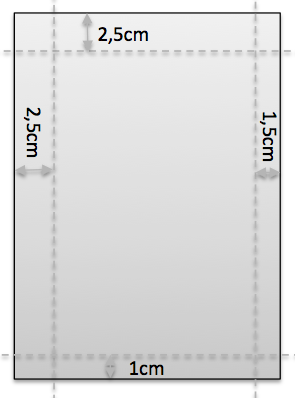
- margins cannot be smaller than the following diagram:
Other Documents
Furthermore, the Order of September 19, 1979 on the filing procedures for patent applications (Articles 3, 7 to 11) sets out the various requirements that the other documents of the application (e.g., request, description, and claims) must meet, including:
- sheets must be in A4 format and used in portrait orientation;
- the text must be typewritten or printed. Only symbols and graphic characters, chemical or mathematical formulas may be handwritten or drawn if necessary;
- for typewritten texts, the line spacing must be 1.5;
- all texts must be in a font where uppercase letters are at least 2.1 mm high (the size depends on the chosen font, so be careful) and in black;
- the lines of the description and claims must be numbered in increments of 5, on the left side of the sheet (but not within the margin);
- the description must not contain references to the claims;
- sheets must be numbered with an Arabic numeral centered at the top of the sheet (but not within the margin);
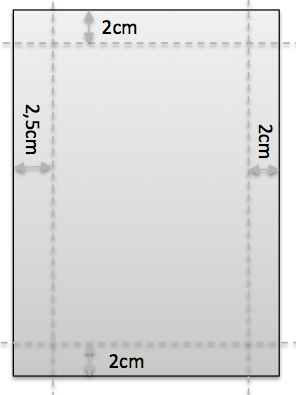
- margins may not be smaller than the following diagram:
Case of DOCX
It is worth noting that Article 7 of Decision 2018-156 of the Director General of the INPI appears to consider that these formalities do not apply to patent applications filed in DOCX format.
For example, Article 9 of Decision 2018-156 of the Director General of the INPI provides for a minimum font size of 11 points, whereas the Order of September 19, 1979 on the filing procedures for patent applications specifies characters with uppercase letters at least 0.21 cm high (other than drawings) and 0.32 cm high for characters in drawings.
This is quite strange and incomprehensible…
Sanction
In the event of an irregularity, a time limit is granted to the applicant to correct the application (R612-46 CPI, paragraph 1).
If the irregularity is not remedied within the granted time limit, the patent application is rejected (R612-46 CPI, paragraph 3); however, the applicant is deemed to have accepted the correction proposed by the INPI (if any) if no response is provided (R612-46 CPI, paragraph 2).
The applicant may then file a request for further processing within 2 months from the notification of the rejection decision (R612-52 CPI; a further processing fee must be paid, and the omitted act must be completed within this time limit).
Sequence Listing of Nucleotides and Amino Acids
Form
The description of the invention may be accompanied by a sequence listing of nucleotides or amino acids, which appears in an annex (R612-13 CPI, 2°).
The standard used is WIPO Standard ST.25 (INPI Examination Guidelines, I-B II.3.9).
It is entitled « Sequence Listing » and has separate pagination (from 1 to n) even if it forms part of the description (INPI Examination Guidelines, I-C I.3.15).
This listing must also be filed in computer-readable form on a data carrier such as a floppy disk or CD-ROM (INPI Examination Guidelines, I-B II.3.9).
A signed declaration must be provided to certify that the paper version of the listing is identical to the electronic one (INPI Examination Guidelines, I-B II.3.9).
Examination at filing
If the prescribed listing has not been filed or has been filed incorrectly, a time limit is set for the applicant to correct the filing (R612-46 CPI, paragraph 1).
If the correction is not made within the set time limit, the patent application is refused (R612-46 CPI, paragraph 3).
The applicant may then file a request for further processing within 2 months from the notification of the refusal decision (R612-52 CPI; a further processing fee must be paid and the omitted act must be completed within this time limit).
Bonjour,
Merci pour cet article constructif.
Cordialement,