
European application
Official fees due to the EPO
Annual fees must be paid starting from the third year (A86(1) EPC). Indeed, it is considered that the first two fees are included in the filing fee.
These fees must be paid at the beginning of the relevant year, on the last day of the month of the filing anniversary (R51(1) EPC).

In practice, two years should be added to the filing date, and the last day of the month should be considered.
Anyone may pay these fees (Guidelines A-X 1).
Extension of time
We may question whether R134(1) EPC (cited in the article on calculation of time limits) is applicable.
This question is legitimate since the payment of annual fees is not subject to a time limit: they simply must be paid before a certain due date set by the regulations.
The case law answer is yes. Indeed, in a decision J4/91, the Legal Division states:
It is generally accepted that Rule 85(1) EPC is applicable by analogy in such a case, which is indeed correct, although strictly speaking it cannot apply here: a « due date » cannot be considered a « time limit » that can be « extended ».
Thus, if an application was filed on 03/03/07, then:
- The annual fee for the fifth year may be paid until 31/03/11 (Thursday), and
- The annual fee for the sixth year may be paid until 31/03/12 (but the time limit is extended under R134(1) EPC until 02/04/12, since March 31 is a Saturday).
However, be aware: using R134(1) EPC (and thus paying without an additional fee a little later) does not mean that the due date is modified.
In the case of the 6-month grace period with an additional fee, the situation is not entirely identical since R134(1) EPC explicitly provides for the extension of time.
Advance payment
Principle
It is possible to pay this fee in advance; however, such payment cannot be validly made more than 3 months in advance (R51(1) EPC).
The previous practice was to allow a small additional advance period, but this tolerance has been removed from the Guidelines.
This time limit is calculated ultimo-ultimo (Guidelines A-X 5.2.4).
Case of the third annual fee
There is an exception for the third annual fee, which may be paid 6 months in advance (R51(1) EPC).
This time limit is calculated ultimo-ultimo (Guidelines A-X 5.2.4).
Late payment with additional fee
Principle
If payment is not made within the prescribed time limits, it remains possible to make the payment within a period of 6 months, subject to the payment of an additional official fee (R51(2) EPC).
It is not necessary to pay the official fee and the additional official fee at the same time.
The applicant is notified, but cannot rely on a failure to notify (Guidelines A-X 5.2.4).
However, it is possible to rely on a notification received but containing an incorrect date (J1/89).
Expiration of the 6-month period
The principle of this 6-month extension is the ultimo-ultimo principle: the 6-month period expires on the last day of the 6th month following the due date (J4/91).
Thus, if the annual official fee and the additional official fee can be paid until 29/02/12 (without extension), the additional 6-month period expires on 31 August 2012 (and not 29/08 as might have been expected).
Start of the 6-month period
The starting point of this period is the last day of the month of the anniversary of the filing of the European patent application WITHOUT taking into account R134 EPC (i.e., it is not a compound period: the expiration date of the previous period does not constitute the starting point of the new period).
The following situation therefore applies:
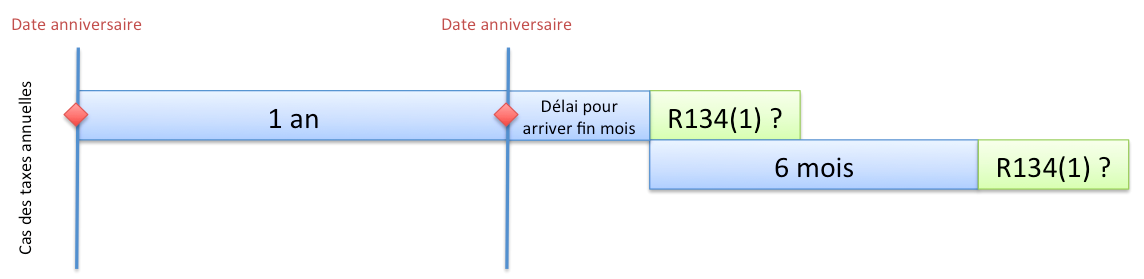
Indeed, if R134 EPC were applied, it could be concluded (J4/91) that the 6-month period is in fact a 7-month period in certain cases:
[… if ] this additional period does not begin to run « on the last day » of the month, [… ] the additional period no longer expires at the end of the sixth month: its expiration is postponed to the seventh month, and one could then fall into the error of applying the last-day principle again to this seventh month.
Amount
The amount of the annual official fees is progressive and is provided for in A2(1).4 RFees:
- for the third year: 445 €
- for the fourth year: 555 €
- for the fifth year: 775 €
- for the sixth year: 995 €
- for the seventh year: 1.105 €
- for the eighth year: 1.215 €
- for the ninth year: 1.325 €
- for the tenth year and each subsequent year: 1.495 €
The additional official fee is 50% of the amount of the official fee (R51(2) EPC together with A2(1).5 RFees).
Refund
The annual official fee paid is refunded if:
- the application is not pending on the date of payment or if the application is no longer pending on the due date of the official fee (Guidelines A-X 10.1.1, payment without cause);
- the payment is made more than 3 months before the due date (see above regarding the grace period, Guidelines A-X 5.2.4).
Sanction
Principle
If the official fee is not paid (or the official fee and the additional fee, where applicable) within the time limits, the application is deemed to be withdrawn (A86(1) EPC, the relevant date for the « deemed to be withdrawn » status is the expiration of the 6-month period, J4/86, but this has been challenged by decision T1402/13, which considers that the relevant date is the anniversary date without the grace period).
The loss of rights is only notified after the expiration of the 6-month period.
Before that, the EPO sends a simple notification indicating that payment can still be made within 6 months.
Restitutio in integrum
A122 EPC applies to the 6-month extension period but cannot be requested earlier (e.g., to avoid paying the additional fee), as the due date is not a time limit.
If the representative sends several registered letters to their client (who has little knowledge of EP law), unfortunately to the wrong address, restitutio in integrum may be requested (J5/13).
End of payment of annual official fees to the EPO
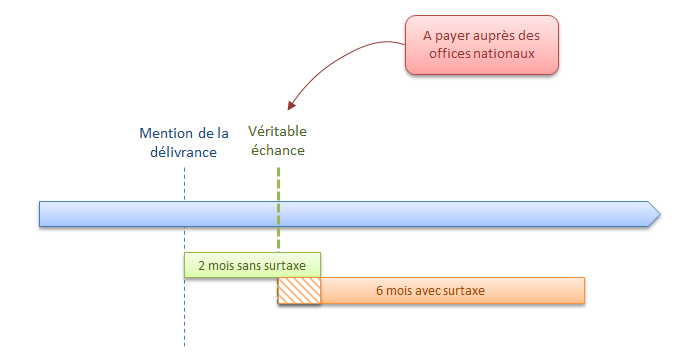
Any year commenced before the EPO publishes the mention of grant (A97(3) EPC) is due to the EPO (A86(2) EPC).
Years are counted from anniversary date to anniversary date of the filing of the application (e.g., from July 25 to July 24, see « Notice concerning the payment of annual fees for European patent applications and European patents« , OJ 1984, 272).
National offices are competent as of the date of publication of the mention of grant of the patent (A141(1) EPC).
If annual official fees fall due within 2 months from the date on which the mention of the grant of the patent is published in the European Patent Bulletin, these annual official fees shall be deemed to have been validly paid if they are paid within this 2-month period (A141(2) EPC).
Special cases
Re-establishment of rights under A122 EPC
It may happen that a deadline was not met during a period when the EPO had considered that a loss of rights had occurred.
Of course, certain losses of rights may be remedied through the provisions of A122 EPC, as detailed in this article on restitutio in integrum.
In this case, it is necessary to pay these renewal fees according to the principle detailed (R51(4) a) EPC and R51(4) b) EPC) in the following figure:
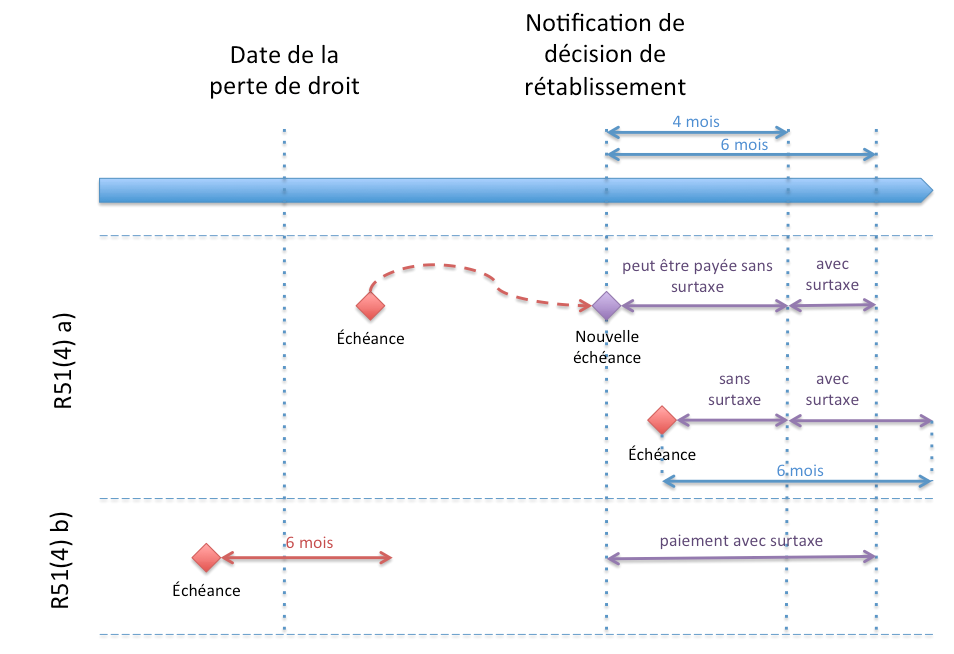
Of course, the notification of the decision on re-establishment is a notification, and therefore the provisions of R126(2) EPC apply.
In the case of R51(4) a) EPC, where the deadline occurs before the notification of re-establishment of rights, the official fee is due on the day of notification (whether that day is a holiday or not), but may simply be paid without additional fee within 4 months. These time limits do not necessarily expire at the end of the month.
In the case of R51(4) a) EPC, where the deadline occurs after the notification of re-establishment of rights, the 6-month period is calculated ultimo-ultimo (J4/91 by analogy).
This provision applies only to patent applications. In the case of restitutio for a patent, it is necessary to refer to the national law of the countries to determine how to pay the renewal fees in those countries (if possible).
Re-establishment of rights following a review
The principle is quite similar to that explained for A122 EPC above:
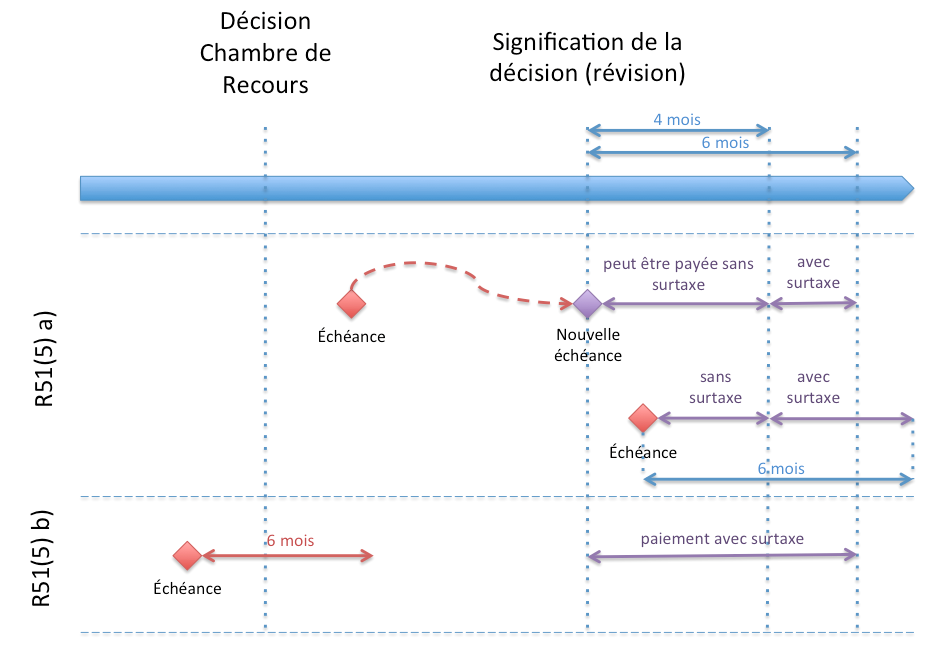
The same remarks as above apply (see above).
Interruption of proceedings
In the event of interruption of proceedings, we have seen that only the 6-month time limit for paying renewal fees with an additional fee was suspended (R142(4) EPC).
Thus, this case can be summarized as follows:
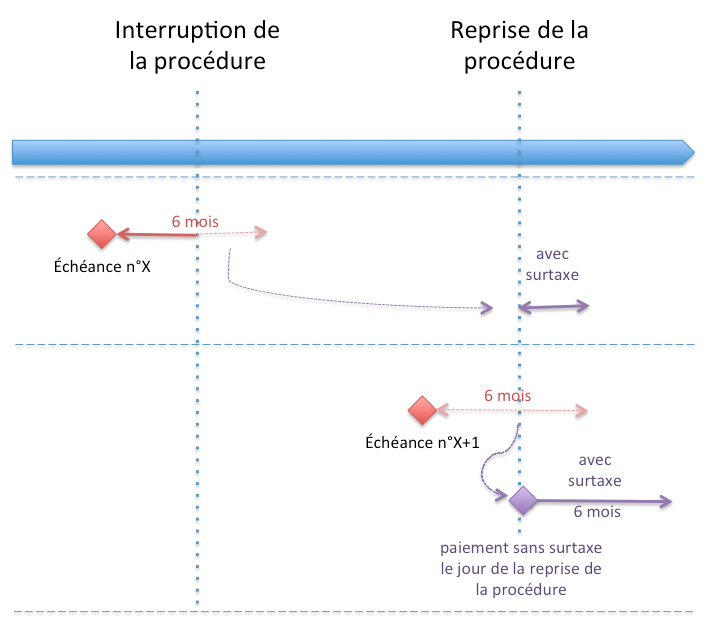
In the second case shown in the figure, payment may be made without additional fee on the first day of the resumption of proceedings (J902/87 = « Decision of the Legal Board of Appeal, dated 17 August 1987 J ../87 », OJ 1988, 323).
Special applications
Of course, unless otherwise indicated, all the provisions presented above apply to these special cases.
Case of a divisional application
When filing a divisional application, an official fee corresponding (R51(3) EPC) must be paid:
- for all annual official fees that have fallen due by the filing date of the divisional application for the parent application;
- optionally, for the annual official fee that would fall due within 4 months from the division.
The key date is the filing date of the parent application (Guidelines A-IV 1.4.3), as this is the date from which the annual official fees for the divisional application will be calculated.
These official fees are due upon filing, but may be paid without surcharge within 4 months from the division (R51(3) EPC).
Additionally, payment may be made within 6 months with a surcharge (R51(2) EPC) from the due date, i.e.:
- the filing date of the divisional application for annual official fees that have fallen due by the filing date of the divisional application, or
- the actual due date for the annual official fee that would fall due within 4 months from the division.
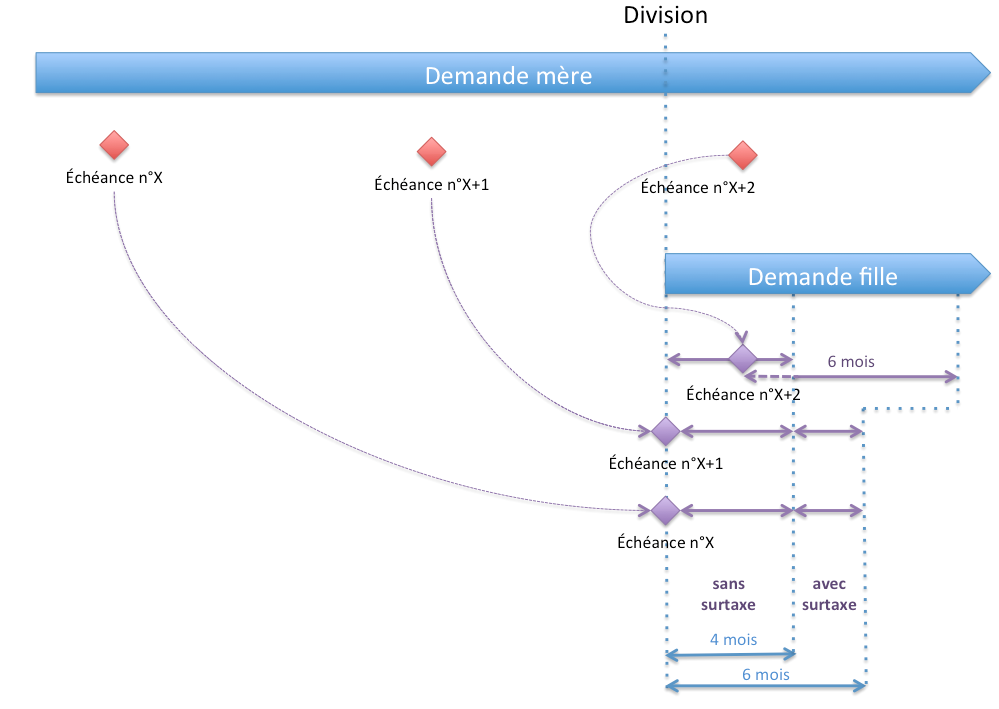
The due date X, X+6 months, X+1, X+1+6 months does not necessarily fall at the end of the month (Guidelines A-IV 1.4.3).
The due date X+2+6 months is calculated ultimo-ultimo (analogy J4/91, Guidelines A-IV 1.4.3).
The 4-month and 6-month time limits benefit from R134 EPC (analogy J4/91).
Case of an application filed after an unauthorized person
In cases where a new application is filed in the context of a « stolen invention » (i.e., a previous application filed by an unauthorized person), the new application benefits from the date of the previous application (A61(1) EPC together with A76(1) EPC).
However, unlike divisional applications, the annual official fees already fallen due for the previous application are not payable (R51(6) EPC).
Case of the 3rd annual official fee for EuroPCT applications
Principle
The annual official fee due for the 3rd year must be paid within 31 months from the priority date (R159(1)(g) EPC) if this deadline has expired.
Thus, no official fee is due:
- if the international application is a priority application;
- if the time gap between the filing of the priority application and the filing of the international application exceeds 7 months.
Early national phase entry cases
In cases of early national phase entry, the question may arise as to whether the annual official fee must be paid within the « true » deadline (i.e., 2 years) or within the 31-month deadline.
Simply put, the 31-month deadline is indeed the maximum deadline: the EPO will not consider a national phase entry request valid until the annual official fee has been paid (Guidelines A-X 5.2.4).
Additional fee for late payment
If the 3rd annuity is not paid on time, it may still be paid with an additional fee within a 6-month period (R51(2) EPC).
Where the due date for payment of the third annuity has expired, the 31-month deadline triggers the additional fee payment period (extending the 31-month deadline if it falls on a closure day for any of the EPO offices, as it is a composite deadline J1/89 and Guidelines A-X 5.2.4).
Where the due date for payment of the third annuity has not yet expired, the 6-month deadline is calculated as usual, i.e., using the « ultimo-ultimo » principle described above.
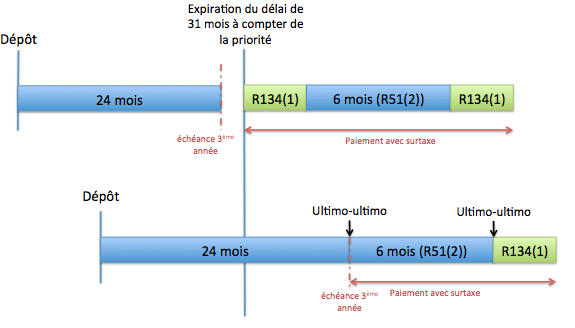
If the annual official fee is still not paid, the application is deemed withdrawn (A153(2) EPC together with A86(1) EPC).
Only A122 EPC applies to the 6-month deadline.
Bonjour,
Pour le paiement de mes annuités ,je passais par un cabinet expert depuis des années.Cependant pour cette année je n’ai pas de nouvelles .Comment et ou dois je payer en direct ?
De plus ayant eu des manques de moyens financiers l’année dernière je n’ai pu honorer toutes mes annuités des 12 pays que j’avais choisi et n’en ai honoré que dans 3 . il m’avait été dit que c’était perdu définitivement .Apparemment il est possible de ré-ouvrir ses droits ? Je vous remercie par avance de votre aide.
Recevez mes sincères salutations