
To obtain a filing date, certain conditions must be verified. It is also possible to correct a filing, but only under certain circumstances.
Conditions for Granting a Filing Date
The Three Minimum Conditions
General
To obtain a filing date, it is only necessary to provide (L612-2 CPI):
- an indication that a patent is sought;
- information allowing the applicant to be identified or contacted;
- a description or a reference to a previously filed application.
Indication That a Patent Is Sought
No formal requirements are necessary.
Thus, this indication may be provided on the form supplied by the INPI (INPI Examination Guidelines, I-B I.1.1), but there is nothing, a priori, to prevent it from being provided on plain paper.
This indication must be drafted in French (R612-8 CPI).
Identification of the Applicant
The following are sufficient (INPI Examination Guidelines, I-B I.1.2):
- for a natural person:
- their surname and first name(s);
- if acting on behalf of a legal entity in formation, in addition, the name of that legal entity;
- for a legal entity:
- the official name of the legal entity (company name, etc.), its legal form, and its registered office, or any information allowing it to be identified with certainty (e.g., SIREN number);
- a correspondence address.
This identification must be drafted in French (R612-8 CPI).
Description and Drawings
Regarding the description, no particular requirements are imposed: even if it does not comply with formal or substantive requirements (L612-2 CPI).
In short, a vague text resembling a description is sufficient…
There are no requirements regarding:
- the language of the description (R612-21 CPI and INPI Examination Guidelines, I-B I.1.4);
- however, a French translation will be requested later (within 2 months following an invitation, R612-21 CPI);
- the presence of claims.
Reference to a Previous Application
Principle
Instead of a description, it is possible to refer to a previous filing (L612-2 CPI).
Requirements at the Time of Filing
For this reference, it is necessary to provide (R612-8 CPI, fourth paragraph), for this previous application:
- the filing date,
- the application number, the office with which it was filed,
- an indication that this reference replaces the description and, where applicable, the drawings.
Provision of a Copy and Translation
Additionally, it is necessary to provide, within 2 months from the filing date of the application, a copy of the previously filed application and, where applicable, its French translation (R612-8 CPI, fifth paragraph).
This copy does not necessarily need to be compliant.
This time limit benefits from a restoration remedy: the remedy must be filed within 2 months from the cessation of the impediment, but without exceeding 1 year from the expiration of the unobserved time limit (L612-16 CPI). The omitted acts must be completed within this time limit.
Correcting Irregularities
Failure to comply with minimum requirements
If the minimum requirements mentioned above are not complied with, the irregularity is notified to the applicant: they then have a period of 2 months to correct it (R612-8 CPI, second paragraph) from the date of receipt of the notification (INPI Examination Guidelines, I-B I.3).
If the applicant provides the missing documents within this period, the filing date is the date on which all documents were provided (R612-8 CPI, third paragraph).
Otherwise, the patent application is declared inadmissible, and any official fees paid are refunded (R612-8 CPI, third paragraph) upon expiry of the appeal period (INPI Examination Guidelines, I-B I.3).
This period may be subject to reinstatement: the reinstatement request must be filed within 2 months from the cessation of the impediment, but no later than 1 year from the expiry of the unobserved period (L612-16 CPI). The omitted acts must be completed within this period.
Special case of missing parts in the description or drawings
Principle
At the time of filing, it may happen that the applicant makes a mistake in the description or drawings (e.g., sending only every other page).
In this case, correction may be possible under certain conditions.
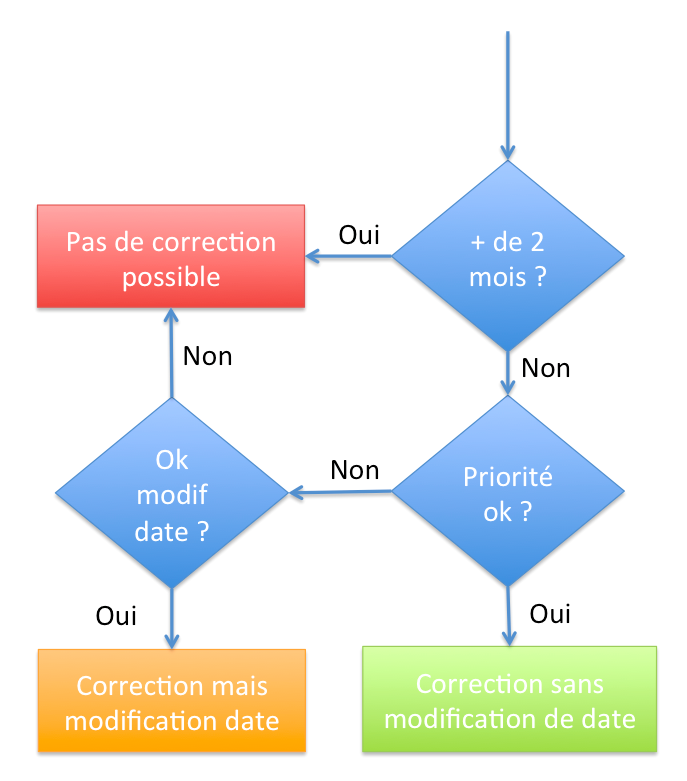
Identification of the error/omission and time conditions
Correction is only possible:
- if the applicant realizes the error and requests correction within 2 months of the filing (R612-9 CPI, second paragraph), or
- if the INPI identifies the applicant’s error (though this is not guaranteed, R612-9 CPI, first paragraph) and the applicant then requests correction within 2 months of receiving the INPI notification (R612-9 CPI, second paragraph and INPI Examination Guidelines, I-B I.4).
This period may be subject to reinstatement: the reinstatement request must be filed within 2 months from the cessation of the impediment, but no later than 1 year from the expiry of the unobserved period (L612-16 CPI). The omitted acts must be completed within this period.
Correction using a priority document
If, in addition, the part that was omitted is fully contained in a document from which priority is claimed, it is then possible to correct the application without losing the initial filing date (R612-9 CPI, third paragraph).
To do this, it will be necessary to provide within the 2-month period mentioned above (R612-9 CPI, third paragraph):
- a request for correction;
- a copy of the priority application (unless it is already available to the INPI):
- indicating where the missing parts are located in this copy; if necessary, a translation into French of the priority application: indicating where the missing parts are located in this translation.
Other corrections
In all other cases, it will not be possible to proceed with the correction without modifying the filing date (i.e., which will become the date on which the correction is made).
Upon receipt of the correction documents, the INPI will notify the applicant that this correction results in a change to the filing date (R612-9 CPI, second paragraph).
The applicant will then have a period of 1 month from the filing of the documents to oppose this by withdrawing their corrections (R612-9 CPI, second paragraph) and thus waive the corrections they themselves proposed.
If no modification is ultimately made (or accepted by the applicant), a « clean-up » of the application is required (R612-9 CPI, fourth paragraph): all references to missing drawings must then be removed from the description so that third parties can understand the application when it is published!
Merci beaucoup pour ce site !!
An International Application of mine within the PCT system has been bublished containing International Search Report and Written Opinion of the International Search Authority. I am informed that my Application now enters the so called National Phase. Is this application of any use so that a french patent be granted to me ( the applicant )?