
Definition of Novelty
Principle
Article L611-11 CPI specifies that an invention is considered novel if it is not part of the prior art.
Documents Constituting Prior Art for Novelty
The prior art includes:
- any public disclosure (written or oral), any public use prior to the filing date of the patent application (L611-11 CPI, second paragraph);
- French/European/international patent applications whose filing date is earlier than the filing date of the application in question, and whose publication date is later (L611-11 CPI, third paragraph together with L611-14 CPI).
It is true that the exact wording of Article L611-11 CPI, third paragraph, is « European or international patent applications designating France, » but:
- European patent applications now necessarily designate France (A79(1) EPC) unless expressly withdrawn (which almost never happens…);
- the filing of a PCT application constitutes designation of all Contracting States (R4.9.a PCT).
- Some have already told me that « France was not designated in a PCT application: it is Europe that is designated« ;
- No, no, and no… one must not confuse the office (EPO) used for entry into the national phase and the designation, which can only designate a Contracting State (and Europe is not a Contracting State).
By « filing date » (in Article L611-11 CPI, third paragraph), the earliest priority date is meant (Paris Court of Appeal, Division 5, Chamber 1, 23 September 2014 and L612-7 CPI, paragraph 5).
It should be noted that, normally, it is necessary to verify that European or international patent applications designate France to be considered part of the prior art. However, this verification is now almost unnecessary, as, from the filing date, these applications are deemed to designate France (respectively A79(1) EPC and R4.9.a.i PCT).
Case of French validations of European patents
Should it be considered that the prior art opposable to a French part of a European patent is:
- that provided by French law on the grounds that the patent has effects in France?
- that provided by the Convention on the Grant of European Patents (EPC) on the grounds that the patent is merely a validation of a European patent?
My answer is simple: both.
Indeed:
- A138(1) EPC provides for invalidity due to lack of novelty (and thus refers to the prior art as defined in the EPC)
- A139(2) EPC provides that any national application or national patent may be used as relevant prior art (to the extent that it would be so against a national application).
Therefore, A139(2) EPC implicitly refers to Article L611-11 CPI, third paragraph.
Regarding the last point, I was challenged on the fact that the wording « A national patent application or a national patent of a Contracting State » did not cover European/international applications mentioned in L611-11 CPI, third paragraph.
In reality, I believe that this does cover these European/international applications, which are therefore opposable as « earlier national rights« .
Indeed:
- an international patent application has the value of a regular national filing (A11.4 PCT) and must therefore be considered as a national application, including for prior art considerations;
- a European application has the value of a regular national filing (A66 EPC) and may be opposed as if it were a national application (A139(1) EPC).
Public availability of a disclosure
Written disclosure
A written disclosure is considered to have been made available to the public if, on the relevant date, members of the public could have accessed it (excluding confidentiality clauses, the public being understood as any person not bound by secrecy, Tribunal de Grande Instance de Paris, ch. 03, 4 March 1998 or Court of Appeal of Paris, ch. 04, 17 September 1997).
It is not necessary for the public to have been aware of the disclosure, but it is sufficient that they could have accessed it (Court of Appeal of Paris, 4th ch., 20 May 1998).
Oral disclosure
An oral disclosure is opposable, but it is still necessary to be able to demonstrate the content of the disclosure (Court of Appeal of Lyon, 1st civ. ch., 15 December 2005).
A written publication subsequent to the oral disclosure does not necessarily prove the content of the oral disclosure (Court of Appeal of Paris, 4th ch., 28 May 1999).
A statement (even if not compliant with the requirements of Article 202 CPC) from a person present may be accepted, but serious doubts may be raised if too much time elapses between the oral disclosure and the statement (e.g., 12 years, Court of Appeal of Paris, 4th ch., 12 May 2006).
Prior use
Prior use must enable the public to comprehend the features of the invention (Tribunal de Grande Instance de Paris, 3e ch., 2e sect., 19 April 2013) or to understand the patented process (Tribunal de Grande Instance de Paris, 3e ch, 1 September 1999).
An analysis of a product may enable a person skilled in the art to comprehend the composition of a product (C. Cass. com., 15 May 2007, No. 06-12487).
For example, an unprotected device that could be seen and examined by visitors (Cour d’appel de Paris, ch. 04, 17 September 1997 or Cour d’appel de Rennes, 2e ch., 21 March 2006) or by an installer (Cour d’appel de Paris, ch. 04 sect. A, 27 November 2002) destroys novelty.
Public and confidentiality
A person bound by secrecy under a confidentiality clause (explicit or implied) is not considered part of the public (Tribunal de Grande Instance de Paris, ch. 03, 4 March 1998 or Cour d’appel de Paris, ch. 04, 17 September 1997).
For example, a confidential marking on a document may suffice to prevent disclosure (C. Cass. com., 7 October 2008, No. 07-17518), but a mere reservation of title is not sufficient.
Confidentiality is never presumed in the context of a relationship with a potential buyer (Tribunal de Grande Instance de Rennes, 2e ch., 10 February 2003), but it is presumed in a business relationship, for example with a service provider (Tribunal de Grande Instance de Rennes, 2e ch., 8 September 1997).
However, in the context of a clinical trial, confidentiality may be implied (Cour d’appel de Paris, ch.14, 16 January 1998, or Tribunal de Grande Instance de Paris, 3e ch, 1 September 1999).
Accessibility and effective access
For prior art to be citable, it must have been accessible to the public, regardless of whether the public actually took notice of it (e.g., airbags sold in cars are accessible even if there is no evidence that a user ever dismantled one, Cour d’appel de Paris, 15 January 2014).
Non-citable disclosures
In case of evident abuse
A disclosure may be disregarded if it results from an evident abuse toward the inventor (L611-13 CPI) and if it occurred within the 6 months prior to the filing date of the French application or the priority application (Cour d’appel de Paris, 4e ch., sect. A, 15 October 2003).
In the case of officially recognized exhibitions
A disclosure may also be disregarded if it was made at an official international exhibition (L611-13 CPI) and occurred within 6 months prior to the filing date of the French application or the priority application (Paris Court of Appeal, 4th ch., sect. A, 15 October 2003).
The list of officially recognized international exhibitions should be checked on the website of the International Exhibitions Bureau.
Furthermore, for such a disclosure to be disregarded, it must be declared at the time of the patent application filing (L611-13 CPI, last paragraph) and the supporting evidence must be provided within 4 months after the filing (R612-22 CPI): this evidence is prepared during the exhibition and details the disclosure.
Content of disclosures
Explicit features
Description or drawings
Naturally, prior art discloses what is clearly apparent (French Supreme Court, Commercial Chamber, 6 June 2001, No. 98-17194) or explicitly derived from its description or drawings.
Abstract
The abstract of a patent application is not necessarily excluded from disclosure. Indeed, it is common for only these abstracts to be translated for invalidity actions (Paris Court of First Instance, 3rd ch., 1st sect., 24 May 2011).
Sufficient/enabling disclosure vs. defective disclosure
The features of the invention must be disclosed in a sufficiently clear manner for a person skilled in the art to understand the invention and reproduce it based on the information provided (Paris Court of Appeal, 4th ch., 17 September 1997 or French Supreme Court, Commercial Chamber, 4 January 1994, No. 91-20644).
Any doubt must benefit the patent proprietor (Paris Court of First Instance, 3rd ch., 1 September 1999).
If the prior art contains an error that anticipates a feature, it should be disregarded (Paris Court of Appeal, 4th ch., 22 February 2008 or INPI Examination Guidelines, I-C-VII 4.2.a).
Accidental disclosure
An accidental disclosure is a relevant disclosure even though the technical problem is quite different.
Under French case law, it is necessary to consider the function of the disclosed means (Paris Court of Appeal, Division 5, 2nd ch., 11 April 2014, MS Développement et al v. Moulages Plastiques du Midi or French Supreme Court, Commercial Chamber, 12 March 1996, No. 94-15283): therefore, if these means are accidental, it is unlikely that the function in the prior art will be identical to the function of the means in the invention.
References to other documents
If a prior art document refers to another document, the combination of these documents cannot be used to challenge the novelty of a claim (Paris Court of First Instance, 3rd ch., 2nd sect., 15 February 2008): such a combination pertains to inventive step, even if explicitly mentioned.
« The specific anticipates the general »
The disclosure of a specific technical feature destroys the novelty of a general technical means claimed (INPI Examination Guidelines, I-C-VII 4.2.d): the converse, however, is not true (Paris Court of First Instance, 3rd ch., 2nd sect., 30 March 2007).
Non-explicit features
Implicit features
A feature may be implicit (Cour d’appel de Paris, pôle 5, ch 1, 27 October 2010) provided that it is necessary and inevitable (INPI Examination Guidelines, I-C-VII 4.2.c).
In such a case, it may be taken into account for the assessment of the novelty of the claim.
Equivalent disclosures
Reasoning by equivalence is not permissible in the assessment of novelty (Tribunal de Grande Instance de Paris, 3e ch., 5 October 1999 or INPI Examination Guidelines, I-C-VII 4.2): this falls under inventive step (Cour d’appel de Paris, 4e ch., sect. B, 20 May 2005).
Use of disclosures to challenge novelty
Principle: no combination
It is not permissible to combine several documents (C. Cass. com., 12 March 1996, No. 94-15283).
To prejudice the novelty of the patent, the prior art must disclose the constituent elements of the invention (Cour d’appel de Paris, Pôle 5, 2e ch., 11 April 2014 or C. Cass. com., 12 March 1996, No. 94-15283) in a « single piece« :
- in the same form,
- in the same arrangement,
- with the same function for the same technical result.
This is referred to as « absolute » or « single and complete » prior art.
If a feature is reproduced but used for a different purpose, the French courts consider that there is no prejudice to novelty (INPI Examination Guidelines, I-C-VII 4.2, Tribunal de grande instance de Paris, 3e ch., 3e sect., 2 May 2014).
This approach seems debatable, as the function of the features is not necessarily described in the prior art documents, which gives an undue advantage to the proprietor.
Exceptions
The French case law appears to consider that in the case of juxtaposition of features (i.e., features that do not produce any result other than the sum of the results specific to each feature), each feature may be anticipated separately (Tribunal de Grande Instance de Strasbourg, 1e ch. civ., 31 January 2005).
Assessment of novelty based on the formulation of the claims under attack
Invention and range of values
Introduction
A selection invention consists in selecting from a known set or a known range:
- individual elements,
- subsets,
- limited sub-ranges of values that have not been explicitly mentioned.
Selection from an individualized list
A selection is novel if several products are disclosed in a prior art document and it is necessary to select the correct combination to arrive at the subject matter of the invention (Tribunal de grande instance de Paris, 3e ch., 3e sect., 25 March 2009).
Selection of a sub-range within a disclosed range
French case law appears to be stricter than the EPO on this subject.
Indeed, to destroy novelty, it appears necessary that the same range be disclosed: a selection of a sub-range thus appears to be novel (Cour d’appel de Paris, 4e ch., sect. B, 31 October 2003).
Whether the sub-range is arbitrary or not appears to relate to inventive step in France (Cour d’appel de Paris, 4e ch., sect. B, 31 October 2003).
It should be noted that there are conflicting decisions (Tribunal de grande instance de Paris, 3e ch., 2e sect., 24 November 2006).
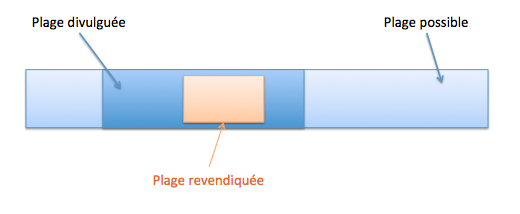 Selection of a sub-range within a range
Selection of a range containing a disclosed value
If the claimed range includes a value disclosed by the prior art, that range will not be novel (Tribunal de grande instance de Paris, 3e ch., 3e sect., 23 May 2007, in this case the claim in question was rejected for lack of inventive step, but for another difference, or Tribunal de grande instance de Paris, 3e ch., 2e sect., 24 November 2006).
It therefore appears necessary to explicitly exclude it.
Selection of a sub-range overlapping a disclosed range
By analogy with the preceding paragraphs, a sub-range overlapping a disclosed range may be novel if the boundaries of the disclosed range are excluded from the claim.
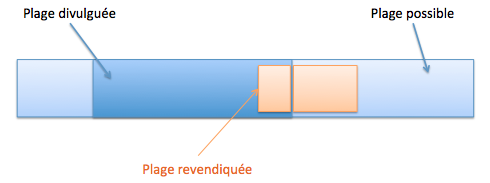 Selection of a sub-range overlapping a range
Furthermore, if no explanation is provided regarding the range, the judge will tend to invalidate the claim for lack of novelty (which is surprising in light of the usual position of the French judge, Tribunal de grande instance de Paris, 3e ch., 2e sect., 24 November 2006).
Claim category
Therapeutic applications
First medical use
The first medical use is provided for in Article L611-11 CPI, paragraph 4.
This article provides that it is possible to claim a product that is not new for use as a medicament: the claim will then be novel (provided, of course, that the use of this product as a medicament was not known) (Tribunal de grande instance de Paris, 3e ch., 1re sect., 12 February 2008).
The claim will then be drafted as follows (INPI Examination Guidelines, I-C-VII 4.2.f):
Product X for use as a medicament, wherein…
If the claim is ever drafted in the Swiss-type format (i.e., Use of product X in the manufacture of a medicament), this does not seem to pose any real issue (Cour d’appel de Paris, ch. 04, 15 September 2000).
Second medical use
The second medical use is provided for in Article L611-11 CPI, paragraph 5.
The claim will then be drafted as follows (INPI Examination Guidelines, I-C-VII 4.2.f):
Product X for use in the treatment of disease Y, wherein…
The claim will then be novel (provided, of course, that the use of this product to treat this disease was not known) even if the product as such is known.
Process
There is not much to say here: all the features of the process must be reproduced.
The use of a known process in a new technical field confers novelty on the process according to the position of the French courts (a sort of “second non-medical use,” Tribunal de Grande Instance de Paris, 3e ch., 1re sect., 19 February 2008).
If the product obtained by the process is novel, this confers novelty on the process itself (INPI Examination Guidelines, I-C-VII 4.2.g):
- to the process for obtaining it, and
- to the use of the product.
Process for + purpose
The purpose of the process must be seen as a limitation (Cour d’appel de Lyon, 14 November 2002): the same process, but used for another purpose/in another use will not anticipate such a claim (Cour d’appel de Paris, Pôle 5, 2e ch., 11 April 2014 or C. Cass. com., 12 March 1996, No. 94-15283).
Process for manufacturing a novel and inventive product
If the product is novel, this confers novelty (INPI Examination Guidelines, I-C-VII 4.2.g) on the process for manufacturing that product.
Product
There is not much to say here: all the features of the product must be reproduced.
Product defined by a process (« product-by-process »)
The wording « Product obtained by process Y » only covers the product actually obtained by that process (Cour d’appel de Paris, 4e ch. sect. B, 28 March 2008).
Therefore, an identical product produced by another process will not anticipate the claim (unlike the situation in Europe).
Product for + purpose
Under French law, due to the requirement of absolute prior art, the purpose of the product must be viewed as a limitation (Cour d’appel de Lyon, 14 November 2002): the same product, but used for a different purpose/in a different use will not anticipate such a claim (Cour d’appel de Paris, Pôle 5, 2e ch., 11 April 2014 or C. Cass. com., 12 March 1996, No. 94-15283).
Use
A new use will, of course, be novel (Cour d’appel de Lyon, 14 November 2002).
The use of a known product/process in a new technical field confers novelty on the use under the position of the French courts (a sort of “second non-therapeutic application,” Tribunal de Grande Instance de Paris, 3e ch., 1re sect., 19 February 2008).
Use of a new and inventive product
If the product is new, this confers novelty (INPI Examination Guidelines, I-C-VII 4.2.g) on the use thereof.
Use of a process for + purpose
This type of claim is equivalent to a claim directed to that process.
Examples
Expressions such as “preferably,” “for example,” “such as,” etc. are not limiting and are disregarded (INPI Examination Guidelines, I-C-IV 3.2.b or Tribunal de grande instance de Paris, 3e ch., 2e sect., 11 July 2014).
Laisser un commentaire