
Who can bring an infringement action?
Principle
The infringement action may be brought by (L615-2 IPC):
- the proprietor of the patent,
- the exclusive licensee, and
- the statutory or compulsory licensee.
The proprietor of the patent
The proprietor of the patent (or patent proprietor) may be the person who filed the patent application, but may also be the person who subsequently acquired the patent.
To identify the patent proprietor, it is useful to consult the entries made in the NRP (National Register of Patents maintained by the INPI) or the EPR (European Patent Register maintained by the EPO). Indeed, assignments, legacies, etc. must be recorded in one of these registers to avoid inopposability (L613-9 IPC).
Thus, if the registers do not mention any assignment:
- either there has been no assignment and the proprietor is the one indicated on the patent specification;
- or there has been an assignment and the patent proprietor has failed to record the assignment in one of these registers. In this case, the proprietor is not entitled to bring an action until the registers have been corrected.
As a rule, acts of infringement prior to the assignment can only be pursued by the former patent proprietor.
However, it is possible for the assignment to provide that the assignee may exercise the assignor’s rights for the period preceding the assignment: this is referred to as subrogation to the assignor’s rights (Cass. com. ch., 11 January 2000, No. 97-10838). If the assignment does not provide for subrogation, the new proprietor cannot pursue acts prior to the assignment. Nevertheless, it appears possible to establish a « confirmatory assignment deed » at any time to confirm the parties’ intention on the date of the assignment (which must, of course, be recorded, see Paris Court of Appeal, Division 5, Chamber 2, 15 March 2019, Case No. 17/02639).
In any event, the recording of the assignment makes it possible for the new proprietor to bring an action, but does not affect the calculation of damages: indeed, the Paris Court of Appeal considers that « the rule of inopposability provided for in Article [L613-9 IPC] cannot have the effect of allowing the infringer to infringe the patent with impunity as long as the assignment has not been recorded » (Paris Court of Appeal, Division 5, Chamber 1, 5 October 2011).
In the case of universal succession (inheritance, company merger, etc.), subrogation is automatic. However, this does not dispense with the need to record the assignment in order to make the rights opposable!
A co-proprietor
A patent may be owned by several persons. In this case, they are referred to as co-proprietors of the patent.
The law provides for a supplementary regime (L613-29 IPC) to govern relations between co-proprietors (specific agreements may replace this supplementary regime).
This supplementary regime provides (L613-29 IPC) that one of the co-proprietors may bring an infringement action without the consent of the other co-proprietors. However, it remains necessary to notify the action to the other co-proprietors to give them the opportunity to join and benefit from it.
While a co-proprietor may act alone, they may only claim the portion of damages that is due to them. In other words, they are not subrogated to the rights of the absent co-proprietors.
The court shall stay proceedings (L613-29 IPC b)) until proof of this notification has been provided to the court. In principle, this proof must be provided within 2 years (Article 386 CCP), but the infringer may request a shorter period from the judge in charge of the case management.
A licensee
The exclusive licensee
Principle
The exclusive licensee is a particular type of licensee: the proprietor of the patent guarantees them exclusivity over a given territory (here, France) and for a given period.
Notice to act
In order to sue a third party for infringement, the exclusive licensee must give notice to act to the proprietor of the patent (L615-2 CPI). Failing this, the action is inadmissible (Tribunal de Grande Instance de Paris, ch. 03, 03 July 1998).
However, it is possible to provide for different terms in the license agreement (« unless otherwise stipulated in the license agreement« , L615-2 CPI).
In practice, the formalism of the notice to act is not always necessary, especially if all parties agree: thus, case law accepts that the proprietor of the patent may indicate to the licensee that they consent to such action without having been « notified to act » (Tribunal de Grande Instance de Paris, ch. 03, 13 March 1998). For example, the proprietor of the patent may authorize the licensee to take infringement action:
- by letter (Tribunal de grande instance de Paris, 3e ch., 3e sect., 28 January 2011) or
- directly in the license agreement (and this, without prior notice to act, but it is necessary that the license agreement contains no ambiguity, Cour d’appel de Paris, ch. 04, sect. B, 16 May 2003).
Conversely, the proprietor of the patent may oppose in the agreement the licensee’s right to take any infringement action. In this case, the patentee might have to initiate the infringement action themselves. Indeed, if they refuse to take action, their contractual liability towards their licensee could be engaged (non-eviction guarantee under Article 1628 of the Civil Code).
Recording of the license
For the licensee’s infringement action to be admissible, it is nevertheless necessary that the license has been recorded in the National Register of Patents (L613-9 CPI).
This last formality is often overlooked when the license is granted to a subsidiary (the parent company being the proprietor of the patent), or when the proprietor of the patent is the company director and « authorizes » their company to exploit the patent:
- if the company exploiting the patent sues an infringer, it will be inadmissible, as it does not have a recorded license;
- if the company director sues the infringer, their damages will be very low, as they do not exploit the patent directly (and the license granted is often free of charge). However, the company exploiting the patent may « intervene » in the proceedings to seek compensation.
Nevertheless, this recording may occur very late, as it only conditions the right to bring an infringement action and not the basis of the damage (C. Cass. ch. com., 18 February 2004, No. 02-16703): it is only important that the license be recorded at the time the judge rules (CA d’Aix en Provence, 3 April 2014).
It should be noted that there is a contrary decision by the Paris Court of Appeal, which considers that this recording conditions the basis of the infringement (Cour d’appel de Paris, Pôle 5, 1re ch., 2 June 2010, Case No. 2007/16086): I believe this decision makes no sense, as Article L613-9 CPI provides that a non-exclusive licensee who has not recorded their license may intervene to obtain compensation for their own damage.
Is the proprietor then deprived of future action?
It is possible to wonder whether the proprietor retains the ability to later bring an action against the infringer (who may, for example, have been convicted once already in proceedings initiated by the exclusive licensee).
In my view, the wording of Article L615-2 CPI does not preclude the patent proprietor from bringing an infringement action on the grounds that they did not exercise it when put on notice by the licensee.
Interpreting this article in such a way would amount to recognizing a form of substitution of the proprietor by the exclusive licensee, and this in complete contradiction with the French procedural principle « nul ne plaide par procureur« .
Similarly, the authority of res judicata does not preclude the proprietor from acting after an action brought by their exclusive licensee: the identity of the parties is not respected (Article 1351 of the Civil Code).
Therefore, while the proprietor’s action cannot be dismissed, it appears that the judge will have to exercise great care when determining damages: they must avoid compensating the same harm twice, while juggling the calculation methods provided under Article L615-7 CPI!
The first decisions on this matter are eagerly awaited…
The compulsory licensee
The regime for compulsory licenses is identical (Article L615-2) to that of exclusive licenses with respect to infringement actions (except that the proprietor cannot include derogatory clauses in a license agreement).
The non-exclusive licensee
The non-exclusive licensee cannot bring an infringement action (Article L615-2 CPI) unless the license agreement expressly authorizes it, and the patent proprietor is informed.
In any case, they may intervene in the action and have their harm recognized (Article 1240 of the Civil Code) if an infringement action is initiated by another party.
Proof of the existence of the license must be provided (Paris Court of Appeal, Division 5, Chamber 2, May 16, 2014; Knauf Insulation v. Saint-Gobain Isover).
Against whom to take action?
Any unauthorized person
If an unauthorized third party performs any of the acts listed in the article « Infringing acts« , it is possible to take action against them.
A licensee
Is it possible to bring an infringement action against one’s own licensee?
The question may arise if a licensee fails to comply with the license agreement (for example, by manufacturing too many products). Are they an infringer or merely in breach of contract?
Article L613-8 CPI answers this question: failure to comply with the limits imposed by the license constitutes infringement.
A third party authorized by a single co-proprietor
If one of the co-proprietors wishes to grant a license to a third party, and if the default regime under Article L613-29 of the IPC applies, it is essential to notify the draft license to the other co-proprietors (Article L613-29 IPC c)): they may oppose it within a period of 3 months (by paying the license fee).
If the notification does not take place, the license is unopposable to the other co-proprietors (French Supreme Court, Commercial Chamber, 15 March 2011, No. 09-71934).
Thus, if the license is valid, the co-proprietors who were not notified may bring an infringement action against the licensees authorized to exploit by the first co-proprietor. Naturally, these licensees may call the first co-proprietor into warranty to avoid bearing the full burden of the sanction.
It is also possible to judicially compel the termination of license agreements entered into (Paris Court of Appeal, Division 5, Chamber 2, 24 May 2013).
A licensee authorized by a proprietor who stole the invention
If a person (whose invention was stolen) claims ownership of a patent before a court (on the basis of Article L611-8 IPC) and if this claim succeeds, all licenses granted by the former proprietor will have been granted without right and will therefore be null and void.
The new proprietor may therefore, in theory, bring an infringement action against the licensees of the former proprietor. Naturally, the licensees may call the former proprietor into warranty to avoid bearing the full burden of the sanction.
The new proprietor may also request the transfer of the licenses (Strasbourg Court of First Instance, 1st Civil Chamber, 6 December 2004, which is unusual, given that the licenses were previously stated to be null and void for lack of object).
The director as a natural person?
In certain situations, the company selling the infringing products is a limited liability company (SARL) with a share capital of a few hundred euros. It may therefore be difficult to obtain compensation…
One may then wonder whether it is possible to take action against the company’s director.
The Aix-en-Provence Court of Appeal seems to consider this possible under Article L223-22 of the French Commercial Code. Indeed, according to the court, acts of infringement committed by a company manager constitute an intentional fault of particular gravity which, as a result, is separable from their corporate functions (Aix-en-Provence Court of Appeal, 30 October 2014).
However, the intentional fault must be clear (i.e., « intentional fault of particular gravity, incompatible with the exercise of their functions« , French Supreme Court, Commercial Chamber, 12 May 2015, No. 14-13024).
On what grounds can an infringement action be brought?
A French patent
Principle
The proprietor of a patent may bring an infringement action in France (Article L615-2 IPC).
Patent application
An infringement action may be brought on the basis of a patent application (Article L615-4 IPC), but the court must stay proceedings until the patent is granted (Article L615-4 IPC, last paragraph).
An action based on a patent application may serve to interrupt the limitation period (Article 2241 of the French Civil Code).
However, if no patent is ever granted, a counterclaim for abusive proceedings may be filed!
Importance of the publication date
Only acts occurring after publication (or notification to the alleged infringer) may be pursued (L615-4 CPI, paragraph 1) (C. Cass. com. of March 26, 1985, No. 83-12290).
Case of broadening after publication
Furthermore, if the set of claims is broadened after such publication (or notification), the infringing acts may not be pursued (L615-4 CPI, paragraph 2).
To make this new, broader set of claims enforceable, it is useful to have it republished by the INPI (or to renotify it), but such republication or renotification does not have the effect of retroactively rendering the claims enforceable (Regional Court of Paris, 3rd Chamber, 3rd Section, October 21, 2003).
A European patent
Principle
A European patent has, from the date of publication of its mention of grant, the same effects as a French patent (A64(1) EPC).
A European patent may therefore be enforced in France in the same manner (provided it is validated in France and the translation of the claims is provided to the INPI, L614-9 CPI).
A full translation of the patent must be provided to the competent court (L614-7 CPI) upon its request or that of the alleged infringer.
A European patent application
Principle
It is entirely possible to bring an infringement action based on a European patent application (L614-9 CPI, paragraph 1) from the date of its publication by the EPO (provided that, if necessary, the translation of the claims is filed with the INPI or notified to the alleged infringer, L614-9 CPI, paragraph 2).
It therefore does not appear possible to take action before a French court prior to the publication of the application by the office (e.g., after notification of the set of claims to the infringer), unlike what is possible for a French application (L615-4 CPI, paragraph 1).
Coexistence of a French patent and a European patent application
If a European patent application covers the same invention as a French patent (e.g., priority application), a decision must be made:
- if you rely on the European patent application:
- the court will refuse to rule immediately and will stay proceedings until the European patent is granted (L615-4 CPI);
- if you rely on the French patent:
- the French patent will be replaced by the French part of the European patent once it is granted (and after the opposition period, L614-13 CPI);
- thus, if litigation is initiated based on a French patent, the French patent could « disappear » mid-proceedings…
- to avoid this procedural issue, the court is required to stay proceedings (L614-15 CPI) pending this potential replacement (if the inventions of the European patent application and the French patent overlap, Tribunal de grande instance de Paris, 3e ch., 4e sect., ordonnance du juge de la mise en état 30 January 2014; Aplix v. Stanhome et al).
The only way to resolve the situation is to withdraw the designation of France in the European patent application (Tribunal de grande instance de Strasbourg, 1re ch. civ., 8 June 2009): the court will no longer be bound by the provisions of Article L614-15 CPI and may issue a judgment based on the French patent.
Based on an international application (PCT)
A PCT application, from the date of publication of the international application, confers the same protection as that granted by a French application (A29.1 PCT together with L614-24 CPI together with A153 EPC) if the PCT application enters the European phase (and subject to providing, if necessary, the INPI with a translation of the claims or notifying the alleged infringer, L614-9 CPI paragraph 2).
When can action be taken?
During the lifetime of the patent
It is possible to initiate an action to pursue any infringing act committed during the term of the patent (L611-2 CPI).
There is no requirement regarding the validity of the title on the date of filing the action: it may have lapsed (provided the infringing acts are not time-barred)!
Statute of limitations
Civil statute of limitations
Infringement acts are time-barred after 5 years in civil proceedings (L615-8 CPI; prior to 11 March 2014, the statute of limitations was 3 years).
Suspension of the civil statute of limitations
Principle
It must be acknowledged that the statute of limitations is not exactly a straightforward concept.
Indeed, Article 2239 of the French Civil Code provides that the statute of limitations is suspended if the judge grants a request for an investigative measure. In this case, it appears that an infringement seizure is considered an investigative measure (2012 report of the Cour de cassation).
Furthermore, the same Article 2239 of the French Civil Code provides that the statute of limitations period resumes after the execution of the investigative measure for a minimum period of 6 months.
Okay, you’re a bit lost… that’s normal:
- if you obtain an infringement seizure order on the last day of the statute of limitations period, in essence, the period will be suspended until you have carried out the seizure, and
- once the seizure has been executed, it will resume until your summons (since the summons must occur well before the additional 6-month period expires, see proof of infringement).
Puzzle for fun
As you know, I really enjoy asking myself questions.
The question I am asking here is: the suspension of the statute of limitations, okay… but against which statute of limitations?
Indeed, does an infringement seizure requested to seize A in the context of a lawsuit against B stop the statute of limitations period concerning the acts of company C?
In my opinion, this suspension cannot be general and should only concern the acts for which the seizure is requested… but in the absence of case law on the subject…
Criminal statute of limitations
Infringement acts are subject to a 6-year criminal statute of limitations (Article 8 of the French Code of Criminal Procedure; prior to March 1, 2017, the statute of limitations was 3 years).
Raising the statute of limitations
The statute of limitations is a plea in bar and must therefore be raised before the judge in charge of case management (Article 789 of the French Code of Civil Procedure). The case management judge may decide whether or not to consider this point.
Litigation
Competent jurisdiction
In civil matters
Principle
Only the Paris Judicial Court (Tribunal de Grande Instance de Paris) has jurisdiction over actions for infringement or nullity (Article L615-17 of the French Intellectual Property Code, together with Article D211-6 of the French Judicial Organization Code), including related unfair competition issues.
In addition, the Paris Judicial Court is also competent to authorize:
- infringement seizures (Article L615-5 of the French Intellectual Property Code, together with Article L615-17 of the French Intellectual Property Code, together with Article D211-6 of the French Judicial Organization Code);
- provisional injunction measures (Article L615-3 of the French Intellectual Property Code, together with Article L615-17 of the French Intellectual Property Code, together with Article D211-6 of the French Judicial Organization Code).
The Paris Court of Appeal has appellate jurisdiction (Paris Court of Appeal, Division 5, Chamber 1, June 20, 2012).
Clarification regarding the jurisdiction of the courts of appeal since November 1, 2009
The application of the 2009 decree granting exclusive jurisdiction to the Paris District Court in patent matters raised questions for determining the competent court of appeal in the event of an appeal against a judgment rendered by a provincial District Court seized before November 1, 2009.
For the Court of Cassation (C. Cass. com., March 3, 2015, No. 14-10568), nothing is stated in Decree No. 2009-1205 of October 9, 2009 regarding exclusive jurisdiction of the Paris Court of Appeal: only the jurisdiction of the Paris District Court is recognized for patents.
Therefore, the general principles of Article R311-3 of the Judicial Organization Code must be applied, according to which the Court of Appeal has jurisdiction over decisions of the District Courts located within its jurisdiction.
In criminal matters
Article L615-17 CPI only mentions « civil actions« , which might suggest that a contrario, the standard procedural rules apply and that all criminal courts have ratione materiae jurisdiction over criminal actions for infringement.
The Court of Cassation confirmed this point in trademark matters (C. Cass. crim., June 19, 2013, No. 12-84533): the special jurisdiction rules of the Intellectual Property Code apply only to civil matters.
Proceedings on the merits
Language of the proceedings
The courts invoke Article 111 of the Ordinance of Villers-Cotterêts of August 1539 to exclude documents in a foreign language (Paris Court of Appeal, Division 1, Chamber 2, March 21, 2012).
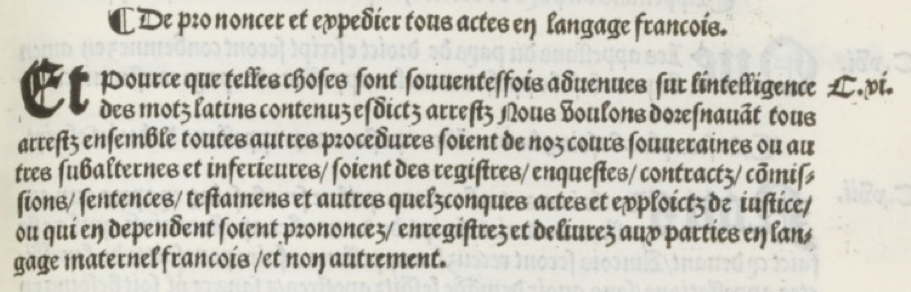
However, formally, the Ordinance of Villers-Cotterêts of August 1539 applies only to procedural documents (i.e., documents drafted by the judges), and it is for the trial judge, in the exercise of their sovereign power, to assess the probative value of the evidence submitted to them (C. Cass. Com. Ch., May 24, 2011, No. 10-18608).
Thus, it is entirely possible for a court to show flexibility (C. Cass. Com. Ch., January 7, 2014, No. 12-25955, although one should not rely on this too much).
The summons
The summons may also be referred to as a « bailiff’s writ. »
Article 56 CPC provides that the summons must contain the subject of the claim with a statement of the legal and factual grounds.
This summons notably includes:
- the capacity and identification of the parties,
- details regarding the court of appearance (here, the Paris Judicial Court),
- an invitation to retain counsel (902 CPC):
- within 15 days (otherwise, a default judgment is normally issued, though this is rarely enforced immediately),
- within 2 months for foreign parties,
- a brief statement of the grounds,
- a statement of the claims and the reasons for the claim (including the cessation of infringement and compensation for damages to ensure the statute of limitations is interrupted for both actions).
At this stage, the court is not aware of the summons. A copy of the summons must therefore be filed with the court: this filing is referred to as the « initiation of proceedings. »
Care must be taken in drafting the summons.
Pre-trial proceedings
These pre-trial proceedings take place before the pre-trial judge.
The judge is responsible for monitoring the proceedings, ensuring that the requested documents are properly exchanged between the parties, etc.
Objections are raised before this judge (771 CPC) (but not pleas of inadmissibility, C. Cass, opinion No. 0060012P of November 13, 2006).
This judge sets the schedule for the submission of briefs and fixes the closure, which ends the exchange of briefs.
Possible dilatory measures
As a means to « delay » proceedings, it is possible to:
- request a stay of proceedings, as of right (i.e., the judge cannot refuse), if you are sued by a co-proprietor without prior notification having been sent to the other co-proprietors. This stay is provided for in Article L613-29 CPI, b);
- request a stay of proceedings, as of right, if you are sued on the basis of a French patent and a European patent application is pending, provided that this European patent application was filed by the same inventor of the French patent (or their successor in title), that it relates to the same invention, and that it benefits from priority (L614-15 CPI);
- request a stay of proceedings, as of right, if the summons is based on a mere patent application and not a patent (L615-4 CPI);
- if a European patent is granted but an opposition is pending, it is possible to request a stay of proceedings for « the proper administration of justice » (a principle of civil procedure). However, judges rarely grant this stay, considering that the opposition process is too « slow. » Note that if you are definitively condemned and the patent is ultimately declared invalid during the opposition, you will not be able to recover the damages paid due to the principle of res judicata (C. cass. ass. pl. February 17, 2012, No. 10-24282);
- if an entitlement action is initiated, you may request a stay, though this is not mandatory, as in the previous case.
Civil sanctions
Injunction under penalty
This injunction is not explicitly provided for in the code but is based on Articles L613-3 and L613-4.
The penalty ensures the enforceability of the court’s decision (imperium of the judge). It is, in a way, a future-oriented condemnation. It is set based on the price of the object to deter the infringer from continuing the infringement.
While this penalty is to be paid to the patent proprietor, it is not automatic. Indeed, to collect the penalty, it is necessary to request the enforcement judge to « liquidate » it (Article 35 of Law 91-650 of July 9, 1991). The judge may reduce or increase it depending on the infringer’s good faith and the difficulties encountered (Article 36 of Law 91-650 of July 9, 1991).
If the judgment is ultimately overturned by a court of appeal or the Cour de cassation, the penalty received must be reimbursed.
Recall from commercial channels
It is possible to request the recall of infringing products from commercial channels (L615-7-1 CPI).
However, it is not entirely clear what the notion of « commercial channels » precisely covers:
- Does it refer to channels located in France?
- Does it cover only the branches of the condemned company?
- Does it concern products purchased by distributors?
Confiscation
Confiscation is a very old sanction, already present in the decree « relatif aux auteurs de découvertes utiles » of December 31, 1790 (see Article 12).
Two theories oppose each other regarding confiscation:
- Should confiscation serve to prevent the continuation of infringement acts?
- Should confiscation serve to compensate the rights proprietor?
While under the 1968 law, the first theory largely dominated, the law was amended in 1978, and today, confiscation is clearly for the benefit of the rights proprietor (L615-7-1).
Destruction
The destruction of infringing products is also possible (L615-7-1):
This destruction is carried out at the infringer’s expense.
Publication of the judgment
While the publication of the judgment may be ordered by the judge (L615-7-1), restraint is advised!
Disparagement, for example, is constituted when:
- reference is made to an infringer’s actions without a court decision;
- reference is made to a truncated court decision;
- loud or provocative commercial advertising uses a court decision, even final, condemning a competitor as its theme.
However, simply sending an email to clients informing them of a judgment (even non-final) is not in itself unfair (Paris Court of Appeal, Pole 1, Chamber 2, June 16, 2016, Case No. 15/068473), but care must still be taken with the terms used (Paris Court of Appeal, Pole 5, Chamber 16, March 3, 2020, Case No. 19/12564).
Damages
Principle
Damages are legally grounded in Article 1240 of the Civil Code.
Basis for Damages
Since March 11, 2014, courts have been given new guidelines for calculating damages (L615-7 CPI).
The court must take into account distinctly (L615-7 CPI):
- the negative economic consequences, including:
- lost profits and
- losses incurred;
- moral prejudice;
- the profits made by the infringer, including savings on investments:
- intellectual,
- material and
- promotional.
In addition, the rights proprietor may prefer to be compensated based on a lump-sum indemnity, which must be higher than the fee that would have been charged for a license (L615-7 CPI, last paragraph).
This last option must likely be disregarded if the action is brought by the exclusive licensee.
Basis for Damages and License Recordal
Recordal of a license is not a condition for calculating the basis for damages.
Such recordal only affects the standing to sue for infringement and not the basis for damages (C. Cass. ch. com., February 18, 2004, No. 02-16703): it is only necessary that the license be recorded at the time the court renders its decision (CA d’Aix en Provence, April 3, 2014).
It should be noted that there is a contrary ruling by the Paris Court of Appeal, which considers that such recordal affects the basis for infringement damages (Paris Court of Appeal, Pole 5, 1st ch., June 2, 2010, Case No. 2007/16086): I believe this ruling makes no sense since L613-9 CPI provides that a non-exclusive licensee who has not recorded the license may intervene to obtain compensation for its own prejudice.
History of the Basis for Damages
Previously, the court only considered the prejudice suffered by the rights proprietor.
Early on, case law faced the following dilemma: if the patent proprietor is an individual and the infringer is a very large multinational, it is likely that the infringer would be able to derive substantial profits from the infringement (due to its size and commercial channels). Conversely, the patent proprietor (a small entity) cannot reach the same markets as the infringer.
For a very long time, case law remained consistent: there is no exception to the general rule, and only the prejudice must be compensated (C. cass. com., January 8, 1963, Mitchell fishing reels case).
Resistance to Infringement
There are cases where the court agrees to compensate the commercial efforts that were necessary for the patent proprietor to commercially resist the infringer, for example by « limiting price increases » (C. cass. ch. com., May 23, 1995, No. 93-18527, Chlortoluron case).
Punitive Damages?
The French approach has always rejected the concept of « punitive damages. »
Nevertheless, it should be recalled that the concept of « punitive damages » is not at all contrary to European law (CJEU Decision C-367/15).
The CJEU also notes that the mere payment of a hypothetical royalty is not sufficient to ensure full compensation for the prejudice suffered, as it would not cover reimbursement of any costs related to the investigation and identification of possible infringement acts, nor compensation for any moral prejudice, nor the payment of interest on the amounts due.
Criminal Sanctions
Principle
Infringement is punishable by criminal penalties (L615-14 CPI, paragraph 1, first sentence):
- by a fine of up to 300 k€;
- by imprisonment for up to 3 years.
Increased penalty in case of repeat offense
In case of repeat offense, the penalty may be doubled (L615-14-1 CPI).
Increased penalty in case of a licensee
If the infringer was a licensee, the penalty may also be doubled (L615-14-1 CPI).
Increased penalty in certain other cases
The penalty may also be increased (L615-14 CPI, paragraph 1, second sentence):
- if the infringement is dangerous to health, or
- if the infringement was committed on the Internet, or
- if the infringement was committed by an organized group
Infringement is then punishable by criminal penalties (L615-14 CPI, paragraph 1, second sentence):
- by a fine of up to 500 k€;
- by imprisonment for up to 5 years.
Additional penalties
As an ancillary measure, the court may order (L615-14-2 CPI):
- that the infringer withdraw, at their own expense, the infringing goods from commercial channels;
- the destruction of the infringing products;
- the delivery of the infringing products to the proprietor;
- damages;
- the publication of the judgment.
Mon commentaire est erroné (basé sur une version de la loi qui n’est pas en vigueur). Toutes mes excuses.
Bonjour,
L615-2 CPI précise que
« Le titulaire d’une licence non exclusive peut exercer l’action en contrefaçon, si le contrat de licence l’y autorise expressément, à condition, à peine d’irrecevabilité, d’informer au préalable le titulaire du brevet. »
Par conséquent, ne faudrait-il pas compléter la partie « 1.4.3 Le licencié simple » et y ajouter cette possibilité ?
Cordialement,
Nouvel article 8 CPP depuis le 1er mars 2017 : prescription des délits au pénal = 6 ans désormais.
Vous avez raison c’est corrigé 🙂
Merci de votre vigilance
Sur le Chapitre sur la compétence :
« Seul le Tribunal de Grande Instance de Paris est compétent pour les actions en contrefaçon ou en nullité (L615-17 CPI32 ensemble D211-6 CPI33) y compris pour les questions connexes de concurrence déloyale. »
Correction : L’article D211-6 cité est issu du code de l’organisation judiciaire et non du CPI.
Site très bien réalisé, bravo et merci.
Cordialement,
Julien Pied