Legal Jurisdiction
General Jurisdiction of the « Court »
Principle
The Unified Patent Court (UPC) has jurisdiction over any dispute related to (Article 3 of the Agreement on a Unified Patent Court):
- A European patent
- with unitary effect;
- without unitary effect;
- A patent application; a supplementary protection certificate (SPC) granted for a patent. This is somewhat unusual since an SPC has a national, not unitary, effect…
- And when referring to a patent, it does not necessarily mean a « European » patent…
Sunrise Period or the Opt-Out Principle
To establish a smooth transition period, a sunrise period was created for invalidity and infringement actions related to:
- A European patent, or
- A supplementary protection certificate granted for a product protected by a European patent.
For a period of 7 years (extendable once) after the entry into force of the Agreement, it will be possible to bring legal proceedings before national courts (Article 83.1 of the Agreement on a Unified Patent Court).
The proprietor may even prevent any proceedings before the UPC by notifying the UPC Registry (a procedure known as opt-out, Article 83.3 of the Agreement on a Unified Patent Court, but for this to be effective, no proceedings must have already been initiated before the UPC).
The proprietor may withdraw this notification if desired (Article 83.4 of the Agreement on a Unified Patent Court, but for this to be effective, no proceedings must have already been initiated before a national court).
Jurisdiction of the Central Division: Invalidity
Principle
Unless an infringement action has been brought before a local/regional division, the Central Division has jurisdiction over actions (Article 33.4 of the Agreement on a Unified Patent Court):
- for invalidity (Article 32.1(d) of the Agreement on a Unified Patent Court);
- for declarations of non-infringement (Article 32.1(b) of the Agreement on a Unified Patent Court).
Two clarifications from the Court of First Instance:
- « the same parties » is interpreted strictly, each company of a group having its own legal personality: the revocation action of an Italian subsidiary remains before the central division even if its Indian parent company and a German subsidiary are already being sued for infringement before the Munich local division (UPC, Central Division Paris, 13 November 2023, Meril Italy v. Edwards, UPC_CFI_255/2023, points 34 to 46);
- what counts is chronological order, to the minute: on 1 June 2023, with the electronic case management system (CMS) down, the revocation action lodged in hard copy at the Luxembourg registry at 11.26 preceded the infringement action lodged at the Munich sub-registry at 11.45, and the central division retained jurisdiction (UPC, Central Division Munich, 24 August 2023, Sanofi v. Amgen, UPC_CFI_1/2023, points 4.6 and 4.7). Nineteen minutes ahead: the UPC's first day was decided by the stopwatch.
Universal Jurisdiction
Furthermore, the Central Division has jurisdiction whenever the parties agree that it does (Article 33.7 of the Agreement on a Unified Patent Court).
Infringement Action Following an Invalidity Action
If an invalidity action has been brought before the Central Division, an infringement action may be brought before any division (territorially competent within the framework of local or regional divisions, Article 33.5 of the Agreement on a Unified Patent Court).
Infringement Action Following a Declaration of Non-Infringement Action
If a declaration of non-infringement action has been brought before the Central Division, this action is stayed if an infringement action (involving the same parties and the same patent) is brought before a local/regional division (Article 33.6 of the Agreement on a Unified Patent Court).
Actions Against the EPO
Actions concerning decisions taken by the European Patent Office in the exercise of its duties fall under the jurisdiction of the Central Division (Article 33.6 of the Agreement on a Unified Patent Court).
Jurisdiction of National/Regional Divisions: Infringement
Principle
The local/regional divisions (of the place of the infringement or the defendant’s domicile/establishment) have jurisdiction (Article 33.1 of the Agreement on a Unified Patent Court) concerning:
- infringement actions (patents and SPCs) and including counterclaims concerning licenses (Article 32.1(a) of the Agreement on a Unified Patent Court); provisional and protective measures and injunctions (Article 32.1(c) of the Agreement on a Unified Patent Court); actions for damages arising from provisional protection (Article 32.1(f) of the Agreement on a Unified Patent Court); actions relating to the use of the invention prior to the grant of the patent or to the right based on prior use of the invention (Article 32.1(g) of the Agreement on a Unified Patent Court).
Universal jurisdiction
Furthermore, the local/regional division has jurisdiction as soon as the parties agree that it does (Article 33.7 of the Agreement on a Unified Patent Court).
Absence of domicile/establishment in the member states
If the defendant has no domicile/establishment in the member states, only the place of the infringement may determine the jurisdiction of the local/regional division (Article 33.1 of the Agreement on a Unified Patent Court).
This may seem self-evident, but it is worth stating.
Infringement in a state that is not party to the Agreement
The court of the Member State of the defendant's domicile, seised of the infringement of a patent granted in another Member State, retains jurisdiction even if the validity of that patent is challenged by way of defence, validity itself falling within the exclusive jurisdiction of the courts of the granting State; for a patent of a third State, it may even rule on the invalidity defence, with effect only between the parties (CJEU, 25 February 2025, BSH Hausgeräte v. Electrolux, Case C-339/22).
The UPC infers from this that it may hear the infringement of the national part of a European patent granted for an EU State not party to the Agreement or for a State bound by the Lugano Convention (e.g. Switzerland), but not its validity; it must stay the proceedings if there is a reasonable and non-negligible risk that this part will be revoked by the courts of the State concerned (UPC, Paris Local Division, 16 January 2026, IMC Créations v. Mul-T-Lock France, UPC_CFI_702/2024 and UPC_CFI_369/2025, point 123).
In practice, a proprietor who limits its unitary patent to escape revocation weakens the Swiss part left as granted: with no revocation action pending in Switzerland, neither an assessment of infringement nor a stay is possible, and the claims for Switzerland were dismissed (same decision, points 124 and 125). What saves the patent on one side of the border may thus doom it on the other.
Absence of local/regional division
If no local/regional division exists in the territory concerned, the central division then has jurisdiction (Article 32.1 of the Agreement on a Unified Patent Court).
Lis pendens and related actions
If a division is seized of a dispute (concerning the cases mentioned above), it is not possible to seize another division (including the central division) (Article 33.2 of the Agreement on a Unified Patent Court) if it involves the same parties and the same patent.
Widespread infringement
If the infringement covers the territory of more than three regional divisions, the regional division seized shall, at the defendant’s request, refer the case to the central division (Article 33.2 of the Agreement on a Unified Patent Court).
It is rather odd that this provision only applies to regional divisions and not local ones. Indeed, at this stage, it is not even certain that more than three regional divisions will exist…
Counterclaim for revocation
It is common for the defendant to file a counterclaim for revocation when sued for infringement.
In such a case, the local/regional division may:
- rule on the counterclaim for revocation, but by requesting the assignment of a technically qualified judge (Article 33.3(a) of the Agreement on a Unified Patent Court);
- refer the counterclaim to the central division (Article 33.3(b) of the Agreement on a Unified Patent Court)
- if revocation of the patent is highly probable, a stay of proceedings concerning the infringement action is ordered (Rule 37 of the Rules of Procedure of the Unified Patent Court);
- if no stay of proceedings concerning the infringement action is ordered, the judge-rapporteur (Rule 40(b) of the Rules of Procedure of the Unified Patent Court).
- at the parties’ request, refer the entire case to the central division (Article 33.3(c) of the Agreement on a Unified Patent Court).
Technical jurisdiction
When the central division has legal jurisdiction, cases are distributed among the three sections of the central division according to the technical field in question:
- Paris
- : performing operations; transporting; textiles; paper; fixed constructions; physics; electricity; London: human necessities; chemistry; metallurgy; Munich: mechanical engineering; lighting; heating; weapons; blasting.
Overview of Competencies
As Napoleon Bonaparte said: « A good sketch is better than a long speech.«
Who said it was simple?
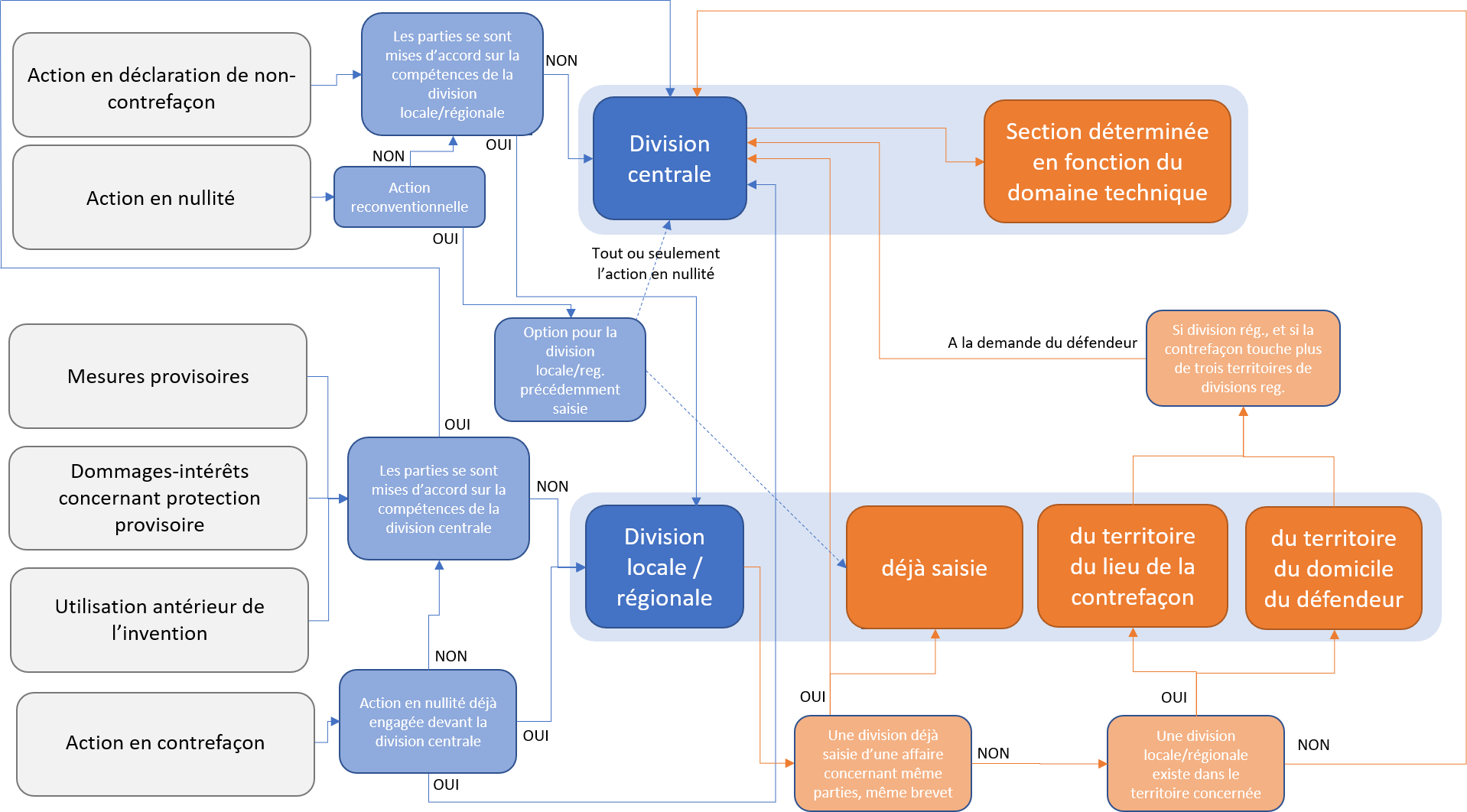
No … this chart is not sponsored by Ibuprofen …
Other Competencies
The UPC divisions are also competent regarding:
- The determination of costs of the proceedings and damages (Preamble 7 of the Rules of Procedure of the Unified Patent Court),
- the management of the proceedings (Chapter 8 of the Rules of Procedure of the Unified Patent Court).