Inventive step

Definition of inventive step
To be patentable, an invention must involve an inventive step (A52(1) EPC).
An invention is considered to involve an inventive step if, to a person skilled in the art, it does not obviously follow from the prior art relevant to the inventive step (A56 EPC).
Prior art
For the definition of prior art, please refer to The definition of prior art.
Proof of disclosure
Regarding the proof of disclosure, please refer to the page Proof of disclosure.
Assessment of inventive step
Combination of documents
It is quite possible to combine several documents (rarely more than two, Guidelines G-VII 6) if this combination is obvious to the person skilled in the art (T2/81): e.g. one of the two documents explicitly refers to the other.
Exceptions to this principle may arise in the case of partial problems, for which each of the problems must be treated separately (Guidelines G-VII 6).
It is also possible to combine two embodiments of the same document if nothing deters the person skilled in the art from this combination (i.e. « teach away », T95/90).
A synergy between the components of a combination is not sufficient, in itself, to establish an inventive step unless it is established that the effect is not obvious (T1639/21). Specifically, this means that even if a combination produces a technical effect superior to the sum of the individual effects of its components, this effect must be unpredictable for the person skilled in the art.
« Problem-solution » approach
The EPO has developed an approach to determine, almost scientifically, whether the invention is inventive.
This approach is not mandatory but is widely recommended (T465/92, Guidelines G-VII 5).
This approach consists of 5 steps:
- determination of the technical field of the invention to limit the prior art;
- determination of the person skilled in the art;
- determination of the closest prior art;
- determination of the objective technical problem;
- determination of the obviousness of the invention.
Step 1: Technical field and limitation of the state of the art
How to determine if a technical field should be considered for the problem-solution approach?
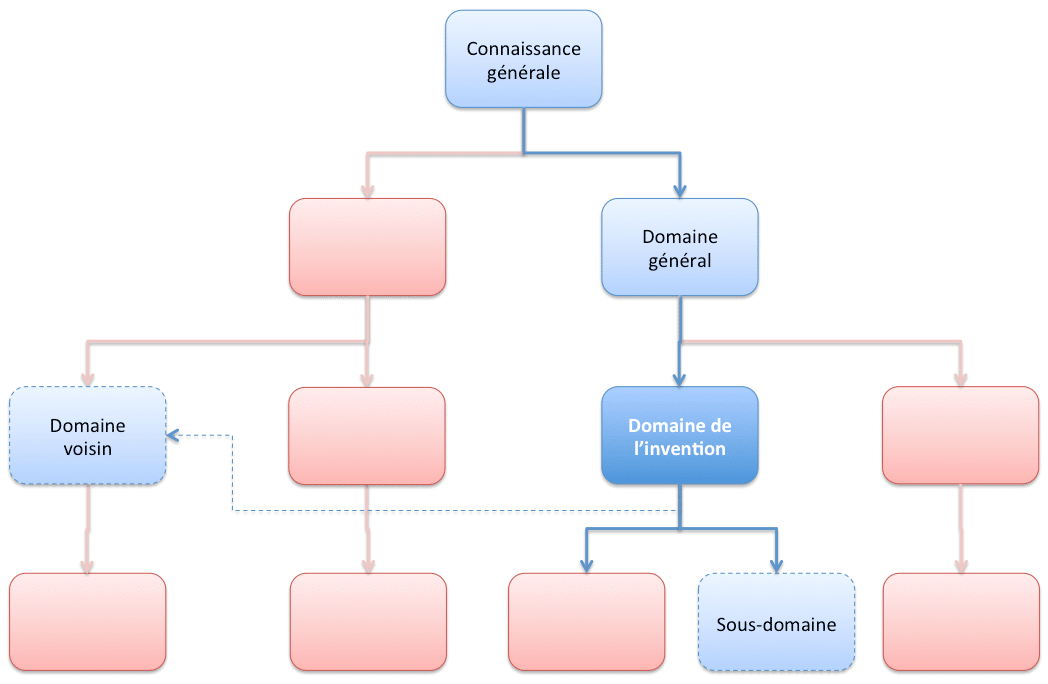
A technical field is considered relevant to the technological field of the invention:
- if this field represents the same technical field as that of the invention;
- if this technical field represents the general knowledge of the person skilled in the art (T195/84);
- if this field is a sub-field of the field of the invention (i.e., a more specific and narrower technical field) and if the main known application of the invention is in this sub-field (T955/90);
- if this field is a « neighboring » field, that is to say:
- if identical or similar problems to those encountered in the field of the invention arise, and which the person skilled in the art would normally also know (T176/84);
- if the materials used are related or if the technical problem arising in the two fields has been debated in the public domain (T560/89).
It should be noted that the technical field that has the most features in common with the invention is not necessarily the one to be retained (even if generally it is suitable, Guidelines G-VII 5.1).
Moreover, prior art cited by the applicant himself is not necessarily relevant for assessing inventive step (T28/87).
Furthermore, the mere fact that the description refers to a document from a distant technical field does not allow this technical field to be considered as close (T28/87).
Step 2: Technical field and person skilled in the art
The person skilled in the art is the person in the technical field of the invention (Guidelines G-VII 3) (i.e., of its technical problem and not of its solution, T422/93).
For example, if the technical problem is « finding an elastic material that does not break easily, » the person skilled in the art will be a specialist in the field of materials even if this material is intended for the manufacture of conveyor belts (T32/81).
The person skilled in the art is understood (Guidelines G-VII 3) to be:
- a normally qualified practitioner, expert in their field;
- who possesses general knowledge in the relevant field;
- and who has an omniscient knowledge of all elements of the prior art (as previously limited),
- and has at their disposal the means and ability to carry out routine work and experiments.
As we can see, the person skilled in the art is a pure fiction of the mind.
This fiction is all the more marked as it is accepted that the person skilled in the art is not necessarily a single person: they can thus be a multidisciplinary team (for example, to solve several sequential problems, T141/87 and Guidelines G-VII 3).
If this person skilled in the art is often a person with average training (i.e., not a Nobel Prize winner, T60/89) consulting the prior art in search of a component having the same function (T142/84), they can nevertheless be a PhD student if the technical field requires it (e.g., DNA sequencing, T412/93, Guidelines G-VII 3.1).
Step 3: Determination of the closest prior art
Principle: same objective or same effects
To determine this closest prior art (i.e., which constitutes the most promising starting point for making an obvious development leading to the invention, Guidelines G-VII 5.1), it must be that:
- this disclosure aims to achieve the same objective or to obtain the same effects as the invention (T482/92, T2255/10);
- or at least that it belongs to the same technical field as the invention (or to a closely related field).
If generally this disclosure is the one that corresponds to a similar use and requires the fewest structural and functional modifications to arrive at the claimed invention (T606/89), this is not a rule (T1666/16): it is therefore necessary to give more weight to the original problem, the purpose of the use, and the effects obtained than to the number of common features in the choice of the closest prior art (T1019/13).
Uniqueness of the closest prior art?
Given the wording « closest, » we might be tempted to conclude that this prior art is necessarily unique.
This is not the case: there may be several closest prior arts (T405/14) or there may be doubt as to the closest prior art (T1148/15).
The relevant question, when it comes to choosing a starting point, is therefore essentially whether it allows a realistic objection to be raised or not.
A document chosen as the closest prior art cannot be excluded simply because another apparently more promising one is available.
Same effects explicitly or intrinsically?
It may happen that a document seeks to solve a problem completely different from the invention (e.g., anti-dandruff effect of a shampoo) but that it contains all the characteristics to solve that of the invention (e.g., silicone having a known conditioning effect).
In this hypothesis, it can quite be chosen as the closest prior art document (T2304/16).
Thus, it is not mandatory to explicitly search for the technical effect in the prior art documents: the mere fact that the prior art intrinsically has the effect is sufficient.
Identification of the purpose of the invention
The determination of the purpose of the invention should not be based on a subjective selection, but must take into account what is claimed (T2255/10).
Case of the best starting point
It is not excluded, even when a document D1 dealing with the same general technical problem (PG) exists, to consider that another document D2, which deals with a similar problem (PS), constitutes a better choice, or at least an equally plausible choice, provided that it immediately appears to the person skilled in the art that what is taught in this document D2 can be adapted to the purpose of the invention in a simple manner and using only their general knowledge (T1841/11).
Nevertheless, in this situation, it is not possible to argue that the person skilled in the art would not have been motivated to solve the general problem PG starting from D2, because the problem-solution approach presupposes that the person skilled in the art wishes to solve PG from the beginning of the inventive process.
Justification of the closest prior art
One may wonder whether the closest prior art must be justified or could be challenged.
In this case, some decisions state that there is no need for justification (T1112/19) and that all documents can be used indifferently.
Focus on a closest prior art in another field
It may happen that the previous analysis leads to selecting a document from a different technical field as the closest prior art.
Under this hypothesis, it should not be forgotten that a closest prior art that does not deal with the same purpose or the same effect as the invention cannot lead the person skilled in the art in an obvious manner towards the claimed invention (T473/15).
Step 4: Determination of the objective technical problem
Introduction
The objective technical problem is the problem that arises, for the person skilled in the art, from the application as filed in view of the objective prior art (T13/84).
This problem must therefore be consistent with the application.
How to formulate it?
Once the closest prior art document is identified, the technical differences (whether structural or functional) between this disclosure and the claims must be examined.
These technical differences make it possible to formulate a problem that the person skilled in the art should address to adapt the closest prior art in order to obtain the technical effects that constitute the contribution of the invention (Guidelines G-VII 5.2): this problem is not necessarily the one presented by the application (it may be less ambitious).
Post-published tests are not taken into account to define the objective technical problem (T852/20, G2/21 contra T1989/19).
In principle, any effect produced by the invention can be used as a basis for formulating the technical problem, if the effect can be deduced from the application as filed (T386/89).
Of course, the objective technical problem is not the initial technical problem posed by the application and may not be explicitly formulated in the application: it is therefore possible to reformulate it (T13/84) even at a late stage (e.g., on appeal, T162/86).
The reformulated technical problem can even be based on new effects if the person skilled in the art can see that these effects were implicitly contained in the initial technical problem (T1329/04)
On the other hand, it is necessary to avoid reasoning a posteriori by introducing elements of the technical solution into the technical problem (T229/85) even if this problem is posed by the description itself (T686/18). Similarly, it is important not to introduce into the formulation of the problem a contribution of the patent in the identification of a problem (e.g., the resolution of a problem that occurs only rarely and which had never been identified by the prior art, T605/20).
Furthermore, if the applicant wishes to introduce the reformulated technical problem into the description, A123(2) EPC must be taken into account (Guidelines G-VII 11).
Impossibility to formulate
In some cases, it may happen that the formulation of the claims is so broad that the formulation of the technical problem is impossible given the multiplicity of possible implementation cases.
In this case, the invention cannot demonstrate inventive step (T1766/16).
Case of the bonus effect
Small additional difficulty: the case of the « bonus effect ».
We speak of a bonus effect when an additional technical effect is obtained, even if surprising, but which must necessarily be obtained.
For example, if we have only one option (or a given number of options) to manufacture a pill and this option necessarily provides a technical effect of uniformization of the pill’s compounds, this uniformization is a bonus effect.
In this hypothesis, this bonus effect should not be taken into account in the formulation of the technical problem or in the reasoning of inventive step (T1936/13).
A crucial and unexpected effect — even if not initially sought — cannot be ignored in the assessment of inventive step (T1356/21, point 3.4; see also T1147/16).
For some case law, for a technical effect to be qualified as a bonus effect, it must be demonstrated that either there is no other alternative to obtain the first effect, or that the second effect is purely accidental (T1356/21, confirming T192/82 and T227/89).
The technical problem necessarily technical?
It may happen that some examiners indicate « The technical problem you present (e.g., simplification of an interaction) is not technical and therefore is not a real technical problem » (experienced situation)…
In the absence of knowing what a « technical problem » is (since no one dares to give a precise definition), it is necessary to analyze the case law. Thus, a valid technical problem is one that allows:
- reducing costs (T255/00, point 2.1.2 – in reality, I think it is better to consider the problem as a reduction of a « constraint » by analogy with the decision T102/08) ;
- increasing the quality of audio (subjective characteristic) (T255/00, point 2.1.2) ;
- simplifying a manufacturing process (T551/09, point 11) ;
- creating an interactive and user-friendly human-machine interface (T333/95, point 4.2) ;
- simply presenting and simplifying the evaluation of image search results (T634/00, points 14 and 15) ;
- improving the appearance of a glass (T1852/09) ;
- allowing a good compromise between several characteristics (T672/21).
Thus, it is quite possible for a technical problem to be subjective (e.g., making an object more beautiful) (T1852/09 or T255/00).
Moreover, the fact that the technical problem is motivated by user choices or non-technical preferences has no influence on the fact that the problem is non-technical (T634/00, point 15).
A mathematical characteristic without relevant technical effect cannot establish an inventive step (T746/22).
Partial technical problems
When the identified technical differences do not all contribute to solving the same technical problem (Guidelines G-VII 6 and T389/86), we speak of partial technical problems.
This can occur in particular in the case of a simple « juxtaposition of characteristics » (i.e., there is no synergy between the different characteristics, Guidelines G-VII 7).
Each partial technical problem will be treated separately, and a « problem-solution » approach will be applied to each of the groups of characteristics contributing to these partial technical problems (possibly with different closest prior art documents) (Guidelines G-VII 6).
It is sufficient that one of these groups of characteristics involves an inventive step for the subject matter of the claim to be inventive (Guidelines G-VII 6).
Proof of the technical effect
In certain specific cases, examiners or members of the boards of appeal may doubt the technical problem posed (by doubting the alleged effect of the feature): this is particularly the case in chemistry, biology, cosmetics, in the case of drugs, etc.
This can also happen in other fields if the claimed technical effect is not credible (T339/13) or is not credible over the entire scope of the claims (T279/17).
This is then referred to as the plausibility of the technical effect (T2015/20).
It is then possible to provide comparative tests (T1127/10, possibly upon request, T609/02), provided that they are verifiable and reproducible.
In particular, if « the description of the procedure and the evaluation of the comparative tests […] are both deficient and insufficiently significant to credibly establish the existence of an improvement« , these tests may not be admissible (T826/11).
Thus, a statistical analysis of the results must be provided, particularly in cases where (T826/11):
- experimental results are close and/or
- the panel of testers or the sample size is limited.
There is no requirement regarding the date of submission of these tests: they may be included in the application but may also be provided after filing, during examination or during an opposition (T2371/13).
The burden of proof lies with the proprietor (T1265/17). Failing this, the Examiner will rely on the plausibility of this technical effect.
Step 5: Determination of the obviousness of the invention
« Would » approach
Once the technical problem is formulated, one must ask whether, in order to solve this problem, the modification of the closest prior art to arrive at the invention would be obvious.
It will be considered that this modification is obvious if the prior art as a whole contains a teaching that would have prompted the person skilled in the art to modify the closest prior art to arrive at the invention (Guidelines G-VII 5.3, T90/84).
This incentive or suggestion may, for example, be:
- the second prior art document proposes to solve the same technical problem or a similar problem;
- the second prior art document suggests (even implicitly, T257/98) such a modification.
If the closest prior art document discourages a solution (i.e., « teach away » in English, T95/90), it is considered that the person skilled in the art will not seek to modify this document in this way. This may also be the case if the solution of the invention goes against the main teaching of the closest prior art document, in view of the goal pursued by this prior art (T2201/10).
It may also happen that the gap between the closest prior art and the invention is so large that it does not allow the person skilled in the art to reasonably overcome the gap (T1571/19).
« Would » approach abusive?
It may happen that some consider that the distinctive feature of your invention is « obvious » and is a « clear choice for the person skilled in the art » faced with your problem…
I admit that in the face of such an argument, it is difficult to defend oneself.
By way of illustration, the EPO indicates that an Examiner may well not cite a document if he considers that the feature is of public notoriety (« Communication from the European Patent Office dated October 1, 2007, concerning methods in the field of economic activities« , OJ 2007, 592).
Fortunately, you can contest it (T766/91): if someone tells you that this feature is part of the general knowledge of the person skilled in the art or that the feature is obvious, you can ask them to demonstrate it (I admit I have not had much success before the Examination Divisions, but well… contrary decisions T1370/15 or T1090/12).
« Could » approach: the problem of searching for an alternative or selecting among obvious choices
A technical problem that arises may well be the search for an alternative (« replacement solution« ) to a known feature (Guidelines G-VII 5.2, T12/07, T1968/08, T894/19).
This problem arises if the technical difference with the prior art provides the same effects (or similar effects) as a feature of this prior art (e.g. the technical problem is to find an alternative to the use of a spring – the prior art disclosing rubber for absorbing shocks, like the spring) (Guidelines G-VII 5.2).
In this situation, it is simply sufficient to prove that the person skilled in the art could have modified (and not would have modified) the state of the art to arrive at the claimed solution (T1419/10).
« Could » approach: double selection of values without technical effect
As we have seen for novelty, it may be that the novelty with respect to a document lies in the fact that a double selection must be made.
However, if this selection does not provide any technical effect, the invention cannot be considered inventive (T1984/15).
« Could » approach: selection among obvious choices
Negative indicators
Complement to an incomplete disclosure
The invention represents one of the solutions that would easily and/or naturally come to the mind of the person skilled in the art to fill a gap/imprecision of a disclosure (Guidelines G-VII 14).
Use of known equivalent
e.g. replacement of an electric pump with a gasoline pump (Guidelines G-VIIA 1).
Use of a known material for its known properties
e.g. use of a detergent for its properties of reducing the surface tension of water (Guidelines G-VIIA 1).
Juxtaposition of features
If the features are known independently, and they function normally without producing an effect that exceeds the sum of the previously known effects, it is likely that this juxtaposition is not inventive (Guidelines G-VIIA 2).
Positive indications
Predictable disadvantage and prejudice
The mere achievement of a disadvantageous effect does not imply any inventive activity (T119/82).
However, if this disadvantageous effect is in reality only a prejudice (i.e., a widely held but inaccurate opinion about a technical fact), inventive activity may be recognized (provided that the existence of the prejudice is proven, T60/82).
Unexpected effect
The achievement of an unexpected technical effect may be considered as an indication of inventive activity (Guidelines G-VII 10.2).
However, if there are no possible alternatives to the differentiating features of the invention, the EPO will consider that this is a « one-way situation » in which the use of the feature obviously leads to predictable advantages and therefore without inventive activity (T192/82).
Long-standing need
When the invention solves a technical problem that specialists have been working on for a long time or meets a long-standing need, this may be considered as an indication of inventive activity (Guidelines G-VII 10.3).
Problem invention
Inventive activity may be recognized when the invention lies in the identification of a problem that was not previously recognized in the state of the art (T2/83, T1641/09, T1201/13).
Special case of « mixed » inventions
I invite you to look at the page on mixed inventions.