
A83 EPC states:
The invention must be disclosed in the European patent application in a manner sufficiently clear and complete for it to be carried out by a person skilled in the art.
Sufficiency of description
Assessment date
Sufficiency of description, to assess the validity of a patent/application, is assessed at the filing date of the application (Guidelines F-II 4.1).
To determine whether a disclosure anticipates an invention, the assessment of sufficiency of description is different: it is at the date of publication of this disclosure that one must consider (or filing date for an A54(3) EPC document) (T206/83, T26/85 and Guidelines G-VI 4).
Assessment criteria
Sufficiency of description is assessed in relation (Guidelines F-II 4.1):
- to the general basic knowledge of the person skilled in the art;
- to the invention described in the application;
- to the cited documents.
If products are claimed, only their manufacture must be sufficiently described (T866/00): it is not necessary to describe their use.
Tests for verifying sufficiency of description
In order to verify that the description is sufficient for the implementation of the invention, the Boards of Appeal have proposed a 4-step test (T593/09, T2403/11):
- Identification of the problem solved by the invention;
- Is the characteristic alleged as insufficiently described (e.g., porosity threshold of a material) relevant to solving this problem?
- Is there a possible ambiguity regarding the measurement/estimation of this characteristic?
- e.g., several measurement methods give different results, depending on the conditions the measurements are different (T2096/12);
- a measurement via a specific machine is mentioned in the description but this machine is no longer manufactured (T1293/13) and it is impossible to know if the new machines give the same result;
- Is the ambiguity such that the invention is not sufficiently described? (e.g., discrimination of materials satisfying the technical problem is not possible).
Once this test is completed, it becomes possible to determine whether the invention is insufficiently described.
For a claimed range to be considered reproducible, the person skilled in the art must be able to achieve its values without excessive effort, and the claim must include the essential technical features allowing this adjustment (T1977/22).
A range of values without an upper bound may be deemed insufficiently described if the provided examples do not cover the entire claimed scope, thereby depriving the person skilled in the art of the ability to reproduce the invention in its entirety (T1942/21, confirming T412/93 and T136/04).
Case of parameter measurement
It should be noted that inaccuracies in the measurement of a parameter or the existence of several measurement methods do not necessarily lead to insufficient description (T608/07, T1768/15) but often to clarity issues.
Nevertheless, in a case where the parameter is crucial to solving the problem underlying the invention, the measurement method must provide consistent values so that the person skilled in the art knows, when reproducing the invention, whether what they produce solves the problem or not (T815/07, T1305/15) : this is then a problem of sufficiency of description.
Case of neural networks
In the case of inventions using a neural network, we may wonder whether it is useful / necessary to describe how the neural network was trained.
This is all the more relevant as training networks requires several megabytes (or even gigabytes) and it is not really feasible to include this data in the text of the application.
According to case law (T161/18), the mere fact of generally indicating that the training data must cover a wide scope (e.g. patient age, sex, etc.) is not sufficient.
It is likely that it will be necessary to precisely indicate what types of data and what parameters / hyper-parameters are used. But to what extent is this a real question …
Case of medicines / pharmaceutical composition
It may happen that an invention relates to a medicine or a pharmaceutical composition without the application containing clinical tests proving that this medicine / pharmaceutical composition has the claimed efficacy / effect.
Nevertheless, this is not sufficient for an objection of insufficiency of description to be raised (T2015/20) : An invention is sufficiently described only if it does not go against a dominant technical opinion and if the patent provides at least one reproducible example.
This is therefore not a question of plausibility (which then relates to inventive step).
Described embodiments
Claim broader than the described embodiments
Principle
According to certain decisions, the description must be sufficient to enable the implementation of almost all the embodiments covered by the claim (T409/91).
Nevertheless, other decisions consider that the criterion of sufficiency of description is met if at least one embodiment is described (T292/85 or T389/94).
It is therefore necessary to look at the facts: if the invention is very innovative, it can often be easily generalized once the person skilled in the art has been guided towards an embodiment (Guidelines F-III 1).
Thus, the description of a single embodiment will be more easily accepted if the invention is innovative (Guidelines F-III 1).
It is appropriate to admit trial and error to a limited extent, for example when it is a still unexplored field or when many technical difficulties arise (T292/85, T409/91 and Guidelines F-III 1).
A broad claim may be admissible if it is possible to extend the given examples by usual methods of experimentation or analysis (Guidelines F-IV 6.3).
« Forbidden area » of a claim or disguised clarity objection
It may happen that a feature is so unclear that the person skilled in the art is unable to know whether or not they are working in the claimed area (« forbidden area »).
Many opponents have often tried to argue that this was a matter of sufficiency of description (clarity not being a ground for opposition).
But today, the boards of appeal are quite unanimous: the definition of the claimed area was a matter of A84 EPC rather than A83 EPC (T1811/13).
It should be ensured that an objection of insufficiency of description arising from an ambiguity is not merely a disguised clarity objection (T608/07, 2.5.2).
Embodiment or operating range…
… not working throughout the entire scope of the claim
Burden of proof
If it is argued that, when complying with the details given in the description, certain areas or certain embodiments do not work, the party raising this issue must provide evidence supporting its position (i.e., serious reservations, supported by verifiable facts, T409/91, T1057/22 and T694/92).
However, this does not mean that, as soon as an area covered by the claim does not work, there is an insufficiency of description. Indeed, when it is clear to the person skilled in the art that such an area is not reasonable or does not work (does not achieve the technical effect), there is no problem (T1943/15, T2773/18).
However, and this is where the real difficulty lies, a limiting feature that appears only in the description cannot be considered as implicit in the claims (T989/16).
Sufficiency of description objection
If a claim covers several embodiments and some do not work, the claim must be considered as insufficiently described even if the other embodiments work correctly (T1173/00, T239/13).
Alternative to this objection
An objection relating to the lack of industrial character (A52(1) EPC) can also be raised (Guidelines F-III 3).
… no longer working
It may happen that an embodiment can no longer be implemented.
This happens when it is so specific that a particular machine is needed to implement it and that this machine no longer exists (e.g., energy of an impact measured using the Drop-Weight Tester RTD-5000 apparatus from Rheometrics, Inc., T1714/15).
In this case, we have a problem of sufficiency of description.
… not always functioning (related to chance)
It may happen that the proper execution of the invention depends on chance (Guidelines F-III 3).
Thus, the details given in the description do not systematically allow obtaining the desired result (Guidelines F-III 3) :
- manufacturing of electronic chips ;
- microbiological process involving mutations ;
- etc.
These inventions will only be considered as sufficiently described if (Guidelines F-III 3) :
- satisfactory results can be obtained repeatedly, even if there are failures ;
- and if it is possible to determine whether the result is satisfactory using non-destructive testing methods.
… not always functioning (reliability less than 100%)
It may happen that certain mechanical devices do not have absolute reliability (e.g., mechanical sorting device).
Therefore, the person skilled in the art must strive to be constructive and not destructive in order to arrive at an interpretation of the claim that makes technical sense and takes into account the entire disclosure of the invention contained in the patent (T383/14).
Thus, even if a mechanical sorting machine occasionally makes sorting errors, the invention will be considered as sufficiently described.
… difficult to achieve or imperfect
The difficulty in achieving an invention does not necessarily mean that the invention is insufficiently described (Guidelines F-III 5.3).
Thus, an embodiment not functioning perfectly (e.g., an electrical switch that, when open, allows a slight residual current to pass) and making certain applications of the invention inoperative only in certain cases (e.g., an electrical circuit requiring an absolutely zero current when the switch is open) will be considered as sufficiently described (Guidelines F-III 5.3).
… not allowing the technical problem to be solved
If the invention does not allow obtaining the alleged technical effect, it is only possible to reject the application on the grounds of insufficient description if this technical effect is claimed (G1/03, point 2.5.2 or T2001/12).
Nevertheless, if the failure to achieve the technical effect is related (T2001/12) :
- to the absence of an essential feature, an objection of clarity may be raised ;
- to the technical impossibility of achieving the effect in view of the statements of the prior art, an objection of inventive step may be raised.
We can summarize as follows the decision G1/03, point 2.5.2 :
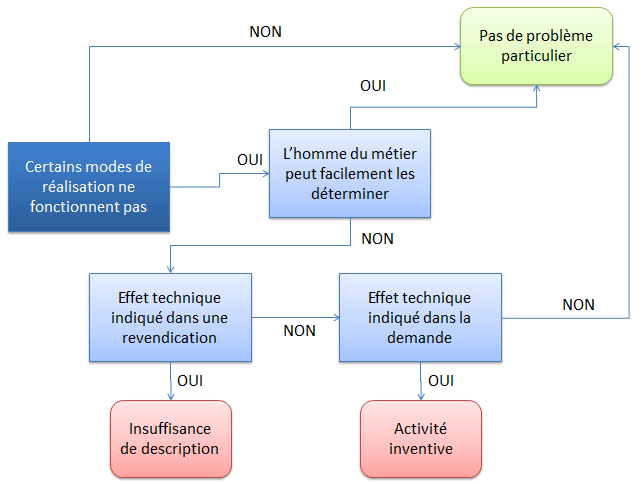
… citing trademarks, proper names, trade names
Indeed, these terms simply constitute an indication of origin and may relate to a whole range of different products.
To be sufficiently described, the product must be sufficiently identified, without reference to any trademark, proper name or trade name, to enable the invention to be carried out, unless these terms have a precise meaning for the person skilled in the art (for example, « Bowden » cable, « Belleville » washer, « Panhard » bar, « Caterpillar » track) (Guidelines F-III 7).
If a product of a brand is mentioned but the composition and method of manufacture of said product is secret, it is highly likely that the requirement of sufficient description is not met (T797/14).
Number of described embodiments
The description must include, at a minimum, the description of an embodiment covered by the claims (Guidelines F-III 1), this embodiment being functional (see above, Guidelines F-III 5.1).
If one embodiment may suffice, it may be wise to provide several, especially if the formulation of the claims is quite broad and the general knowledge of the person skilled in the art is not sufficient to extrapolate the realization of the embodiments not described, but covered (T727/95) by the claims.
Non « classical » method
When the applicant chooses to use non-ordinary methods (e.g., measurements), it is advisable to detail them particularly to ensure that these methods are sufficiently described (T602/10).
Incorporation by reference
An application will not be insufficiently described if an essential element of the description is mentioned by reference only without being reproduced in full.
The language of the cited document does not matter (T920/92).
The reference will be valid if (Guidelines H-V 2.5 together Guidelines H-IV 2.3.1):
- at the filing date, a copy of this document was available to the EPO (which is the case if it is another European patent application, T737/90);
- at the date of publication, this document was accessible to the public (T426/96).
Burden of proof
It is first up to the opponent/examining division to demonstrate, on the balance of probabilities, that a person skilled in the art would be unable to reproduce the invention, and if the opponent/examining division has fulfilled its burden of proof, this burden then shifts to the proprietor who seeks to refute the facts definitively established by counter-arguments (Guidelines F-III 1, Guidelines F-III 4, T518/17).
Sanction
In case of insufficient description, the claims should be limited to exclude the insufficiently described embodiments (Guidelines F-III 2).
Moreover, it is impossible, after the filing, to add the missing description to the application to « make » the invention sufficiently described: indeed, such a modification would be contrary to Article A123(2) EPC.
Sufficiency of the claims
As you all know, the claims are part of the description in Europe. Therefore, they contribute to the sufficiency of the description (A83 EPC).
In fact, it will be possible to raise an issue of sufficiency of description if the claims do not present the invention in a sufficiently complete manner so that the invention can be carried out (i.e., if essential features are missing, R43(1) EPC).
Indeed, the person skilled in the art must find in the claims indications of the essential features for the implementation of the invention in its entire scope. And if they cannot, we have a sufficiency problem (T623/16).
Rules for drafting the description
Principle
The R42 EPC precisely defines the rules to which the description must comply.
This rule aims to (Guidelines F-II 4.1)
- ensure that the patent application contains sufficient technical information for a person skilled in the art to carry out the invention as claimed,
- enable the reader of the invention’s disclosure to understand the contribution made to the state of the art by the invention as claimed.
State of the art
If the search report reveals relevant documents, a reference to these documents may be required (R42(1) b) EPC) along with a brief summary.
This a posteriori introduction does not contravene A123(2) EPC (T11/82).
If the Examiner requires that a reference be introduced, this requirement must be met or the application may be rejected (A97(2) EPC) or the patent revoked (A101(3) b) EPC).
If a prior art is A54(3) EPC, it is useful to mention it in the application (Guidelines F-II 4.3).
Technical problem and solutions
The R42(1) c) EPC requires that it be possible to deduce the technical problem from the application.
The statement of the problem must not include disparaging statements (Guidelines F-II 4.5).
It is possible to draft this solution by reference to the claims: « This problem is solved by the device of claim 1 » (this is not possible in France).
Description of at least one embodiment
It is appropriate to refer to the chapter on the sufficiency of description concerning this description (R42(1) e) EPC).
A simple copy-paste of a computer program is not sufficient to meet this requirement (Guidelines F-II 4.12) even if it is possible to illustrate the invention.
Industrial application
Most often, this industrial application (R42(1) f) EPC) can be directly deduced from the application and it is not necessary to explicitly indicate it.
If it is not obvious (e.g., a test method), it must be explained (Guidelines F-II 4.9).
Its mention is mandatory for an invention relating to a gene sequence (R29(3) EPC).
Incorporation by reference
Principle
It is possible to incorporate into a claim a feature present in a document cited in the application, if it is clear that this document is part of the invention for which protection is sought (T6/84).
The language of the citation does not matter (T920/92).
A123(2) EPC
If this incorporation by reference is essential for the invention, the applicant must explicitly integrate these features into the description (Guidelines F-III 8).
For this integration not to be contrary to A123(2) EPC, it is necessary (Guidelines H-V 2.5, T689/90) :
- that protection is or could be sought for these features ;
- that such features contribute to achieving the technical objective pursued by the invention and are therefore part of the solution to the technical problem underlying the invention claimed in the application ;
- that such features are obviously implicitly included in the description of the invention that the application must contain at the time of filing (A78(1) b) EPC), and are therefore part of the content of the application as filed (A123(2) EPC) ;
- that said features are precisely defined and can be identified among all the technical information contained in the reference document.
The mere citation of a document is a priori not sufficient (T276/99). In contrast, the indication « the polymer of document D1 is advantageous » is sufficiently precise.
Public accessibility of the reference
The reference will be valid if (Guidelines H-V 2.5 together with Guidelines H-IV 2.3.1) :
- at the filing date, a copy of this document was available to the EPO (which is the case if it is another European patent application, T737/90) ;
- at the publication date, this document was accessible to the public (T426/96).
Prohibited elements
The description must not contain (R48(1) EPC) :
- elements contrary to public order ;
- derogatory statements ;
- foreign or superfluous elements.
The filing section checks these conditions (A90(3) EPC) and omits these elements in the publication of the application (Guidelines A-III 8.1).
If such elements are found only at the examination stage, the examining division will request their removal (Guidelines F-II 7.5).
Filing of biological material
Introduction
This topic is addressed here because, even if it is not exactly part of the description, the filing of biological material is a key element for the sufficiency of disclosure.
Definition of biological material
Biological material is defined when this material (R26(3) EPC) :
- contains genetic information ;
- and is, in a biological system :
- self-reproducible or
- reproducible.
Conditions to be met
Principle
In order to meet the requirement of sufficiency of disclosure, it is necessary that:
- a sample of the biological material has been deposited with an authorized depositary authority (R31(1) a) EPC) :
- cf. Budapest Treaty of April 28, 1977 ;
- at the latest on the filing date of the application (to allow the Examiner to have access to it, Guidelines F-III 6.2) ;
- the authorized depositary authorities (about 40) are mentioned (« 4.2 International depositary authorities according to Article 7 of the Budapest Treaty« , OJ 2012, 324, II.1.4 and I.4.2) :
- the application contains the relevant information available to the applicant on the characteristics of the biological material (R31(1) b) EPC). In general, this relevant information is (Guidelines F-III 6.3) :
- the classification of the biological material (e.g.: for bacteria, the relevant literature for classification will be R.E. Buchanan, N.E. Gibbons: Bergey’s Manual of Determinative Bacteriology) ;
- the important differences compared to known biological materials ;
- the morphological and biochemical characteristics, insofar as the applicant has this information :
- useful information for the recognition and reproduction or multiplication of the biological material, for example suitable media (composition of ingredients) ;
- the proposed taxonomic description, insofar as the applicant has this information ;
- if the deposited biological material cannot reproduce itself but must be reproduced in a biological system (e.g. viruses or free RNA), the aforementioned information for this biological system (possibly associated with a deposit of this biological system) ;
- the following is provided for the deposited biological material :
- the indication of the depositary authority (R31(1) c) EPC) ;
- the indication of the accession number (R31(1) c) EPC).
- if the biological material was deposited by a person other than the applicant, that it is provided (R31(1) d) EPC) ;
- the name and address of the depositor
- a document proving that the depositor
- has authorized the applicant to refer in the application to the deposited biological material and
- has unconditionally and irrevocably consented to make the deposited material available to the public.
However, the mere deposit of biological material cannot in itself constitute a patent application (T418/89).
Case of reference to a previous application
When an application is filed by reference to a previous application, the following conditions are deemed to be met at the filing date insofar as they were met at the filing date of the previous application (Guidelines A-IV 4.1.2) :
- relevant information available to the applicant on the characteristics of the biological material (R31(1) b) EPC) ;
- indication of the depositary institution of the deposited biological material (R31(1) c) EPC) ;
- indication of the accession number of the deposited biological material (R31(1) c) EPC).
Procedure
Verification
The Receiving Section verifies, during the examination for certain irregularities (A90(3) EPC), whether the application meets the requirements of R31(1) c) EPC and R31(1) d) EPC (Guidelines A-III 1.2 iv).
If the Receiving Section finds that the information is missing, it informs the applicant (Guidelines A-IV 4.2).
Time limit for correction
The time limit for correcting this irregularity is (R31(2) EPC, minimum of the following time limits) :
- 16 months from the priority date (or at least before the end of the technical preparations for publication) ;
- before any request for early publication under A93(1) b) EPC ;
- 1 month after the notification to the applicant that a third party may inspect the file, because an action has been brought against him (A128(2) EPC).
A122 EPC applies.
This time limit therefore does not run from the notification indicating the irregularity.
If the information under R31(1) c) EPC and R31(1) d) EPC is provided later, the application will be insufficiently described (Guidelines F-III 6.3) even if it is provided after:
- via a correction under R56 EPC,
- via the provision of an earlier application to which reference is made under R40 EPC.
Rejection of the application
If a provision of R31(1) EPC is not complied with, the sufficiency of disclosure is not met and the application is rejected under A97(2) EPC (Guidelines F-III 6.3).
In this case, the loss of rights occurs from the filing date (even if a filing date is granted).
Thus, even if the application is rejected, the priority of this first application may be validly claimed by a second application if and only if for this first application, a sample was filed at the latest on the filing date of the first application (i.e. R31(1) a) EPC was complied with) by application of A88(4) EPC (T193/95).
Access to biological material
Principle
Normally, from the publication of the patent application, the biological material is accessible to anyone who requests it (or earlier by a third party if an action is brought against this third party under A128(2) EPC) (R33(1) EPC) :
- if the applicant has requested it before the completion of the technical preparations for publication (R32(1) EPC) :
- a sample is given to an expert if the access request is made :
- before the publication of the mention of the grant (R32(1) a) EPC) ;
- before the expiration of a period of 20 years from the filing if the application is refused / withdrawn / deemed to be withdrawn (R32(1) b) EPC) ;
- the experts can be :
- any natural person designated by the person wishing to access the biological material, if they prove during this access request that the applicant agrees (R32(2) a) EPC) ;
- a person approved by the President of the EPO (fewer than 20 experts who have not changed since 1992, list in « 1.5 Experts in microbiology approved by the President of the EPO in accordance with Rule 32, paragraph 2, letter b EPC« , OJ 2012, 324 which refers to « List of approved experts for the purposes of R28 EPC« , OJ 1992, 470) (R32(2) b) EPC) ;
- a sample is given to an expert if the access request is made :
- otherwise,
- a sample is then given directly to this person.
Restriction on use
However, the person who has access to this material must undertake to (R33(2) EPC) (until the patent expires in all states or until the application is refused / withdrawn / deemed to be withdrawn) :
- not to communicate it to a third party (even in a derived form) :
- unless the applicant authorizes it,
- unless the material derived from it is communicated to make a filing of biological material (R33(3) EPC) for a patent procedure ;
- to use it only for experimental purposes :
- unless the applicant authorizes it ;
- unless this person has a compulsory license.
[…] (4) « Suffisance de description et règles de rédaction » (rubrique « Les brevets en Europe », « Les conditions de la brevetabilité »), sur le site SedLex, https://www.sedlex.fr/brevets-ep/conditions-de-brevetabilite/suffisance-de-description/ […]