
EPO designated or elected
Principle
A European patent may be obtained via the international route (A153(1) EPC in accordance with A4.1.ii PCT and A45.1 PCT).
Designation of the EPO for a State
However, the EPO may only be a designated or elected Office for a State if, at the time of the filing of the international application (J30/90), that State:
- is a contracting State of the EPC and
- is designated in the international application.
Mandatory designation of the EPO for certain States
For certain countries, it is not possible to obtain a patent via the international route without designating the EPO for the purpose of obtaining a European patent (Applicant’s Guide, Annex B1, in accordance with A4.1.ii PCT and A45.2 PCT):
- Belgium,
- Cyprus, France, Greece, Ireland, Italy, Latvia, Malta, Monaco, Netherlands,
- Slovenia.
For other States, the designation of a State is made both for the purpose of national protection and for a European patent (e.g., United Kingdom) (in accordance with A45.1 PCT): at the national level, each country may decide whether there is a cumulation of protections (A139(3) EPC).
Effects of entering the national phase
File inspection
At the international stage, the EPO as an IPEA may not make files available to third parties (A38.1 PCT and R94.2 PCT) except:
- for the applicant or a person authorized by them;
- for elected Offices after the establishment of the IPER (R94.2 PCT).
However, as an elected Office, the EPO allows access to the international application file upon publication of the application (« Access to PCT files« , OJ 2003, 382 in accordance with R94.3 PCT): it is not necessary for the applicant to have indicated their intention to enter the European phase.
The conditions for file inspection are the same as for a European application.
Provisional protection
Principle
Provisional protection is generally provided upon international publication (A153(3) EPC in accordance with A29.1 PCT) in an official language of the EPO (A153(3) EPC in accordance with A29.2 PCT).
Entering the national phase
There is therefore no requirement to enter the national phase, provided that the application has been published in an official language of the EPO.
If the national phase is never entered, the protection shall be deemed never to have had effect (A67(4) EPC, since the patent application shall be deemed withdrawn under R160(1) EPC) and a notification shall be sent to the applicant (who may then request a decision under R160(2) EPC together with R112(2) EPC).
International publication in a non-official language
If the application is not published in French, English, or German, provisional protection is only granted from the time the translation is provided and published by the EPO (A153(4) EPC in accordance with A29.2 PCT).
This publication requires that the international application has entered the European phase (R159(1)(a) EPC and Guidelines E-IX 2.5.1).
State of the art under A54(3) EPC
For an international application to form part of the state of the art under A54(3) EPC, it must have entered the European phase.
I refer to this diagram from the article « Novelty » to detail the « Euro-PCT » section:
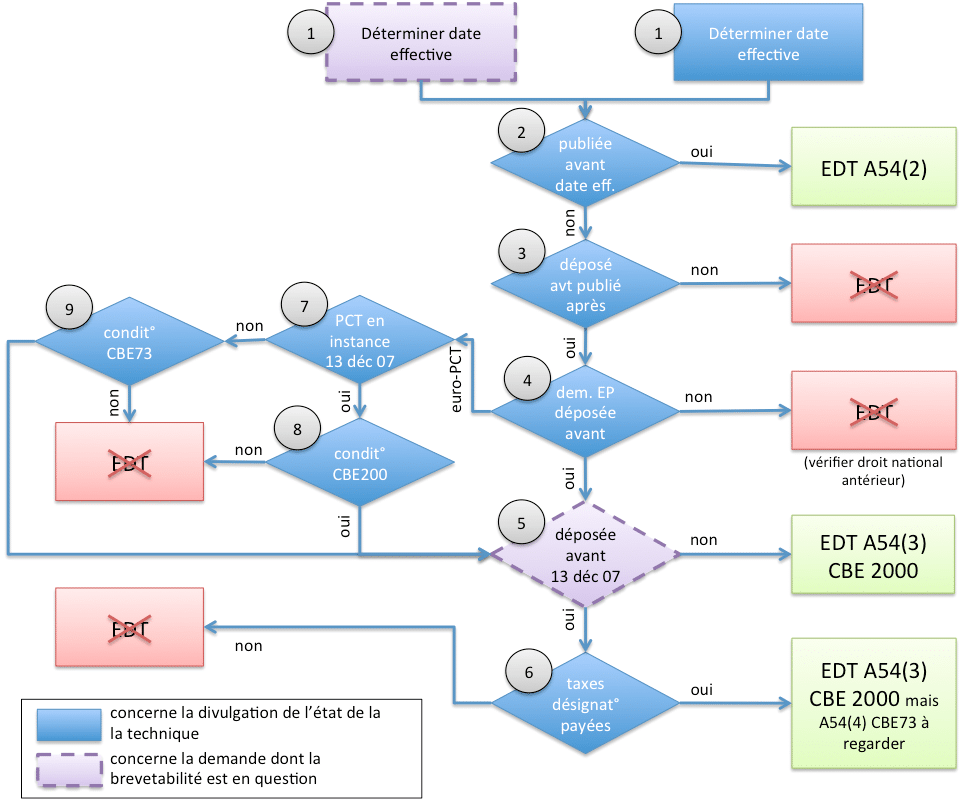
- If the disclosure is a Euro-PCT application (and meets points 7 to 9 below), it must be determined whether the application whose patentability is in question was filed internationally before December 13, 2007 (i.e., the entry into force of the EPC 2000); otherwise, the document is an A54(3) EPC document.
- If the application whose patentability is in question was filed before December 13, 2007 (and meets points 7 to 9 below), it is then necessary to verify that the conditions set out in the EPC73 are met regarding the prior art application:
- The opposability of the prior art application is assessed country by country: to be opposable in a country, it is necessary that this prior art application has validly designated that country (A54(4) EPC73).
- If the prior art application is a simple EP application:
- The designation fees under A79(2) EPC73 must have been validly paid (R23bis EPC73).
- It is necessary to pay the national fee of R106 EPC73, i.e., the filing fee and the designation fees;
- The designation fees may in any event be paid within a period of 31 months (R107(1) EPC73) or within a period of 6 months from the date of the mention of the publication of the international search report (whichever period expires later).
- It is necessary to file a translation of the PCT application if it is not in one of the EPO official languages (A153(4) EPC);
- It is necessary to pay the filing fee of R159(1) c) EPC.
- It is necessary to file a translation of the PCT application if it is not in one of the EPO official languages;
- It is necessary to pay the national fee of R106 EPC73, i.e.:
- the filing fee and
- the designation fees;
- The designation fees may be paid within a period of 31 months (R107(1) EPC73) or within a period of 6 months from the date of the mention of the publication of the international search report (whichever period expires later).
General information on entry into the European phase
Steps for entry into the European phase
Entry into the European phase can be made using Form 1200, although its use is not mandatory.
Entry into the European phase can be made online using the EpoLine/CMS software or the online form (« Decision of the President of the European Patent Office, dated May 9, 2018, on the electronic filing of documents« , OJ 2018, A45).
Time limits for entry into the European phase
Principle
The time limit for entry into the European phase is 31 months from the priority date (R159(1) EPC in accordance with A22.1 PCT and A22.3 PCT if the EPO is the designated Office, A39.1.a PCT and A39.1.b PCT if the EPO is the elected Office).
Extension of time limit for entry into the national phase
The provisions of R134 EPC apply to the time limit for entry into the national phase under R159 EPC.
Early entry into the national phase
Normally, even in the case of early entry into the national phase, the EPO does not process the application unless the applicant expressly requests it (« Notice from the European Patent Office dated 21 February 2013 concerning the request for early processing« , OJ 2013, 156 in accordance with A23.2 PCT or A40.2 PCT).
If the express request for early entry into the national phase is submitted before the publication of the international application, the applicant or the EPO must additionally request the IB to communicate the documents of the application pursuant to A20 PCT (A23.2 PCT or A40.2 PCT together with R47.4 PCT).
No specific form is required for this request.
The applicant must then comply with the national phase entry requirements mentioned below (e.g., pay the filing fee, the additional fee if the application comprises more than 35 pages, file a translation, specify the documents of the application, and pay the search fee) (« Notice from the European Patent Office dated 21 February 2013 concerning the request for early processing« , OJ 2013, 156).
Requirements for entry into the European phase
Filing fee
Principle
This requirement is set out in R159(1)(c) EPC.
Basic fee
The national fee (under A22.1 PCT and A39.1(a) PCT) is the filing fee under A78(2) EPC together with R159(1)(c) EPC.
This official fee is (A2(1).1 RFees):
- 115 € if the entry into the national phase is filed online;
- 200 € if the entry into the national phase is not filed online.
Official fee for more than 35 pages
Furthermore, an additional filing official fee must be paid if the application exceeds (strictly) 35 pages and if the international application enters the European phase after April 1, 2009 (« Notice from the European Patent Office dated January 26, 2009, concerning the fee structure in 2009« , OJ 2009, 118).
The additional official fee is set out in A2(1).1bis RFEE (14 € per page strictly above 35).
The number of pages is calculated based on (« Notice from the European Patent Office dated January 26, 2009, concerning the fee structure in 2009« , OJ 2009, 118):
- the international application as published;
- any amendments after receipt of the ISR (A19 PCT);
- one page for the abstract;
- one page for the bibliographic data even if it spans more than one page;
- amendments submitted upon entry into the European phase (A34 PCT) if they are available to the EPO by the date of payment of the additional official fee and if the payment date falls within the 31-month time limit;
- if the applicant indicates that new pages replace the claims, the old claims are not taken into account and the new pages are taken into account, but only if this indication occurs before payment of the additional official fees and within the 31-month time limit.
If the international application has not been published in an official language (« Notice supplementing the Notice from the European Patent Office dated January 26, 2009, concerning the fee structure in 2009« , OJ 2009, 338), the same principles apply, but amendments upon entry into the European phase (A34 PCT) must be submitted directly in an official language.
Time limit
The filing official fee (including the additional official fee for more than 35 pages) must be paid within the 31-month time limit (R159(1)(c) EPC).
Sanction
In case of failure to comply, the application shall be deemed withdrawn (R160(1) EPC in accordance with A24.1.iii PCT or A39.2 PCT).
The EPO shall then notify the applicant of this loss of rights (R160(2) EPC). The applicant may then request a decision (R160(2) EPC together with R112(2) EPC).
Legal remedies
Principle
A121 EPC applies to the 31-month time limit (« Notice from the European Patent Office dated 26 January 2009 concerning the fee structure for 2009« , OJ 2009, 118, Guidelines E-IX 2.1.3).
The amount for further processing is calculated based on the number of pages in the file at the expiry of the time limit (Guidelines A-III 13.2).
It is also possible to benefit from the provisions of R49.6 PCT, which allows, in the event of failure to perform one of the acts for entry into the national phase, reinstatement of rights if the failure to observe the time limit occurred despite due care required by the circumstances having been taken (« Notice from the European Patent Office dated 7 November 2007 concerning the withdrawal of reservations under the PCT« , OJ 2007, 692).
The requirements in terms of evidence are quite similar to those of A122 EPC (R49.6.c PCT and R49.6.d.ii PCT).
The request for reinstatement of rights must be filed within 2 months from the removal of the impediment, but no later than 12 months from the expiry of the 31-month time limit (R49.6.b PCT).
A reinstatement fee must be paid (equal to the restitutio fee): 610 € (A2(1).13 RFees in accordance with R49.6.d.i PCT).
Restitutio in integrum versus R49.6 PCT
Since restitutio in integrum (A122 EPC) is also possible for the time limit under A121 EPC, one might think that the provisions of R49.6 PCT are redundant… (since the time limit under A122 EPC expires, by definition, after that of R49.6 PCT).
This is not entirely true…
Indeed:
- the legitimate reasons that may allow restitutio in integrum (A122 EPC) relate to the acts of further processing (i.e., due care must be exercised in relation to the acts that should have enabled further processing);
- the legitimate reasons that may allow reinstatement under the PCT (R49.6 PCT) relate to the acts of entry into the national phase (i.e., due care must be exercised in relation to the acts that should have enabled entry into the national phase).
Designation fee
Principle
This requirement is set out in R159(1)(d) EPC.
Amount
The designation fee (R159(1) d) EPC together with A79(2) EPC and R39(1) EPC in accordance with R49.1.a PCT or R76.5 PCT) is 1 280 € (A2(1).3 RRT).
Time limit
In principle, the designation fee must be paid (longer of the two time limits, R159(1) d) EPC):
- within the 31-month time limit;
- within the 6-month time limit from the international publication of the ISR (A153(6) EPC together with R39(1) EPC, only applicable if the ISR is published 25 months after the priority).
Sanction
Otherwise, the application shall be deemed withdrawn (R160(1) EPC).
The EPO shall then notify the applicant of this loss of rights (R160(2) EPC). The applicant may then request a decision (R160(2) EPC together with R112(2) EPC).
Legal remedies
A121 EPC applies to the 31-month time limit (Guidelines E-IX 2.1.3).
R49.6 PCT is not applicable, since the designation fee is not part of the national fee referred to in A22 PCT, which alone allows for re-establishment of rights (EuroPCT Guide 5.8 point 5.8.007).
Annual fee for the 3rd year
Principle
The annual fee due for the 3rd year must be paid within the 31-month time limit from the priority (R159(1) g) EPC) if this deadline has expired.
Thus, no fee is due:
- if the international application is a priority application;
- if the time gap between the filing of the priority application and the filing of the international application exceeds 7 months.
Additional official fee for late payment
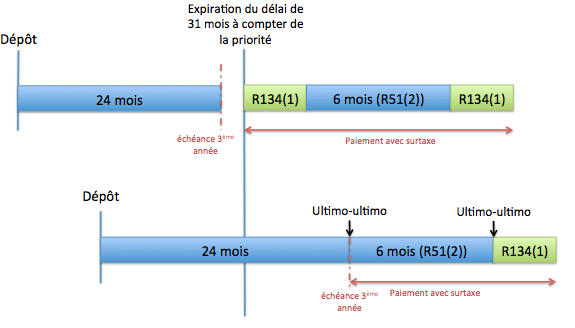
If the 3rd-year official fee is not paid on time, it may still be paid with an additional official fee within a period of 6 months (R51(2) EPC).
If the due date for payment of the third-year official fee has expired, the 31-month period triggers the period for payment with an additional official fee (by extending the 31-month period if it falls on a day when one of the EPO offices is closed, as it is a composite period, J1/89 and Guidelines A-X 5.2.4).
If the due date for payment of the third-year official fee has not yet expired, the calculation of the 6-month period is carried out as usual, i.e., using the « ultimo-ultimo » principle described in the article on payment of annual fees.
Sanction
If the annual official fee is still not paid, the application is deemed to be withdrawn (A153(2) EPC together with A86(1) EPC).
Legal remedies
Only A122 EPC is applicable to the 6-month period.
Search fee
Principle
A search fee must be paid if a search report is to be drawn up (see below, A153(7) EPC together with R159(1) e) EPC).
This fee must be paid within the 31-month period from the priority date (R159(1) e) EPC).
Amount
By default, the amount of this fee is 1165 € (A2(1).2 RFees) for applications filed as of 1 July 2005.
Reduction of the search report official fee
In certain situations, the search official fee is reduced:
- there is an exemption from the supplementary search (and thus no official fee is due) if:
- the ISA or the SISA is the EPO (« Notice from the European Patent Office dated 6 February 2012 concerning search and examination fees« , OJ 2012, 212, point 3.a));
- the ISA, for a filing made before 1 July 2005, was (« Notice from the European Patent Office dated 6 February 2012 concerning search and examination fees« , OJ 2012, 212, point 3.b)):
- the Swedish Patent Office,
- the Austrian Patent Office,
- the Spanish Patent Office.
- there is a reduction of 1 420 € of the supplementary search official fee (which is 1 775 €), A2(1).2 RFees) if the filing was made after 1 July 2005 and if the ISA is (« Decision of the Administrative Council of 16 December 2015 reducing the fee due for supplementary European search when the international search report or the supplementary international search report has been drawn up by the Austrian Patent Office, the Spanish Patent and Trademark Office, the Finnish Patent and Registration Office, the Swedish Patent and Registration Office, the Nordic Patent Institute or the Visegrad Patent Institute (CA/D 8/15)« , OJ 2016, A2):
- the Austrian Patent Office,
- the Finnish Patent Office,
- the Swedish Patent Office,
- the Spanish Patent Office,
- the Nordic Patent Institute,
- the Visegrad Patent Institute.
These provisions were adopted by the Administrative Council pursuant to A153(7) EPC.
Sanction
Otherwise, the filing is deemed withdrawn (R160(1) EPC).
The EPO then notifies the applicant of this loss of rights (R160(2) EPC). The applicant may then request a decision (R160(2) EPC together with R112(2) EPC).
Legal remedies
A121 EPC applies to the 31-month time limit (Guidelines E-IX 2.1.3).
Claim fees
Number of claims
The EPO bases its calculation on the documents of the filing on which the grant procedure is to be based to determine the number of claims exceeding 15 (R162(1) EPC).
Amount
Each claim from the 16th onwards incurs an official fee of 280 € and then 630 € beyond the 51st (A2(1).15 RFees).
Time limit
This official fee must be paid within the 31-month time limit from the priority (R162(1) EPC together with R159(1) EPC).
However, the applicant may pay it within a 6-month time limit from the notification (R162(2) EPC, which is issued upon expiry of the 31-month time limit, combined with the notification under R161(1) EPC, « Notice dated 13 October 1999 concerning amendments to the Implementing Regulations to the European Patent Convention and the Rules relating to Fees« , OJ 1999, 696, point I.10) indicating that it has not been paid.
This payment is calculated based on any amended claims in response to R161(1) EPC (R162(3) EPC).
Waiver of receipt of R162 EPC
Upon entry into the national phase, the applicant may waive the right to receive the notification R162 EPC reminding them to pay the claims official fees (as with the waiver of the notification R161 EPC, « Notice from the European Patent Office dated 30 November 2015 concerning ways to expedite the European grant procedure« , OJ 2015, A94).
To do so, the applicant must, upon entry into the national phase:
- have filed amendments in response to the written opinion of the ISA (or the SISA or IPEA, as applicable);
- paid the necessary claims official fees.
Automatic debiting
In the case of automatic debiting, the claims official fees are deemed received on the last day of the 6-month time limit (unless contrary instructions are received by the EPO, point 6.1.b ADA, OJ 3/2009, supplement).
It is not possible to benefit from the automatic debiting procedure if the applicant waives the right to receive the R162 EPC: in this case, the applicant must pay the claims official fees upon entry into the national phase by other means.
Refund in case of reduction in the number of claims
If amended claims filed within the 6-month time limit from the notification under R161(1) EPC and R161(2) EPC result in a reduction in the number of claims subject to an official fee, and the claims official fees have already been paid, the excess amount is refunded (R162(2) EPC and R162(3) EPC).
Any subsequent reduction in the number of claims (e.g., due to a lack of unity of invention requiring restriction) does not entitle the applicant to a refund (J3/09).
Sanction
If a claims official fee is not paid within the time limits, the corresponding claim (i.e., the one with the highest ranking necessarily) is deemed withdrawn (R162(4) EPC).
A claim deemed withdrawn, which is not otherwise present in the description or drawings, cannot be used for a subsequent amendment (Guidelines E-IX 2.1.3).
Legal remedy
The A121 EPC applies to this 6-month time limit.
Request for examination and examination fee
Requirement
A request for examination must be filed (R159(1) f) EPC). When the applicant uses Form 1200 for entry into the national phase, the box is already checked.
The request for examination is only deemed to be filed after payment of the examination official fee (A94(1) EPC).
Time limit
The request for examination must be filed (the later of the two time limits):
- within the time limit of 31 months from the priority (R159(1) f) EPC);
- within the time limit of 6 months from the international publication of the ISR (A153(6) EPC together with R70(1) EPC, only applicable if the ISR is published 25 months after the priority).
Sanction
Otherwise, the application is deemed to be withdrawn (R160(1) EPC).
The EPO then notifies the applicant of this loss of rights (R160(2) EPC). The applicant may then request a decision (R160(2) EPC together with R112(2) EPC).
Legal remedies
A121 EPC applies to the time limit of 31 months (Guidelines E-IX 2.1.3).
Invitation to maintain the request
If the applicant has filed the request for examination before the supplementary search report is notified (if a supplementary search is to be carried out), the EPO sets a time limit for the applicant to confirm the request (J8/83 and R70(2) EPC, the reasoning of decision
J8/83 is that the supplementary search report is a search report and therefore R70(2) EPC applies naturally).
This notification also invites the applicant to comment on the objections raised in the ESR (R70bis(2) EPC, the case of the supplementary search report is expressly provided for by this rule).
If the applicant withdraws the application or does not respond to this invitation, the official fee is refunded in full (J8/83 and A11 a) RFees).
It is possible for the applicant to definitively waive the possibility of confirming the request upon entry into the national phase (via the PACE program,
« Notice from the European Patent Office dated 30 November 2015 concerning the programme for accelerated processing of European patent applications (« PACE »)« , OJ 2015, A93).
If no supplementary search report is to be carried out, this invitation is not issued, and the Examining Division becomes competent upon receipt by the EPO of the request for examination (J8/83).
A withdrawal can (at best) only allow a refund of up to 75 % of the examination official fee (A11 a) RFees).
Examination official fee
Amount
If no supplementary search report has been drawn up and for applications filed as of 1 July 2005, the examination official fee is 1730 € (A2(1).6 RFees).
Otherwise, the examination official fee is 1555 € (A2(1).6 RFees) for applications filed as of 1 July 2005.
Reduction
If the EPO acted as IPEA, the examination fee is reduced by 50 % (A14(2) RRT) unless the examination in the European phase relates to subject-matter not covered in the international phase.
Additionally, a reduction of 20 % (A153(2) EPC together with R6(3) EPC together with A14(4) EPC and A14(1) RRT) may be obtained if the applicant (having their residence or principal place of business in a contracting state with an official language other than English, French, or German, or being a national of such a state) files the request for examination in that national language.
The two reductions may be combined (Guidelines A-X 9.3.2).
Indication of the basis for the procedure
The applicant must specify the parts of the application (possibly amended) on which the grant procedure is to be based (R159(1)(b) EPC).
This must be done within 31 months from the priority date (R159(1)(b) EPC).
Thus, the application may be amended solely for the purpose of entering the national phase or after receipt of the WO-ISA (A19 PCT): such amendments may be considered as a response to the written opinion of the WO-ISA, thereby effectively removing the obligation to respond to the communication under R161(1) EPC (OJ 2009, 533, point 5.2.2).
Of course, the requirements for identifying and justifying amendments (R137(4) EPC) remain applicable (even if, a priori, as long as the examining division is not competent, no communication will be issued to remedy this irregularity, R137(4) EPC, second sentence).
At worst, if the amendments do not appear to be supported and the search is significantly impacted by the amendments, the examiner in charge of the search may issue a communication under R63 EPC (Guidelines B-VIII 6).
If, in response to the R161(2) EPC, the applicant amends the application, such amendments will, of course, be taken into account during the supplementary search and examination (Guidelines B-II 4.3.3).
Translation
Requirement
This requirement is set out in R159(1)(a) EPC.
A translation of the international application must be filed with the EPO if the language of filing or publication of that application was not an official language of the EPO (A153(4) EPC in accordance with A22.1 PCT together with R49.1(a)(i) PCT or A39.1(a) PCT together with R76.5 PCT).
If the international application is already in an official language of the EPO, no translation may be filed (G4/08).
Time limit
The translation must be filed within 31 months from the priority date (R159(1)(a) EPC).
Content
The translation must cover (A22 PCT and R49.5 PCT):
- the description;
- the claims as filed;
- the text of the drawings;
- the abstract;
- any amendment to the claims (as well as statements explaining such amendments; if a translation is not submitted, the EPO may disregard the amendment, R49.5.c PCT);
- any request for correction under R91.3.d PCT.
Sanction
Translation of the main documents
Principle
If the translation is not submitted within the time limit, the application is deemed withdrawn (R160(1) EPC).
The EPO then notifies the applicant of this loss of rights (R160(2) EPC). The applicant may then request a decision (R160(2) EPC together with R112(2) EPC).
A121 EPC applies to the 31-month time limit (Guidelines E-IX 2.1.2).
Since the translation is governed by A22 PCT, it is also possible to benefit from the provisions of R49.6 PCT, which allow, in the event of failure to perform one of the acts for entry into the national phase, to be reinstated in rights if the failure to meet the time limit occurred despite due care required by the circumstances having been taken (« Notice from the European Patent Office, dated 7 November 2007, concerning the withdrawal of reservations under the PCT« , OJ 2007, 692).
The requirements in terms of evidence are quite similar to those of A122 EPC (R49.6.c PCT and R49.6.d.ii PCT).
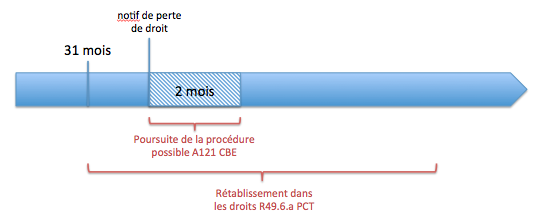
The request for reinstatement of rights must be filed within 2 months from the removal of the impediment, but no later than 12 months from the expiry of the 31-month time limit (R49.6.b PCT).
A reinstatement fee must be paid (equal to the restitutio fee): 1 165 € (A2(1).13 RRT in accordance with R49.6.d.i PCT).
Restitutio in integrum versus R49.6 PCT
As restitutio in integrum (A122 EPC) is also available for the time limit under A121 EPC, we might think that the provisions of R49.6 PCT are redundant… (since the time limit under A122 EPC expires by definition after that of R49.6 PCT).
This is not entirely true…
Indeed:
- the legitimate reasons that may allow for restitutio in integrum (A122 EPC) relate to the acts of further processing (i.e., the required diligence must pertain to the acts that should have enabled further processing);
- the legitimate reasons that may allow for restoration under the PCT (R49.6 PCT) relate to the acts of entry into the national phase (i.e., the required diligence must pertain to the acts that should have enabled entry into the national phase).
Translation of secondary documents
If any documents annexed to the international preliminary examination report are drafted in a language other than that of the proceedings, and if a translation is not provided, the applicant is invited to furnish a translation into the language of the proceedings within a specified time limit (Guidelines E-IX 4.3).
If a translation is not submitted, the EPO may disregard these documents (R49.5.c PCT).
Examination of the translation
If the EPO is informed by the IB that certain elements of the international application have been omitted from the publication of the application (e.g., elements contrary to morality), the EPO also verifies that they have been omitted from the translation (Guidelines E-IX 2.3.7).
Exhibition attestation
Principle
The exhibition attestation must be provided within a time limit of 31 months from the priority date (R159(1)(h) EPC in accordance with A27.2.ii PCT together with R51bis.1.a.v PCT).
Sanction
The sanction for failure to provide the attestation is that the disclosure made at the exhibition becomes citable as prior art (A55(2) EPC).
Legal remedy
A121 EPC is applicable.
Since the sanction for failure to provide the attestation is not a cessation of the effects of the international application, the restoration of rights under R49.6 PCT is inapplicable.
Inventor designation
Requirement
If the inventor designation under R19(1) EPC has not been made within the time limit of 31 months from the priority date, the EPO invites the applicant to do so within 2 months (R163(1) EPC).
Sanction
Failing this, the application is refused (R163(6) EPC).
Legal remedies
Principle
A121 EPC is applicable to this 2-month time limit.
Since the designation of the inventor is referred to in A22 PCT, it is also possible to benefit from the provisions of R49.6 PCT, which allow, in the event of failure to perform one of the acts for entry into the national phase, to be restored in rights if the non-observance of the time limit occurred despite the due care required by the circumstances having been taken (« Notice from the European Patent Office, dated 7 November 2007, concerning the withdrawal of reservations under the PCT« , OJ 2007, 692).
The requirements in terms of evidence are quite similar to those of A122 EPC (R49.6.c PCT and R49.6.d.ii PCT).
The request for re-establishment of rights must be filed within 2 months from the removal of the impediment, but no later than 12 months from the expiry of the 31-month time limit (R49.6.b PCT).
A re-establishment fee must be paid (equal to the restitutio fee): 1 165 € (A2(1).13 RRT in accordance with R49.6.d.i PCT).
Restitutio in integrum versus R49.6 PCT
Since restitutio in integrum (A122 EPC) is also possible for the time limit under A121 EPC, one might think that the provisions of R49.6 PCT are redundant… (since the time limit under A122 EPC expires by definition after that of R49.6 PCT).
This is not entirely true…
Indeed:
- the legitimate reasons that may allow restitutio in integrum (A122 EPC) relate to the acts of further processing (i.e. the due care must relate to the acts that should have enabled further processing);
- the legitimate reasons that may allow restoration under the PCT (R49.6 PCT) relate to the acts of entry into the national phase (i.e. the due care must relate to the acts that should have enabled entry into the national phase).
Provision of the filing number or copy of the earlier application
Requirement
If a priority is claimed, and the filing number or copy of the priority application (under R52(1) EPC and R53 EPC) is not provided within the 31-month time limit, the EPO invites the applicant to provide it within a 2-month time limit (R163(2) EPC).
Transmission by the IB
Normally, the IB transmits this information to the EPO if it has it (which is usually the case, since this information is required in the international phase for the RO).
If the applicant has duly submitted a copy to the RO or the IB (or requested transmission by paying the corresponding official fee R17.1.b PCT and R17.1.b-bis PCT), the EPO cannot request this copy again from the applicant (R17.2.a PCT).
The EPO must begin the examination even if the decision to grant may be delayed while awaiting this copy (Guidelines E-IX 2.3.5).
Translation of the earlier application
The EPO may request the translation of the priority application (R51bis.1.e PCT or R76.5 PCT) under certain conditions (particularly when the priority is important for patentability).
Exceptions to the requirement to submit the copy
As with the filing requirements, this obligation to provide the copy has exceptions.
If the priority document was filed in certain countries, it is not necessary to produce a certified copy thereof: cooperation agreements allow the EPO to automatically obtain these documents without any action by the applicant (R53(2) EPC and OJ 2020, A57).
The following are concerned (Guidelines A-III 6.7):
- A European application,
- An international application if the RO is the EPO:
- A United States application (regular or
Principle
If the applicant must submit to the EPO a sequence listing compliant with the requirements, within a period of 31 months from the priority (R163(3) EPC together with R159(1) EPC).
If the sequence listing is not received by the EPO within the time limit, the applicant is invited to provide it within a period of 2 months from the notification (R163(3) EPC) while also paying a late furnishing official fee (R163(3) EPC together with R30(3) EPC): 220 € (A2(1).14bis RRT).
Sanction
Otherwise, the application is refused (R163(3) EPC together with R30(3) EPC).
Legal remedy
The A121 EPC is applicable (there are two omitted acts in the case where nothing has been done).
However, since this act is not listed under A22 PCT, the provisions of R49.6 PCT concerning the reinstatement of rights are inapplicable.
Applicant information
Requirements
If, upon expiry of the 31-month period from the priority, the address, nationality, or the state of domicile or registered office of an applicant is missing, the EPO invites the applicant to provide this information within a period of 2 months (R163(4) EPC).
Sanction
If not complied with, the application is refused (R163(6) EPC).
Legal remedy
The A121 EPC is applicable to this 2-month period.
However, since this act is not listed under A22 PCT, the provisions of R49.6 PCT concerning the reinstatement of rights are inapplicable.
Representation
Principle
If no representative is appointed by the end of the 31-month period from the priority date (whereas the applicant is not domiciled in a contracting state A133(2) EPC), the EPO invites the applicant to appoint a representative within 2 months (R163(5) EPC in accordance with A27.7 PCT together with R51bis.1.b.i PCT or with A27.7 PCT together with R76.5 PCT).
Sanction
If this time limit is not observed, the application is refused (R163(6) EPC).
Legal remedy
The A121 EPC is applicable to the above 2-month period.
However, since this act is not listed under A22 PCT, the provisions of R49.6 PCT concerning the reinstatement of rights are inapplicable.
Procedure following entry into the national phase
Review of certain decisions taken during the international phase
The EPO is not bound to uphold all decisions that may have been taken by the various authorities at the international procedure stage, for example:
- the refusal of a filing date or the fact that the application is deemed withdrawn (A25.2 PCT) or
- a decision concerning the excuse (or lack thereof) of a delay.
The examining division is competent to review these decisions (R159(2) EPC).
In the event of a review invalidating a previous decision, the EPO issues a decision that is subject to appeal.
Statement and amendment of the application
Principle
The applicant has the right to file amendments (R161 EPC in accordance with A28.1 PCT or A40.1 PCT) within 6 months from the corresponding notification (minimum of 1 month prescribed by A28.1 PCT together with R52.1 PCT or A40.1 PCT together with R78.1 PCT).
Of course, the requirements for identification and justification of amendments (R137(4) EPC) remain applicable even in response to this notification.
Waiver
Upon entry into the national phase, the applicant may waive the right to receive the notification under R161 EPC allowing amendments to be made to the application (« Notice from the European Patent Office dated 30 November 2015 concerning ways to expedite the European grant procedure« , OJ 2015, A94).
To do so, the applicant must, upon entry into the national phase:
- have filed amendments in response to the written opinion of the ISA (or the SISA or IPEA, as applicable);
- paid the necessary claim official fees.
Different scenarios
EPO = ISA and IPEA
The applicant has the opportunity to respond to the international preliminary examination report (R161(1) EPC) and, where applicable, the EPO invites the applicant to remedy any irregularities noted in this report.
These amendments may be unrelated to the examination report if they are made at the same time as the response to this notification (Guidelines C-III 2.2): other amendments will be subject to the approval of the examining division (R137(2) EPC and R137(3) EPC).
A response is mandatory, unless:
- the examination report contains no objections (Guidelines E-IX 3.3.2);
- the applicant has already submitted amendments or comments upon entry into the national phase (Guidelines E-IX 3.3.1) and if the applicant indicates that these amendments/comments are to form the basis for examination (Guidelines E-IX 3.3.4).
The time limit for responding to the notification is 6 months from the date of notification (R161(1) EPC).
If a response is mandatory but no response is provided, the application is deemed withdrawn (R161(1) EPC).
A121 EPC applies to this 6-month time limit.
EPO = ISA only
The fact that another office acted as IPEA in the international procedure does not affect the following (Guidelines E-IX 3.2).
The applicant has the opportunity to comment on the written opinion attached to the international search report (R161(1) EPC) and, where applicable, the EPO invites the applicant to remedy any deficiencies noted in that written opinion.
These amendments may be unrelated to the written opinion if they are made at the same time as the response to this notification (Guidelines C-III 2.2): other amendments will be subject to the approval of the examining division (R137(2) EPC and R137(3) EPC).
A response is mandatory, unless:
- the written opinion does not contain any objections (Guidelines E-IX 3.3.2);
- the applicant has already submitted amendments or comments upon entry into the national phase (Guidelines E-IX 3.3.1) and if the applicant indicates that these amendments/comments are to form the basis for the examination (Guidelines E-IX 3.3.4);
- the applicant has submitted amendments in response to the IPRP under A19 PCT (Guidelines E-IX 3.3.1) and if the applicant maintains these amendments upon entry into the national phase and provides a translation where applicable (Guidelines E-IX 3.3.4, « Notice from the European Patent Office dated 15 October 2009 concerning amendments to the Implementing Regulations to the European Patent Convention« , OJ 2009, 533, point 5.2.2);
- the applicant has submitted, where applicable, amendments during the international examination under A34 PCT (Guidelines E-IX 3.3.1) and if the applicant maintains these amendments upon entry into the national phase and provides a translation where applicable (Guidelines E-IX 3.3.4, « Notice from the European Patent Office dated 15 October 2009 concerning amendments to the Implementing Regulations to the European Patent Convention« , OJ 2009, 533, point 5.2.2).
The time limit for responding to the notification is 6 months from the date of notification (R161(1) EPC).
If a response is mandatory but no response is filed, the application is deemed to be withdrawn (R161(1) EPC).
A121 EPC applies to this 6-month time limit.
EPO = neither ISA, nor SISA, nor IPEA
The applicant is invited, if they so wish, to amend the application freely (R161(2) EPC) within a time limit of 6 months from the date of notification.
Of course, the applicant may amend the application without waiting for this notification upon entry into the national phase (« Notice from the European Patent Office dated 15 October 2009 concerning amendments to the Implementing Regulations to the European Patent Convention« , OJ 2009, 533, point 5.2.5).
There is no sanction for failing to respond to R161 EPC (Guidelines E-IX 3.1).
EPO = neither ISA, nor SISA, but IPEA
This may occur in particular if the ISA was AT, ES, FI, SE or XN.
The wording of R161(1) EPC does not appear to make a response to the notification mandatory (i.e., the provisions of the preceding paragraph then apply).
EPO = SISA
The procedure is very similar to the case where the EPO is ISA only.
If the EPO has been SISA, the applicant is invited to comment on the supplementary international search report (explanations on the citations of documents deemed relevant and on the scope of the search under R45bis.7.e PCT) (R161(1) EPC).
The time limit for responding to the communication is 6 months from the date of notification (R161(1) EPC).
If a response is mandatory but no response is filed, the application is deemed to be withdrawn (R161(1) EPC).
A121 EPC applies to this 6-month time limit.
Supplementary search report
Principle
The international search report normally replaces the European search report (A153(6) EPC).
However, a supplementary search must be carried out upon entry into the national phase (A153(7) EPC).
Indeed, upon entry into the European phase, even if a search has been carried out during the international phase, the EPO wishes to verify that it was of good quality: a supplementary search report is therefore established.
Exemption from the supplementary search report
There is an exemption from the supplementary search if:
- the ISA or the SISA is the EPO (« Notice from the European Patent Office dated 6 February 2012 concerning search and examination fees« , OJ 2012, 212, point 3.a));
- the ISA, for an application filed before 1 July 2005, was (« Notice from the European Patent Office dated 6 February 2012 concerning search and examination fees« , OJ 2012, 212, point 3.b)):
- the Swedish Patent Office,
- the Austrian Patent Office,
- the Spanish Patent Office.
These provisions were adopted by the Administrative Council under A153(7) EPC.
Basis of the supplementary search report
The supplementary search report is based on the documents indicated by the applicant at the time of entry into the regional phase (R159(1) b) EPC) or amended in response to the communication under R161(2) EPC (Guidelines B-II 4.3.3).
Nature of the supplementary search report
The supplementary search report is not published but is available through file inspection.
This search report includes a search opinion.
Unity of invention issue
Cases where a supplementary search must be carried out by the EPO
If the EPO considers that there is no unity of invention, the supplementary search report is drawn up only for the first invention (partial supplementary search report, R164(1) a) EPC).
This partial supplementary search report is not accompanied by a written opinion (« Notice from the European Patent Office, dated 10 June 2014, concerning the amendment of Rules 164 and 135 EPC« , OJ 2014, A70, point 8).
Since 1 November 2014 (« Decision of the Administrative Council of 16 October 2013 amending Rules 135 and 164 of the Implementing Regulations to the European Patent Convention« , OJ 2013, 503), a notification is sent to the applicant to ask whether they wish, within 2 months from the date of notification, to pay a supplementary search official fee for each invention not searched (R164(1) b) EPC).
This time limit is excluded from further processing (R135(2) EPC) and only restitutio in integrum under A122 EPC applies.
A supplementary search report (covering all inventions for which an official fee has been paid) is then drawn up accordingly (R164(1) c) EPC) with a written opinion.
Cases where the EPO has waived a supplementary search
If the EPO has waived the performance of a supplementary search, but the invention claimed upon entry into the national phase has not been searched, the EPO notifies the applicant to pay a supplementary search official fee within a period of 2 months (R164(2) a) EPC).
This time limit is excluded from further processing (R135(2) EPC) and only restitutio in integrum under A122 EPC applies.
The results of this search will be communicated to the applicant in a notification under A94(3) EPC or a notification under R71(3) EPC (R164(2) b) EPC). This notification also gives the applicant a time limit to comment on the conclusions of the examining division and on the results of the annexed search, as well as to amend the description, claims and drawings on their own initiative (« Notice from the European Patent Office, dated 10 June 2014, concerning the amendment of Rules 164 and 135 EPC« , OJ 2014, A70, point 16).
This supplementary search will not include a written opinion (R164(4) EPC together with R62 EPC).
Where applicable, the EPO will also invite the applicant to limit the application to one invention among the searched inventions (either at the international stage or at the supplementary search stage, R164(2) c) EPC and R164(3) EPC together with R62bis EPC).
Examination
Principle
The examination of the application then follows the same principles or procedure as for a « normal » European application.
Lack of unity issue
It may happen that the examining division finds that (R164(2) EPC):
- the application does not comply with the requirement of unity of invention,
- or that the claimed invention has not been searched in:
- the supplementary search,
- or, failing that:
- the international search,
- the supplementary international search.
It then invites the applicant to limit the invention (R164(2) EPC) to the subject matter covered by the search.
R137(5) EPC may serve as a basis for a refusal in this case (T2459/12) and not R164(2) EPC, which only states that a notification is sent.
Laisser un commentaire