
French patent application or French patent
Principle
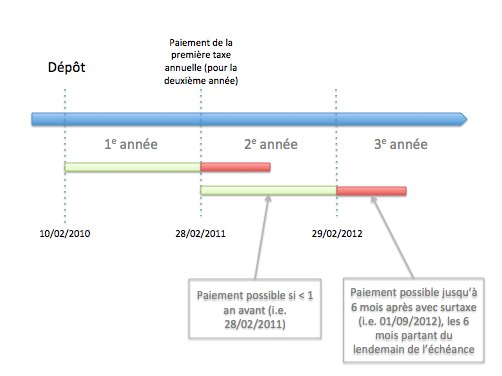
Every French patent application or French patent requires the payment of an annual official fee to the INPI (L612-19 CPI, paragraph 1) from the first year. Indeed, it is considered that the first official fee is paid as part of the filing official fee (R613-46 CPI).
The annual official fees must be paid at the beginning of the year in question, on the last day of the month of the filing anniversary (R613-46 CPI).
Extension of the payment deadline
One may wonder what happens if the last day of the anniversary month is a Sunday or a public holiday.
This question is legitimate, as the payment of annual official fees is not subject to a deadline (since R618-3 CPI applies only to deadlines): they must simply be paid before a certain due date set by the regulations.
In this case, the INPI guidelines inform us that an extension does exist (INPI Examination Guidelines, II-A 2) and that R618-3 CPI is indeed applicable.
Advance payment
It is possible to pay this official fee in advance; however, such payment cannot be validly made more than 1 year in advance (R613-46 CPI).
Late payment with additional official fee
Principle
If payment is not made on time, it remains possible to make the payment within a period of 6 months, subject to the payment of an additional official fee (L612-19 CPI, paragraph 2).
Normally, the INPI notifies the proprietor by standard mail to inform them that they have not paid their annual official fee, but the proprietor cannot rely on a lack of notification (R613-48 CPI).
Start of the 6-month period
For standard applications
This 6-month period begins on the day following the due date of the annual official fee (R613-47 CPI), i.e., on the first day of the following month.
If the due date fell on a weekend or a public holiday (and thus the deadline was extended under R618-3 CPI), it appears that the INPI’s practice does not start the 6 months from the extended due date but only from the normal due date.
This INPI practice does not seem entirely consistent with the wording of L612-19 CPI, but so be it…
For divisional applications
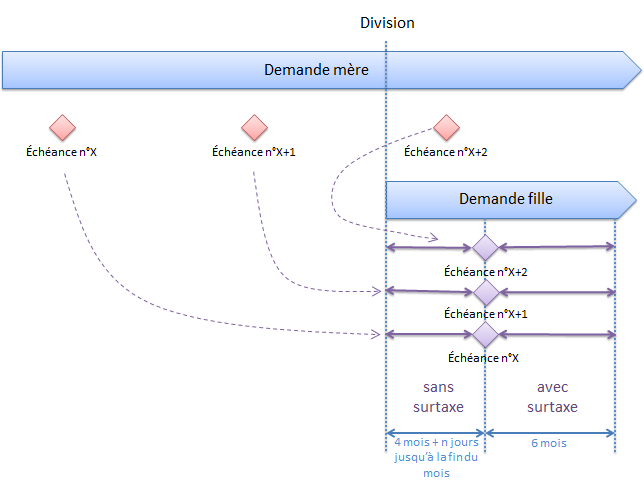
For divisional applications (R613-47 CPI), the INPI considers that payment may be validly made up to the last day of the fourth month following the date of receipt of the divisional application documents (INPI Examination Guidelines, II-A 2).
According to the INPI (INPI Examination Guidelines, II-A 2), if such payment has not been made within the aforementioned 4 months, it may still be validly made (with an additional late official fee) within a grace period of 6 months from the expiration of the 4-month period.
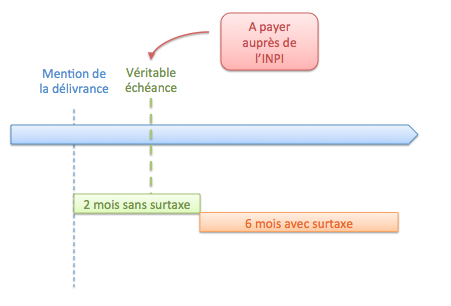
We therefore have the following principle scheme:
Personally, I am highly skeptical of such an interpretation. I do not believe that Article R613-47 CPI states so much.
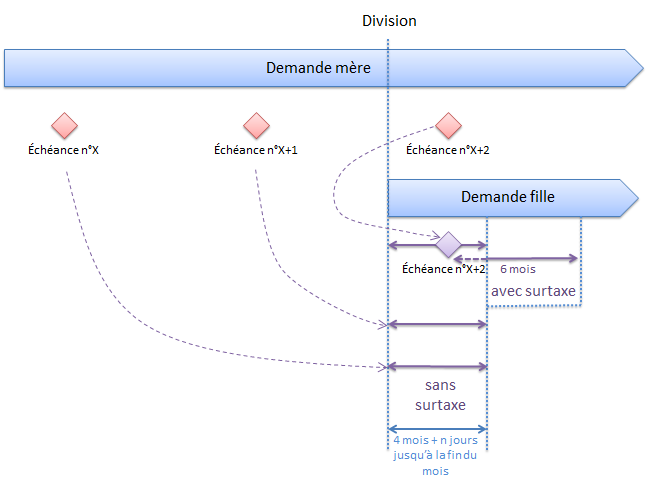
If the 4-month period is a period during which payment « is considered to have been validly made » (legal fiction under Article R613-47 CPI), the due date for the annual official fee (i.e., the date on which payment is due) does not appear to me to be modified.
Thus, in my entirely personal interpretation, the 6-month period begins on the « normal » due date of the annuity, and the following scheme would be the correct principle scheme:
Expiration of the 6-month period
The 6-month period expires on the day having the same date as the due date of the annual official fee (R618-3 CPI).
When referring to the due date, we mean the actual due date, not the due date potentially extended by the INPI Examination Guidelines, II-A 2 (well… this seems to be the Office’s practice…).
Unlike in Europe, there is no indication that the period ends at the end of the month (ultimo-ultimo): therefore, if the due date was February 28, the grace period will in principle expire on August 28… Well, in principle…
Amount
Payment is made at the rate in force on the day of payment (unless a notice indicating a different rate has been sent to the applicant) (R613-47 CPI).
In case of reinstatement, the applicable rate is the one in force on the date of reinstatement (R613-47 CPI).
A reduction in official fees is granted, up to the 7th annuity, if the proprietor of the patent application or the patent is (L612-20 CPI):
- a natural person,
- a small or medium-sized enterprise (an enterprise with fewer than 1000 employees and of which no more than 25% of the capital is held by another entity not meeting the same condition),
- a non-profit organization in the education or research sector.
The reduction is (Order of April 24, 2008 on official fees for procedures collected by the INPI, Article 2):
- 50% for official fees up to the 5th,
- 25% for official fees 6 and 7,
- 0% for official fees 8 to 20.
Insufficient payment, but corrected
If an annuity is paid but insufficiently, it is possible to correct the payment, without a surcharge, within the 6-month period mentioned above (R613-47 CPI, paragraph 4 and INPI Examination Guidelines, II-A 2).
Sanction
The applicant/proprietor who has not paid the annual fee by the end of the 6-month grace period shall be deemed to have forfeited their rights (L613-22 CPI).
The following shall be considered as failure to pay the annual official fee (INPI Examination Guidelines, II-A 5):
- non-payment;
- payment at an insufficient rate;
- payment allocated to a different anniversary date;
- payment allocated to a different patent application or patent.
Forfeiture, as determined by a decision of the Director General of the INPI, shall take effect on the due date of the unpaid annual fee (L613-22 CPI).
However, this effect does not appear to be retroactive since the Cour de cassation has indicated that the relevant date for determining whether a patent had lapsed was the date of the decision of the Director General of the INPI establishing the forfeiture (C. Cass. com., 18 October 2011, No. 10-24326): why make it simple when you can make it complicated…
European patent application
No annual fee is due to the INPI as long as no European patent has been granted (A86(1) EPC).
I invite you to read the article on payment of annual fees in Europe for more details.
French part of a European patent
Principle
The INPI is competent from the date of publication of the mention of grant of the patent (A141(1) EPC) to collect the annual official fees.
The foregoing provisions for French patent applications/patents therefore apply.
Transitional period provided for by the EPC
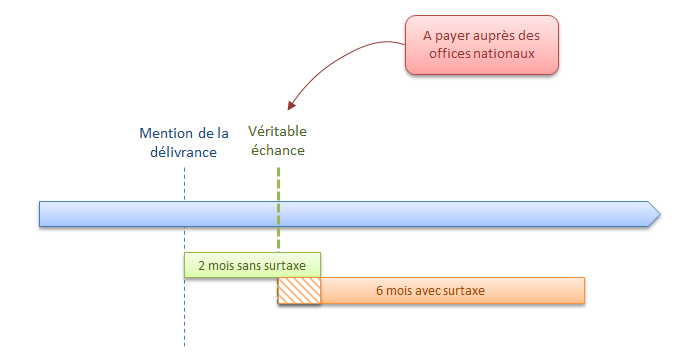
For greater flexibility, the EPC provides for a transitional period immediately following the publication of the mention of grant.
If annual fees fall due within 2 months from the date on which the mention of the grant of the patent was published in the European Patent Bulletin, these annual fees shall be deemed to have been validly paid if they have been paid to the INPI within this 2-month period (A141(2) EPC).
Of course, the EPC also provides for a 6-month grace period for the payment of annual fees (R51(2) EPC).
The principle set out in the EPC is therefore as follows:
However, the wording of Article R614-16 CPI is somewhat different and has raised some questions:
Where payment of an annual fee has not been made by the end of the period referred to in paragraph 2 of Article 141 of the Convention on the Grant of European Patents, said fee may be validly paid within an additional period of six months, subject to payment of a surcharge within the same period.
Should it be understood that the 6-month period does not overlap with the 2-month period (as indicated above), but is added to it?
According to the judges, Article R614-16 CPI (which is more flexible than the EPC provisions) indeed indicates that the 2-month period should be extended by an additional 6-month period (Paris Court of Appeal, 23 September 2014).
Que est l’intérêt pour moi de payé la 20 me annuités d’un brevet français que je n’ai pas exploité pendant ces 19 années alors qu’il ne serra plus protégé en juin 2022 et ainsi, son exploitation je crois serra accessible puisque plus protégé Nous sommes ce mois ci en aout 2021 .
A moins bien sur qu’un autre détail sur les conséquence à venir m’échappe ? . Merci d’avance de vos réponses éclairés qui pourrait changé ce point de vue
Merci pour cet article.
Y a-t-il un délai officiel de conservation des récépissés de paiement d’annuité ?
How & who to should we pay the patent renewal fees .I have spent hours looking for methods of payment without success
What happens if a European patent is granted in less than 2 years from the filing date, e.g. 23 months from the filing date?
This means that the 3rd year renewal fee is never due at the EPO, so that Article 86(2) does not apply, since no renewal fees are paid to the EPO at all. This would seem to leave a lack of clarity as to the first renewal fee due at INPI. Must the second year FR national fee be paid on grant as well as the third year FR national fee, or only the third year fee?
Une précision concernant le point de départ du délai de grâce pour le paiement des annuités, paragraphe 1.4.2 de votre article, très bien rédigé d’ailleurs. Actuellement, la pratique de l’office français est la suivante : le point de départ du délai de grâce n’est pas prorogé lorsqu’il tombe un jour férié ou chômé. Par contre, l’échéance de ce délai peut elle-même être prorogée, selon R. 613-8 CPI. Concrètement, c’est seulement l’expiration d’un délai qui peut être prorogé et non son point de départ.