
Request for examination
Standard application
Submission of the request for examination
Form and deadline
The request for examination (A94(1) EPC) must:
- be submitted in writing (R70(1) EPC, the form 1001 has a pre-checked box for the applicant) by the applicant,
- be accompanied by the payment of the examination fee (A94(1) EPC),
- be submitted at any time (Guidelines C-II 1), but within 6 months from the mention of the publication of the search report in the European Patent Bulletin (R70(1) EPC).
This deadline benefits from the further processing of the A121 EPC.
If the date of the mention of the publication of the EESR in the EPO Bulletin is not correct in the notification according to R69(1) EPC, this date must be taken into account (unless it is absurd, e.g., publication in 5013, R69(2) EPC).
If this request is submitted at the time of filing, a box is already pre-checked in the form 1001 of the request for grant (Guidelines A-VI 2.2) and to pay the examination fees.
It can also be submitted on plain paper by paying the examination fee.
The date of submission of the request for examination is recorded in the EPO Register (R143(1) m) EPC).
The date of publication of the European search report is notified to the applicant by means of a notification issued according to R69(1) EPC.
Examination fee
Principle
The examination fee is 1555 € (A2(1).6 EPC) for applications filed after January 1, 2005 and 1730 € otherwise.
This fee can be paid by anyone.
Reduction before April 1, 2014
It is possible to benefit from a 20% reduction (R6(3) EPC together A14(4) EPC and A14(1) EPC) if the applicant (having his domicile or headquarters in a contracting state having a language other than German, English or French as an official language, or being a national of that state) submits the request for examination in this national language.
Reduction as of April 1, 2014
However, for applications filed (entering the national phase) as of April 1, 2014 (« Decision of the Administrative Council of 13 December 2013 amending Rule 6 of the Implementing Regulations to the European Patent Convention and Article 14(1) of the Rules relating to Fees« , OJ 2014, A4), to benefit from this reduction, all applicants must be (R6(4) EPC and R6(7) EPC) :
- a small or medium-sized enterprise ;
- a natural person ; or
- a non-profit organization, a university or a public research institution.
The criteria are given in the Commission Recommendation 2003/361/EC of 6 May 2003 (R6(5) EPC).
Applicants must declare their membership in one of the categories mentioned above, but the EPO may request evidence in case of doubt (R6(6) EPC).
The applicant will obtain a 30% reduction in fees (A14(1) RFE).
Payment of the fee before the request is filed
If an examination fee is paid before the request for examination is filed, it will be automatically refunded, even if the request for examination is filed the next day (fee paid without cause, Guidelines A-X 10.1.1).
Confirmation of the request
Principle
In the event that the applicant has validly filed a request for examination before the search report is notified to them, a confirmation will be requested (R70(2) EPC) within a specified period.
This specified period is 6 months from the mention of the publication of the EESR in the EPO Bulletin (« Communication from the European Patent Office dated 15 October 2009 concerning amendments to the Implementing Regulations to the European Patent Convention« , OJ 2009, 533, point 5.1.4, Guidelines C-II 1.1).
A121 EPC applies to this period.
Within this same period, the applicant can respond to the objections raised in the EESR (R70bis(2) EPC).
Responding to the objections is considered as a declaration from the applicant confirming the maintenance of the application even if this is not explicit (Guidelines C-II 1.1).
Waiver of confirmation
This confirmation, however, has two exceptions.
No confirmation will be requested if:
- the proprietor has explicitly waived it (Guidelines C-VI 3) ;
- the proprietor has filed a PACE request (acceleration of the procedure, Guidelines E-VIII 3.2).
In the case of a waiver, and if the applicant has subscribed to automatic debiting, the examination fee is debited upon receipt of the waiver.
Penalty
Failure to present
If not presented within the time limits, the application shall be deemed to be withdrawn (A94(2) EPC).
This finding is made by the Receiving Section, which is then competent (R10(1) EPC).
If examination fees have been paid (in full or in part), they shall be fully refunded (A11 a) RFR).
Failure to confirm
If the applicant does not confirm the examination within the prescribed time limit or does not respond to the objections of the EESR, the application shall be deemed to be withdrawn (R70(3) EPC and R70bis(3) EPC).
This finding is made by the Receiving Section, which is then competent (R10(3) EPC).
If the request is ultimately not maintained, the examination fee shall then be fully refunded (A11 a) RFR), as the Examining Division is not yet competent (Guidelines A-VI 2.2).
Withdrawal
Of the request
If a request is filed, it can no longer be withdrawn (R70(1) EPC).
Of the application
If the application is withdrawn, the examination fee is fully refunded (A11 a) RFR) if the substantive examination has not begun (the EPO informs of the expected date of the start of this examination (« Notice from the European Patent Office dated June 30, 2016, concerning the refund of the examination fee (Article 11 of the Rules relating to Fees« , OJ2016, A49) but only on the register OJ 2019, A104).
If the substantive examination has begun (A11 b) RFR) :
- is refunded at 50% if the withdrawal occurs:
- before the expiry of the time limit for responding to the first invitation under A94(3) EPC;
- or in the case of a direct notification under R71(3) EPC, before the day before the date of this notification.
- is not refunded in other cases.
Transfer of Competence
If the request is validly filed within the time limits, the examining division becomes competent:
- as soon as the EESR is transmitted to the applicant:
- if the request was previously filed and
- if the applicant has waived their right to confirmation (R10(4) EPC);
- failing that, upon receipt of the applicant’s confirmation,
- if the request was filed before the transmission of the EESR (R10(3) EPC);
- failing that, upon filing of the examination request (R10(2) EPC).
If the application is withdrawn, the examination fee is fully refunded (A11 a) RFR) if the substantive examination has not started (the EPO informs of the expected start date of this examination (« Notice from the European Patent Office dated June 30, 2016, concerning the refund of the examination fee (Article 11 of the Rules relating to Fees« , OJ2016, A49)).
If the substantive examination has started (A11 b) RFR):
- 50% is refunded if the withdrawal occurs:
- before the expiry of the time limit for responding to the first invitation under A94(3) EPC;
- or in the case of a direct R71(3) EPC notification, before the day before the date of this notification.
- no refund is made in other cases.
The fact that the examination has started must be based on clear and transparent elements (« Notice from the European Patent Office dated January 29, 2013 concerning the adaptation of the system for refunding search and examination fees« , OJ 2013, 153): the date of launching the search algorithm for documents A54(3) EPC by the examiner in charge of the examination is thus recorded in the file so that it can be verified.
Case of the Euro-PCT Application
Everything proceeds exactly like a classic application. However, there is a small particularity regarding the deadline for filing the request!
The examination request must be filed:
- within 6 months from the international publication of the international search report (A153(6) EPC together R70(1) EPC);
- if the previous deadline expires before the national phase entry, upon national phase entry.
These deadlines benefit from the further processing of A121 EPC.
Principles Guiding the Examination
Good Faith
The examination procedure must be guided by the principle of good faith, including that of the Examining Division (J27/92).
For example, if the office treats an applicant’s response as a valid procedural act (e.g., request for an extension of time), it is not possible to challenge its validity (T1825/14).
Adversarial
In addition, the procedure is adversarial (A113(1) EPC). Decisions must therefore be based on grounds on which the parties have had an opportunity to comment:
- a party must have the opportunity to comment on a document, even if it is the party itself that submitted the document (T18/81);
- the various parties must be made aware of their gross errors (e.g., inversion of document dates, T185/82).
Examiner not bound
The Examiner is not bound by the positions of the Search Division regarding lack of unity (Guidelines C-III 3.1.1).
Recusal of the Examiner
Although the provisions of A24(3) EPC concerning recusal should only apply to members of the Boards of Appeal and the Enlarged Board of Appeal, decision G5/91 indicated that the obligation of impartiality also applies to officers of the EPO departments of first instance.
However, the fact that a member of the Opposition Division is a former employee of the applicant is not sufficient reason to declare that member partial (T143/91).
If a member of a board has a close family relationship with a party, that member should withdraw (G1/05).
Examination file
The file transmitted to the Examiner contains:
- the request for examination;
- the description, drawings, and claims (as filed);
- the amendments made to date (if any exist):
- the amendments made after the transmission of the search report to the applicant (R70(2) EPC);
- the amendments made on the applicant’s own initiative (R137(2) EPC)
- the applicant’s positions following any third-party observations (R114(2) EPC);
- the search report and any observations from the applicant;
- the priority documents;
- copies of the cited documents.
Steps of the examination
Response to the search report
Principle
Response to the extended European search report is mandatory if irregularities are reported (R70bis(1) EPC and R70bis(2) EPC).
No response necessary
It is not necessary to respond to the search report if:
- no objection is reported in the EESR (R70bis(1) EPC and R70bis(2) EPC);
- notification has been waived R70(2) EPC.
Time limit
The time limit for responding is 6 months from the mention of the publication in the EPO Bulletin of the ESR (R70bis(1) EPC together R70(1) EPC or R70bis(2) EPC together R70(2) EPC together « Communication from the European Patent Office dated 15 October 2009 concerning amendments to the Implementing Regulations to the European Patent Convention« , OJ 2009, 533, point 5.1.4).
A121 EPC applies to this time limit.
Amendments
It is possible to introduce any desired amendments (R137(2) EPC) provided that these amendments have been the subject of the search or are unitary with the initial invention (R137(5) EPC).
These amendments do not have to be motivated by a potential objection (R137(2) EPC), but must be made simultaneously with the response to the ESR (Guidelines C-III 2).
This possibility will no longer be available thereafter (R137(3) EPC).
Sanction in case of non-response
In case of non-response (and if the response is mandatory), the application is deemed to be withdrawn (R70bis(3) EPC).
The following are not considered acceptable responses (Guidelines B-XI 8) :
- a procedural request (e.g., request for an interview) ;
- a request that at this stage cannot be accepted (e.g., request for a decision on the state of the file).
Analysis of the response to the ESR
Analysis of amendments
The examiner examines the amendments and the applicant’s observations in response to the ESR (Guidelines C-I 4).
If amendments have not been identified or if their basis has not been identified in the application, a notification under R137(4) EPC is sent to obtain this indication.
If objections concerning unity of invention A82 EPC, any issue that led to an incomplete search R63(1) EPC or the uniqueness of claims of the same type have been raised R43(2) EPC and these objections are still valid, the examiner :
- re-examines these issues and
- invites the applicant to limit their application if they remain relevant (respectively A82 EPC, R63(3) EPC and R62bis(2) EPC).
Search for conflicting patent applications
The examiner will then search for conflicting patent applications (A54(3) EPC) if this search has not yet been carried out (Guidelines B-VI 4.1).
The initiation of this search is recorded in the file.
Examination of missing parts
If the examiner considers that, despite the non-modification of the filing date following the filing of the missing part, the conditions of R56(3) EPC (or R20.5.d PCT) are not met, he indicates this to the applicant, giving him the opportunity to present his observations.
The examiner then indicates the new filing date (Guidelines C-III 1). The applicant is notified that he can still withdraw the missing parts within a period of 2 months in order to retain his date… otherwise the filing date will indeed be changed.
Examination of claims filed after the filing
The examiner checks whether the claims are contrary to A123(2) EPC (Guidelines C-III 1).
A request for indication of support in the description may be made according to R137(4) EPC.
Official letters
The notification
Of course, despite the modifications made or the arguments presented in response to the search report, the examining division may:
- maintain its objections;
- not be convinced;
- have new objections.
A notification (A94(3) EPC and R71(1) EPC) is then sent to the applicant to encourage him to present new arguments or new modifications in order to put the application in order for grant.
This notification must be reasoned (R71(2) EPC).
The response period
Principle
This notification must be answered within a specified period (R71(1) EPC): that is to say between 2 and 4 months (R132(2) EPC). Normally, we have the following principle (Guidelines E-VII 1.2):
- 2 months if the irregularity raised is minor or purely formal in nature;
- 4 months in other cases.
This period benefits from A121 EPC.
Extension
This period can be extended to 6 months upon request before the expiration of said period (R132(2) EPC).
Normally, no justification is required (Guidelines E-VIII 1.6).
The response
Principle
In principle, it is possible to amend the application (A123(1) EPC), but this amendment must be authorized by the Examining Division (R137(3) EPC).
Limits to the discretionary power of the Examination Division
The case law has sought to limit the discretionary power that might appear absolute of the Examination Division.
Thus, a modification aimed at removing a previous modification remains a modification to be authorized (Guidelines H-III 2.5).
Furthermore, modifications should be acceptable if (T937/09) :
- they are made in response to a notification raising for the first time reasoned objections ;
- these objections could already have been raised in the first notification ;
- they constitute an objective attempt to overcome these objections.
If to be accepted, the requests must be prima facie valid, the refusal of the request must not be limited to mere allegations (T233/12 or T1214/09) and it must indicate in what respect the applicant’s arguments are erroneous.
Waiver of the response ?
The fact that the applicant sends a procedural order letter does not mean that he has responded to the notification and that he waives his right to be heard (T685/98).
Special case of waiver to confirm the examination
If the applicant has requested an examination and has waived the possibility of confirming it, the written opinion is omitted: a notification under A94(3) EPC (Guidelines C-VI 3 and R62(1) EPC) is issued a few days later.
When responding to this first notification under A94(3) EPC, it is quite possible for the applicant to amend his application as he wishes (i.e. without authorization from the examination division, R137(2) EPC, Guidelines H-II 2.2).
Modification with non-searched elements
Principle
Amendments to the claims (R137(5) EPC) :
- must not relate to elements that have not been searched and
- that are not linked to the invention or to the plurality of inventions initially claimed so as to form a single general inventive concept.
These two conditions are cumulative (Guidelines H-II 6.2 and T708/00, paragraph 4, last paragraph).
It is thus possible to draw the following consequences:
- The fact that the elements have not been searched while the initial claims are unitary with the new claims does not allow to overcome an objection under R137(5) EPC ;
- the amendment of the initial claim by a limitation of the description generally does not allow to raise an objection under R137(5) EPC (T377/01) ;
- The fact that an additional search is necessary is not a criterion for raising an objection under R137(5) EPC (Guidelines H-II 6.2) unless the inventive concept of the claim has changed (T1394/04) ;
- it is possible to combine two claims except if one of the claims belonged to a block considered as non-unitary (a priori or a posteriori) with the initial claim (T708/00 and T333/10), because in this case, the inventive concept changes.
Lack of unity and combination of two claims from different groups
As we have seen, it is possible to combine two claims except if one of the claims belonged to a block considered as non-unitary (a priori or a posteriori) with the initial claim (T708/00 and T333/10), because in this case, the inventive concept changes.
However, it is necessary to be careful.
For the sake of simplicity, the Examiner most often indicates rough groupings, each claim belonging to only one group. For example:
- Group 1 consists of claims 1, 2, 5, 9 and
- Group 2 consists of claims 3, 4, 6, 7 and 8.
In reality, this division is erroneous due to the usual multiple dependencies of the claims.
For example, if claim 3 depends « on one of the preceding claims« , this claim 3 will be in group 2 only in its dependence with claim 1 but will also be in group 1 in its dependence with claim 2.
Therefore, in the example above, it will not be possible to combine 1+3 but it will be possible to combine 1+2+3.
Special case of Euro-PCT applications
If the ISR during the international phase of a Euro-PCT application has covered all the claims, but that, during the supplementary search report, a unity problem was raised and that only the first invention was searched, only the latter will be considered as having been the subject of a search (T1981/12).
The R137(5) EPC can serve as a basis for a rejection in this case (T2459/12) and not the R164(2) EPC which only indicates that a notification is sent.
Amendment with elements excluded from the search
It may happen that the applicant has indicated a subset of claims to be searched:
- either because the EPO considered that the claims as filed do not comply with R43(2) EPC (only one independent claim of the same type, R62bis EPC) ;
- or because the EPO considered that a complete search was not possible (R63 EPC).
In this situation, it is not possible to re-introduce, as a main claim (i.e., as an independent claim), the elements excluded from the search (R137(5) EPC).
However, it is always possible to combine two claims: a first claim and a second dependent claim, if the first claim has been searched, even if the second dependent claim has not been searched (T708/00 contra T333/10).
Amendment with abandoned elements
If the applicant has deleted an element from the application, they must avoid any statement that could be interpreted as an abandonment. In the case of abandonment, this element cannot be re-introduced (Guidelines H-III 2.5).
Form of amendments
Amendments must meet the formal requirements and in particular R50 EPC (A123(1) EPC).
In particular:
- amendments must be clearly indicated to the EPO and indicate, where appropriate, the basis for the amendment (R137(4) EPC).
- if this is not the case, the EPO may request that this irregularity be corrected within 1 month (R137(4) EPC, except in oral proceedings or in preparation thereof, Guidelines H-III 2.1.3).
- in the absence of a response, the application is deemed to be withdrawn (A94(4) EPC) ;
- the 1 month period is not extendable (« Notice from the European Patent Office dated 15 October 2009 concerning amendments to the Implementing Regulations to the European Patent Convention« , OJ 2009, 533, point 7.3) ;
- A121 EPC applies to this period ;
- if new amendments are submitted within this period, still without indicating the basis for the amendments, the application is directly deemed to be withdrawn (A94(4) EPC) without new notification (Guidelines H-III 2.1.2).
- if this is not the case, the EPO may request that this irregularity be corrected within 1 month (R137(4) EPC, except in oral proceedings or in preparation thereof, Guidelines H-III 2.1.3).
- if the initial application was not filed in an official language, it is sufficient to indicate the basis in the translated version (Guidelines H-III 2.1) ;
- by filing copies of pages of the original application showing the amendments (Guidelines H-III 2.3)
- by filing replacement pages identified using revision marks (Guidelines H-III 2.2),
- but this technique should (in theory) only be allowed if the modifications are so numerous that they would affect the clarity of the copies mentioned above (Guidelines H-III 2.3)
- the filing of completely retyped parts should normally not be allowed, as verifying that there is no unsupported and « hidden » addition can be extremely long and tedious (T113/92)
- thus, handwritten amendments should normally be prohibited.
It is not possible to « file » new claims by simply indicating that claims 1 and 7 are merged (T1480/12).
Principle of unity of the application
In principle, the European application forms a whole and it is not possible to have multiple sets of claims (A118 EPC).
This principle has certain exceptions if:
- the EPO is informed of the existence of prior national rights (R138 EPC) within the meaning of A139(2) EPC.
- it is not the examiner’s role to judge whether the applicant has correctly limited their application in relation to the prior national right (Guidelines H-III 4.5) ;
- they must verify that the limitation does not contravene the requirements of the EPC ;
- a modified description and drawings may be required (e.g., modification of the description to explain why a new set has been introduced (Guidelines H-III 4.5) ;
- there is an A54(3) EPC document considered as prior art for an application filed before 13 December 2007 (i.e., under the EPC73 regime) and not designating the same countries as the prior art (R87 EPC73 and Guidelines H-III 4.2) ;
- there has been a transfer of the patent for some designated states only, under A61 EPC.
- there were reservations from certain states under A167(2) a) EPC73 or A167(2) b) EPC73 :
- these reservations only applied to applications filed before 7 October 1992 ;
- the States could exclude from patentability:
- chemical, pharmaceutical or food products as such ;
- agricultural or horticultural processes.
- Austria made reservations regarding chemical, pharmaceutical or food products as such (« Reservations made by Austria Article 167, paragraph 2, letter a) of the EPC« , OJ 1979, 289); these reservations no longer have effect since 7 October 1987 ;
- Greece and Spain made reservations regarding chemicals, pharmaceuticals or food products as such (« Greece and Spain, Contracting States of the European Patent Convention as of October 1, 1986« , JO 1986, 200). These reservations no longer have any effect since October 7, 1992 (« Communiqué from the President of the European Patent Office dated May 13, 1992, relating to the reservations made by Spain and Greece under Article 167 EPC« , JO 1992, 301) ;
- these reservations apply only to applications and not to already granted patents (and therefore not to the opposition procedure, « Communiqué from the European Patent Office dated June 18, 2007, following the communiqué dated March 8, 2007, relating to the question of the direct applicability in Spain of Article 70(7) of the TRIPS Agreement to European patent applications filed before the expiration of the reservation made by Spain under Article 167(2)a) EPC« , JO 2007, 439).
Languages
Contrary to popular belief, the applicant can use any official language of the EPO (R3(1) EPC and Guidelines A-VII 2) to respond to notifications.
In reality, only the EPO is bound by the language of the procedure (Guidelines A-VII 1.2).
However, amendments to the application must be filed in the language of the procedure (R3(2) EPC).
They are not required to be submitted within a specific timeframe and therefore cannot benefit from the exemptions of A14(4) EPC.
Auxiliary Requests
It is quite possible, in response, to present auxiliary sets of claims without abandoning the main set (T1105/96).
However, if too many sets are filed, they will not be admissible (T907/91).
If the applicant indicates that the main set is not withdrawn if an auxiliary request is accepted, the auxiliary requests cannot be the subject of a notification R71(3) EPC : the auxiliary requests are not « true » auxiliary requests (Guidelines H-III 3).
The examiner will first study the main request and then, if it is not considered patentable (Guidelines C-V 1.1), the auxiliary requests in order of preference indicated until finding a patentable one. The examiner will then issue a notification R71(3) EPC indicating why the other requests are not acceptable (generally, by referring to previous notifications, Guidelines E-X 2.9).
Sanction
In case of non-response, the application is deemed to be withdrawn (A94(4) EPC).
Consideration of the Response
It is important to note that the Examining Division must take into account the arguments provided by the applicant.
This consideration cannot really be cursory, such as « the arguments are not convincing. »
It must respond precisely to the different arguments (T1385/16).
Otherwise, there is a violation of the right to be heard (T1385/16).
Telephone interviews
When the application is about to be granted, the examiner may consider a telephone interview to overcome the final issues (Guidelines C-IV 3).
When it is the applicant who requests an interview or a telephone interview, the examiner should accept it unless he considers that it will be of no use in advancing the file (Guidelines C-VII 2.1). In any case, the subjects to be discussed should be specified in advance.
During a telephone interview or an interview, the examiner will note the essential points of the discussion, draw up a report and finally make it appear in the file (Guidelines C-VII 2.5). A copy of the report will be notified to the applicant or, where appropriate, to his representative.
Rejection of the application
Principle
The application is rejected if the examining division (as a whole and not simply the first examiner) considers that the application does not meet the conditions set by the EPC (A97(2) EPC) after at least one notification from the examining division: in practice, this means that a rejection cannot be obtained before any notification A94(3) EPC.
One may wonder if a rejection can be pronounced after a notification R161(1) EPC (since the examining division is competent – R10(2) EPC – unlike R161(2) EPC where the examining division is not yet competent – R10(3) EPC or R10(4) EPC). It would seem that no: there must be at least one notification A94(3) EPC, R71(1) EPC or R71(2) EPC (Guidelines E-IX 4.1).
The signature of all members (or their seal) must appear on the decision (Guidelines C-VIII 6 and R113(2) EPC). The name of the agent can only be omitted when the document is produced automatically by computer (this is not the case in a decision, even if the document is produced by computer).
His power is entirely discretionary in this matter (T84/82), but:
- the rejection cannot occur before the response to the first notification from the examining division;
- the rejection cannot be based on grounds on which the applicant has not been able to take a position (A113(1) EPC).
The rejection must be reasoned (R111(2) EPC).
There is no partial rejection (T5/81).
The examining division must strike a fair balance between the interest of the applicant (appropriate protection) and the interest of the EPO (rapid conclusion of the procedure) (T755/96).
Focus on adapting the description to the claims
According to the Guidelines F-IV 4.3, parts of the description not covered by the amended claims must be deleted or indicated as no longer covered because they create doubt as to the scope of protection to the point that the claims become unclear or are not based on the description (A84 EPC).
And the examining divisions strictly follow these guidelines to the point of rejecting certain applications.
The decision T1989/18 considers on the contrary that A84 EPC (or R42 EPC, R43 EPC, R48 EPC, T56/21) does not allow such a rejection, because, if the claims are clear in themselves and supported by the description, their clarity is not affected by the fact that the description also contains non-claimed objects (contra T1024/18). For T 0056/21, there is no legal basis for requiring that the description of a patent application be adapted to correspond to admissible claims of narrower scope.
Consistency between the description and the claims is an essential requirement to satisfy A84 EPC. Inconsistencies, such as embodiments incompatible with the claims or an incomplete definition of the invention, violate this article, even if the claims are clear in themselves. This obligation aims to ensure legal certainty and an unambiguous interpretation of the subject matter of protection, in accordance with A69 EPC (T3097/19). This decision marks a reversal from previous decisions (T1989/18, T1024/18, T56/21), by stating that the « embodiments of the invention » must necessarily fall within the scope of the claims to avoid any ambiguity about the extent of protection.
Focus on the « decision rendered in the state of the file »
The applicant may wish to shorten a procedure and request that a decision in the state of the file be rendered (Guidelines E-X 2.5) : an appeal is possible against this decision.
It should be ensured that the decision is correctly reasoned, complete and self-contained (unless reference is made to a previous notification which contains all the objections Guidelines C-V 15.2). The reasons for the rejection must have been given in the previous notifications (simple minutes of an oral procedure are often insufficient) (T1309/05, T1442/09, T1612/07).
If new arguments are to be presented or if the applicant has presented new amendments/arguments, the decision in the state of the file will not be possible and a new notification A94(3) EPC will be issued (Guidelines C-V 15.4)
Grant envisaged
This grant can very well be envisaged as early as the response to the EESR, if any new searches carried out by the examiner have yielded no results (« Communication from the European Patent Office dated July 1, 2005 relating to the new Rule 44bis EPC (introduction of the extended European search report), amending Articles 2 and 10 of the Rules relating to Fees and reducing the search fee for supplementary European search reports under Article 157(3)b) EPC« , OJ 2005, 435, point I.2).
Notification of the intended text
The decision to grant can only be based on a text proposed or approved by the applicant (A113(2) EPC).
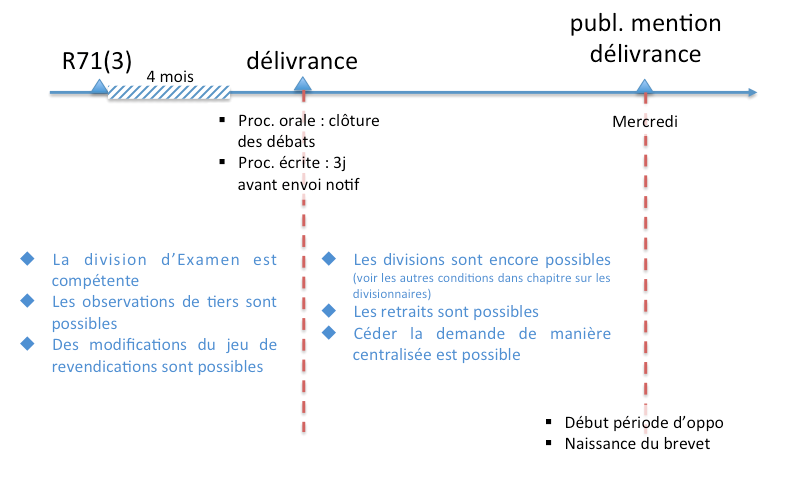
Thus, before the decision to grant, the Examination Division notifies the applicant with the text (or « DruckExemplar ») for which it intends to grant (A97(1) EPC together with R71(3) EPC).
This text may include any modifications made by the Examiner (e.g., formal corrections, substantive limitations, T1255/04, etc.) if the examiner reasonably believes that these will be accepted by the applicant (Guidelines C-V 1.1):
- Harmonization of the description and claims;
- Deletion of vague or clearly unimportant indications;
- Introduction of SI units;
- Introduction of reference numbers in the claims;
- Introduction of a summary of the closest prior art to the invention;
- Modifications which, although modifying the scope of an independent claim, are nevertheless clearly necessary;
- Correction of linguistic errors
- etc.
The applicant then has a period of 4 months to give their agreement to this text (R71(3) EPC).
A121 EPC applies to this period.
Sanction
The application is deemed to be withdrawn (R71(7) EPC):
- in case of non-response, or
- if the response (in case of agreement) omits an essential element (grant fee, translation, claim fees).
If A121 EPC applies to this period, there is only one fee for further processing to be paid even if several acts have been missed (forgotten fees, translations not provided): 240 € further processing fee (A2(1).12 RFR).
If the applicant agrees with the DruckExemplar
Steps to be taken to give consent
Within the aforementioned 4-month period, the applicant must:
- pay the grant and publication fee (R71(3) EPC): 965 € (A2(1).7 RFR and A2(2).7 RFR);
- for European patent applications filed before April 1, 2009 and international applications entering the regional phase before this date, this fee includes an additional fee per page from the 36th page (inclusive) (Guidelines C-V 1.2):
- 14 €/page from the 36th page (A2(2).7 RFR).
- the number of pages is calculated from the DruckExemplar and not from the pamphlet (J4/81).
- this additional fee is now included in the filing fee (Guidelines A-III 13.2) and is therefore not due for European patent applications filed after April 1, 2009, and international applications entering the regional phase after this date.
- for European patent applications filed before April 1, 2009 and international applications entering the regional phase before this date, this fee includes an additional fee per page from the 36th page (inclusive) (Guidelines C-V 1.2):
- provide a translation of the claims (for all sets if applicable Guidelines C-V 1.3) in the two other official languages other than the language of the proceedings (R71(3) EPC) for the pamphlet (A14(6) EPC);
- this translation will not be checked by the examiner (Guidelines C-V 1.3);
- it is not possible to correct these translations through R140 EPC, as they are not part of the grant decision (Guidelines H-VI 3.3);
- pay the claims fee (R71(4) EPC), provided for in A2(1).15 RFR (225 €/claim from the 16th and 555 €/claim from the 51st, if the application is filed after April 1, 2009) and A2(2).15 RFR (225 €/claim beyond the 16th, if filed before April 1, 2009):
- if the set of claims to be granted includes more than 15 claims (strictly);
- if the claims fee has not already been paid at the time of filing (R45(1) EPC) or at the time of entry into the national phase (R162(1) EPC);
- furthermore, if the number of claims has decreased between filing and grant, the claims fees are not refunded (Guidelines C-V 1.4);
- the set to be considered for the calculation is the one that contains the most claims (Guidelines C-V 1.4, e.g., several sets due to national prior art).
Completing all these actions constitutes consent (R71(5) EPC).
It should be noted that the texts of the translations of the claims in the two official languages other than the language of the proceedings have no legal effect at the EPO level (Guidelines A-VII 8). Nevertheless, it is necessary to look at the national law of each country to know the legal effect of these translations concerning the protection conferred by the patent (e.g., in France, if the translation is narrower than the initial claims, the narrower scope must be taken into account for the infringement analysis, L614-10 CPI).
Withdrawal of agreement
It is possible to withdraw one’s agreement exceptionally (Guidelines H-II 2.6), but at the discretion of the examining division:
- admission of minor modifications not requiring the resumption of examination and not significantly delaying the decision to grant (G7/93);
- filing of separate sets of claims for designated states having made a reservation.
If the division does not wish to resume the examination, a rejection will probably be pronounced based on A97(2) EPC.
In any case, the examining division will not be able to restart the examination after the decision to grant (G12/91)
If the applicant does not agree with the DruckExemplar
Principle
It is possible to propose certain modifications within the 4-month period (R71(6) EPC).
These modifications can be submitted within this period, even if the applicant’s agreement had already been given previously (G7/93, even if it concerns EPC73, it seems that its reasons remain valid) as long as the decision to grant has not been handed over to the internal mail service (G12/91, i.e., 3 days before the date indicated on the notification, unless a date of handover to the internal mail is clearly indicated on the decision, T2573/11) and that the modifications are minor and do not require the resumption of substantive examination.
By submitting the modifications, the applicant is deemed to have withdrawn their agreement (Guidelines H-II 2.6).
If the examining division approves the proposed modifications and/or is convinced by the arguments presented, it will issue a new notification under R71(3) EPC unless the applicant explicitly waives this right (« Notice from the European Patent Office dated June 8, 2015 concerning the possibility of waiving the right to receive a new notification under Rule 71(3) EPC« , OJ 2015, A52). Of course, if the applicant waives their right to receive a new R71(3) EPC, they must, at the same time as this waiver, perform all the necessary acts to give their agreement (see above: fees, translation, etc.).
Otherwise, the examination procedure will resume (R71(6) EPC).
The same applies if the applicant requests the cancellation of all or part of the modifications made by the examiner (Guidelines C-V 4.1).
Of course, all the rules useful for responding to an A94(3) EPC are applicable here: in particular, it is necessary to identify the basis for the modifications (R137(4) EPC).
Response to a second Rule 71(3) EPC communication
Fees already paid upon the first Rule 71(3) EPC notification are offset against the new fees (Rule 71bis(5) EPC, but with separate treatment, one not being usable to pay the other).
If the grant and publication fee (« Notice from the European Patent Office dated 13 December 2011 concerning amended Rule 71 EPC and new Rule 71a EPC« , OJ 2012, 52 and Guidelines A-X 11.1):
- increases (e.g., increase in fee scales), the balance must be paid within the prescribed time limit.
- decreases (e.g., reduction in the number of pages), the surplus is refunded.
If the claims fee (« Notice from the European Patent Office dated 13 December 2011 concerning amended Rule 71 EPC and new Rule 71a EPC« , OJ 2012, 52 and Guidelines A-X 11.2):
- increases (e.g., increase in the number of claims), the balance must be paid within the prescribed time limit.
- decreases, the surplus is refunded.
Other fees paid (e.g., further processing fee) are not offset against these new fees (Guidelines A-X 11.4).
Legal value of the Druckexemplar
If the patent specification is incorrect, only the text on the basis of which the decision to grant was taken is authoritative (Guidelines C-V 10).
Resumption of examination
It may happen that the examining division resumes examination even though a Rule 71(3) EPC communication has been sent: this is rare, but remains possible until the decision to grant (Rule 71bis(2) EPC, i.e., 3 days before the dispatch of the notification by the EPO, G12/91, unless a date of handover to the internal mail is clearly indicated on the decision, T2573/11).
This case may occur, in particular (Guidelines C-V 6.1):
- in the case of third-party observations providing an interesting document;
- in the case of amendments made by the applicant.
Withdrawal or refusal before notification of the decision to grant
If the application is refused, withdrawn, or deemed to be withdrawn before the notification of the decision to grant, the grant and publication fee will be refunded (Rule 71bis(6) EPC):
- for withdrawal, the refund is immediate;
- for refusal, the refund occurs at the end of the period for filing an appeal (Guidelines A-X 10.2.5);
- for deemed withdrawal, the refund occurs at the end of the period for requesting further processing (Guidelines A-X 10.2.5).
Any claims fees possibly paid are not covered by this refund (Guidelines A-X 10.2.5).
Decision to grant
Content of the decision
If the decision to grant is finally taken (after the applicant’s agreement, see above, and after the end of the technical preparations for publication Guidelines C-V 10), the decision indicates:
- the version of the text on which the decision was taken (R71bis(1) EPC);
- the date of the mention of the grant.
Deadline for a grant
One may wonder if the expiration of the patent will block a possible grant. According to the Board of Appeal, the applicant is perfectly entitled to request a grant even after the expiration of the application because rights may be affected by this grant (T910/18).
Correction of errors in the decision
Principles
Errors in the text of the patent of the grant decision cannot be corrected (G1/10).
Translations of the claims are not part of the decision and therefore cannot be corrected under R140 EPC (Guidelines H-VI 3.3).
A legal error cannot be corrected (G1/97): only an appeal is possible.
Case of a text in 71(3) that is clearly erroneous
It may happen that the text of the 71(3) is clearly erroneous (e.g., a page is missing) but the proprietor still gives their agreement on the text.
Under this hypothesis, the Boards of Appeal may still accept an appeal against the grant decision by considering that the EPO’s practice of making minor modifications to the text and justifying its modifications would not be followed: the text attached to the notification under Rule 71(3) EPC could not be the text according to which the examining division envisaged the grant (T1003/19).
Correction of the description using a re-translation
It is always possible to bring the text of the application into conformity with the text as filed (A14(2) EPC) because it is the filed text that is authoritative (A70(2) EPC).
However, after the grant (e.g., in opposition), the correction must not extend the scope of the protection (A101(3) EPC together A123(3) EPC).
Date of the decision
During an oral procedure, it is customary to consider that the date of the decision is that of the closure of the debates during the oral procedure (G12/91 and R111(1) EPC).
For a written procedure, the Enlarge Board of Appeal has determined that the decision was made 3 days before the dispatch of the notification by the EPO (G12/91).
Effect of the decision
The decision concludes the examination procedure: no further arguments or new documents can be considered by the examining division.
Conversely, the examining division may consider new elements submitted by the parties up to the day before the decision date. Furthermore, the examining division is not bound by the fact that it has issued a notification under R71(3) EPC, i.e., by the fact that it once considered granting the patent.
Thus, the examination procedure can be resumed at any time before the decision to grant (R71bis(2) EPC).
If the application is refused, withdrawn, or deemed to be withdrawn before the notification of the decision to grant, the grant and publication fee is refunded (R71bis(6) EPC).
Publication of the mention of the grant
Publication date
This publication normally occurs on one of the Wednesdays following the decision to grant (4 weeks after the issuance of the decision, « Notice from the European Patent Office dated 25 April 2006 concerning the completion of the technical preparations for the publication of European patent specifications » , OJ 2006, 409).
Two situations can block the grant process:
- if an annual fee
- falls due before the notification R71(3) EPC, the decision to grant is suspended (Guidelines C-V 2 and R71bis(1) EPC);
- falls due after the notification R71(3) EPC and before the next possible publication date in the EPO Bulletin, this fee is due to the EPO and the publication of the mention of the grant is suspended until the payment is made (R71bis(4) EPC);
- the applicant is informed of this (R71bis(4) EPC);
- if the fee (and, where applicable, the surcharge) is not paid within the time limits, the application is deemed to be withdrawn (A86(1) EPC). Only A122 EPC is applicable.
- if the designation fee
- falls due before the notification R71(3) EPC, the grant is suspended (Guidelines C-V 2 and R71bis(1) EPC);
- falls due after the notification R71(3) EPC (normally, this fee is due 6 months after the publication of the ESR, R39 EPC), the publication of the mention of the grant is suspended until the payment is made (R71bis(3) EPC).
- if the fee is not paid within the time limits, the application is deemed to be withdrawn (A79(2) EPC together with R39(2) EPC).
The publication date is recorded in the EPR (R143(1) o) EPC).
Effects of publication
The decision to grant takes effect only upon publication of the mention of the grant: this publication is the event that « gives birth » to the patent (A64(1) EPC and A97(3) EPC).
The duration of protection conferred by the patent is 20 years from the filing of the application (A63(1) EPC, and not from its priority date). However, it is possible for a contracting state to provide for a longer duration in certain specific situations, particularly if the product or process is subject to an administrative procedure (A63(2) EPC, such as marketing authorizations).
This protection extends to the territories of the contracting states for which the patent is validated (A64(1) EPC) and possibly certain additional territories if these have been declared by the contracting states (A168(1) EPC, e.g., Mayotte for France, former Netherlands Antilles for the Netherlands, the Isle of Man for the United Kingdom).
The publication of the mention of the grant triggers the following events:
- it is no longer possible to divide the application (the application no longer being pending, G1/09, and Guidelines A-IV 1.1.1);
- it is no longer possible to withdraw the application (same remark);
- it is no longer possible to assign the application in a centralized manner (A71 EPC, same remark).
Finally, the 9-month opposition period begins from this date.
Publication of the patent specification
Publication date
The EPO publishes the patent specification as soon as possible after the publication of the mention of the grant (at the same time according to « Notice from the European Patent Office dated 25 April 2006 concerning the completion of the technical preparations for the publication of European patent specifications« , OJ 2006, 409).
Legal nature and authoritative text
The authoritative text is the Druckexemplar and not the patent specification (Guidelines C-V 10): its sole purpose is simply to facilitate public access to the content of the patent.
Technical preparations for the publication of the patent specification
The period between the start of the technical preparations for the publication of the patent specifications and their effective publication is 5 weeks (« Notice from the European Patent Office dated 25 April 2006 concerning the completion of the technical preparations for the publication of European patent specifications« , OJ 2006, 409).
Content and form
The patent specification includes (R73(1) EPC) :
- the description,
- the claims,
- where applicable, the drawings.
It also mentions:
- the period during which an opposition is possible (R73(1) EPC),
- the designated contracting states (R73(3) EPC), i.e. those still designated at the time of the completion of the technical preparations for publication (Guidelines C-V 10).
These patent specifications are published in electronic form on the Internet (R73(2) EPC and « Decision of the President of the European Patent Office dated 12 July 2007 concerning the form of publication of European patent applications, European search reports and European patent specifications » OJ EPO 2007, Special edition No. 3 D.3, A2(1)).
No paper copy is sent to the applicant unless requested (this is a free request, Guidelines C-V 1.5 for grant, Guidelines D-VI 7.2.3 for opposition).
The patent specification is published in the language of the proceedings (A14(6) EPC) and the claims are in the three official languages of the EPO.
Correction of errors in the patent specification
If an error is found in the patent specification, the EPO may at any time correct its error on its own initiative or upon request (Guidelines C-V 10 or Guidelines H-VI 4).
This correction is recorded in the European Patent Register.
There is no point in filing an appeal against the decision to grant (T84/16) because the patent specification is not part of the decision.
Some have argued that this correction procedure is not provided for by the EPC and that an appeal is therefore fully justified: for the Board of Appeal (T84/16), the obligation imposed on the EPO by A98 EPC to publish the text of the granted patent implies the obligation to correctly reproduce this text. The fact that the EPO can at any time correct errors in the published text is therefore in accordance with the principle of good administration.
Patent certificate
Upon publication, the EPO issues the patent proprietor with a certificate (R74 EPC).
This certificate is provided in paper format to the proprietor(s).
It is possible to obtain certified copies of the certificate upon payment of an administrative fee of 55 € (« Decision of the President of the European Patent Office dated 12 July 2007 concerning the completion of the technical preparations for the publication of the European patent application« , OJ EPO 2007, Special edition No. 3 D.1, A1(3) and « Schedule of fees and expenses » OJ EPO 3/2012, supplement, 2.1 point 4, p19).
Graphical summary
Duration of the examination
There is no « standard » duration for the examination of an application.
However, there may be situations where several years elapse between each notification from the EPO: this may constitute a procedural defect.
By way of illustration, the following situation was considered a procedural defect (T823/11) :
- entry into the European phase: 1997;
- supplementary European search report: 1999;
- first notification from the examining division: 2004;
- second notification: 2005;
- third notification: 2006;
- oral proceedings: 2010.
However, let us not be mistaken… you will only be reimbursed for your appeal fee, not for all the fees you have paid during the entire procedure, right?
Laisser un commentaire