
The minimum requirements for obtaining a filing date must not be confused with the filing requirements for a European patent application.
Let us examine these filing requirements in detail.
The Receiving Section verifies that the ten requirements of R57 EPC (together with A90 EPC) are fully complied with.
The requirements
Provision of the translation of the application
Requirements
A translation into one of the EPO’s official languages (English, French, German) must be provided if:
- The patent application was not filed in one of these languages (A14(2) EPC together with R6 EPC);
- The patent application contains a reference to a text that is not drafted in one of these languages (R40(3) EPC, second sentence);
- The patent application is a divisional application and the text of the patent application is drafted in the language of the divisional application, which is not an official language (R36(2) EPC).
The time limit for providing the translation is 2 months (respectively R6(1) EPC, R40(3) EPC and R36(2) EPC).
It should also be noted that the translation provided may be amended during the entire procedure, with the original text in the foreign language prevailing (A14(2) EPC).
Sanction
If the translation is not provided within the 2-month time limit, the EPO notifies the applicant (A90(4) EPC) and sets a further 2-month time limit (R58 EPC) to correct the deficiency.
If no translation is received by the EPO upon expiry of this further time limit, the application is deemed to be withdrawn (R90(5) EPC together with A14(2) EPC).
Both time limits may benefit from restitutio in integrum under A122 EPC, but it is advisable to act from the second time limit (i.e., 12 months from the expiry of the time limit set in the notification).
Provision of the request for grant
R41 EPC sets out a number of requirements that the request for grant must satisfy (mandatory under A78(1)(a) EPC).
This requirement is verified by the Receiving Section (A90(3) EPC together with A78(1)(a) EPC together with R41 EPC).
Requirements
The request must be filed using the EPO Form 1001 (Guidelines A-III 4.1) unless the application is a Euro-PCT application (since PCT Rule 49.4 prohibits any obligation to use a national form).
In addition, the request must:
- contain a request for the grant of a European patent (EPC Rule 41(2)(a));
- This request is always present on Form 1001.
- contain the title of the invention (EPC Rule 41(2)(b));
- this requirement is not very « strict. » Indeed, the EPO may decide to amend it on its own initiative (Guidelines A-III 7.2).
- indicate the name, address, nationality, and State of residence (or principal place of business) of the applicant (EPC Rule 41(2)(c));
- in the case of multiple applicants, this information must be provided for each applicant (Guidelines A-III 4.2.1).
- if a representative is appointed, indicate their name, address, nationality, and State of residence (or principal place of business) (EPC Rule 41(2)(d));
- in the case of a divisional application, indicate this and specify the number of the earlier application (EPC Rule 41(2)(e));
- in the case of a new filing for an invention previously filed by an unauthorized person, indicate the number of the initial application (EPC Rule 41(2)(f));
- in the case of a priority claim, contain a declaration specifying (EPC Rule 41(2)(g)):
- the filing date,
- the State in which it was filed,
- and its filing number (EPC Rule 52(1), which adds this last requirement);
- contain the signature of the applicant (or their representative) (EPC Rule 41(2)(h));
- in the case of multiple applicants, a signature is required for each applicant or for their representative (Guidelines A-III 4.2.2), even if one of the applicants is the common representative of the others under EPC Rule 151(1) (Guidelines A-VIII 3.4);
- the fact that the signature is not that of the person indicated in the request (e.g., a representative is appointed but an employee of the applicant signs) only means that the signature is missing but does not imply that the application was never filed (J19/13), and it is therefore not possible to obtain a refund of the official fees.
- contain a list of the documents accompanying the request (including the number of pages of the description, claims, drawings, and abstract) (EPC Rule 41(2)(i));
- include the designation of the inventor if the inventor is the applicant (EPC Rule 41(2)(j)):
- if the inventor is not the applicant, the designation is provided in a separate document (EPC Rule 19(1) and Guidelines A-III 5.1).
Sanction
If the request does not comply with these conditions or if no request for grant has been filed at the time of filing, the EPO notifies the applicant (A90(3) EPC and A90(4) EPC) and sets a 2-month time limit (R57 b) EPC together with R58 EPC) to correct the error.
If no correction is made by the expiry of this time limit, the application is refused (A90(5) EPC).
This time limit benefits from the restitutio in integrum under A122 EPC (i.e. 12 months from the expiry of the time limit set in the notification).
Clarification on the priority claim
Of course, the EPO cannot know whether a priority claim is missing or incorrect. Thus, in practice, this requirement is of little significance. It is even less significant given that the priority claim may be corrected later under R52(3) EPC.
Filing of claim(s)
Requirements
As we saw in the article « Obtaining a filing date« , claims are no longer required to obtain a filing date from the EPO. Nevertheless, they must still be provided for the remainder of the procedure, particularly the search.
This requirement is also stated in A78(1) c) EPC.
Sanction
If the application does not contain any claims at the time of filing, the EPO notifies the applicant (A90(4) EPC) and sets a 2-month time limit (R58 EPC) to correct the error.
If no correction is made by the expiry of this time limit, the application is refused.
This time limit benefits from the restitutio in integrum under A122 EPC (i.e. 12 months from the expiry of the time limit set in the notification).
If the number of claims exceeds 15
Principle
If the number of claims provided exceeds 15, a claims fee is due for each claim from the 16th onward (R45(1) EPC).
This official fee is 280 € from the 16th to the 50th claim (A2(1).15 RFees) and 630 € beyond.
Time limits
This official fee must be paid within 1 month from the first filing of claims (R45(2) EPC).
If no official fee is paid, a notice of irregularity is sent by the Receiving Section to the applicant, and a further 1-month time limit is granted (R45(2) EPC; no additional official fee is due).
A121 EPC applies to both these time limits.
Sanction
If, at the end of this final period, the official fees are still not paid, the corresponding claims are deemed withdrawn (R45(3) EPC).
Features contained in a deemed withdrawn claim, which are also present in the description, may be reintroduced into the application (J15/88). If they do not appear in the description, the claims will be considered as truly withdrawn and they cannot be reintroduced (a priori, an amendment to the description at the time of non-payment of the official fee to provide support for the claims in the description should be acceptable).
Insufficient payment
If there is an insufficient payment of the official fee to cover all claims and there is no indication, at the time of payment, of the claims for which the official fees have been paid, a notification is sent to the applicant to inquire (A6(2) RFEE).
If the applicant does not respond, the payment is not deemed void (contrary to what is stated in the second sentence of A6(2) RFEE, as this sentence no longer applies): the payment is deemed to have been made for the first claims starting from the 16th (J9/84).
Case of reference for claims
The irregularity notification under R45(2) EPC will not be sent (Guidelines A-III 9):
- as long as the applicant has not submitted the copy of the earlier application:
- indeed, the applicant has a 2-month period from the filing date to provide this copy (R40(3) EPC);
- before the EPO does not know the number of claims;
- and as long as the 1-month period from the filing date (R45(2) EPC) has not expired (since a reference to claims of another application is considered as a filing of claims within the meaning of this rule).
Withdrawal of claims after filing
Once the application has been filed and before payment of the claim fees, it is not possible to withdraw certain claims exempt from the official fee in order to benefit others (e.g., withdrawal of all claims except 1-2 and 30-25): only the first claims 1-15 will be exempt from official fees (J9/84).
If a claim is withdrawn at a later stage of the procedure, the claim fees that would have been paid are not refunded.
It is entirely possible to reintroduce a claim deemed withdrawn during the examination (subject to R137(5) EPC) if and only if the subject matter of the claim is found in the description (J15/88, T490/90 and Guidelines A-III 9 by implication).
Provision of the abstract
Requirements
The abstract has no legal value (A85 EPC); it is not part of the content of the application (T246/86).
Nevertheless, it must be provided (A78(1)(e) EPC).
Of course, the abstract must correspond to the application; otherwise, it will not be considered as having been provided (Guidelines A-III 10.2).
Form
The abstract must contain (preferably 150 words maximum, R47(3) EPC):
- a statement of the title of the invention (R47(1) EPC);
- a concise summary of the matter contained in the description, claims and drawings. This summary (R47(2) EPC):
- indicates the technical field of the invention;
- enables the understanding of the technical problem;
- enables the understanding of the gist of the proposed solution;
- includes, where applicable, the chemical formula that best characterizes the invention;
- does not contain any statement on the merits or value of the invention.
- references to the drawings in parentheses where possible (R47(4) EPC).
The applicant must indicate which figure is likely to accompany the publication of the abstract, but this indication is not binding on the EPO (R47(4) EPC).
The figure may be selected by the Search Division if:
- no figure has been selected by the applicant (Guidelines A-III 10.3);
- the selected figure is not satisfactory to the EPO (Guidelines F-II 2.4).
It is not possible to draw a special figure for publication (Guidelines A-IX 2.3).
Examination
Beyond its presence, which is verified by the Receiving Section, the Search Division checks the content of the abstract (Guidelines B-X 7).
The definitive content of the abstract falls within the competence of the Search Division (R66 EPC). The prior art found during the search must not have any impact (Guidelines F-II 2.2).
Sanction
If the application does not contain an abstract at the time of filing, the EPO notifies the applicant (A90(4) EPC) and sets a 2-month period (R58 EPC) to correct the omission (Guidelines A-III 16.2).
If no correction is made by the end of this period, the application is refused.
This period benefits from the restitutio in integrum under A122 EPC (i.e. 12 months from the expiry of the period set by the notification).
Payment of the examination fee
The examination fee is « due » on the date of filing the request for examination (Guidelines A-X 5.2.2): since the request for grant filed at the time of filing includes this request, the examination fee may be validly paid at filing.
However, this is not mandatory: it must simply be paid within 6 months from the date of publication of the search report in the European Patent Bulletin (R70(1) EPC).
Payment of the filing and search fees
Requirements
The filing and search official fees must be paid (A78(2) EPC) within a period of 1 month from:
- the filing of a « standard » application (R38(1) EPC);
- the filing of a divisional application (R36(3) EPC);
- the filing of a new application for an invention previously filed by an unauthorized person (R17(2) EPC).
No notification regarding this irregularity will be issued (R58 EPC).
The 1-month period is calculated from the date of filing of the first documents (even if a filing date cannot be accorded, G3/98).
If the application exceeds 35 pages
Principle
Furthermore, an additional filing official fee must be paid if the application exceeds (strictly) 35 pages, as it forms part of the filing official fee: description, claims (first set filed), drawings, and abstract (« Notice from the European Patent Office dated 26 January 2009 concerning the fee structure for 2009« , OJ 2009, 118).
Time limit
This latter official fee must be paid (R38(2) EPC and R38(3) EPC) within a period of 1 month from (the latest expiring time limit being taken into account):
- the filing of the application;
- the filing of the first set of claims;
- the submission of the certified copy of the reference text referred to in R40(3) EPC and, where applicable, a translation thereof.
Text to be considered
The text to be considered for calculating the number of pages is, for a direct European application, the complete text of the filing (regardless of its language), i.e., description, claims, drawings, and one page for the abstract, and not the translation of this text (Guidelines A-III 13.2).
In the case of a reference, it is the text of the earlier application.
For Euro-PCT applications, please refer to the article on the national phase / regional phase.
Amount
The filing official fee is set out in A2(1).1 RFees (115 € for online filing, 200 € otherwise).
The additional official fee if the application exceeds 35 pages is set out in A2(1).1bis RFees (14 € per page strictly exceeding 35).
The search official fee is set out in A2(1).2 RFees (1165 € for a standard application filed after 1 July 2005, 840 € for a standard application filed before 1 July 2005).
Reduction of official fees
Normally, the language of the filing may be any language (A14(2) EPC).
However, if an applicant has their residence (or registered office) in one of the contracting states (or is a national of one of those states residing abroad) and that state has an official language other than English, French, or German, the applicant may file the description, with the other parts possibly in another language (Guidelines A-X 9.2.2 and G6/91), in one of those languages (R6(3) EPC together with A14(4) EPC).
A reduction of official fees is then available.
For applications filed (entering the national phase) as of April 1, 2014 (« Decision of the Administrative Council of 13 December 2013 amending Rule 6 of the Implementing Regulations to the European Patent Convention and Article 14(1) of the Rules relating to Fees« , OJ 2014, A4), to benefit from this reduction, all applicants must be (R6(4) EPC and R6(7) EPC):
- a small or medium-sized enterprise;
- a natural person; or
- a non-profit organization, a university, or a public research organization.
The criteria are set out in Commission Recommendation 2003/361/EC of 6 May 2003 (R6(5) EPC), and recalled in the « Notice from the European Patent Office, dated 10 January 2014, concerning the amendment of Rule 6 EPC and Article 14(1) RFees« , OJ 2014, A23).
Applicants must declare their eligibility under one of the above categories, but the EPO may request evidence in case of doubt (R6(6) EPC).
All applicants (in case of multiple applicants) must meet the above criteria (R6(7) EPC). However, it is not necessary that they all be nationals or residents of a contracting state with an official language other than English, French, or German (J4/18).
For this reduction of official fees to apply, the translation may be filed at the same time or later (but in any case not before, G6/91).
The applicant will receive a 30% reduction of official fees (A14(1) RFees) on the filing fee only.
The additional fee for more than 35 pages is also reduced (Guidelines A-III 13.2).
No reduction of the search fee is provided.
Sanctions
The EPO verifies that these official fees have been paid (A90(3) EPC together with R57 e) EPC).
If the filing official fee (and, where applicable, the additional official fee) and/or the search official fee is missing upon expiry of the 1-month period, the application is deemed withdrawn (A78(2) EPC for standard applications, R17(2) EPC for applications filed by an unauthorized person, and R36(3) EPC for divisional applications).
This period benefits from further processing under A121 EPC.
If the issue is the payment of the additional official fee, the amount of the further processing official fee is calculated based on the number of pages in the file for which the official fee has not been paid (Guidelines A-III 13.2).
Designation of the inventor
Requirements
It is necessary, at the time of filing, to designate the inventor(s) (A81 EPC and R19(1) EPC), even if the inventor(s) wish to remain anonymous to third parties and do not wish to appear in the published documents (R20(1) EPC).
This designation must include (R19(1) EPC):
- The first and last name(s) of the inventor(s);
- The full address(es) of the inventor(s);
- A declaration indicating the origin of the right to the patent (A81 EPC, e.g., a declaration such as « by virtue of the contract dated… » or « the applicant being the universal heir of… » is sufficient Guidelines A-III 5.3);
- The signature of the applicant or the representative. If there are multiple applicants, the signature of each applicant, their representative, or the common representative is required (Guidelines A-VIII 3.4), as the designation of inventors is not considered an accompanying document that may remain unsigned under R50(3) EPC.
Non-publication
An inventor may wish not to be mentioned in the publication of the invention.
They may make such a request in writing to the EPO (R20(1) EPC). This request must be signed (R50(3) EPC).
Their name will not (Guidelines A-III 5.2):
- be recorded in the European Patent Register pursuant to R143(1) g) EPC;
- be published in the application if the request is received before completion of the technical preparations for publication;
- be accessible to public file inspection (R144 c) EPC).
Inventor Information
If the applicant is not the inventor or the sole inventor, the EPO notifies them (R19(3) EPC):
- the filing number;
- the filing date and, where applicable, the date, state, and priority number of the priority application;
- the name of the applicant;
- the title of the invention;
- the designated states.
The inventor may waive this notification (« Notice from the European Patent Office dated 5 April 1991 concerning the possibility for the inventor to waive the notification informing him of his designation as provided for in Rule 17(3) EPC« , OJ 1991, 266).
Neither the applicant nor the inventor may rely on the omission of this notification (R19(4) EPC) or on errors contained therein.
If the registered letter is returned because the address is incorrect, the EPO will request the correct address from the applicant (Guidelines A-III 5.4). The notification will be resent if a new address is provided; otherwise, nothing further will be done.
Correction
A correction of inventor may be made (R21(1) EPC) upon request.
There are no time limits for such a correction. The correction may even be requested after proceedings before the EPO have been concluded (Guidelines A-III 5.6 and Guidelines A-XI 4).
Corrections may include:
- the addition of an inventor:
- the consent of the other inventors already designated is not required (Guidelines A-III 5.6 and J8/82);
- the consent of the inventor to be added is not required (J8/82);
- the request must contain the same information as for a designation, i.e., the information under R19(1) EPC (see above, R21(1) EPC).
- the removal of an incorrectly designated inventor:
- their consent is then required (R21(1) EPC).
- the consent of the other inventors is not required.
Where the request is filed by a third party, the consent of the applicant or the proprietor is required (R21(1) EPC).
Such a correction is handled by the formalities officer, unless there is reason to believe that the decision will not grant the correction (A20 EPC).
There will be no notification concerning this irregularity (R58 EPC).
Sanction in case of failure to designate or irregularities
If no inventor is designated or if the designation contains irregularities (e.g., no first names of the designated inventor) at the time of filing, the EPO will note this (A90(3) EPC together with R57 f) EPC) and notify the applicant (A90(4) EPC).
The applicant has a period of 16 months from the filing date to correct the error (R60(1) EPC). If the correction is made before the completion of the technical preparations for publication, the correction is deemed to have been received in due time (R60(1) EPC, last sentence, i.e., 5 weeks before publication in light of the « Decision of the President of the European Patent Office dated 25 April 2006 concerning the completion of the technical preparations for publication of the European patent application« , OJ 2006, 405).
Furthermore, if early publication is requested, the 16-month period remains in effect (J1/10).
If no correction is made by the expiry of this period, the application is refused (A90(5) EPC together with R60(1) EPC), and the applicant is informed accordingly.
The 16-month period benefits from further processing under A121 EPC.
Designation of an artificial intelligence as inventor
Under the EPC, an inventor must be a natural person with legal capacity.
Thus, a patent application designating a non-existent person as inventor may lead to the refusal of the application under A81 EPC (J8/20).
Priority claim
Requirements for the priority declaration
If a priority claim is made, a priority declaration must be filed (A88(1) EPC).
This declaration (R52(1) EPC) includes:
- the filing date;
- the Paris Convention or WTO member state in which the filing was made;
- the filing number.
This declaration must be completed at the time of filing (A88(1) EPC together with R52(2) EPC).
However, this declaration may be completed before the expiration of the latest of the following time limits:
- within 16 months from the earliest priority date (for an addition, R52(2) EPC, Guidelines A-III 6.5.1);
- within a period of 16 months from the earliest of the following dates (for a correction, R52(3) EPC):
- the earliest priority date before correction, and
- the earliest priority date after correction;
- within a period of 4 months from the filing date (for a correction, R52(3) EPC);
- within a set time limit for the correction of the application number designation following a notification (see below).
However, these time limits no longer apply if an early publication request is filed (R52(4) EPC).
Only A122 EPC is applicable to these time limits.
Requirement for the submission of the certified copy
Principle and time limit
A certified copy of the priority document must also be submitted (R53(1) EPC) within 16 months from the earliest priority date (in principle, this time limit is not affected by an early publication).
Furthermore, in case of non-submission, a notification will be issued by the EPO, which will trigger a new time limit (see below).
Format of the copy
The copy may be filed:
- in paper format (note: a simple printout of an electronic document is not sufficient: this refers to the paper document issued by the office of origin);
- by CD (Guidelines A-III 6.7) if:
- the CD was burned by the issuing office in a non-modifiable manner;
- the content is certified by that office;
- the filing date is certified by that office.
- by electronic filing only if (« Decision of the President of the European Patent Office, dated 9 May 2018, on the electronic filing of documents« , OJ 2018, A45):
- the document is signed by the issuing office;
- the signature of that office is recognized by the EPO.
- the submission is made via EPOLINE (« Decision of the President of the European Patent Office, dated 9 May 2018, on the electronic filing of documents« , OJ 2018, A45) or via the CMS (« Decision of the President of the European Patent Office, dated 15 November 2018, on the electronic filing of priority documents« , OJ 2018, A93)
Use of the copy for other requirements
This official copy may satisfy the requirements of the declaration concerning the filing date and the filing number if this official copy (Guidelines A-III 6.5):
- is provided within the prescribed time limits above;
- includes the mention of the earlier filing date.
Exception concerning the submission of the earlier application
If the priority document was filed in certain countries, it is not necessary to submit a certified copy thereof: cooperation agreements (DAS) allow the EPO to automatically obtain these documents without any action by the applicant (R53(2) EPC and OJ 2020, A57).
The following are thus concerned (Guidelines A-III 6.7):
- a European application,
- an international application if the RO is the EPO;
- a US application (regular or provisional)
- for provisional applications, a PTO/SB/39 form must be filed with the USPTO to authorize the communication of this application (« Notice from the European Patent Office, dated 27 June 2007, concerning practical aspects of the electronic exchange of priority documents between the EPO and the United States Patent and Trademark Office (USPTO)« , OJ 2007, 473),
- a Korean application (patent or utility model),
- a Chinese application (patent or utility model),
- a Japanese application (patent or utility model);
Thus, the EPO includes this copy in the file free of charge without the need to request it (Guidelines F-VI 3.3, except for US provisional applications, as a PTO/SB/39 form must be filed with the USPTO to authorize the communication of this application, « Notice from the European Patent Office, dated 27 June 2007, concerning practical aspects of the electronic exchange of priority documents between the EPO and the United States Patent and Trademark Office (USPTO)« , OJ 2007, 473).
Irregularity Notification and Corrections
There are various cases that may or may not generate an irregularity notification:
- Notification:
- If the certified copy of the priority document is not provided within 16 months from the earliest priority (A90(4) EPC together with R59 EPC);
- If the filing number is not provided (and not « incorrect, » as the EPO does not verify) within 16 months from the earliest priority (A90(4) EPC together with R59 EPC).
- No notification:
- If there is an omission of a claim (since the EPO cannot determine whether priority is intended);
- If the filing date is not provided (or is incorrect, as R58 EPC does not apply to R57 g) EPC, Guidelines A-III 6.5). If the indicated date is more than 12 months earlier, the applicant is informed so that they may correct it if desired (Guidelines A-III 6.6; this notification does not set a time limit, so the provisions of R52(3) EPC must be observed);
- If the designation of the State is not provided (or is incorrect, as R58 EPC does not apply to R57 g) EPC, Guidelines A-III 6.5);
- If the filing number is incorrect.
The above time limits benefit from restitutio in integrum under A122 EPC.
Sanction
In the event of a notification, the EPO sets a new time limit for providing the missing information (R59 EPC).
A122 EPC alone applies to this new time limit.
After the expiration of the applicable time limits above, no amendment or addition of priority may be granted.
If the applicant fails to correct their declaration within this final time limit or does not submit the requested copy of the earlier application, priority is lost, and the applicant is informed (A90(5) EPC).
In the absence of a notification, the applicant must correct their priority using the provisions of R52(3) EPC (see the time limits above). If the requirements are not met by the end of the prescribed time limits, priority is lost, and the applicant is informed (A90(5) EPC).
Correction under Rule 139 EPC
It appears possible to request a correction under Rule 139 EPC. However, a number of conditions must be met:
- date and state of filing of the earlier application (Guidelines A-V 3):
- the request for amendment must have been filed early enough to be taken into account before publication (e.g., simple mention of the correction in the publication);
- or, otherwise,
- if the error is obvious (J8/80) or the information is manifestly inconsistent (J3/91 and J2/92);
- if it is apparent from the published application that an error was made (J6/91);
- if the remainder of the proceedings cannot lead the public to believe that the priority claim was correct (T713/02);
- if another priority is added and is later (J4/82).
- filing number:
- it is possible to correct it at any time, even after publication, since the incorrect number cannot prejudice the rights of third parties (provided that the priority document is on file, J3/91).
Normally, this correction is carried out by the formalities officer (« Decision of the President of the European Patent Office, dated 12 December 2013, concerning the delegation to non-examining staff of certain tasks of the examining or opposition divisions« , OJ 2014, A6, point 22).
However, if the formalities officer makes a correction, this does not mean that the matter is definitively settled (T713/02).
Submission of a translation of the priority document?
Principle
At the time of filing and when claiming a new priority, it is not necessary to translate the priority application.
However, during the examination or in the course of an opposition (exceptional case « Notice from the European Patent Office, dated 28 January 2013, concerning amended Rule 53(3) EPC« , OJ 2013, 150), it may happen that such a translation is requested: if the validity of the priority claim is relevant to establish whether the invention is patentable (i.e., if an intervening prior art document is found by the Examiner), then a translation will have to be provided in one of the official languages after notification by the EPO and within a set time limit (R53(3) EPC).
This set time limit is (« Notice from the European Patent Office, dated 28 January 2013, concerning amended Rule 53(3) EPC« , OJ 2013, 150):
- in the case of a European application:
- aligned with the time limit for filing the request for examination (R70(1) EPC) or with the time limit for confirming the examination (R70(2) EPC), depending on the circumstances, if the validity of the priority claim becomes relevant when the European search report is completed.
- set by the examining division if the validity of the priority claim becomes relevant during the examination procedure.
- in the case of a Euro-PCT application:
- set by the examining division (if the EPO acted as ISA or SISA).
- in the case of a European patent:
- set by the opposition division if the validity of the priority claim becomes relevant during the opposition procedure.
A121 EPC applies to this time limit for the applicant, whereas A122 EPC applies to the proprietor.
Statement of complete translation
It is also possible to provide a statement indicating that the European application is a complete translation of the priority document (R53(3) EPC, second sentence).
This statement may be made in the request for grant form (Guidelines A-III 6.8.6).
Sanction
If no translation is submitted within the time limits, the intervening documents will be considered citable (i.e., loss of the right of priority, A90(5) EPC and R53(3) EPC, last sentence).
Verification of the validity of the priority claim
Principle
The receiving section is not required to verify the validity of the priority. However, if this validity can be clearly called into question (e.g., title of the priority application « Oil well drilling method », title of the European application « Laceless shoe »), the applicant will be informed (Guidelines A-III 6.4).
This is only examined in detail if an intervening prior art document is relevant to the validity of the patent (Guidelines F-VI 2.1).
Same Invention
A priority filing P discloses the same invention as a claim of the subsequent filing DU claiming that priority if (Guidelines F-VI 2.2 and G2/98) the person skilled in the art can, using common general knowledge, derive directly and unambiguously from the content of P the subject-matter of the claim of DU.
The drawings of filing P may be used (A88(4) EPC and T169/83).
Elements mentioned in a reference to the prior art or in a disclaimer cannot be taken into consideration (Guidelines F-VI 2.2).
Finally, it is necessary that the content of DA be sufficiently described and enable the implementation of the invention (T843/03).
Clarification Regarding Loss of Priority Right / Waiver
The loss of the priority right (or its waiver) is not retroactive: even if it makes no difference to the applicant, the consequences for third parties may be significant.
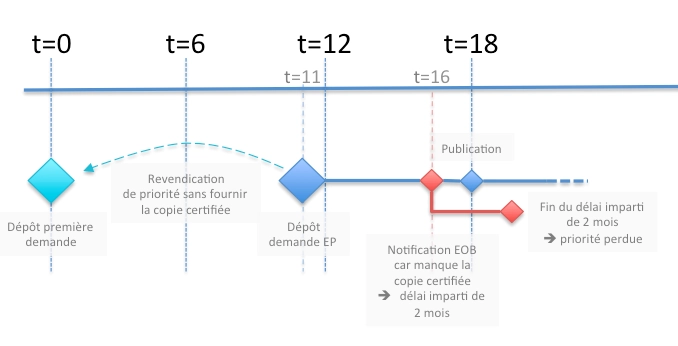
Let us consider the following diagram:
Consequences for the Applicant
For the applicant, the consequence is clear: they will not be able to invoke their priority in the grant procedure (their effective filing date is t=11).
A notification is issued to the applicant in accordance with R112(1) EPC.
Time limits (only those not yet expired, Guidelines A-III 6.11) are then calculated from the new filing date (Guidelines E-VIII 1.5).
If this loss or waiver occurs after the completion of technical preparations for publication but before publication, it does not prevent publication (Guidelines F-VI 3.5).
Consequences for Third Parties
For third parties, the consequence is different:
- If the priority was withdrawn/rejected after publication while the priority claim was valid (e.g., the time limit for submitting the copy had not expired), it will be opposable against their own filing as of the date of the priority document (the effective filing date is then t=0, e.g., if the copy is not submitted in time, Guidelines G-IV 5.1.1).
- If the priority was withdrawn/rejected before publication, the effective date of the filing will be that of the filing date (t=11, Guidelines G-IV 5.1.1).
Appointment of a Representative
Requirements
For proceedings before the EPO (with the exception of the formal act of filing), persons not residing in one of the member states must be represented by an authorized representative (A133(2) EPC).
Care must be taken, as nationality plays no role here.
Sanction
If no representative is appointed at the time of filing (and such appointment is mandatory), the EPO notifies the applicant (A90(4) EPC) and sets a 2-month period (R58 EPC) to correct the error.
If no correction is made by the end of this period, the application is refused (A90(5) EPC).
This period benefits from restitutio in integrum under A122 EPC (i.e., 12 months from the expiry of the period set by the notification).
Formal requirements for the text and drawings
Requirements
Drawings
R46 EPC sets out the formal requirements for drawings, including:
- drawings must be in black and white, using lines, without shading;
- drawings must be « sufficiently » large;
- lettering on drawings (references, text, etc.) must be simple (not circled, without parentheses, without quotation marks). It must use the Latin or Greek alphabet. The font size must not be less than 3.2 mm (the size depends on the font chosen, so care must be taken).
- margins must not be less than shown in the following diagram:
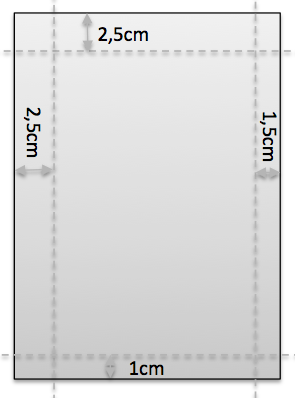
Although colors are prohibited for drawings, it should be noted that the EPC contains no requirements regarding the use of photographs or the color of such photographs. Thus, photographs may be in color even if the public disclosure is in black and white (Guidelines A-IX 1.2).
Other documents
Additionally, R49 EPC sets out further requirements for the documents of the application (including the description), including:
- sheets must be in A4 format and used in portrait orientation (except possibly for drawings, tables, or mathematical formulas);
- sheets must be numbered with Arabic numerals centered at the top of the sheet (but not in the margin);
- lines of the description and claims must be numbered in increments of 5, on the left side of the sheet (but not in the margin);
- the request for grant, the description, the claims, and the abstract must be typewritten or printed (except possibly for symbols and graphic characters, chemical or mathematical formulas);
- for typewritten text, the line spacing must be 1.5;
- all text must be in a font where uppercase letters are at least 2.1 mm high (the size depends on the font chosen, so care must be taken) and in black;
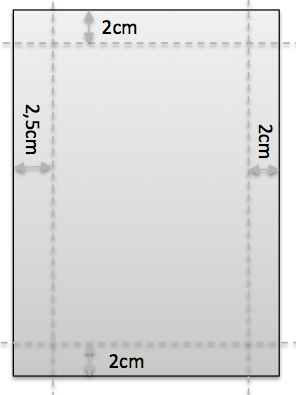
- margins must not be less than shown in the following diagram:
Case of a reference
In the case of a reference, it is the certified copy (or, where applicable, its translation) that must comply with the formal requirements (Guidelines A-III 3.2.1).
Sanction
If one of the previous requirements is not complied with at the time of filing, the EPO notifies the applicant (A90(4) EPC) and sets a 2-month time limit (R57 i) EPC together with R58 EPC) to correct the error.
If no correction is made by the expiry of this time limit, the application is refused (A90(5) EPC).
Normally, the filing section does not verify compliance with the requirement under R46(2) i) EPC (« Reference signs shall not be used for the drawings unless they appear in the description and in the claims, and vice-versa« ). This point will be reviewed by the Examining Division (Guidelines A-III 3.2).
This time limit benefits from restitutio in integrum under A122 EPC (i.e. 12 months from the expiry of the time limit set by the notification).
Sequence Listing of Nucleotides and Amino Acids
Form
The application must include the nucleotide sequences disclosed in the application (R30(1) EPC) in accordance with the « Decision of the President of the European Patent Office dated 28 April 2011 on the filing of sequence listings » (OJ 2011, 372).
The standard used is WIPO Standard ST.25 (Guidelines A-IV 5 and Guidelines F-II 6.1).
In particular, the sequence listing must be filed on an electronic data carrier (e.g. CD) (« Decision of the President of the European Patent Office dated 28 April 2011 on the filing of sequence listings« , OJ 2011, 372, Art. 1).
Furthermore, if the listing is also provided in paper format, a declaration must be submitted to certify that the listing is identical to the electronic one.
Examination at filing
The filing section checks, during the examination as to irregularities (A90(3) EPC together with R57 j) EPC), whether the prescribed sequence listing has been filed (Guidelines A-III 1.2).
If the applicant has not submitted a sequence listing (or the required declaration), the filing section invites the applicant within a period of 2 months (A90(3) EPC together with A90(4) EPC together with R30(3) EPC):
- to remedy the irregularity;
- to pay a late furnishing fee (A2(1).14bis RFees): 220 €.
Otherwise, the application is refused (A90(5) EPC together with R30(3) EPC).
A121 EPC is applicable (there are two omitted acts in the case where nothing has been done).
If the electronic medium contains unreadable, incomplete or infected information, the applicant is informed and invited to resubmit a replacement copy within a non-extendable period of 2 months (« Decision of the President of the European Patent Office, dated 28 April 2011, on the filing of sequence listings« , OJ 2011, 372, Art. 3(3)).
If a sequence is filed or corrected after the filing date, a declaration must be provided by the representative or the applicant to certify that the sequence submitted does not go beyond the content of the application as filed (« Decision of the President of the European Patent Office, dated 28 April 2011, on the filing of sequence listings« , OJ 2011, 372, Art. 2(2)).
Publication
The sequence listing is published as part of the description (« Decision of the President of the European Patent Office, dated 28 April 2011, on the filing of sequence listings« , OJ 2011, 372, Art. 6).
Late-filed sequences
If a sequence is filed late under R56(2) EPC (change of filing date), the filing section will check the formal requirements of this filing after the expiry of the 1-month period to withdraw (R56(6) EPC), and if an irregularity is found, will send a notification inviting the applicant to correct it within a 2-month period (A90(3) EPC together with A90(4) EPC together with R30(3) EPC, Guidelines A-IV 5.1).
If a sequence is filed late under R56(3) EPC (retention of the filing date), the filing section will check the formal requirements of this filing upon receipt of the sequence, and if an irregularity is found, will send a notification inviting the applicant to correct it within a 2-month period (A90(3) EPC together with A90(4) EPC together with R30(3) EPC, Guidelines A-IV 5.1).
The sequence filed under R56(2) EPC or R56(3) EPC does form part of the description as of the filing date, and the provisions of R30(2) EPC stating otherwise do not apply (Guidelines A-IV 5.1).
Sequences in a application filed by reference
A sequence contained in an earlier application to which reference is made (under R40(1)(c) EPC) at the filing date does form part of the new application (unless the sequence was contained only in the claims and these are not incorporated under R57(c) EPC) (Guidelines A-IV 5.2).
The filing section will check the formal requirements of the sequence when it receives the earlier application, and if an irregularity is found, will send a notification inviting the applicant to correct it within a 2-month period (A90(3) EPC together with A90(4) EPC together with R30(3) EPC, Guidelines A-IV 5.2).
If the earlier application is a European application or a PCT application filed with the EPO, the requirements of R30(1) EPC (e.g., submission of a CD, declaration of compliance, etc.) are deemed to be fulfilled upon the filing of the new application (Guidelines A-IV 5.2).
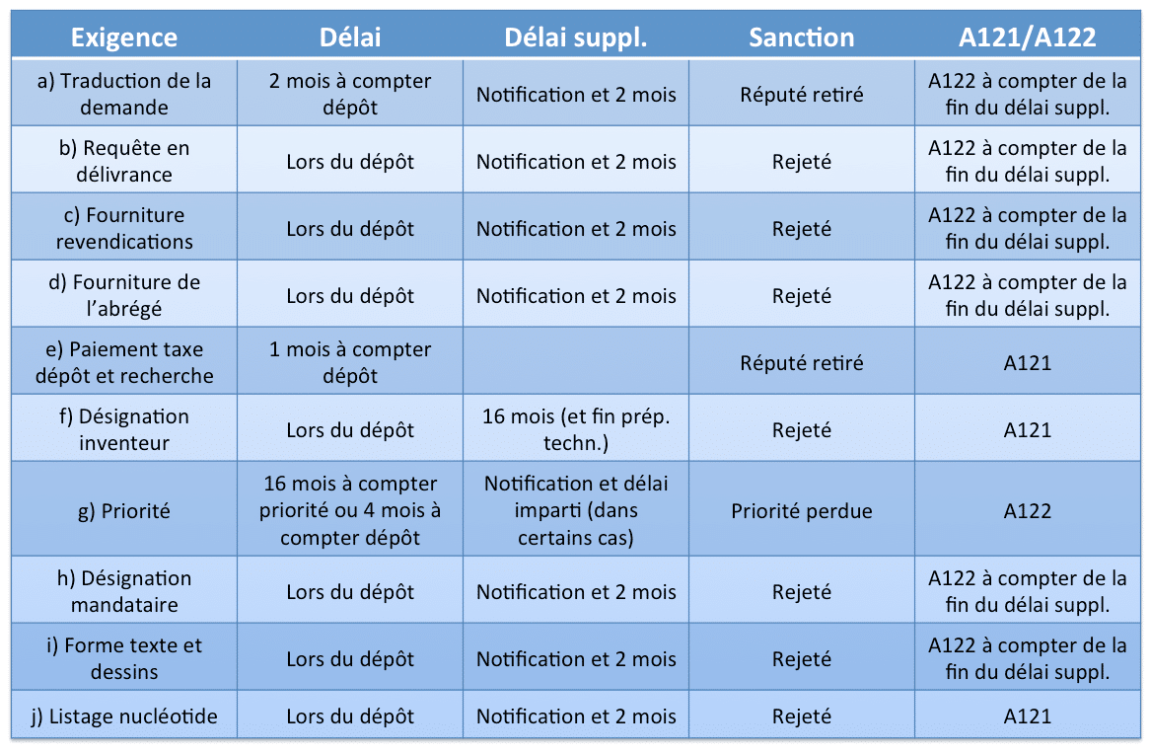
Summary of these requirements
Here is a graphical summary of the various requirements:
…………………….bonjour…………………….
Je posede des brevet à breveté. .. vue le parcours du combattant. ….. et une tonne de paperasse. … ………..
Moi créateurs et inventeur autodidacte. ……
La PAPERASSE. Tres peux pour moi. …….
Moi…… ont ma fait une proposition à l’étranger. ………. (vue les articles si dessus
Du grand n’importe quoi. …… )
Les frais 100/100 pris en compte des le départ
Se brevet personne peut me le prendre. ….
Sans mon autorisation. ….. je suis tres déçue
En plus une lenteurs incroyable. …. PEEÉEUUUUUFFFFF. ………