
Scope of application
Conditions
For restitutio in integrum (A122 EPC) to apply to a missed time limit, several conditions must be met:
- A time limit has not been observed before the EPO (A122(1) EPC);
- The failure to observe this time limit has had the direct consequence (A122(1) EPC):
- the refusal of the European patent application or of a request,
- the deemed withdrawal of the application,
- the revocation of the European patent,
- the loss of any other right or of a means of redress.
- A written request must be filed (R136(1) EPC) and comply with the formal requirements (signature, margin, etc.) of R50 EPC, as it is a document submitted « subsequently » (i.e., after the filing date);
- The request must be reasoned and present the facts supporting the request (R136(2) EPC): it is necessary to prove that the applicant/proprietor exercised all due care required by the circumstances (A122(1) EPC);
- The person filing the request must be:
- the applicant (A122(1) EPC) recorded in the European Patent Register,
- the proprietor (A122(1) EPC) recorded in the European Patent Register,
- an opponent who has filed an appeal, only with respect to the time limit for filing the statement of grounds of appeal (G1/86 and Guidelines E-VIII 3.1.2). An opponent may not benefit from this reinstatement if the time limit for filing an appeal is missed (T210/89);
- in particular, this person cannot be a national office concerning, for example, a time limit for forwarding (J3/80), as this time limit was not the applicant’s responsibility to observe.
- The request must be filed:
- within 2 months from the removal of the obstacle (R136(1) EPC),
- and without exceeding 1 year (preclusion period) from the missed time limit (R136(1) EPC).
- There are two exceptions for which the request for restitutio must be filed within 2 months (shortened preclusion period) from the missed time limit (R136(1) EPC):
- the 12-month priority time limit (A87(1) EPC);
- the time limit for filing a petition for review (A112a(4) EPC).
- An official fee must be paid within these time limits (R136(1) EPC): 1 165 € (A2(1).13 RRT);
- The omitted acts must be completed within these time limits (R136(2) EPC).
Focus on the missed deadline
A122 EPC applies only if a deadline has not been met before the EPO. If a date is missed, it is not possible to request re-establishment of rights.
For example, no re-establishment of rights can be requested for:
- the date set for oral proceedings (Guidelines E-VIII 3.1.1);
- the end of the period during which the application is pending (J21/96);
- the failure to pay an annual fee before a national office.
In the event of two missed deadlines expiring independently of each other, two requests for re-establishment of rights must be filed with two official fees, even if they can be submitted in the same letter, regardless of whether these missed deadlines are based on the same causes/reasons or not (J26/95).
Focus on « all due care required by the circumstances »
Principle
The aim is to ensure that an isolated mistake in a system that normally functions satisfactorily does not result in a loss of rights (T179/87).
Due care is understood as the care that the proprietor/applicant/representative (normally competent) would exercise under the given circumstances (T30/90).
Persons to whom the duty of due care applies
The duty of due care applies to both the applicant and the representative, whether the representative is a European representative or a foreign representative (J5/80, J3/08, T742/11, T2274/11).
Proof of due care
The applicant/proprietor (or the opponent, where applicable) or their representative (if applicable, i.e., employee, attorney, professional representative) must prove that they exercised all due care and that the missed deadline was due to exceptional circumstances.
Proof of this due care (e.g., accident report) may be provided after the deadline (T324/90), even though the reasoned statement must be provided within the deadlines.
This due care is assessed as of the date of the missed deadline (J1/07).
Examples of insufficient vigilance
By way of illustration, these “excuses” were not considered sufficient:
- a client order had been placed in spam/quarantine and had not been seen (T1289/10);
- the EPO or PCT authorities had failed to forward certain information to the representative for the continuation of the procedure (J23/87), as the latter should have noticed it;
- ignorance or erroneous interpretation of a provision of the EPC even if the person is not a representative (J2/02 or J31/92);
- the implementation of a new IT system (T489/04);
- a representative practicing alone had not taken measures to ensure, in case of absence or illness, that other persons monitor compliance with deadlines (J41/92);
- the fact that a reminder was not issued by the administrative service demonstrates that the deadline monitoring system is not functioning correctly (T686/97);
- the fact that certain tasks were entrusted to assistants and that the representative did not exercise due vigilance in their dealings with the assistant (selection of a qualified person for the function, informing them of the tasks to be performed, reasonably monitoring their execution) (J5/80, same for a temporary worker replacing the assistant, J16/82). No task involving interpretation of the law may be entrusted to the assistant.
- the deadline monitoring system had a programming error (T473/07);
- a representative had not verified that all attachments were present before signing on EPOLINE (T1101/14): signing an incorrect document is therefore incompatible with the required vigilance unless particular circumstances are invoked (T1095/06);
- a foreign representative believed that the instruction had been given to the European representative and recorded the deadline as processed in the deadline monitoring system (J5/18, i.e. vigilance does not presume that the person has a good knowledge of the EPC).
Examples of sufficient due care
By way of illustration, the following « excuses » have been deemed sufficient:
- an isolated mistake in the application of a deadline monitoring system that, otherwise, functions correctly (J2/86). Evidence of such correct functioning may be the fact that it has operated effectively for several years (J31/90);
- divergent decision T1465/07: an independent cross-checking mechanism must be implemented;
Focus on the end of the impediment
Case-by-case analysis
Often, the impediment arises from the fact that a deadline was incorrectly noted, forgotten, etc.
In practice, it is quite difficult to determine and depends on the facts of the case.
Date by which the problem should have been noticed if all due care had been exercised
The end of the impediment is therefore the moment when the person handling the proceedings before the EPO should have noticed it if all due care had been exercised:
- the date on which the representative’s assistant was informed is irrelevant (T191/82);
- if the representative has changed without the EPO being informed, service on the former representative triggers the 2-month period (T32/04).
Thus, if a party instructs its representative not to forward EPO notifications, it cannot rely on this lack of knowledge to request restitutio (T840/94).
End of the case law on « due care »?
According to decision J1/20, the required due care relates to the missed deadline and not to the end of the impediment.
Therefore, it should no longer be necessary to consider the « date by which the problem should have been noticed » but rather the « actual date on which the problem was noticed » (the applicant and not their representative, J1/20).
Case of the notification of loss of rights
The end of the impediment is deemed to occur at the latest upon receipt, by the responsible person, of the notification of loss of rights or the decision to refuse.
The 10-day rule does not apply since this is a question of fact and not a legal fiction (J7/82).
Focus on the time limit for late actions
The 12-month time limit for late actions (or the shortened 2-month time limit for late actions) is a composite time limit (i.e., the first missed time limit must be extended under R134(1) EPC before applying the time limit for late actions).
It may happen that the request for restitutio in integrum is filed within the time limit for late actions without all the grounds being presented within that time limit (but within the 2-month period from the removal of the impediment) (J6/90).
What matters is that the file demonstrates sufficiently clearly by the end of the time limit for late actions that the applicant is doing everything possible to preserve their rights (J6/90).
The following situation is therefore admissible:
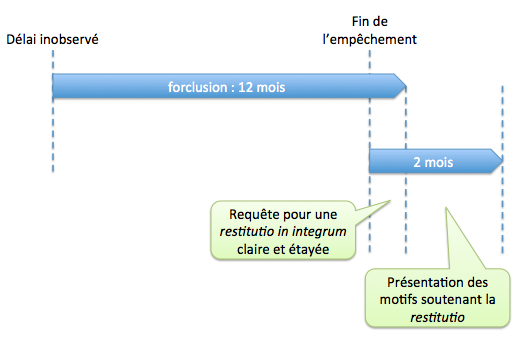
The time limit for late actions may be interrupted by the incapacity of the representative or the applicant under R142 EPC (J902/87).
Focus on loss of rights
In the event of a loss of rights, the EPO notifies the party under R112 EPC.
It is often useful to request a decision at the same time as filing a request for restitutio in integrum while paying the corresponding official fee. If the EPO decides that the loss of rights was not justified, the restitutio official fee will be refunded as it was paid without cause.
Exclusions
The following are excluded from restitutio in integrum:
- the 2-month time limit for filing the request for restitutio in integrum and the 12-month time limit for late actions (A122(4) EPC and R136(3) EPC);
- time limits that benefit from further processing (R136(3) EPC; however, the time limit for further processing may benefit from restitutio in integrum).
Late payment
In the event of late payment of the restitutio official fee, there are two situations (R1/18):
- if the restitutio concerns one of the following time limits, the request for restitutio is deemed not to have been filed, and the official fee is refunded:
- the 12-month priority period (A87(1) EPC);
- the time limit for filing a petition for review (A112a(4) EPC).
- otherwise, the request for restitutio is filed but not admissible: the restitutio official fee is therefore not refunded.
The reason is that the second case requires a precise examination of the date of the removal of the impediment (which is not the case for the first two time limits, which run from the end of the missed time limit). Therefore, it is not possible to verify that the conditions are met without considering the request as filed.
Restoration
Competent Authority
The competent authority to verify the admissibility of the request is the authority that was competent at the time of failure to observe the time limit (R136(4) EPC).
In the event of refusal of the request, it is necessary to provide reasons for the refusal (Guidelines E-VIII 3.3). If the request is granted, no reasoning is required (except in opposition proceedings, as the other parties are parties to the proceedings Guidelines E-VIII 3.3 T552/02 and T1561/05).
This decision is subject to appeal (unless it is issued by a board of appeal).
Effects
When the request is granted, the legal consequences of the failure to observe the time limit are deemed not to have occurred (A122(3) EPC).
Nevertheless, if a third party has begun to work (or has made effective and serious preparations to work the invention) in good faith the invention between the loss of rights and the publication of the decision to re-establish rights, it will be possible for them to continue such working free of charge for their own purposes or needs (A122(5) EPC).
To benefit from this free license, it is nevertheless necessary that the patent application has been published (J5/79).
The decision to re-establish rights is published in the EPO Bulletin (R143(1) u) EPC).
Restitutio by a Contracting State
A State may decide to grant restitutio (A122(6) EPC) for time limits provided by the EPC and to be observed before the authorities of that State.
For example:
- the time limit for filing a translation of the granted patent (A65 EPC);
- the time limit for conversion (A135(2) EPC and R155(1) EPC);
- the time limit for payment of renewal fees for the granted patent (A141 EPC).
Laisser un commentaire