General Information
The international examination may be requested under Chapter II of the PCT (A31.1 PCT) to obtain a non-binding preliminary opinion on the following issues:
- novelty (the invention has no prior art in the state of the art under R64.1 PCT (A33.2 PCT)),
- inventive step (the invention is not obvious to a person skilled in the art considering the state of the art under R64.1 PCT (A33.3 PCT)), and industrial applicability (the invention can be produced or used in any kind of industry (A33.4 PCT)).
The international examination procedure remains confidential (except for the fact that such examination has been requested) (A38 PCT and R94 PCT).
Request for International Preliminary Examination
Prerequisites
Conditions
To file a request for international preliminary examination, it is necessary:
- that one of the applicants (A31.2.a PCT and R54.2 PCT) at the date of the request for examination (e.g., assignment recorded by the IB, R92bis.1.a.i PCT): must be domiciled in one of the Contracting States bound by Chapter II; or be a national of one of the Contracting States bound by Chapter II; and that the application was filed with an RO of a Contracting State bound by Chapter II (A31.2.a PCT and R54.2 PCT). If the IB is the RO, it is deemed to act for the RO of the Contracting State of its domicile or of which it is a national (R54.3 PCT).
States Bound by Chapter II
Currently, all PCT members are bound by Chapter II (see Annex A of the Applicant’s Guide), which significantly reduces the impact of such conditions (i.e., no reservation under A64.1 PCT).
Sanction
If these conditions are not met, the request for examination is considered not to have been filed (R54.4 PCT).
Indications in the Request Form for Examination
If the indications regarding the domicile or nationality of the applicant provided in the request form for international preliminary examination do not confirm the applicant’s right to file such a request, the IPEA informs the applicant and the IB: the request is considered not to have been filed (R61.1.b PCT together with R54.4 PCT).
However, it is possible to correct the request form by providing evidence establishing the applicant’s nationality or domicile (Administrative Instructions 614): the IPEA will consider that the request was correctly filed on the date of the first submission of the request for examination if the evidence is deemed satisfactory.
Competence
Principle
The request for international preliminary examination must be filed with a competent IPEA (A31.6.a PCT).
The IPEAs are appointed by the Assembly (A32.3 PCT together with A16.3 PCT):
- Austria, Australia, Brazil, Canada, China, Egypt, EPO, Spain, Finland, India, Israel, Japan, Republic of Korea, Russia, Sweden, USA, Nordic Patent Institute.
Limitation of Competence by the RO
Each RO (except the IB) indicates the list of competent IPEAs (A32.2 PCT and R59.1 PCT).
If the RO is the IB, the competent IPEAs are the union of the IPEAs that would have been competent if the application had been filed with each possible RO (R59.1.b PCT together with R35.3.a PCT).
A RO may limit the possible IPEAs based on the type (e.g., language) of the application (R59.1.a PCT together with R35.2.a.ii PCT).
Limitation of Competence by the IPEA
The IPEA may limit its competence, for example, based on the ISA that performed the search (A32.3 PCT together with A16.3.b PCT).
Filing with an Incorrect Authority
If the request for examination is filed with an authority that is not competent to act as IPEA (other than the IB), that authority will affix the date of receipt to the request for examination (R59.3.a PCT) and transmit this request to the IB.
Once this request for examination is with the IB (or if it was received directly from the applicant, R59.3.b PCT) or if the non-competent authority decides to do so itself (R59.3.f PCT), the request is forwarded to the competent IPEA. This forwarding follows the following logic (R59.3.c PCT):
- if only one IPEA is competent, the IB or the non-competent authority transmits the request for examination to that authority and informs the applicant. Or
- if several IPEAs may be competent,
- the IB or non-competent authority invites the applicant to indicate the IPEA to which the request for examination should be transmitted. The applicant must respond within the time limit that expires the latest among (together with R54bis.1.a PCT):
- 3 months from the date of transmission to the applicant of the ISR, or
- 22 months from the priority date,
- 15 days from the invitation.
- if the applicant responds, the IB or non-competent authority transmits the request to the indicated IPEA (R59.3.e PCT);
- otherwise, the request is deemed never to have been filed (R59.3.e PCT).
- the IB or non-competent authority invites the applicant to indicate the IPEA to which the request for examination should be transmitted. The applicant must respond within the time limit that expires the latest among (together with R54bis.1.a PCT):
The date affixed by the non-competent authority or the IB will be considered as the effective date of receipt of the request for examination by the IPEA (R59.3.e PCT).
Time Limit
Principle
The request for examination must be filed before the expiration of the time limit that expires the latest among (R54bis.1.a PCT):
- 19 months for countries with reservations (A39.1.a PCT)
- otherwise:
- 3 months from the date of transmission to the applicant of the ISR, or
- 22 months from the priority date.
Otherwise, the request for examination is deemed not to have been filed (R54bis.1.b PCT).
Exceptions
For the following states (which have made a reservation under A22.1 PCT), the international request for examination must be filed before the expiration of the 19-month time limit from the priority date (A39.1.a PCT) so that the entry into the national phase is deferred to 30 months (instead of 20 months):
- Luxembourg,
- Uganda,
- United Republic of Tanzania.
Form of the Request
The request for examination must be made on form PCT/IPEA/401 (printed or computer-printed, A31.3 PCT together with R53.1.a PCT together with Administrative Instructions 102).
This form is available from the IB, the RO, or the IPEA (R53.1.b PCT).
Representation by a Representative
Representation by a representative is never mandatory before the IPEA.
However, if the applicant so wishes, they may be represented by:
- the same representative as for the filing or any representative authorized to act before the RO (R90.1.a PCT);
- by a representative authorized to act before the IPEA (R90.1.c PCT).
In addition, the representative appointed before the RO may appoint a secondary representative to perform acts before the IPEA (R90.1.d PCT).
Common representative
As with the filing, in the case of multiple applicants and if no common representative has been appointed, it is necessary to designate a common representative.
If no common representative is designated by the applicants (R90.2.a PCT), the first applicant who is entitled to file an application with the RO is considered the common representative (R90.2.b PCT).
Contents of the demand
The demand for examination must include:
- A petition (R53.2.a.i PCT); preferably worded as indicated in R53.3 PCT: « Demand for international preliminary examination under Article 31 of the Patent Cooperation Treaty – The undersigned requests that the international application specified below be the subject of an international preliminary examination in accordance with the Patent Cooperation Treaty », details concerning the applicant (R53.2.a.ii PCT and R53.4 PCT) and, where applicable, the representative (R53.2.a.ii PCT and R53.5 PCT):
- the same rules as for the filing apply (R4 PCT);
- in the case of multiple applicants, it is sufficient for this information to be provided for at least one of them to render the demand for examination valid (R60.1.a-bis PCT); details concerning the international application to which it relates (R53.2.a.iii PCT and R53.6 PCT): the name,
- the address of the applicant,
- the title of the invention,
- the date of the international filing (if the applicant knows it) and
- the number of the international application or, failing that, the name of the receiving Office with which the international application was filed.
- where applicable, a statement concerning amendments (R53.2.a.iv PCT):
- this statement must indicate whether the amendments are to be taken into account for the examination (a copy of the amendments must then be attached) or whether other amendments under A34 PCT are to be taken into account (R53.9 PCT);
- this statement may indicate, if the applicant still has time to submit amendments, that the applicant wishes to defer the examination (R53.9.b PCT);
- the IPEA will then defer its examination until such amendments have been received (A34.1 PCT together with R69.1.c PCT).
- and a signature (R53.2.b PCT) of all applicants (R53.8.a PCT):
- but there is no irregularity if only one of the applicants signs (R60.1.a-ter PCT);
- a representative or common representative may sign the demand for examination on behalf of the applicants (R90.3 PCT). A general power of attorney (R90.5.a PCT) or specific power of attorney (R90.4.a PCT) may be required by the IPEA (or waived, R90.4.d PCT and R90.5.c PCT).
- Certain ROs may accept « seals » in place of signatures (R2.3 PCT). This may notably be the case for the Chinese, Japanese, or Korean Offices (Applicant’s Guide §5.091).
Language of the demand for examination
The demand for examination must be submitted (A31.3 PCT together with R55.1 PCT):
- in the language of the international filing,
- where applicable, in the language of publication,
- if neither the language of the international filing nor the language of publication is accepted by the IPEA, in a language of the translation of the international application (see below).
Language of the international application
Filing as Filed
A translation of the international application is required when neither the language of filing nor the language of publication is accepted by the IPEA.
This translation must be in a language of publication (R55.2.a.ii PCT) and in a language accepted by the IPEA (R55.2.a.i PCT).
This requirement also applies to parts or missing elements provided after the filing date (R55.2.a-bis PCT).
The submission of this translation is not mandatory (R55.2.b PCT):
- if the ISA is the IPEA and
- if a translation was submitted to the ISA for the purposes of the search.
If no translation is submitted, the IPEA invites the applicant to submit the required translation within a minimum period of 1 month (R55.2.c PCT). If no translation is submitted, the request for examination is deemed never to have been submitted (R55.2.d PCT).
Amendments
Amendments made under Article 19 PCT (and any letter accompanying such amendments) must also be translated in the same manner if the applicant wishes these amendments to be taken into account (R55.3.b.ii PCT).
If no translation is submitted, the IPEA invites the applicant to submit the required translation within a minimum period of 1 month (R55.3.c PCT). If no translation is submitted, the amendments are not taken into account for the examination (R55.3.d PCT).
Election of States
A request for examination constitutes an election of all designated States that are bound by Chapter II (i.e., all, R53.7 PCT).
Official Fees
Handling Fee
Principle
The handling fee (R57.1 PCT) is set by the IB in the Schedule of Fees (R57.2 PCT): 200 Swiss francs.
Time Limit
It is collected by the IPEA for the benefit of the IB (R57.1 PCT) within a time limit (R57.3 PCT):
- of 1 month from the date of actual receipt of the request for examination by the IPEA (the date of the request for examination may be earlier if it is submitted to the IB or a non-competent authority, see above).
- of 22 months from the priority date (not applicable if the IPEA is also the ISA and wishes to undertake the examination at the same time as the search, R57.3.c PCT).
Official fees are deemed to have been paid on time if payment is received before the IPEA sends the notification of non-payment (see below, R58bis.1.c PCT).
Reduction
A 90% reduction of the processing official fee is available if the applicant is a national or domiciled in:
- a country whose national income per capita is less than US$3,000 (Fee Schedule, point 5.a) or
- a country classified as a least developed country by the United Nations (Fee Schedule, point 5.b).
All applicants (even if they are not part of the PCT system) must meet this criterion to benefit from the reduction (Fee Schedule, point 5).
Currently, WIPO indicates that the following states benefit from this reduction (90% official fee reduction for the PCT):
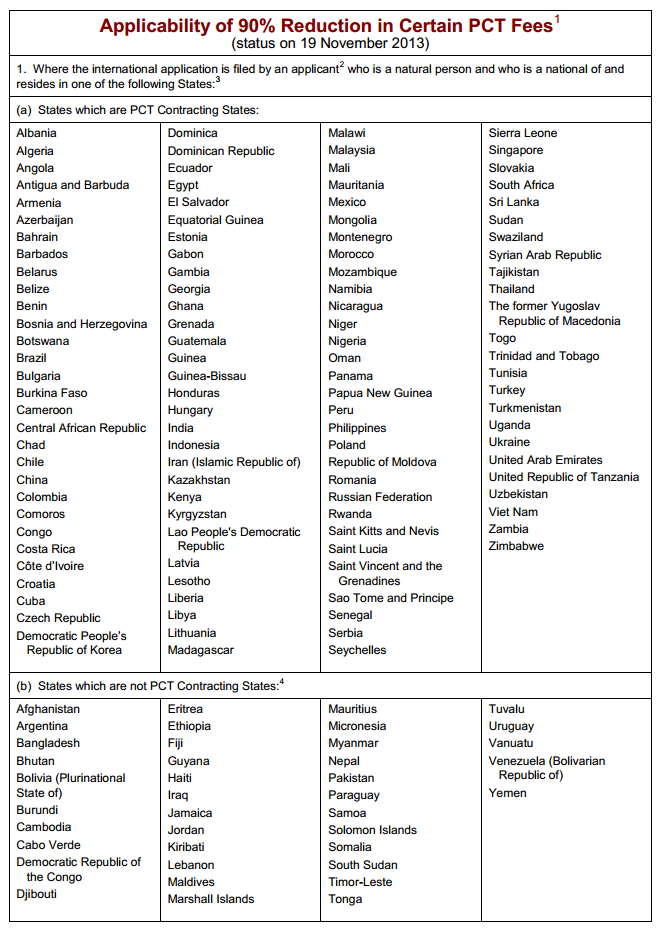 States benefiting from a reduction under the PCT
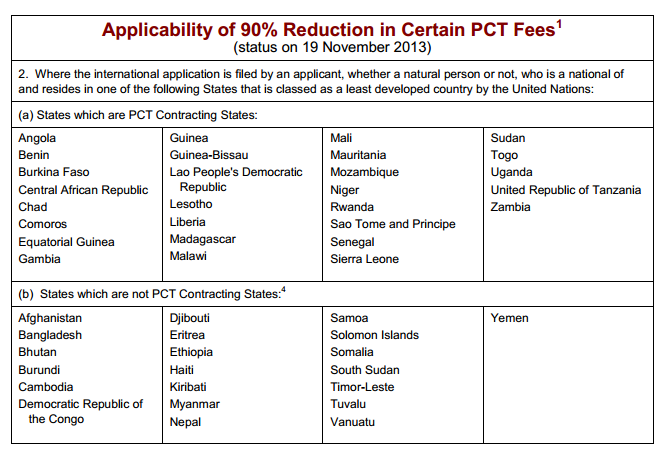 States benefiting from a reduction under the PCT (based on the United Nations list)
Preliminary Examination Official Fee
Principle
The preliminary examination official fee is set by the IPEA for its own benefit (PCT Rule 58.1.a and PCT Rule 58.1.b).
Time Limit
It must be paid to the IPEA (PCT Rule 58.1.c) within a time limit (PCT Rule 58.1.b in conjunction with PCT Rule 57.3):
- of 1 month from the date of actual receipt of the demand for examination by the IPEA (the date of the demand for examination may be earlier if it is submitted to the IB or a non-competent authority, see above).
- of 22 months from the priority date (not applicable if the IPEA is also the ISA and wishes to undertake the examination at the same time as the search, PCT Rule 58.1.b in conjunction with PCT Rule 57.3.c).
The official fees are deemed to have been paid in due time if payment is received before the IPEA sends the notification of non-payment (see below, PCT Rule 58bis.1.c).
Reduction
A reduction of this official fee may apply to nationals of certain underdeveloped states, but this depends on the specific provisions applicable to the IPEA.
Failure to Pay
Notification
In the event of failure to pay (R58bis.1.a.ii PCT) or insufficient payment (R58bis.1.a.i PCT) within the time limit, the IPEA invites the applicant to pay within 1 month from the date of the invitation (R58bis.1.a PCT).
This time limit is extendable (applicant’s guide §10.047).
A late payment fee may be required by the IPEA (R58bis.1.a PCT):
- 50% of the unpaid amount (R58bis.2.a.i PCT);
- without being less than the processing fee (R58bis.2.a.ii PCT);
- without exceeding twice the processing fee (R58bis.2.b PCT).
Sanction
If payment is not made, the request for examination is deemed not to have been submitted, and the IPEA so declares (R58bis.1.b PCT).
Refund
Processing fee
The IPEA will refund the processing fee (R57.4 PCT) if the request for examination is withdrawn before it has been sent to the International Bureau, or if the request for examination is considered not to have been submitted (unauthorized applicant or request submitted too late).
Preliminary examination fee
Each IPEA freely decides on the refund of the preliminary examination fee.
Withdrawal of a request for preliminary examination
Competent authority
The applicant may withdraw their request by submitting a declaration to the IB (A37.3.a PCT and R90bis.4.b PCT). However, if this declaration is transmitted to the IPEA, the latter records the date of receipt on the declaration and forwards it to the IB: this date shall be deemed to be the date of submission to the IB (R90bis.4.c PCT).
The IB notifies the elected Offices concerned and the IPEA (A37.3.b PCT).
Time limit
This declaration must be received by the IB within 30 months from the priority date (R90bis.4.a PCT).
Fee
Withdrawal does not incur any fees (applicant’s guide §11.060).
Signature
The withdrawal declaration must be signed by all applicants (R90bis.5 PCT).
This signature may be replaced by the signature of:
- the representative (R90.3.a PCT);
- the common representative designated by the other applicants (R90.3.c PCT).
However, the applicant deemed to be the common representative may not sign this declaration (R90.3.c PCT together with R90bis.5 PCT): in this case, all applicants must sign.
Power of attorney
A power of attorney is always required in this case by the competent authority (R90.4.e PCT): no waiver by the authority is possible.
Effects
The withdrawal of all elections of elected States results in the withdrawal of the request for international preliminary examination (A37.2 PCT): the IPEA then terminates the processing of the international application (R90bis.6.c PCT).
If the request for examination for an elected State is withdrawn after the time limit under A22 PCT, the application is deemed withdrawn for that State (A37.4.a PCT, no State having provided otherwise, applicant’s guide §11.061): these provisions are only relevant for States with different time limits for designated States and elected States, i.e., those having made a reservation to A22.1 PCT: Luxembourg, Uganda, United Republic of Tanzania (since for these the time limit is not 30 months but 20 months).
Processing of the Request for Examination and Correction of Irregularities
Receipt by the IPEA
Upon receipt, the IPEA notifies the applicant of the date of receipt of the request for examination (R61.1.b PCT).
The IPEA then examines the conditions to be met by the request (R61.1.a PCT).
Correction of Formal, Language or Content Irregularities
Principle
If irregularities are found (concerning the form or content of the request), the IPEA invites the applicant (R60.1.a PCT) to correct these irregularities within a minimum period of one month.
The time limit may be extended as long as no decision has been taken (R60.1.a PCT).
In Case of Response
In case of a response, the corrected request for examination is deemed to have been received on the initial date of receipt (R60.1.b PCT).
However, if the irregularity prevents the identification of the international application, the request is deemed received on the date of correction (R60.1.b PCT), and the IPEA informs the applicant of this new date (R61.1.b PCT).
In Case of No Response
If no response is provided within the time limits, the request is considered never to have been submitted (R60.1.c PCT), and the IPEA declares this (R60.1.c PCT and R61.1.b PCT) to the applicant and the IB.
Transmission to the IB and Notification to Elected Offices
The IPEA sends the request for examination or a copy thereof to the IB (R61.1.a PCT).
The IB then notifies the elected Offices of their election (A31.7 PCT and R61.2 PCT): the applicant is informed of this fact.
Publication in the Gazette
The IB publishes in the Gazette the particulars relating to the request for examination and the list of elected States (R61.4 PCT and Administrative Instructions 431).
International Preliminary Examination
Start Date of the Examination
Principle
Normally, the IPEA begins the examination (A34.1 PCT together with R69.1.a PCT):
- if the time limit for submitting a request for examination has expired (R54bis.1.a PCT, i.e., max of 22 months from the priority date and 3 months from the transmittal of the ISR) and
- as soon as it has in hand:
- the request for examination,
- the processing fee and the international preliminary examination fee,
- the ISR with the written opinion.
Deferred Start
Irregularities
Naturally, if the request for examination has irregularities as previously indicated, the examination is deferred as long as the irregularities persist (R60.1.c PCT).
Case of A19 PCT amendments
If amendments have been made in response to the WOISA and a statement indicates that these amendments must be taken into consideration for the examination, the IPEA will defer its examination until these amendments have been received (A34.1 PCT together with R69.1.c PCT).
Thus, the applicant has an interest in including a copy of the amendments in the examination request (R53.9.a.i PCT) even if the IB will ultimately communicate them (R62.1.ii PCT).
Early start (integrated procedure)
If the IPEA is also the ISA, the IPEA may decide (unless instructed otherwise by the applicant, e.g., they wish to file amendments under A34 PCT) to integrate the examination into the search (R69.1.b PCT).
In this case, the written opinion of the WOISA (R43bis.1 PCT) is not mandatory if the IPEA has no observations to make (A34.2.c PCT and R69.1.b-bis PCT).
Priority document
A copy of the priority document must be submitted to the IPEA (R66.7.a PCT): if it has already been submitted to the IB, the IB will transmit a copy to the IPEA.
If this copy is not submitted, the IPEA may prepare its report as if the priority were not claimed (R66.7.a PCT), but this has no effect on the national phases: the applicant must be given the opportunity to submit the priority document to the elected Offices within a reasonable time (R17.1.c PCT).
If the copy is submitted but in a language not accepted by the IPEA and if the IPEA considers that the priority claim is essential to patentability, the IPEA may request a translation from the applicant within 2 months; otherwise, the report may be prepared as if the priority were not claimed (R66.7.b PCT).
Prior art
The prior art for the purposes of the examination includes anything that has been made available (A33.2 PCT and R64.1 PCT):
- to the public;
- anywhere in the world;
- by written disclosure.
Other disclosures or earlier national rights may nevertheless be mentioned in the search report (e.g., oral disclosure) (R64.2 PCT and R64.3 PCT).
Basis of the examination
Principle
The international examination generally relates to the content of the international application (R66.1.a PCT).
Consideration of A19 PCT / A34 PCT amendments
For the examination, it is also possible to take into consideration (R66.1.c PCT and R66.1.d PCT):
- amendments made under A19 PCT,
- amendments made under A34 PCT, for the purposes of the examination (e.g., following a written opinion).
However, this consideration is not mandatory if the IPEA has begun drafting its written opinion or examination report (R66.4bis PCT).
Consideration of corrections of obvious errors
The IPEA must also take into account obvious errors under R91.1 PCT (R66.1.d-bis PCT).
However, this consideration is not mandatory if the IPEA has begun drafting its written opinion or examination report (R66.4bis PCT).
Subject matter / claims excluded from examination
A claim that has not been the subject of a search need not be the subject of an international examination (R66.1.e PCT).
The first written opinion mentions this (R66.2.a.vi PCT) as does the final report (R70.2.d PCT).
Supplementary search
Since July 1, 2014, the IPEA carries out a supplementary search in order to discover the prior art that was published or became available after the date on which the international search report was established (R66.1ter PCT).
This supplementary search is mentioned in the examination report (R70.2.f PCT).
Communication between the IPEA and the applicant
Written opinion
Principle
A « written opinion » is a notification sent by the IPEA to inform the applicant of its observations on the application.
The written opinion must:
- be reasoned (R66.2.b PCT);
- invite the applicant to submit a written response (R66.2.c PCT);
- set a time limit for response (R66.2.d PCT, normally 2 months).
The IPEA may issue several written opinions if time permits (R66.4.a PCT), particularly if the applicant responds within a short time limit (R66.4.b PCT).
If the IPEA has no observations, it does not issue a written opinion (A34.2.c PCT) and the final examination report is established directly (applicant’s guide §10.066).
Deemed first written opinion
The written opinion prepared by the ISA may be considered as the first written opinion established by the IPEA (R43bis.1.c PCT): the applicant is then invited to respond to this written opinion before the expiration of the time limit for requesting examination (R43bis.1.c PCT, i.e., max of 22 months from the priority date and 3 months from the transmittal of the ISR).
This procedure does not apply if the IPEA has declared so (R66.1bis.b PCT): for example, this procedure applies to the EPO/IPEA if the ISA was also the EPO (JO 2005, 493).
Content of written opinions
In the written opinions, the IPEA must indicate (R66.2.a PCT):
- whether the application contains subject matter in respect of which it is not required to carry out an examination (A34.4 PCT),
- whether any of the claims does not appear to be novel, inventive, or industrially applicable,
- whether the form or content of the application is incorrect,
- whether an amendment goes beyond the disclosure of the invention as filed,
- whether clarity issues are apparent,
- whether an invention has not been the subject of a search,
- whether the nucleotide sequence listing required for a meaningful examination is missing,
- whether the formulation of multiple dependencies is not permitted by the national law governing the IPEA.
Response to the written opinion
The applicant may, in response (A34.2.d PCT):
- submit, for example, amendments (A34.2.b PCT);
- present arguments (R66.3.a PCT).
This response must be addressed directly to the IPEA (R66.3.b PCT).
This applies to the response to the first written opinion, as well as to subsequent ones (R66.4.a PCT).
Informal communications
It should be noted that these clarifications may be provided verbally (at a minimum unofficially), or in writing with the IPEA (A34.2.a PCT).
The IPEA may contact the applicant informally (R66.6 PCT) by telephone, in writing, or by means of interviews. It may grant more than one interview if the applicant requests it, or if it so wishes.
Amendment under A34.2.b PCT
Definition
An amendment is any change (other than an obvious error) made to the description, claims, and drawings (R66.5 PCT).
Competent authority
The competent authority to receive amendments under A34.2.b PCT is the IPEA (R66.1.d PCT).
Time limit
Amendments made under A34.2.b PCT may be filed (R66.1.b PCT):
- at the same time as the request for examination;
- if time permits, as long as the examination report has not been issued (see also R66.3 PCT for the response to the first written opinion, R66.4 PCT for responses to subsequent written opinions);
New matter
Amendments made under A34.2.b PCT may not go beyond the disclosure of the invention as filed (A34.2.b PCT).
If such an amendment is detected by the IPEA, it will be noted in the next written opinion and in the examination report: the final report will be established as if this amendment had not been made (R70.2.c PCT).
Form
Description and drawings
An amendment to the description and drawings must be made by submitting a replacement sheet for the sheet(s) containing an amendment (R66.8.a PCT).
A letter must accompany these replacement sheets, indicating the differences as well as the basis and (preferably) the reasons for the amendment (R66.8.a PCT).
These amendments may be made on a copy of the sheet as filed (e.g., deletions, minor amendments) if clarity and reproduction possibilities are not impaired (R66.8.b PCT).
Claims
The same requirements as amendments under Article 19 PCT apply (Rule 66.8(c) PCT together with Rule 46.5 PCT).
The applicant is required to submit replacement sheets containing a complete set of claims to replace all claims as filed (Rule 66.8(c) PCT together with Rule 46.5(a) PCT).
The amendments may consist of a deletion, addition, or modification of text. The claims must be numbered in consecutive Arabic numerals (Administrative Instructions 205(a)).
The amendments must be indicated in a letter of transmittal (Rule 66.8(c) PCT together with Rule 46.5(b) PCT and Administrative Instructions 205(b)). For each of the claims, it must be indicated whether:
- the claim is unamended;
- the claim is deleted; the claim is new;
- the claim replaces one or more claims as filed; the claim is the result of the division of a claim as filed; the claim replaces one or more claims as previously amended;
- the claim is the result of the division of a claim as previously amended.
In the absence of such a letter of transmittal or indication of the amendments, the IPEA may refuse to consider these amendments (Rule 70.2(c-bis) PCT). The same applies to a national office (Applicant’s Guide §11.047A).
The last set of claims filed replaces the previous claims (Rule 66.8(c) PCT).
Language
As with the request for examination, amendments or any letter must be submitted:
- in the language of filing of the international application (Rule 12.2(a) PCT),
- where applicable, in the language of publication (Rule 55.3(a) PCT),
- if neither the language of filing nor the language of publication is accepted by the IPEA, in a language of the translation of the international application (Rule 55.3(b)(i) PCT).
If an amendment or the letter of transmittal is not submitted in the correct language, a translation may be required within a minimum period of one month (Rule 55.3(c) PCT).
If no translation is submitted within the time limit, the amendments will not be taken into account for the purposes of the international examination (Rule 55.3(d) PCT).
Official Fee
There is no official fee for filing an amendment (Applicant’s Guide §10.071).
Mention of Amendments in the Examination Report
The examination report indicates the basis on which it is established (Rule 70.2(a) PCT).
The following are annexed to the examination reports (Rule 70.16 PCT):
- the latest set of amended claims (and accepted, unless the IPEA considers that the latest set of claims contains subject matter extending beyond the disclosure as filed);
- the replacement sheets of the description.
Unity of Invention
Additional Official Fees
Principle
In the event of a lack-of-unity objection, the IPEA must issue a first written opinion (R66.2.a.iii PCT) indicating that it does not believe there is unity, and await the applicant’s response.
Only thereafter (W6/99, R68.1 PCT), and if the application is still considered non-unitary by the IPEA, that authority may invite the applicant to pay additional official fees (A34.3.a PCT) within 1 month from the date of the invitation (R68.2.iii PCT):
- indicating at least one possibility for amendment (R68.2.i PCT);
- providing reasons for its position (R68.2.ii PCT);
- specifying the number of additional official fees to be paid (R68.2.iv PCT).
The IPEA may decide not to issue this invitation, but in such case, it must conduct the examination for the entire application and state in the report why it still considers there to be a lack of unity (R68.1 PCT).
These official fees are paid directly to the IPEA (R68.3.b PCT).
Each IPEA is free to set the amount of the additional official fees (R68.3.a PCT).
Non-payment
In the event of non-payment of the requested additional official fees, the IPEA will not conduct the examination on the claims not covered by the fees: only the main invention indicated by the IPEA or the applicant (A34.3.c PCT together with A34.3.a PCT) will be examined (most often, this is the first invention, but there is no obligation, R68.5 PCT).
The national law of any contracting state may provide that the unexamined parts are considered withdrawn unless a specific official fee is paid (A34.3.b PCT).
Protest
Principle
Any applicant may pay the additional official fees under protest, i.e., by submitting a reasoned statement seeking to demonstrate that the application meets the unity of invention requirement (R68.2.v PCT together with R68.3.c PCT) or that the number of official fees requested is excessive.
Reconsideration
In such case, a reconsideration body of the IPEA will review the protest (R68.3.c PCT): this body shall consist of at least one person other than the examiner who made the initial decision (R68.3.d PCT).
If the protest is justified, the additional official fee shall be refunded in whole or in part (R68.3.c PCT).
Protest fee
A protest fee may optionally be required by the IPEA (R68.3.e PCT), to be paid within 1 month from the invitation to pay the official fees (R68.2.v PCT): if not paid, the IPEA may consider that the protest was not filed and so declares (R68.3.e PCT).
If the protest is justified, the protest fee shall be refunded in full (R68.3.e PCT).
International Preliminary Examination Report
Time limit
The report must be established (the longer of the following time limits) within (A35.1 PCT together with R69.2 PCT):
- 28 months from the priority date;
- 6 months from the time prescribed (R69.1 PCT) for commencing the examination;
- 6 months from the date of receipt by the IPEA of the translation of the application (if required).
Content
The examination report includes (A35.1 PCT and A35.2 PCT together with R70 PCT) in particular:
- A statement indicating whether or not each claim is considered to be novel, inventive, and industrially applicable (R70.6.a PCT);
- An explanation of this statement, especially if it is negative (R70.8 PCT);
- Citations of the relevant documents (R70.7.a PCT):
- The specific passages must be indicated (R70.7.b PCT together with R43.5.e PCT);
- The International Patent Classification of the application (R70.5.a PCT together with R43.3.a PCT).
Language
The language of the report is (R70.17 PCT):
- If a translation of the application has been provided to the IPEA (under R55.2 PCT) in that language;
- Otherwise, in the language of publication.
In addition, the report is translated into English (A36.2.a PCT together with R72.1.a PCT) by the IB. If an elected state requires a translation of the annexes to the report to be submitted, it is the applicant’s responsibility to provide it (A36.2.b PCT together with R74 PCT).
Transmission of the Examination Report and the Written Opinion
Transmission
The IPEA transmits to the applicant and the IB, on the same day (A36.1 PCT together with R71.1 PCT), a copy of the examination report and its annexes.
The IB then transmits the report to the elected Offices (A36.3.a PCT together with R73.1 PCT and R73.2 PCT), as well as, where applicable, an English translation if required by the elected Offices. A copy of this translation is also sent to the applicant (R72.2 PCT).
This transmission is not carried out before the expiration of a 30-month period from the priority date (R73.2.a PCT), unless early national phase entry has occurred and the IB is in possession of the examination report (R73.2.b.i PCT).
In the event of early national phase entry where the IB is not in possession of the examination report, the IB simply transmits the written opinion of the ISA (R73.2.b.ii PCT), as well as, where applicable, an English translation if required by the elected Offices (R72.2bis PCT).
Applicant’s Observations
Regarding the Translation
If the applicant considers that the translation carried out by the IB is incorrect, the applicant may send observations to any elected State and sends a copy of these observations to the IB (R72.3 PCT).
Regarding the Substance
Any other observations must be addressed during the national phase to the elected Office (applicant’s guide §10.079).
Copy of Cited Documents
The applicant or an elected Office may obtain, upon request, for 7 years from the filing date, a copy of the documents cited in the examination report by requesting them from the IPEA (A36.4 PCT together with R71.2 PCT).
Laisser un commentaire