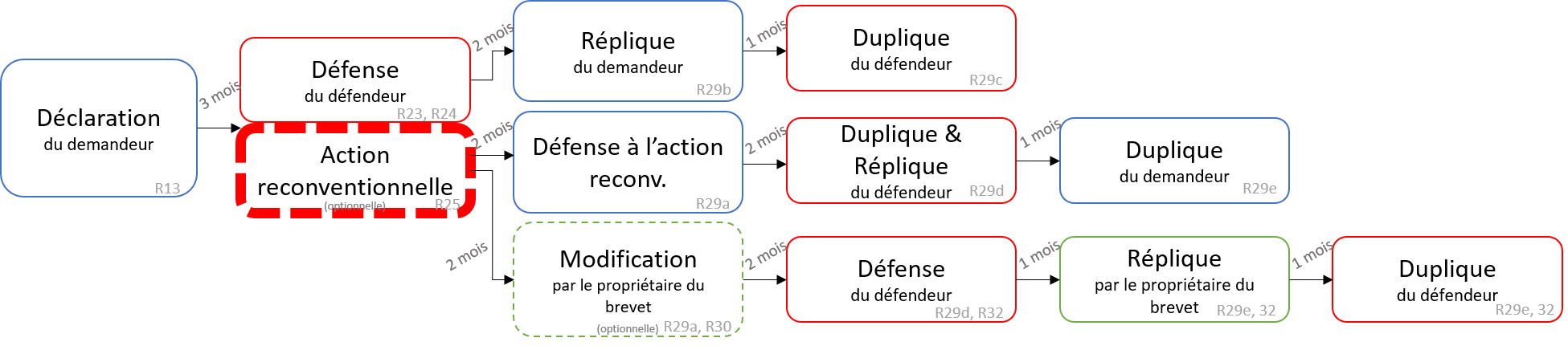
The defendant in an infringement action who contends that the patent is invalid must lodge a counterclaim for revocation in its Statement of defence (R25.1 RoP UPC). This counterclaim lengthens the written procedure and raises the question of “bifurcation”.
The counterclaim
Content
The counterclaim, directed against the proprietor of the patent, states in particular (R25.1 RoP UPC):
- the extent to which revocation is sought (point (a));
- the grounds for revocation, supported by legal arguments, and where appropriate the proposed interpretation of the claims (point (b));
- the facts and evidence relied on (points (c) and (d));
- the orders sought for the interim procedure (point (e));
- the defendant’s position on the options under Article 33(3) (deciding everything, referring to the central division, staying) (point (f));
- the list of documents, with any requests for exemption from translation and for confidentiality (point (g));
- the identity of the proprietor, if it is not the claimant (point (h)).
If the claimant is not the proprietor (or not the only proprietor), the Registry serves the counterclaim on the proprietor, who becomes a party to the revocation proceedings (R25.2 RoP UPC).
Fee
The fee for the counterclaim is equal to that for the infringement action, up to a maximum of €26,500 (R26 RoP UPC and table of court fees, section III). Failing payment within 14 days of the Registry’s invitation, a decision by default may be given (R27 RoP UPC).
Defence to the counterclaim and application to amend
Defence to the counterclaim for revocation
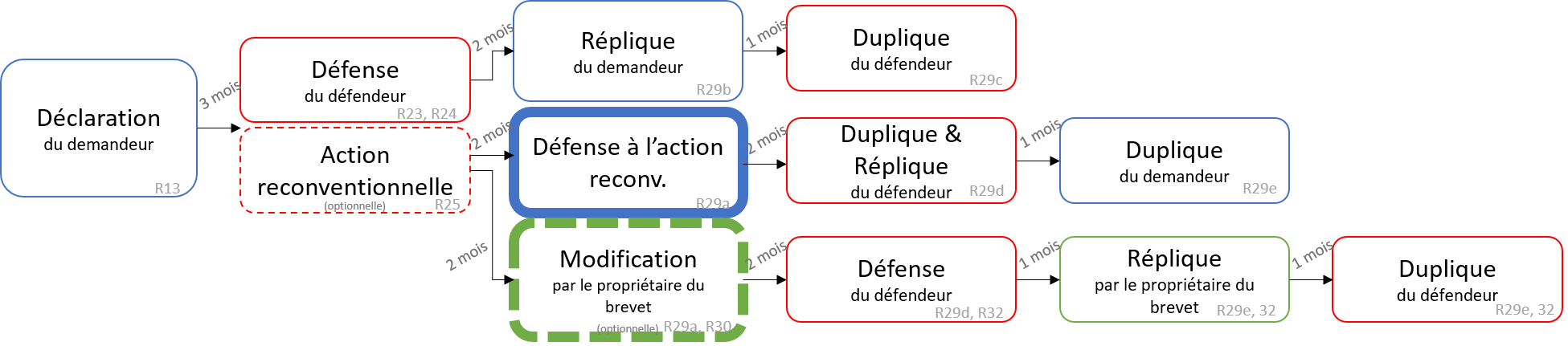
Within two months of service of the Statement of defence, the claimant lodges its Defence to the counterclaim for revocation, together with its Reply on infringement and, where appropriate, its application to amend the patent (R29(a) RoP UPC).
The Defence states in particular the facts and evidence relied on, the reasons why the counterclaim should be dismissed, including why each dependent claim is allegedly valid in its own right, and the claimant’s position on the options under Article 33(3) (R29A RoP UPC).
Application to amend the patent
The proprietor may propose amendments to the claims (and, where appropriate, to the description), in the form of auxiliary sets of claims. The application contains (R30.1 RoP UPC):
- the proposed amendments, in the language in which the patent was granted, with a translation into the language of the proceedings if different and, for a unitary patent, at the defendant’s request, into the language of its domicile or of the place of infringement;
- an explanation of why the amendments satisfy A84 EPC and A123(2) and (3) EPC, why the amended claims are valid and, where appropriate, why they are infringed;
- an indication of whether or not the requests are conditional, their number having to remain reasonable.
Any subsequent request to amend is only admitted with the leave of the Court (R30.2 RoP UPC). The Court takes all circumstances into account, in particular the proprietor’s ability to show that the amendment could not, with reasonable diligence, have been filed earlier, and that it will not unreasonably impede the other party; the first-instance judge enjoys a margin of discretion which the Court of Appeal reviews only to a limited extent (UPC, Court of Appeal, 25 Nov. 2025, Meril v. Edwards, UPC_CoA_464/2024 and joined cases, headnote 2).
If other proceedings concerning the patent are pending (opposition before the EPO, for example), the proprietor must notify its application to amend in those proceedings (R30.3 RoP UPC).
Reply and Rejoinder
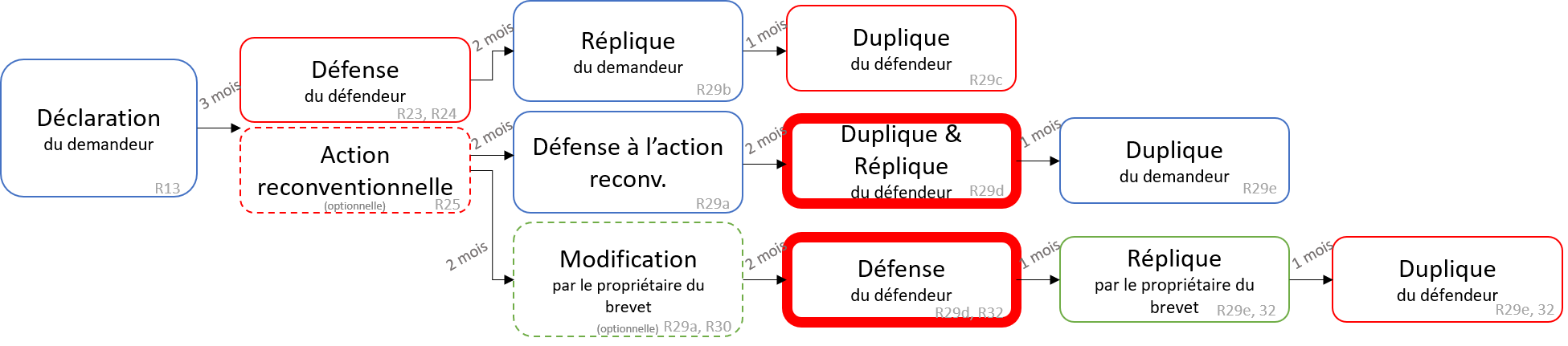
Within two months of service of the Defence to the counterclaim, the defendant may lodge its Reply on revocation, together with its Rejoinder on infringement and its Defence to the application to amend (R29(d) RoP UPC). The Defence to the application to amend sets out why the amendments are not allowable and why the patent cannot be maintained as amended, where appropriate with auxiliary non-infringement arguments (R32.1 and R32.2 RoP UPC).
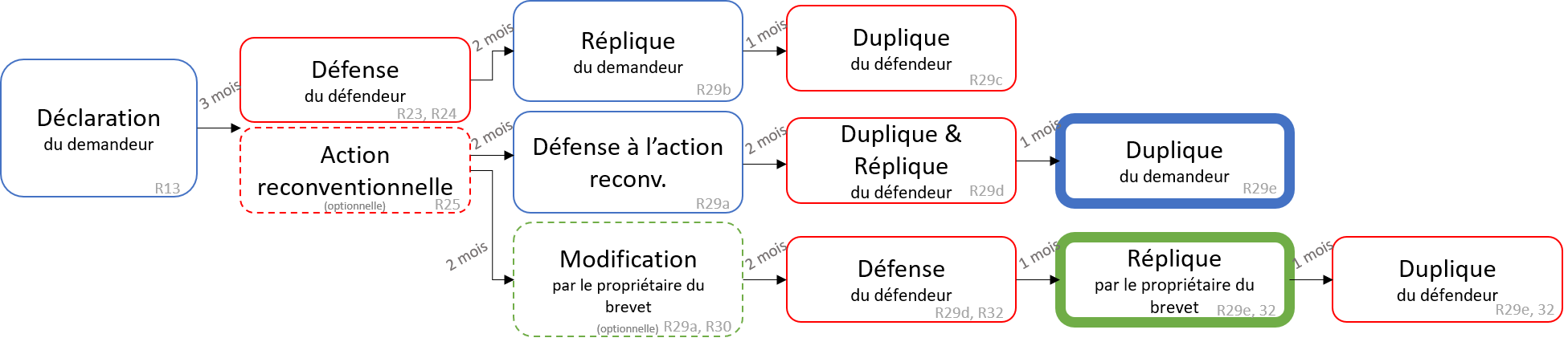
Within the following month, the claimant may lodge its Rejoinder on revocation, together with its Reply to the Defence to the application to amend (R29(e) and R32.3 RoP UPC).
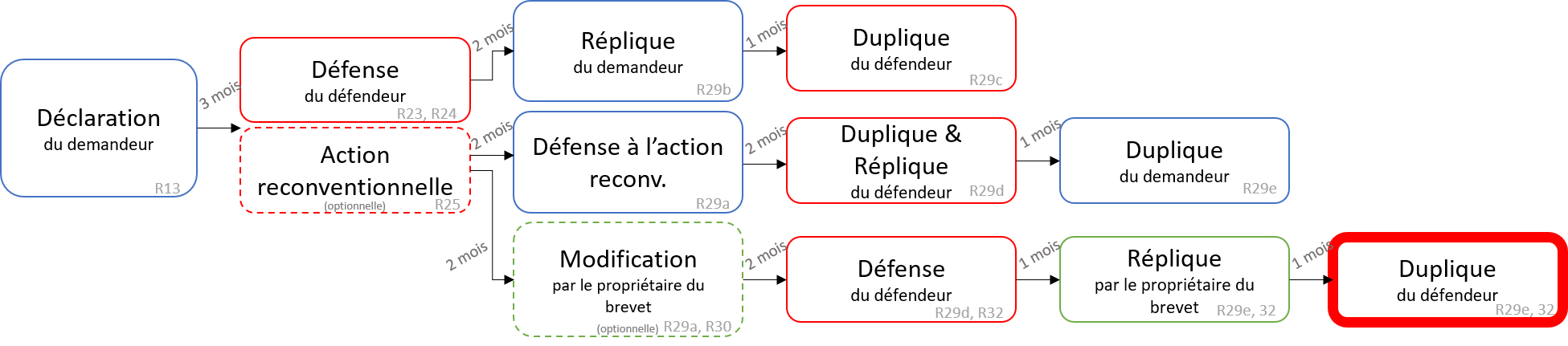
Finally, the defendant may respond within one month to this Reply on the amendment, by a Rejoinder limited to the points it raises (R32.3 RoP UPC).
All in all, a written procedure with a counterclaim and an application to amend lasts in the order of eight to nine months, after which the judge-rapporteur closes it (R35 RoP UPC).
Choice of division: Article 33(3)
The three options
After hearing the parties, the local or regional division may (A33(3) UPCA):
- proceed with both the infringement action and the counterclaim, requesting the allocation of a technically qualified judge (point (a));
- refer the counterclaim to the central division and suspend or proceed with the infringement action (point (b));
- with the agreement of the parties, refer the whole case to the central division (point (c)).
The panel’s decision
The panel decides by an order briefly stating its reasons, after hearing the parties, as soon as practicable after the closure of the written procedure, or earlier if appropriate (R37.1 and R37.2 RoP UPC). Accordingly:
- if it keeps the counterclaim, it requests the allocation of a technically qualified judge, if one has not already been allocated (R37.3 RoP UPC);
- if it refers the counterclaim, it may stay the infringement action, and shall do so where there is a high likelihood that the relevant claims will be held invalid (R37.4 RoP UPC); if there is no stay, it informs the central division of the dates of its interim procedure and of its oral hearing (R37.5 RoP UPC).
If only the counterclaim is referred
The central division deals with the counterclaim on the basis of the written pleadings already exchanged: its judge-rapporteur gives the necessary directions and sets the dates of the interim conference and of the oral hearing (R38 RoP UPC). If the language of the proceedings was not that of the patent, he or she may order the translation of all or part of the pleadings within one month (R39 RoP UPC).
Where the infringement action has not been stayed, the central division accelerates the proceedings and endeavours to hold its oral hearing on revocation before the hearing on infringement (R40(b) RoP UPC). The local division may, for its part, give its decision on infringement subject to the condition that the patent is not held invalid (R118.2(a) RoP UPC).
If the whole case is referred
The central division confirms, as far as possible, the dates already set, and may order translations; the parties may request a single judge (R41 RoP UPC).